Thank you for visiting SNEWPapers!
Sign up free
Literary
August 30, 1816
Alexandria Gazette, Commercial And Political
Alexandria, Virginia
What is this article about?
Philosophical essay exploring dreams as evidence of the soul's independence from the body, their potential divine or demonic origins, and classification into natural, evil-spirited, and providential types. Includes a narrative of a dissolute youth's dream of hell, fulfilled by his sudden death exactly one month later.
Clipping
OCR Quality
95%
Excellent
Full Text
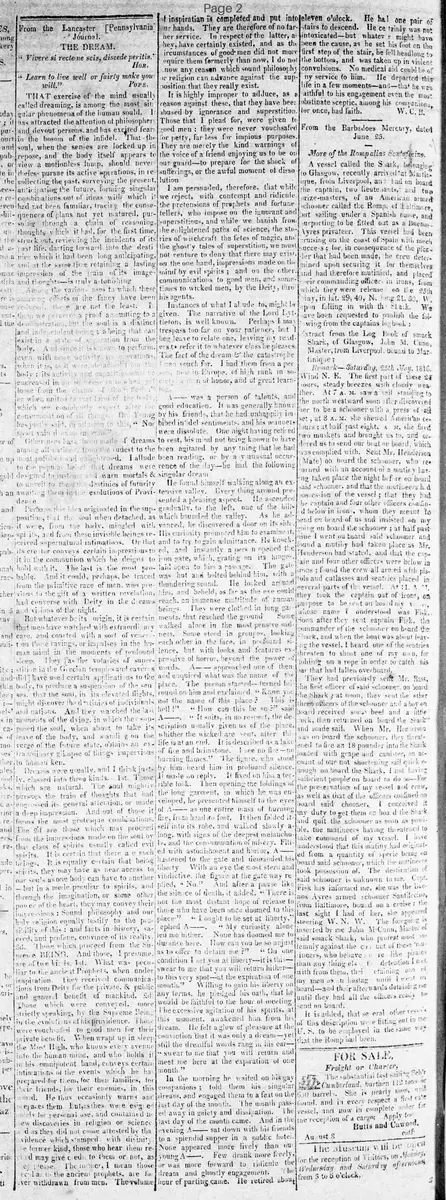
From the Lancaster Pennsylvania Journal:
THE DREAM.
Vivere si recte scis, discede peritis.
HOR.
"Learn to live well or fairly make your will."
POPE.
THAT exercise of the mind usually called dreaming, is among the most singular phenomena of the human soul. It has attracted the attention of philosophers and devout persons, and has excited fears in the bosom of the infidel. That the soul, when the senses are locked up in repose, and the body itself appears to view a motionless lump, should nevertheless pursue its active operations, in recollecting the past, surveying the present, anticipating the future, forming singular combinations out of ideas with which it had not been familiar, tracing the consequences of plans not yet matured, pursuing through a chain of reasoning, thoughts which it had, for the first time, struck out, reviewing the incidents of its past life, darting forward into the destinies which it had been long anticipating, and at the same time retaining a lasting impression of the train of its images and thoughts--is truly astonishing.
Among the various uses to which these vagaries of the fancy have been reduced, there are not the least. In them we perceive a proof amounting to a demonstration, that the soul is a distinct and independent thing; a being that can exist in a state of separation from the body. And since it is known to perform, even with more active operations, when it is, as it were, detached from the body: its activity and capacities must be increased in an even greater ratio when loose from the chains of the sense; or when united to that form of the body, which we confidently expect after the consummation of all things. Dr. Young has justly said, in allusion to this, "Nor sport vain dreams in vain."
Greater uses have been made of dreams among all nations, from the rudest to the most polished and enlightened. Allude to the popular belief that dreams were designed to instruct and warn mortals, and to unveil to them the destinies of futurity awaiting them in the evolutions of Providence.
Perhaps this idea originated in the supposition, that the soul when detached, as it were, from the body, mingled with spirits, and from these invisible beings received supernatural intimations. Or that its creator conveys certain impressions to it in the communion which he deigns to hold with it. The last is the most probable. And it could, perhaps, be traced from the primitive race of men, who previous to the gift of a written revelation, had converse with Deity in the dreams and visions of the night.
But whatever be its origin, it is certain that men have watched with extraordinary care, and courted with a sort of veneration, those ravings, or impulses in the human mind in the moments of profound sleep. They as the votaries of superstition in the Grecian temples and caverns--did have used certain applications to the body, to produce a suspension of the senses, that the soul, in its elevated flights, might discover the destinies of individuals and nations. And they watched the last moments of the dying, in which they supposed the soul, when about to take its leave of the body, and standing on the verge of the future state, obtains an extraordinary glimpse of things impervious to human ken.
Dreams were usually, and I think justly, classed into three kinds. 1st. Those which are natural. The soul nightly pursues the train of thoughts that had engrossed its general attention, or made a deep impression. And out of those it forms the most grotesque combinations.
The 2nd are those which may proceed from the impressions made on the soul by that class of spirits usually called evil spirits. It is certain that there are such beings. It is equally certain that being spirits, they may have as near access to our souls as one body can have to another--but in a mode peculiar to spirits. And through the imagination, or some other power of the heart, they may convey their impressions. Sound philosophy and our holy religion equally testify to the possibility of this: and facts in history, sacred and profane, convince of its reality.
3d. Those which proceed from the Supreme BEING. And those, I presume, are of two kinds. 1st. What was peculiar to the ancient Prophets, when under inspiration. They received communications from Deity for the private, & public and general benefit of mankind. 2d. Those which were conveyed, more strictly speaking, by the Supreme Being, in the evolutions of his providence. Those were vouchsafed to good men for their private benefit. When wrapt up in sleep the Most High, who knows every avenue into the human mind, and who holds it in his omnipotent hand, conveys certain intimations of the events which he has prepared for them, for their families, for their friends, for their enemies, in this world. He thus occasionally warns and directs them. But these were designed only for personal use, and contained no new discoveries in religion or science; and as they did not come attested by that evidence which stamped, with divinity the former kind; those who hear them received may give credit to them or not, as they please. The former, I mean those peculiar to the ancient prophets, are for ever withdrawn from men. The volume of inspiration is completed and put into our hands. They are therefore of no further service. In respect of the latter, they have certainly existed, and as the circumstances of good men did not more require them formerly than now, I do not know any reason which sound philosophy or religion can advance against the supposition that they really exist.
It is highly improper to adduce, as a reason against these, that they have been abused by ignorance and superstition. Those that I plead for, were given to good men: they were never vouchsafed for petty, far less for impious purposes. They are merely the kind warnings of the voice of a friend enjoying us to be on our guard--to prepare for the shock of sufferings, or the awful moment of dissolution.
I am persuaded, therefore, that while we reject, with contempt and ridicule, the pretensions of prophets and fortune-tellers, who impose on the ignorant and superstitious, and while we banish from the enlightened paths of science the stories of witchcraft the feats of magic, and the ghostly tales of superstition, we must not venture to deny that there may exist, on the one hand, impressions made on the mind by evil spirits; and on the other, communications to good men, and sometimes to wicked men, by the Deity, through his agents.
Instances of what I allude to, might be given. The narrative of the Lord Lyttleton, is well known. Perhaps I may trespass too far on your patience, but I beg leave to relate one, leaving my readers to refer it to whatever class he pleases. The fact of the dream & the catastrophe I can vouch for. I had them from a person, now in Europe, of high rank in society, of honor, and of great learning.
A-- was a person of talents, and good education. It was generally known by his friends, that he had unhappily imbibed infidel sentiments, and his manners were dissolute. One night having retired to rest, his mind not being known to have been agitated by any thing that he had been reading, or by any unusual occurrence of the day--he had the following singular dream.
He found himself walking along an extensive valley. Every thing around presented a pleasing aspect. He ascended gradually, to the left, one of the hills which bounded the valley. As he advanced, he discovered a door on its side. His curiosity prompted him to examine it, and to try to gain admittance. He knocked, and instantly a person opened the iron gate, which, grating on its hinges, laid open to him a passage. The gate was shut and bolted behind him, with a thundering sound. He looked around him, and beheld, as far as the eye could reach, an immense multitude of human beings. They were clothed in long garments, that reached the ground. Some walked alone in the most pensive sadness. Some stood in groups, looking each other in the face, in profound silence, but with looks and features expressive of horror, beyond the power of words. As he approached one of them and enquired what was the name of the place. The person started--turned full round on him and exclaimed "Know you not the name of this place? This is hell!" "How can this be so?" said A--. "It suits, in no respect, the description usually given us of the place, whither the wicked are sent, after this life is at an end. It is described as a lake of fire and brimstone. I see no fire--no burning flames." The figure, who stood by him heard him in profound silence. It made no reply. It fixed on him a terrible look. Then opening the foldings of the long garment, in which he was enveloped, he presented himself to the eyes of A-- as one entire mass of burning fire, from head to foot. It then folded itself into its robe, and walked slowly along, with signs of the deepest melancholy and the consummation of misery. Filled with astonishment and horror, A-- hastened to the gate and demanded his liberty. With an eye the most stern and vindictive, the figure at the gate way replied, "No." And after a pause like the silence of death, it added, "There is not the most distant hope of release to those who have been once doomed to this place." "I ought to be set at liberty," replied A--. "My curiosity alone led me hither. None has doomed me to dwell here. How can you be so unjust as to offer to detain me?" "On one condition I set you at liberty--it is this: swear to me that you will return hither-- to this very spot--at the expiration of one month." Willing to gain his liberty on any terms, he pledged his oath, that he would be faithful to the hour of meeting. The excessive agitation of his spirits, at this moment, awakened him from his dream. He felt a glow of pleasure at the conviction that it was only a dream--yet still the dreadful words rang in his ear-- "swear to me that you will return and meet me here at the expiration of one month."
In the morning he waited on his gay companions; told them his singular dream, and engaged them to a feast on the last day of the month. The month passed away in gaiety and dissipation. The last day of the month came. And in the evening A-- sat down with his friends to a splendid supper in a public hotel. None appeared more lively than our young A--. Few drank more freely, or was more forward to ridicule the dream and ghostly engagement. The hour of parting came. He retired about eleven o'clock. He had one pair of stairs to descend. He certainly was not intoxicated--but whatever might have been the cause, as he set his foot on the first step of the stair, he fell headlong to the bottom, and was taken up in violent convulsions. No medical aid could be of any service to him. He departed this life in a few moments--and--that he was faithful to his engagement even the most obstinate sceptic, among his companions, for once, had faith.
W. C. B.
THE DREAM.
Vivere si recte scis, discede peritis.
HOR.
"Learn to live well or fairly make your will."
POPE.
THAT exercise of the mind usually called dreaming, is among the most singular phenomena of the human soul. It has attracted the attention of philosophers and devout persons, and has excited fears in the bosom of the infidel. That the soul, when the senses are locked up in repose, and the body itself appears to view a motionless lump, should nevertheless pursue its active operations, in recollecting the past, surveying the present, anticipating the future, forming singular combinations out of ideas with which it had not been familiar, tracing the consequences of plans not yet matured, pursuing through a chain of reasoning, thoughts which it had, for the first time, struck out, reviewing the incidents of its past life, darting forward into the destinies which it had been long anticipating, and at the same time retaining a lasting impression of the train of its images and thoughts--is truly astonishing.
Among the various uses to which these vagaries of the fancy have been reduced, there are not the least. In them we perceive a proof amounting to a demonstration, that the soul is a distinct and independent thing; a being that can exist in a state of separation from the body. And since it is known to perform, even with more active operations, when it is, as it were, detached from the body: its activity and capacities must be increased in an even greater ratio when loose from the chains of the sense; or when united to that form of the body, which we confidently expect after the consummation of all things. Dr. Young has justly said, in allusion to this, "Nor sport vain dreams in vain."
Greater uses have been made of dreams among all nations, from the rudest to the most polished and enlightened. Allude to the popular belief that dreams were designed to instruct and warn mortals, and to unveil to them the destinies of futurity awaiting them in the evolutions of Providence.
Perhaps this idea originated in the supposition, that the soul when detached, as it were, from the body, mingled with spirits, and from these invisible beings received supernatural intimations. Or that its creator conveys certain impressions to it in the communion which he deigns to hold with it. The last is the most probable. And it could, perhaps, be traced from the primitive race of men, who previous to the gift of a written revelation, had converse with Deity in the dreams and visions of the night.
But whatever be its origin, it is certain that men have watched with extraordinary care, and courted with a sort of veneration, those ravings, or impulses in the human mind in the moments of profound sleep. They as the votaries of superstition in the Grecian temples and caverns--did have used certain applications to the body, to produce a suspension of the senses, that the soul, in its elevated flights, might discover the destinies of individuals and nations. And they watched the last moments of the dying, in which they supposed the soul, when about to take its leave of the body, and standing on the verge of the future state, obtains an extraordinary glimpse of things impervious to human ken.
Dreams were usually, and I think justly, classed into three kinds. 1st. Those which are natural. The soul nightly pursues the train of thoughts that had engrossed its general attention, or made a deep impression. And out of those it forms the most grotesque combinations.
The 2nd are those which may proceed from the impressions made on the soul by that class of spirits usually called evil spirits. It is certain that there are such beings. It is equally certain that being spirits, they may have as near access to our souls as one body can have to another--but in a mode peculiar to spirits. And through the imagination, or some other power of the heart, they may convey their impressions. Sound philosophy and our holy religion equally testify to the possibility of this: and facts in history, sacred and profane, convince of its reality.
3d. Those which proceed from the Supreme BEING. And those, I presume, are of two kinds. 1st. What was peculiar to the ancient Prophets, when under inspiration. They received communications from Deity for the private, & public and general benefit of mankind. 2d. Those which were conveyed, more strictly speaking, by the Supreme Being, in the evolutions of his providence. Those were vouchsafed to good men for their private benefit. When wrapt up in sleep the Most High, who knows every avenue into the human mind, and who holds it in his omnipotent hand, conveys certain intimations of the events which he has prepared for them, for their families, for their friends, for their enemies, in this world. He thus occasionally warns and directs them. But these were designed only for personal use, and contained no new discoveries in religion or science; and as they did not come attested by that evidence which stamped, with divinity the former kind; those who hear them received may give credit to them or not, as they please. The former, I mean those peculiar to the ancient prophets, are for ever withdrawn from men. The volume of inspiration is completed and put into our hands. They are therefore of no further service. In respect of the latter, they have certainly existed, and as the circumstances of good men did not more require them formerly than now, I do not know any reason which sound philosophy or religion can advance against the supposition that they really exist.
It is highly improper to adduce, as a reason against these, that they have been abused by ignorance and superstition. Those that I plead for, were given to good men: they were never vouchsafed for petty, far less for impious purposes. They are merely the kind warnings of the voice of a friend enjoying us to be on our guard--to prepare for the shock of sufferings, or the awful moment of dissolution.
I am persuaded, therefore, that while we reject, with contempt and ridicule, the pretensions of prophets and fortune-tellers, who impose on the ignorant and superstitious, and while we banish from the enlightened paths of science the stories of witchcraft the feats of magic, and the ghostly tales of superstition, we must not venture to deny that there may exist, on the one hand, impressions made on the mind by evil spirits; and on the other, communications to good men, and sometimes to wicked men, by the Deity, through his agents.
Instances of what I allude to, might be given. The narrative of the Lord Lyttleton, is well known. Perhaps I may trespass too far on your patience, but I beg leave to relate one, leaving my readers to refer it to whatever class he pleases. The fact of the dream & the catastrophe I can vouch for. I had them from a person, now in Europe, of high rank in society, of honor, and of great learning.
A-- was a person of talents, and good education. It was generally known by his friends, that he had unhappily imbibed infidel sentiments, and his manners were dissolute. One night having retired to rest, his mind not being known to have been agitated by any thing that he had been reading, or by any unusual occurrence of the day--he had the following singular dream.
He found himself walking along an extensive valley. Every thing around presented a pleasing aspect. He ascended gradually, to the left, one of the hills which bounded the valley. As he advanced, he discovered a door on its side. His curiosity prompted him to examine it, and to try to gain admittance. He knocked, and instantly a person opened the iron gate, which, grating on its hinges, laid open to him a passage. The gate was shut and bolted behind him, with a thundering sound. He looked around him, and beheld, as far as the eye could reach, an immense multitude of human beings. They were clothed in long garments, that reached the ground. Some walked alone in the most pensive sadness. Some stood in groups, looking each other in the face, in profound silence, but with looks and features expressive of horror, beyond the power of words. As he approached one of them and enquired what was the name of the place. The person started--turned full round on him and exclaimed "Know you not the name of this place? This is hell!" "How can this be so?" said A--. "It suits, in no respect, the description usually given us of the place, whither the wicked are sent, after this life is at an end. It is described as a lake of fire and brimstone. I see no fire--no burning flames." The figure, who stood by him heard him in profound silence. It made no reply. It fixed on him a terrible look. Then opening the foldings of the long garment, in which he was enveloped, he presented himself to the eyes of A-- as one entire mass of burning fire, from head to foot. It then folded itself into its robe, and walked slowly along, with signs of the deepest melancholy and the consummation of misery. Filled with astonishment and horror, A-- hastened to the gate and demanded his liberty. With an eye the most stern and vindictive, the figure at the gate way replied, "No." And after a pause like the silence of death, it added, "There is not the most distant hope of release to those who have been once doomed to this place." "I ought to be set at liberty," replied A--. "My curiosity alone led me hither. None has doomed me to dwell here. How can you be so unjust as to offer to detain me?" "On one condition I set you at liberty--it is this: swear to me that you will return hither-- to this very spot--at the expiration of one month." Willing to gain his liberty on any terms, he pledged his oath, that he would be faithful to the hour of meeting. The excessive agitation of his spirits, at this moment, awakened him from his dream. He felt a glow of pleasure at the conviction that it was only a dream--yet still the dreadful words rang in his ear-- "swear to me that you will return and meet me here at the expiration of one month."
In the morning he waited on his gay companions; told them his singular dream, and engaged them to a feast on the last day of the month. The month passed away in gaiety and dissipation. The last day of the month came. And in the evening A-- sat down with his friends to a splendid supper in a public hotel. None appeared more lively than our young A--. Few drank more freely, or was more forward to ridicule the dream and ghostly engagement. The hour of parting came. He retired about eleven o'clock. He had one pair of stairs to descend. He certainly was not intoxicated--but whatever might have been the cause, as he set his foot on the first step of the stair, he fell headlong to the bottom, and was taken up in violent convulsions. No medical aid could be of any service to him. He departed this life in a few moments--and--that he was faithful to his engagement even the most obstinate sceptic, among his companions, for once, had faith.
W. C. B.
What sub-type of article is it?
Essay
Prose Fiction
Vision Or Dream
What themes does it cover?
Religious
Death Mortality
Moral Virtue
What keywords are associated?
Dreams
Soul
Providence
Hell
Infidelity
Divine Warnings
Evil Spirits
What entities or persons were involved?
W. C. B.
Literary Details
Title
The Dream.
Author
W. C. B.
Form / Style
Philosophical Essay With Embedded Dream Narrative
Key Lines
Vivere Si Recte Scis, Discede Peritis. Hor. "Learn To Live Well Or Fairly Make Your Will." Pope.
In Them We Perceive A Proof Amounting To A Demonstration, That The Soul Is A Distinct And Independent Thing; A Being That Can Exist In A State Of Separation From The Body.
This Is Hell!
Swear To Me That You Will Return Hither To This Very Spot At The Expiration Of One Month.
That He Was Faithful To His Engagement Even The Most Obstinate Sceptic, Among His Companions, For Once, Had Faith.