Thank you for visiting SNEWPapers!
Sign up free
Editorial
May 18, 1801
The National Intelligencer And Washington Advertiser
Washington, District Of Columbia
What is this article about?
An editorial republishes arguments from a New Hampshire paper favoring a law mandating contributions to public worship with denominational choice, but presents them to warn against threats to freedom of conscience and oppose religious establishment.
Clipping
OCR Quality
98%
Excellent
Full Text
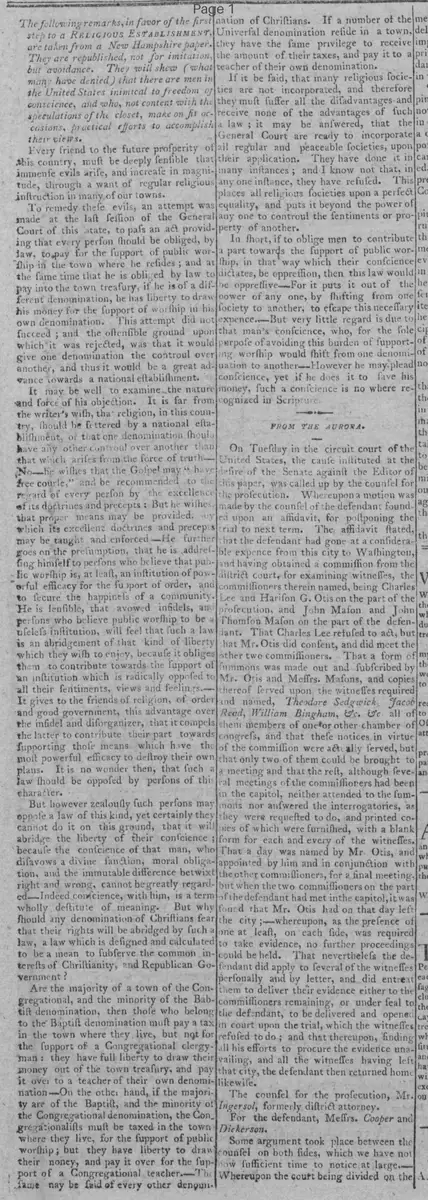
The following remarks, in favor of the first step to a Religious Establishment, are taken from a New Hampshire paper. They are republished, not for imitation, but avoidance. They will shew (what many have denied) that there are men in the United States inimical to freedom of conscience, and who, not content with the speculations of the closet, make on fit occasions, practical efforts to accomplish their views.
Every friend to the future prosperity of this country, must be deeply sensible that immense evils arise, and increase in magnitude, through a want of regular religious instruction in many of our towns. To remedy these evils, an attempt was made at the last session of the General Court of this state, to pass an act providing that every person should be obliged, by law, to pay for the support of public worship in the town where he resides; and at the same time that he is obliged by law to pay into the town treasury, if he is of a different denomination, he has liberty to draw his money for the support of worship in his own denomination. This attempt did not succeed; and the ostensible ground upon which it was rejected, was that it would give one denomination the controul over another, and thus it would be a great advance towards a national establishment.
It may be well to examine the nature and force of this objection. It is far from the writer's wish, that religion, in this country, should be fettered by a national establishment, or that one denomination should have any other controul over another than that which arises from the force of truth. No he wishes that the Gospel may "have free course," and be recommended to the regard of every person by the excellence of its doctrines and precepts: But he wishes that proper means may be provided, by which its excellent doctrines and precepts may be taught and enforced—He further goes on the presumption, that he is addressing himself to persons who believe that public worship is, at least, an institution of powerful efficacy for the support of order, and to secure the happiness of a community.
He is sensible, that avowed infidels, and persons who believe public worship to be a useless institution, will feel that such a law is an abridgement of that kind of liberty which they wish to enjoy, because it obliges them to contribute towards the support of an institution which is radically opposed to all their sentiments, views and feelings. It gives to the friends of religion, of order and good government, this advantage over the infidel and disorganizer, that it compels the latter to contribute their part towards supporting those means which have the most powerful efficacy to destroy their own plans. It is no wonder then, that such a law should be opposed by persons of this character.
But however zealously such persons may oppose a law of this kind, yet certainly they cannot do it on this ground, that it will abridge the liberty of their conscience: because the conscience of that man, who disavows a divine sanction, moral obligation, and the immutable difference betwixt right and wrong, cannot be greatly regarded—Indeed conscience, with him, is a term wholly destitute of meaning. But why should any denomination of Christians fear that their rights will be abridged by such a law, a law which is designed and calculated to be a means to subserve the common interests of Christianity, and Republican Government?
Are the majority of a town of the Congregational, and the minority of the Baptist denomination, then those who belong to the Baptist denomination must pay a tax in the town where they live, but not for the support of a Congregational clergyman: they have full liberty to draw their money out of the town treasury, and pay it over to a teacher of their own denomination—On the other hand, if the majority are of the Baptist, and the minority of the Congregational denomination, the Congregationalists must be taxed in the town where they live, for the support of public worship; but they have liberty to draw their money, and pay it over for the support of a Congregational teacher.—The same may be said of every other denomination of Christians. If a number of the Universal denomination reside in a town, they have the same privilege to receive the amount of their taxes, and pay it to a teacher of their own denomination.
If it be said, that many religious societies are not incorporated, and therefore they must suffer all the disadvantages—and receive none of the advantages of such a law; it may be answered, that the General Court are ready to incorporate all regular and peaceable societies, upon their application. They have done it in many instances; and I know not that, in any one instance, they have refused. This places all religious societies upon a perfect equality, and puts it beyond the power of any one to controul the sentiments or property of another.
In short, if to oblige men to contribute a part towards the support of public worship, in that way which their conscience dictates, be oppression, then this law would be oppressive—For it puts it out of the power of any one, by shifting from one society to another, to escape this necessary expence.—But very little regard is due to that man's conscience, who, for the sole purpose of avoiding this burden of supporting worship would shift from one denomination to another—However he may plead conscience, yet if he does it to save his money, such a conscience is no where recognized in Scripture.
Every friend to the future prosperity of this country, must be deeply sensible that immense evils arise, and increase in magnitude, through a want of regular religious instruction in many of our towns. To remedy these evils, an attempt was made at the last session of the General Court of this state, to pass an act providing that every person should be obliged, by law, to pay for the support of public worship in the town where he resides; and at the same time that he is obliged by law to pay into the town treasury, if he is of a different denomination, he has liberty to draw his money for the support of worship in his own denomination. This attempt did not succeed; and the ostensible ground upon which it was rejected, was that it would give one denomination the controul over another, and thus it would be a great advance towards a national establishment.
It may be well to examine the nature and force of this objection. It is far from the writer's wish, that religion, in this country, should be fettered by a national establishment, or that one denomination should have any other controul over another than that which arises from the force of truth. No he wishes that the Gospel may "have free course," and be recommended to the regard of every person by the excellence of its doctrines and precepts: But he wishes that proper means may be provided, by which its excellent doctrines and precepts may be taught and enforced—He further goes on the presumption, that he is addressing himself to persons who believe that public worship is, at least, an institution of powerful efficacy for the support of order, and to secure the happiness of a community.
He is sensible, that avowed infidels, and persons who believe public worship to be a useless institution, will feel that such a law is an abridgement of that kind of liberty which they wish to enjoy, because it obliges them to contribute towards the support of an institution which is radically opposed to all their sentiments, views and feelings. It gives to the friends of religion, of order and good government, this advantage over the infidel and disorganizer, that it compels the latter to contribute their part towards supporting those means which have the most powerful efficacy to destroy their own plans. It is no wonder then, that such a law should be opposed by persons of this character.
But however zealously such persons may oppose a law of this kind, yet certainly they cannot do it on this ground, that it will abridge the liberty of their conscience: because the conscience of that man, who disavows a divine sanction, moral obligation, and the immutable difference betwixt right and wrong, cannot be greatly regarded—Indeed conscience, with him, is a term wholly destitute of meaning. But why should any denomination of Christians fear that their rights will be abridged by such a law, a law which is designed and calculated to be a means to subserve the common interests of Christianity, and Republican Government?
Are the majority of a town of the Congregational, and the minority of the Baptist denomination, then those who belong to the Baptist denomination must pay a tax in the town where they live, but not for the support of a Congregational clergyman: they have full liberty to draw their money out of the town treasury, and pay it over to a teacher of their own denomination—On the other hand, if the majority are of the Baptist, and the minority of the Congregational denomination, the Congregationalists must be taxed in the town where they live, for the support of public worship; but they have liberty to draw their money, and pay it over for the support of a Congregational teacher.—The same may be said of every other denomination of Christians. If a number of the Universal denomination reside in a town, they have the same privilege to receive the amount of their taxes, and pay it to a teacher of their own denomination.
If it be said, that many religious societies are not incorporated, and therefore they must suffer all the disadvantages—and receive none of the advantages of such a law; it may be answered, that the General Court are ready to incorporate all regular and peaceable societies, upon their application. They have done it in many instances; and I know not that, in any one instance, they have refused. This places all religious societies upon a perfect equality, and puts it beyond the power of any one to controul the sentiments or property of another.
In short, if to oblige men to contribute a part towards the support of public worship, in that way which their conscience dictates, be oppression, then this law would be oppressive—For it puts it out of the power of any one, by shifting from one society to another, to escape this necessary expence.—But very little regard is due to that man's conscience, who, for the sole purpose of avoiding this burden of supporting worship would shift from one denomination to another—However he may plead conscience, yet if he does it to save his money, such a conscience is no where recognized in Scripture.
What sub-type of article is it?
Moral Or Religious
Constitutional
Legal Reform
What keywords are associated?
Religious Establishment
Freedom Of Conscience
Public Worship
New Hampshire
General Court
Denominational Choice
Infidels
What entities or persons were involved?
General Court Of New Hampshire
Congregational Denomination
Baptist Denomination
Universal Denomination
Editorial Details
Primary Topic
Opposition To Mandatory Public Worship Funding As A Step Toward Religious Establishment
Stance / Tone
Critical Of Proposed Law Favoring Religious Establishment, Defending Freedom Of Conscience
Key Figures
General Court Of New Hampshire
Congregational Denomination
Baptist Denomination
Universal Denomination
Key Arguments
Men In The Us Are Inimical To Freedom Of Conscience And Seek Religious Establishment
Attempt To Pass Law Requiring Payment For Public Worship Failed Due To Fears Of Denominational Control
Law Would Compel Infidels To Support Religion, Destroying Their Plans
Denominations Can Draw Funds For Their Own Teachers, Ensuring Equality
General Court Incorporates Societies, Preventing Control Over Others
Shifting Denominations To Avoid Tax Shows Insincere Conscience