Thank you for visiting SNEWPapers!
Sign up free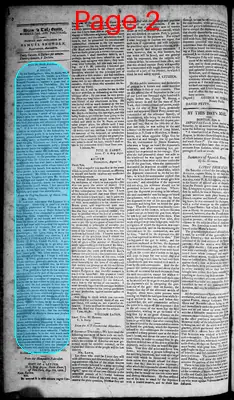
Editorial
September 10, 1808
Alexandria Daily Gazette, Commercial & Political
Alexandria, Virginia
What is this article about?
An editorial from the North American defends Federalists against accusations of treason and promoting Union dissolution by an opposition writer 'Franklin.' It counters by alleging Democratic leaders, exemplified by William B. Giles' 1799 statement favoring separation, plotted disunion. Quotes a letter from Lewis Burwell detailing Giles' conversation.
Clipping
OCR Quality
95%
Excellent
Full Text
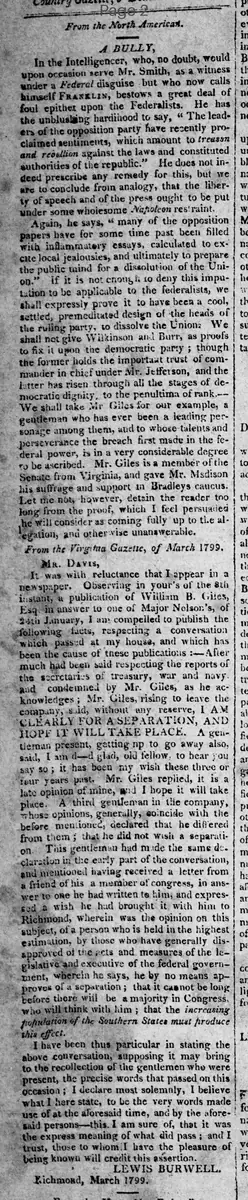
From the North American.
A BULLY,
In the Intelligencer, who, no doubt, would upon occasion serve Mr. Smith, as a witness under a Federal disguise—but who now calls himself Franklin, bestows a great deal of foul epithet upon the Federalists. He has the unblushing hardihood to say, "The leaders of the opposition party have recently proclaimed sentiments, which amount to treason and rebellion against the laws and constituted authorities of the republic." He does not indeed prescribe any remedy for this, but we are to conclude from analogy, that the liberty of speech and of the press ought to be put under some wholesome Napoleon restraint.
Again, he says, "many of the opposition papers have for some time past been filled with inflammatory essays, calculated to excite local jealousies, and ultimately to prepare the public mind for a dissolution of the Union." If it is not enough to deny this imputation to be applicable to the Federalists, we shall expressly prove it to have been a cool, settled, premeditated design of the heads of the ruling party, to dissolve the Union: We shall not give Wilkinson and Burr, as proofs to fix it upon the democratic party; though the former holds the important trust of commander in chief under Mr. Jefferson, and the latter has risen through all the stages of democratic dignity, to the penultima of rank.—
We shall take Mr. Giles for our example, a gentleman who has ever been a leading personage among them, and to whose talents and perseverance the breach first made in the federal power, is in a very considerable degree to be ascribed. Mr. Giles is a member of the Senate from Virginia, and gave Mr. Madison his suffrage and support in Bradley's caucus.
Let me not, however, detain the reader too long from the proof, which I feel persuaded he will consider as coming fully up to the allegation, and otherwise unanswerable.
From the Virginia Gazette, of March 1799.
MR. Davis,
It was with reluctance that I appear in a newspaper. Observing in yours of the 8th instant, a publication of William B. Giles, Esq. in answer to one of Major Nelson's, of 24th January, I am compelled to publish the following facts, respecting a conversation which passed at my house, and which has been the cause of these publications:—After much had been said respecting the reports of the secretaries of treasury, war and navy, and condemned by Mr. Giles, as he acknowledges; Mr. Giles, rising to leave the company, said, without any reserve, I AM CLEARLY FOR A SEPARATION, AND HOPE IT WILL TAKE PLACE. A gentleman present, getting up to go away also, said, I am d—d glad, old fellow, to hear you say so; it has been my wish these three or four years past. Mr. Giles replied, it is a late opinion of mine, and I hope it will take place. A third gentleman in the company, whose opinions, generally, coincide with the before mentioned, declared that he differed from them; that he did not wish a separation. This gentleman had made the same declaration in the early part of the conversation, and mentioned having received a letter from a friend of his a member of congress, in answer to one he had written to him, and expressed a wish he had brought it with him to Richmond, wherein was the opinion on this subject, of a person who is held in the highest estimation, by those who have generally disapproved of the acts and measures of the legislative and executive of the federal government, wherein he says, he by no means approves of a separation; that it cannot be long before there will be a majority in Congress, who will think with him; that the increasing population of the Southern States must produce this effect.
I have been thus particular in stating the above conversation, supposing it may bring to the recollection of the gentlemen who were present, the precise words that passed on this occasion; I declare most solemnly, I believe what I here state, to be the very words made use of at the aforesaid time, and by the aforesaid persons—this I am sure of, that it was the express meaning of what did pass; and I trust, those to whom I have the pleasure of being known will credit this assertion.
LEWIS BURWELL.
Richmond, March 1799.
A BULLY,
In the Intelligencer, who, no doubt, would upon occasion serve Mr. Smith, as a witness under a Federal disguise—but who now calls himself Franklin, bestows a great deal of foul epithet upon the Federalists. He has the unblushing hardihood to say, "The leaders of the opposition party have recently proclaimed sentiments, which amount to treason and rebellion against the laws and constituted authorities of the republic." He does not indeed prescribe any remedy for this, but we are to conclude from analogy, that the liberty of speech and of the press ought to be put under some wholesome Napoleon restraint.
Again, he says, "many of the opposition papers have for some time past been filled with inflammatory essays, calculated to excite local jealousies, and ultimately to prepare the public mind for a dissolution of the Union." If it is not enough to deny this imputation to be applicable to the Federalists, we shall expressly prove it to have been a cool, settled, premeditated design of the heads of the ruling party, to dissolve the Union: We shall not give Wilkinson and Burr, as proofs to fix it upon the democratic party; though the former holds the important trust of commander in chief under Mr. Jefferson, and the latter has risen through all the stages of democratic dignity, to the penultima of rank.—
We shall take Mr. Giles for our example, a gentleman who has ever been a leading personage among them, and to whose talents and perseverance the breach first made in the federal power, is in a very considerable degree to be ascribed. Mr. Giles is a member of the Senate from Virginia, and gave Mr. Madison his suffrage and support in Bradley's caucus.
Let me not, however, detain the reader too long from the proof, which I feel persuaded he will consider as coming fully up to the allegation, and otherwise unanswerable.
From the Virginia Gazette, of March 1799.
MR. Davis,
It was with reluctance that I appear in a newspaper. Observing in yours of the 8th instant, a publication of William B. Giles, Esq. in answer to one of Major Nelson's, of 24th January, I am compelled to publish the following facts, respecting a conversation which passed at my house, and which has been the cause of these publications:—After much had been said respecting the reports of the secretaries of treasury, war and navy, and condemned by Mr. Giles, as he acknowledges; Mr. Giles, rising to leave the company, said, without any reserve, I AM CLEARLY FOR A SEPARATION, AND HOPE IT WILL TAKE PLACE. A gentleman present, getting up to go away also, said, I am d—d glad, old fellow, to hear you say so; it has been my wish these three or four years past. Mr. Giles replied, it is a late opinion of mine, and I hope it will take place. A third gentleman in the company, whose opinions, generally, coincide with the before mentioned, declared that he differed from them; that he did not wish a separation. This gentleman had made the same declaration in the early part of the conversation, and mentioned having received a letter from a friend of his a member of congress, in answer to one he had written to him, and expressed a wish he had brought it with him to Richmond, wherein was the opinion on this subject, of a person who is held in the highest estimation, by those who have generally disapproved of the acts and measures of the legislative and executive of the federal government, wherein he says, he by no means approves of a separation; that it cannot be long before there will be a majority in Congress, who will think with him; that the increasing population of the Southern States must produce this effect.
I have been thus particular in stating the above conversation, supposing it may bring to the recollection of the gentlemen who were present, the precise words that passed on this occasion; I declare most solemnly, I believe what I here state, to be the very words made use of at the aforesaid time, and by the aforesaid persons—this I am sure of, that it was the express meaning of what did pass; and I trust, those to whom I have the pleasure of being known will credit this assertion.
LEWIS BURWELL.
Richmond, March 1799.
What sub-type of article is it?
Partisan Politics
Constitutional
What keywords are associated?
Federalists
Democrats
Union Dissolution
Giles
Separation
Partisan Accusations
Virginia Senate
What entities or persons were involved?
Franklin
Mr. Smith
Federalists
Opposition Party
Wilkinson
Burr
Mr. Giles
Mr. Madison
Bradley
Lewis Burwell
William B. Giles
Major Nelson
Mr. Jefferson
Editorial Details
Primary Topic
Accusations Of Disunion Against Democratic Leaders
Stance / Tone
Defensive Of Federalists, Accusatory Toward Democrats
Key Figures
Franklin
Mr. Smith
Federalists
Opposition Party
Wilkinson
Burr
Mr. Giles
Mr. Madison
Bradley
Lewis Burwell
William B. Giles
Major Nelson
Mr. Jefferson
Key Arguments
Federalists Not Promoting Treason Or Disunion
Democratic Leaders Like Giles Premeditated Union Dissolution
Giles Stated Support For Separation In 1799 Conversation
Evidence From Burwell's Letter Contradicts Giles' Denials