Thank you for visiting SNEWPapers!
Sign up free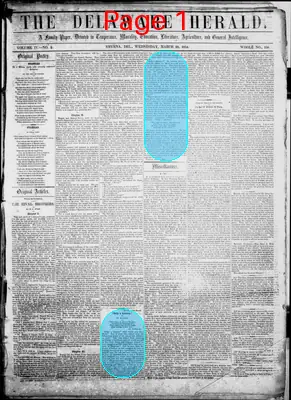
Editorial
March 29, 1854
The Delaware Herald
Smyrna, Kent County, Delaware
What is this article about?
An editorial poem and prose piece defends the dignity of laborers, critiquing social prejudice and aristocracy that exclude them from society, emphasizing honor in honest work, character, and contributions to the world.
Clipping
OCR Quality
98%
Excellent
Full Text
Written for the Herald.
"Only a Laborer."
BY CHARLIE.
"These claim no gaud of heraldry,
And scorn the knighting rod,
Their coat-of-arms is noble deeds—
Their peerage from God."
—C. D. STEUART.
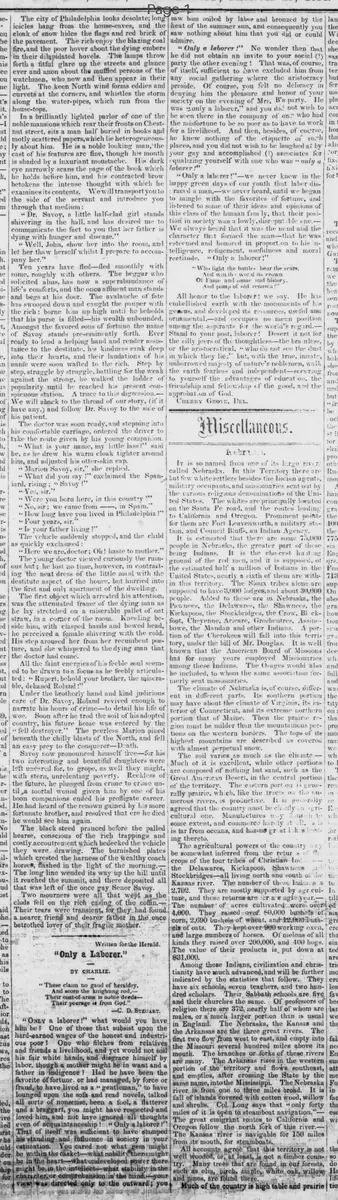
"Only a laborer!" what would you have him be? One of those that subsist upon the hard-earned wages of the honest and industrious poor? One who filches from relatives and friends a livelihood, and yet would not soil his fair white hands, and disgrace himself by labor, though a mother might be in want and a father in indigence? Had he have been the favorite of fortune, or had managed, by force or fraud, to have lived as a "gentleman," to have lounged upon the sofa and read novels, talked all sorts of nonsense, been a fool, a flatterer and a braggart, you might have respected and loved him, and not have ignored all thoughts even of acquaintanceship! "Only a laborer!" That of itself was sufficient to have stamped his standing and influence in society in your estimation. You cared not what gem might be within the casket—what nobility there might be in the heart—what undeveloped power there might be in the intellect—what stability in the character or comprehension in the mind,—your view was directed only to the outward: you saw him soiled by labor and bronzed by the heat of the summer sun, and consequently you saw nothing about him that you did or could admire.
"Only a laborer!" No wonder then that he did not obtain an invite to your social (?) party the other evening! That was, of course, of itself, sufficient to have excluded him from any social gathering where the aristocracy preside. Of course, you felt no delicacy in denying him the pleasure and honor of your society on the evening of Mrs. B's party. He was only a laborer," and you did not wish to be seen there in the company of one who had the misfortune to be so poor as to have to work for a livelihood. And then, besides, of course he knew nothing of the etiquette of such places, and you did not wish to be laughed at by your gay and accomplished (!) associates for equalizing yourself with one who was "only a laborer!"
"Only a laborer!"—we never knew in the happy green days of our youth that labor disgraced a man,—we never heard, until we began to mingle with the favorites of fortune, and listened to some of their ideas and opinions of this class of the human family, that their position in society was a lowly, disreputable one.—We always heard that it was the mind and the character that formed the man—that he was esteemed and honored in proportion to his intelligence, refinement, usefulness and moral rectitude. "Only a laborer!"
"Who fight the battles bear the scars,
And win the world's crown
Of Fame and name and history,
And pomp of old renown?"
All honor to the laborer! we say. He has embellished earth with the monuments of his genius, and developed its resources, useful and ornamental,—and occupies no mean position among the aspirants for the world's regard.—Stand to your post, laborer! Desert it not for the silly jeers of the thoughtless—the brainless, or the aristocratical, "who do not see the dust in which they lie," but, with the true, innate, unborrowed majesty of nature's noblemen, walk the earth fearless and independent—securing to yourself the advantages of education, the friendship and fellowship of the good, and the approbation of God.
CHERRY GROVE, DEL.
"Only a Laborer."
BY CHARLIE.
"These claim no gaud of heraldry,
And scorn the knighting rod,
Their coat-of-arms is noble deeds—
Their peerage from God."
—C. D. STEUART.
"Only a laborer!" what would you have him be? One of those that subsist upon the hard-earned wages of the honest and industrious poor? One who filches from relatives and friends a livelihood, and yet would not soil his fair white hands, and disgrace himself by labor, though a mother might be in want and a father in indigence? Had he have been the favorite of fortune, or had managed, by force or fraud, to have lived as a "gentleman," to have lounged upon the sofa and read novels, talked all sorts of nonsense, been a fool, a flatterer and a braggart, you might have respected and loved him, and not have ignored all thoughts even of acquaintanceship! "Only a laborer!" That of itself was sufficient to have stamped his standing and influence in society in your estimation. You cared not what gem might be within the casket—what nobility there might be in the heart—what undeveloped power there might be in the intellect—what stability in the character or comprehension in the mind,—your view was directed only to the outward: you saw him soiled by labor and bronzed by the heat of the summer sun, and consequently you saw nothing about him that you did or could admire.
"Only a laborer!" No wonder then that he did not obtain an invite to your social (?) party the other evening! That was, of course, of itself, sufficient to have excluded him from any social gathering where the aristocracy preside. Of course, you felt no delicacy in denying him the pleasure and honor of your society on the evening of Mrs. B's party. He was only a laborer," and you did not wish to be seen there in the company of one who had the misfortune to be so poor as to have to work for a livelihood. And then, besides, of course he knew nothing of the etiquette of such places, and you did not wish to be laughed at by your gay and accomplished (!) associates for equalizing yourself with one who was "only a laborer!"
"Only a laborer!"—we never knew in the happy green days of our youth that labor disgraced a man,—we never heard, until we began to mingle with the favorites of fortune, and listened to some of their ideas and opinions of this class of the human family, that their position in society was a lowly, disreputable one.—We always heard that it was the mind and the character that formed the man—that he was esteemed and honored in proportion to his intelligence, refinement, usefulness and moral rectitude. "Only a laborer!"
"Who fight the battles bear the scars,
And win the world's crown
Of Fame and name and history,
And pomp of old renown?"
All honor to the laborer! we say. He has embellished earth with the monuments of his genius, and developed its resources, useful and ornamental,—and occupies no mean position among the aspirants for the world's regard.—Stand to your post, laborer! Desert it not for the silly jeers of the thoughtless—the brainless, or the aristocratical, "who do not see the dust in which they lie," but, with the true, innate, unborrowed majesty of nature's noblemen, walk the earth fearless and independent—securing to yourself the advantages of education, the friendship and fellowship of the good, and the approbation of God.
CHERRY GROVE, DEL.
What sub-type of article is it?
Labor
Social Reform
What keywords are associated?
Dignity Of Labor
Social Prejudice
Aristocracy Critique
Working Class Honor
Moral Worth
What entities or persons were involved?
Laborer
Aristocracy
Mrs. B
Editorial Details
Primary Topic
Defense Of The Dignity Of Labor Against Social Prejudice
Stance / Tone
Strongly Pro Labor And Critical Of Aristocracy
Key Figures
Laborer
Aristocracy
Mrs. B
Key Arguments
Labor Does Not Disgrace A Man; Idleness And Dependence Do
True Worth Is In Character, Intelligence, And Moral Rectitude, Not Social Status
Laborers Contribute To Society's Progress And Deserve Honor
Social Exclusion Of Laborers Based On Class Is Unjust And Superficial