Thank you for visiting SNEWPapers!
Sign up free
Literary
March 11, 1826
Northern Star, And Warren And Bristol Gazette
Warren, Bristol County, Rhode Island
What is this article about?
The narrative follows Edenfield, a young American during the Revolutionary War, who fights bravely at Brandywine and elsewhere seeking fame and happiness. Post-war, he pursues pleasure, wealth, and travel through Europe but finds true contentment only in romantic love and marriage to Ellen, the anonymous sender of a medal.
Clipping
OCR Quality
95%
Excellent
Full Text
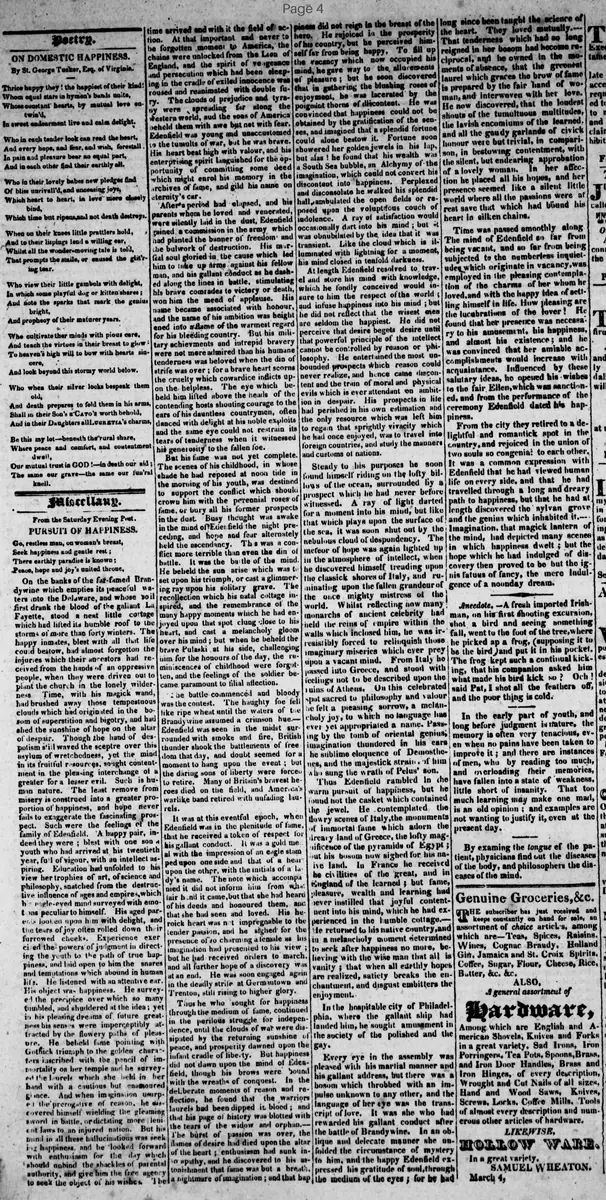
On the banks of the far-famed Brandywine which empties its peaceful waters into the Delaware, and whose soil first drank the blood of the gallant Lafayette, stood a neat little cottage which had lifted its humble roof to the storms of more than forty winters. The happy inmates, blest with all that life or could bestow, had almost forgotten the injuries which their ancestors had received from the hands of an oppressive people, when they were driven out to plant the church in the lonely wilderness. Time, with his magick wand, had brushed away those tempestuous clouds which had originated in the bosom of superstition and bigotry, and had shed the sunshine of hope on the altar of despair. Though the hand of despotism still waved the sceptre over this asylum of wretchedness, yet the mind in its fruitful resources, sought contentment in the pleasing interchange of a greater for a lesser evil. Such is human nature. The least remove from misery is construed into a greater proportion of happiness, and hope never fails to exaggerate the fascinating prospect. Such were the feelings of the family of Edenfield.
A happy pair, indeed they were: blest with one son of youth who had arrived at his twentieth year, full of vigour, with an intellect aspiring. Education had unfolded to his view her trophies of art, of science and philosophy, snatched from the destructive influence of ages and empires, which his eagle-eyed mind surveyed with emotion peculiar to himself. His aged parents looked upon him with delight, and the tears of joy often rolled down their furrowed cheeks. Experience exercised the powers of judgment in directing the youth to the path of true happiness, and laid open to him the snares and temptations which abound in human life. He listened with an attentive ear. His object was happiness. He surveyed the precipice over which so many tumbled, and shuddered at the idea; yet in his pleasing dreams of future greatness his senses were imperceptibly attracted by the flowery paths of pleasure. He beheld fame pointing with Gothic triumph to the golden characters inscribed with the pencil of immortality on her temple and he surveyed the laurels which she held in her hand with a cautious but enamoured glance. And when imagination usurped the prerogative of reason, he discovered himself wielding the gleaming sword in battle, or dictating more lenient laws to an injured nation. But his mind in all these hallucinations was seeking happiness, and he looked forward with enthusiasm to the day which should unbind the shackles of parental authority, and give him the free agency to seek the object of his wishes in the time arrived and with it the field of action.
At that important and never to be forgotten moment America, the chains were unlocked from the Lion of England, and the spirit of vengeance and persecution which had been sleeping in the cradle of exiled innocence was roused and reanimated with double fury. The clouds of prejudice and tyranny lowered over the western world, and the sons of America were spreading far along the beheld them with awe but not with fear. Edenfield was young and unaccustomed to the tumults of war, but he was brave. His heart beat high with valour, and his enterprising spirit languished for the opportunity of committing some deed which might enrol his memory in the archives of fame, and gild his name on eternity's car.
After a period had elapsed, and his parents whom he loved and venerated, were violently laid in the dust, Edenfield gained a commission in the army which had planted the banner of freedom and the bulwark of destruction. His martial soul gloried in the cause which led him to take up arms against his fellow man, and his gallant conduct as he dashed along the lines in battle, stimulating his brave comrades to victory or death, won him the meed of applause. His name became associated with honour, and the flame of his ambition was heightened into a flame of the warmest regard for his bleeding country. But his military achievements and intrepid bravery were no more admired than his humane tenderness was beloved when the din of strife was over; for a brave heart scorns the cruelty which cowardice inflicts upon the helpless. The eye which beheld him lifted above the heads of the contending hosts shouting courage to the ears of his dauntless countrymen, often danced with delight at his noble exploits and the same eye could not restrain its tears of tenderness when it witnessed his generosity to the fallen foe.
But his fame was not yet complete. The scenes of his childhood, in whose shade he had reposed at noontide in the morning of his youth, was destined to support the conflict which should crown him with the perennial roses of fame, or bury all his former prospects in the dust. Busy thought was awake in the mind of Edenfield the night preceding, and hope and fear alternately held the ascendancy. This was a conflict more terrible than even the din of battle. It was the battle of the mind. He beheld the sun arise which was to set upon his triumph, or cast a glimmering ray upon his solitary grave. The recollection which his natal cottage inspired, and the remembrance of the many happy moments which he had enjoyed upon that spot clung close to his heart, and cast a melancholy gloom over his mind: but when he beheld the brave Pulaski at his side, challenging him for the honours of the day, the reminiscences of childhood were forgotten, and the feelings of the soldier became paramount to filial affection.
The battle commenced and bloody was the contest. The haughty foe fell like ripe wheat until the waters of the Brandywine assumed a crimson hue. Edenfield was seen in the midst surrounded with smoke and fire, British thunder shook the battlements of freedom that day, and doubt seemed for a moment to hang upon the event; but the daring sons of liberty were forced to retire. Many of Britain's bravest heroes died on the field, and America's warlike band retired with unfading laurels.
It was at this eventful epoch, when Edenfield was in the plenitude of fame, that he received a token of respect for his gallant conduct. It was a gold medal with the impression of an eagle stamped upon one side and that of a heart upon the other, with the initials of lady's name. The note which accompanied it did not inform him from what fair hand it came, but that she had heard of his deeds and honoured them, and that she had seen and loved. His heroic heart was not impregnable to the tender passion, and he sighed for the presence of so charming a female as his imagination had presented to his view; but he had received orders to march, and all further hope of a discovery was at an end. He was soon engaged again in the deadly strife at Germantown and Trenton, still rising to higher glory.
Thus he who sought for happiness through the medium of fame, continued in the perilous struggle for independence, until the clouds of war were dissipated by the returning sunshine of peace, and prosperity dawned upon the infant cradle of liberty. But happiness did not dawn upon the mind of Edenfield, though his brows were bound with the wreaths of conquest. In the deliberate moments of reason and reflection, he found that the warrior's laurels had been dipped in blood; and that his page of history was blotted with the tears of the widow and orphan. The burst of passion was over, the flames of desire had died upon the altar of the heart: enthusiasm had sunk into apathy, and he discovered to his astonishment that fame was but a breath, a nightmare of imagination; and that happiness did not reign in the breast of the hero. He rejoiced in the prosperity of his country, but he perceived himself far from being happy.
To fill up the vacancy which now occupied his mind, he gave way to the allurements of pleasure; but he soon discovered that in gathering the blushing roses of enjoyment, he was lacerated by the poignant thorns of discontent. He was convinced that happiness could not be obtained by the gratification of the senses, and imagined that a splendid fortune could alone bestow it. Fortune soon showered her golden jewels in his lap, but alas! he found that his wealth was a South Sea bubble, an alchemy of the imagination, which could not convert his discontent into happiness. Perplexed and disconsolate he walked his splendid hall, ambulated the open fields or reposed upon the voluptuous couch of indolence. A ray of satisfaction would occasionally dart into his mind; but it was obnubilated by the idea that it was transient. Like the cloud which is illuminated with lightning for a moment, his mind closed in tenfold darkness.
At length Edenfield resolved to travel and store his mind with knowledge, which he fondly conceived would insure to him the respect of the world; and infuse happiness into his mind; but he did not reflect that the wisest men are seldom the happiest. He did not perceive that desire begets desire until that powerful principle of the intellect cannot be controlled by reason or philosophy. He entertained the most unbounded prospects which reason could never realize, and hence came discontent and the train of moral and physical evils which is ever attendant on ambition in despair. His prospects in life had perished in his own estimation and the only resource which was left him to regain that sprightly vivacity which he had once enjoyed, was to travel into foreign countries, and study the manners and customs of nations.
Steady to his purposes he soon found himself riding on the lofty billows of the ocean, surrounded by a prospect which he had never before witnessed. A ray of light darted for a moment into his mind, but like that which plays upon the surface of the sea, it was soon shut out by the nebulous cloud of despondency. The meteor of hope was again lighted up in the atmosphere of intellect, when he discovered himself treading upon the classic shores of Italy, and ruminating upon the fallen grandeur of the once mighty mistress of the world. Whilst reflecting how many monarchs of ancient celebrity had held the reins of empire within the walls which enclosed him, he was irresistibly forced to relinquish those imaginary miseries which ever prey upon a vacant mind.
From Italy he passed into Greece, and stood with feelings not to be described upon the ruins of Athens. On this celebrated spot sacred to philosophy and valour he felt a pleasing sorrow, a melancholy joy, to which no language has ever yet appropriated a name. Passing by the tomb of oriental genius; imagination thundered in his ears the sublime eloquence of Demosthenes, and the majestic strain, of him who sung the wrath of Pelus' son.
Thus Edenfield rambled in the warm pursuit of happiness, but he found not the casket which contained the jewel. He contemplated the flowery scenes of Italy, the monuments of immortal fame which adorn the dreary land of Greece, the lofty magnificence of the pyramids of Egypt; but his bosom now sighed for his native land. In France he received the civilities of the great, and in England of the learned; but fame, pleasure, wealth and learning had never instilled that joyful contentment into his mind, which he had experienced in the humble cottage.
He returned to his native Country, and in a melancholy moment determined to seek after happiness no more, believing with the wise man that all is vanity; that when all earthly hopes are realized, satiety breaks the enchantment, and disgust embitters the enjoyment. In the hospitable city of Philadelphia, where the gallant ship had landed him, he sought amusement in the society of the polished and the gay. Every eye in the assembly was pleased with his martial manner and his gallant address, but there was a bosom which throbbed with an impulse unknown to any other, and the language of her eye was the transcript of love. It was she who had rewarded his gallant conduct after the battle of Brandywine.
In an oblique and delicate manner she unfolded the circumstance of mystery to him, and the happy Edenfield expressed his gratitude of soul, through the medium of the eyes; for he had long since been taught the science of the heart. They loved mutually. That tenderness which had so long reigned in her bosom had become reciprocal, and he owned in the moments of absence, that the greatest is prepared by the fair land of woman, and interwoven with her love. He now discovered, that the loudest shouts of the tumultuous multitudes, the lavish encomiums of the learned, and all the gaudy garlands of civic honour were but trivial, in comparison, in bestowing contentment, with the silent, but endearing approbation of a lovely woman.
In her affection he placed all his hopes, and her presence seemed like a silent little world where all the passions were at rest save that which had bound his heart in silken chains. Time was passed smoothly along. The mind of Edenfield so far from being vacant, and so far from being subjected to the numberless inquietudes which originate in vacancy, was employed in the pleasing contemplation of the charms of her whom he loved, and with the happy idea of settling himself in life. How pleasing are the lucubrations of the lover! He found that her presence was necessary to his amusement, his happiness, and almost his existence; and he was convinced that her amiable accomplishments would increase with acquaintance.
Influenced by these salutary ideas, he opened his wishes to the fair Ellen, which was sanctioned, and from the performance of the ceremony Edenfield dated his happiness. From the city they retired to a delightful and romantic spot in the country, and rejoiced in the union of two souls so congenial to each other. It was a common expression with Edenfield that he had viewed human life on every side, and that he had travelled through a long and dreary path to happiness, but that he had at length discovered the sylvan grove and the genius which inhabited it. Imagination, that magick lantern of the mind, had depicted many scenes in which happiness dwelt: but the hope which he had indulged of discovery then proved to be but the ignis fatuus of fancy, the increasing indulgence of a noonday dream.
A happy pair, indeed they were: blest with one son of youth who had arrived at his twentieth year, full of vigour, with an intellect aspiring. Education had unfolded to his view her trophies of art, of science and philosophy, snatched from the destructive influence of ages and empires, which his eagle-eyed mind surveyed with emotion peculiar to himself. His aged parents looked upon him with delight, and the tears of joy often rolled down their furrowed cheeks. Experience exercised the powers of judgment in directing the youth to the path of true happiness, and laid open to him the snares and temptations which abound in human life. He listened with an attentive ear. His object was happiness. He surveyed the precipice over which so many tumbled, and shuddered at the idea; yet in his pleasing dreams of future greatness his senses were imperceptibly attracted by the flowery paths of pleasure. He beheld fame pointing with Gothic triumph to the golden characters inscribed with the pencil of immortality on her temple and he surveyed the laurels which she held in her hand with a cautious but enamoured glance. And when imagination usurped the prerogative of reason, he discovered himself wielding the gleaming sword in battle, or dictating more lenient laws to an injured nation. But his mind in all these hallucinations was seeking happiness, and he looked forward with enthusiasm to the day which should unbind the shackles of parental authority, and give him the free agency to seek the object of his wishes in the time arrived and with it the field of action.
At that important and never to be forgotten moment America, the chains were unlocked from the Lion of England, and the spirit of vengeance and persecution which had been sleeping in the cradle of exiled innocence was roused and reanimated with double fury. The clouds of prejudice and tyranny lowered over the western world, and the sons of America were spreading far along the beheld them with awe but not with fear. Edenfield was young and unaccustomed to the tumults of war, but he was brave. His heart beat high with valour, and his enterprising spirit languished for the opportunity of committing some deed which might enrol his memory in the archives of fame, and gild his name on eternity's car.
After a period had elapsed, and his parents whom he loved and venerated, were violently laid in the dust, Edenfield gained a commission in the army which had planted the banner of freedom and the bulwark of destruction. His martial soul gloried in the cause which led him to take up arms against his fellow man, and his gallant conduct as he dashed along the lines in battle, stimulating his brave comrades to victory or death, won him the meed of applause. His name became associated with honour, and the flame of his ambition was heightened into a flame of the warmest regard for his bleeding country. But his military achievements and intrepid bravery were no more admired than his humane tenderness was beloved when the din of strife was over; for a brave heart scorns the cruelty which cowardice inflicts upon the helpless. The eye which beheld him lifted above the heads of the contending hosts shouting courage to the ears of his dauntless countrymen, often danced with delight at his noble exploits and the same eye could not restrain its tears of tenderness when it witnessed his generosity to the fallen foe.
But his fame was not yet complete. The scenes of his childhood, in whose shade he had reposed at noontide in the morning of his youth, was destined to support the conflict which should crown him with the perennial roses of fame, or bury all his former prospects in the dust. Busy thought was awake in the mind of Edenfield the night preceding, and hope and fear alternately held the ascendancy. This was a conflict more terrible than even the din of battle. It was the battle of the mind. He beheld the sun arise which was to set upon his triumph, or cast a glimmering ray upon his solitary grave. The recollection which his natal cottage inspired, and the remembrance of the many happy moments which he had enjoyed upon that spot clung close to his heart, and cast a melancholy gloom over his mind: but when he beheld the brave Pulaski at his side, challenging him for the honours of the day, the reminiscences of childhood were forgotten, and the feelings of the soldier became paramount to filial affection.
The battle commenced and bloody was the contest. The haughty foe fell like ripe wheat until the waters of the Brandywine assumed a crimson hue. Edenfield was seen in the midst surrounded with smoke and fire, British thunder shook the battlements of freedom that day, and doubt seemed for a moment to hang upon the event; but the daring sons of liberty were forced to retire. Many of Britain's bravest heroes died on the field, and America's warlike band retired with unfading laurels.
It was at this eventful epoch, when Edenfield was in the plenitude of fame, that he received a token of respect for his gallant conduct. It was a gold medal with the impression of an eagle stamped upon one side and that of a heart upon the other, with the initials of lady's name. The note which accompanied it did not inform him from what fair hand it came, but that she had heard of his deeds and honoured them, and that she had seen and loved. His heroic heart was not impregnable to the tender passion, and he sighed for the presence of so charming a female as his imagination had presented to his view; but he had received orders to march, and all further hope of a discovery was at an end. He was soon engaged again in the deadly strife at Germantown and Trenton, still rising to higher glory.
Thus he who sought for happiness through the medium of fame, continued in the perilous struggle for independence, until the clouds of war were dissipated by the returning sunshine of peace, and prosperity dawned upon the infant cradle of liberty. But happiness did not dawn upon the mind of Edenfield, though his brows were bound with the wreaths of conquest. In the deliberate moments of reason and reflection, he found that the warrior's laurels had been dipped in blood; and that his page of history was blotted with the tears of the widow and orphan. The burst of passion was over, the flames of desire had died upon the altar of the heart: enthusiasm had sunk into apathy, and he discovered to his astonishment that fame was but a breath, a nightmare of imagination; and that happiness did not reign in the breast of the hero. He rejoiced in the prosperity of his country, but he perceived himself far from being happy.
To fill up the vacancy which now occupied his mind, he gave way to the allurements of pleasure; but he soon discovered that in gathering the blushing roses of enjoyment, he was lacerated by the poignant thorns of discontent. He was convinced that happiness could not be obtained by the gratification of the senses, and imagined that a splendid fortune could alone bestow it. Fortune soon showered her golden jewels in his lap, but alas! he found that his wealth was a South Sea bubble, an alchemy of the imagination, which could not convert his discontent into happiness. Perplexed and disconsolate he walked his splendid hall, ambulated the open fields or reposed upon the voluptuous couch of indolence. A ray of satisfaction would occasionally dart into his mind; but it was obnubilated by the idea that it was transient. Like the cloud which is illuminated with lightning for a moment, his mind closed in tenfold darkness.
At length Edenfield resolved to travel and store his mind with knowledge, which he fondly conceived would insure to him the respect of the world; and infuse happiness into his mind; but he did not reflect that the wisest men are seldom the happiest. He did not perceive that desire begets desire until that powerful principle of the intellect cannot be controlled by reason or philosophy. He entertained the most unbounded prospects which reason could never realize, and hence came discontent and the train of moral and physical evils which is ever attendant on ambition in despair. His prospects in life had perished in his own estimation and the only resource which was left him to regain that sprightly vivacity which he had once enjoyed, was to travel into foreign countries, and study the manners and customs of nations.
Steady to his purposes he soon found himself riding on the lofty billows of the ocean, surrounded by a prospect which he had never before witnessed. A ray of light darted for a moment into his mind, but like that which plays upon the surface of the sea, it was soon shut out by the nebulous cloud of despondency. The meteor of hope was again lighted up in the atmosphere of intellect, when he discovered himself treading upon the classic shores of Italy, and ruminating upon the fallen grandeur of the once mighty mistress of the world. Whilst reflecting how many monarchs of ancient celebrity had held the reins of empire within the walls which enclosed him, he was irresistibly forced to relinquish those imaginary miseries which ever prey upon a vacant mind.
From Italy he passed into Greece, and stood with feelings not to be described upon the ruins of Athens. On this celebrated spot sacred to philosophy and valour he felt a pleasing sorrow, a melancholy joy, to which no language has ever yet appropriated a name. Passing by the tomb of oriental genius; imagination thundered in his ears the sublime eloquence of Demosthenes, and the majestic strain, of him who sung the wrath of Pelus' son.
Thus Edenfield rambled in the warm pursuit of happiness, but he found not the casket which contained the jewel. He contemplated the flowery scenes of Italy, the monuments of immortal fame which adorn the dreary land of Greece, the lofty magnificence of the pyramids of Egypt; but his bosom now sighed for his native land. In France he received the civilities of the great, and in England of the learned; but fame, pleasure, wealth and learning had never instilled that joyful contentment into his mind, which he had experienced in the humble cottage.
He returned to his native Country, and in a melancholy moment determined to seek after happiness no more, believing with the wise man that all is vanity; that when all earthly hopes are realized, satiety breaks the enchantment, and disgust embitters the enjoyment. In the hospitable city of Philadelphia, where the gallant ship had landed him, he sought amusement in the society of the polished and the gay. Every eye in the assembly was pleased with his martial manner and his gallant address, but there was a bosom which throbbed with an impulse unknown to any other, and the language of her eye was the transcript of love. It was she who had rewarded his gallant conduct after the battle of Brandywine.
In an oblique and delicate manner she unfolded the circumstance of mystery to him, and the happy Edenfield expressed his gratitude of soul, through the medium of the eyes; for he had long since been taught the science of the heart. They loved mutually. That tenderness which had so long reigned in her bosom had become reciprocal, and he owned in the moments of absence, that the greatest is prepared by the fair land of woman, and interwoven with her love. He now discovered, that the loudest shouts of the tumultuous multitudes, the lavish encomiums of the learned, and all the gaudy garlands of civic honour were but trivial, in comparison, in bestowing contentment, with the silent, but endearing approbation of a lovely woman.
In her affection he placed all his hopes, and her presence seemed like a silent little world where all the passions were at rest save that which had bound his heart in silken chains. Time was passed smoothly along. The mind of Edenfield so far from being vacant, and so far from being subjected to the numberless inquietudes which originate in vacancy, was employed in the pleasing contemplation of the charms of her whom he loved, and with the happy idea of settling himself in life. How pleasing are the lucubrations of the lover! He found that her presence was necessary to his amusement, his happiness, and almost his existence; and he was convinced that her amiable accomplishments would increase with acquaintance.
Influenced by these salutary ideas, he opened his wishes to the fair Ellen, which was sanctioned, and from the performance of the ceremony Edenfield dated his happiness. From the city they retired to a delightful and romantic spot in the country, and rejoiced in the union of two souls so congenial to each other. It was a common expression with Edenfield that he had viewed human life on every side, and that he had travelled through a long and dreary path to happiness, but that he had at length discovered the sylvan grove and the genius which inhabited it. Imagination, that magick lantern of the mind, had depicted many scenes in which happiness dwelt: but the hope which he had indulged of discovery then proved to be but the ignis fatuus of fancy, the increasing indulgence of a noonday dream.
What sub-type of article is it?
Prose Fiction
Journey Narrative
What themes does it cover?
Love Romance
Moral Virtue
Liberty Freedom
What keywords are associated?
Pursuit Of Happiness
American Revolution
Brandywine Battle
Fame And Glory
Romantic Love
Moral Reflection
European Travel
Literary Details
Key Lines
His Object Was Happiness.
Thus He Who Sought For Happiness Through The Medium Of Fame, Continued In The Perilous Struggle For Independence, Until The Clouds Of War Were Dissipated By The Returning Sunshine Of Peace, And Prosperity Dawned Upon The Infant Cradle Of Liberty.
He Now Discovered, That The Loudest Shouts Of The Tumultuous Multitudes, The Lavish Encomiums Of The Learned, And All The Gaudy Garlands Of Civic Honour Were But Trivial, In Comparison, In Bestowing Contentment, With The Silent, But Endearing Approbation Of A Lovely Woman.
It Was A Common Expression With Edenfield That He Had Viewed Human Life On Every Side, And That He Had Travelled Through A Long And Dreary Path To Happiness, But That He Had At Length Discovered The Sylvan Grove And The Genius Which Inhabited It.