Thank you for visiting SNEWPapers!
Sign up free
The Poplar Standard
Poplar, Roosevelt County, Montana
What is this article about?
Aunt Adeline, born into slavery circa 1840 in North Carolina, loyally served the Hoffman and Skaggs families across generations, migrating from Missouri to Montana. She became a vital midwife and caregiver in gold rush communities, delivering hundreds of babies and aiding miners and cowboys, now nearing 100 years old.
Merged-components note: Merged split sections of the 'Aunt Adeline' biographical story, including title, body parts, and caption; changed caption label to story as it is integral to the narrative.
Clipping
OCR Quality
Full Text
Near 100,
Doc to Early Miners,
Cowboys,
Says Years Fly
If You Keep Movin'
By CHADBOURNE M. WALLIN
I had Snooker, the 3-year-old, in my arms when I walked through the yard mud and into the big, two-story stone Skaggs ranch house in the coulee on the east slope of the Judith mountains near Lewistown, Mont. Aunt Adeline was in the kitchen, washing dishes. She came out and I put Snooker on his feet. She saw him and said, "Whose boy are you?"
Snooker, as usual when startled, put half his right hand in his mouth, tucked in his chin and looked out from lowered brows.
"I think you're my boy," Adeline told him. She made a face and ran out her tongue. Snooker questioned a parted moment more, took his hand out of his mouth and smiled—his O.K. smile.
Then they stood and beamed at each other, the span of a century between them. Snooker, 3, chunky, blond, blue-eyed, just beginning. Adeline, "just gently pushin' a hundred if I'se really not some more," near the end of the trail, black of skin and eye, the hairs on her chin and upper lip white, the wool beneath her spotless kerchief grizzled grey. Years apart, yet friends.
The yellow tom with the bobbed tail stretched and mewed beneath the heater and Snooker went to investigate. I said: "Adeline, what have you been doing these past 100 years?"
"You see what I was doin' when you came in? Washin' dishes! That's what I've been doin' all my life. Lawdy, if I had a penny for every dish I've washed or a dollar for every child I've borned—well, I wouldn't be washin'."
"And what did you do when you weren't washing dishes or borning babies?"
"Lived," said Adeline, complacently. "Lived and kept movin'. That's all there is to life."
Part of Northwest History
The Lord has had to grant Adeline 100 years, more or less, because she had so much living to do. She has lived through four major phases of the country's history until, in the end, she has become a part of the history of the northwest. Her "children," literally hundreds of them, live in all parts of the world and have their children. Born a slave, she never has been a slave because "somebody just owned me." For five generations she has been with the same "folks" and is willing and able to help the sixth generation when it comes along.
Hers has been the slavery of a mutual devotion, an influence which, when she was offered her freedom, caused her to refuse to leave the family.
You read stories about faithful old family retainers in the deep south but you don't often encounter them in the foothills of the Rockies, but Adeline there, maintaining the old servant tradition of her native North Carolina.
The life she has seen has brought Adeline her own philosophy, not so much cultured as acquired without conscious effort. Her mind is bright, her memory good and accurate and, as she nears the century mark, she has a quiet laugh and an eager "Sho nuff?" for the new and interesting.
You get the impression that she always has been interested in life as she has gone on cooking, washing, working in the fields, nursing and mothering not only her own families but half the countryside as well.
Adeline now may lay claim to being the oldest woman in the northwest, although accuracy as to her birthday is not certain. She was born in slavery on the plantation of Daniel Ryan near Dallas, N.C., about 1840. Her mother was the property of Daniels but her father belonged to a neighboring planter named Ford.
When Ryan died he willed certain slave children to his sons and daughters. To Mrs. Jacob Hoffman, born Peggy Ryan, was willed Adeline. Mrs. Hoffman had been married on the plantation and had lived there until after the birth of her third child when, with her husband, she had moved to near Gravelton, Mo.
By Wagon in 1856
On news of Ryan's death Jacob Hoffman hitched a team to a wagon and drove to North Carolina for Adeline and her brother and sister, who were to go to other relatives living in the middle west. He took the children and headed west again in the summer of 1856.
"I sure must have cried all the way back," Adeline says. "I remember that grandpa (Hoffman) gave me candy and tried every way to make things nice for me but I just wouldn't listen. I wanted to stay with my mother.
Grandpa said he almost made up his mind to turn around and take me back to her only she had gone to join my father.
"When we reached the Mississippi and the ferry at Cape Girardeau I just closed my eyes and wouldn't look until we were over. I never saw the river. I just thought that, once we were over, I would be gone from home for good."
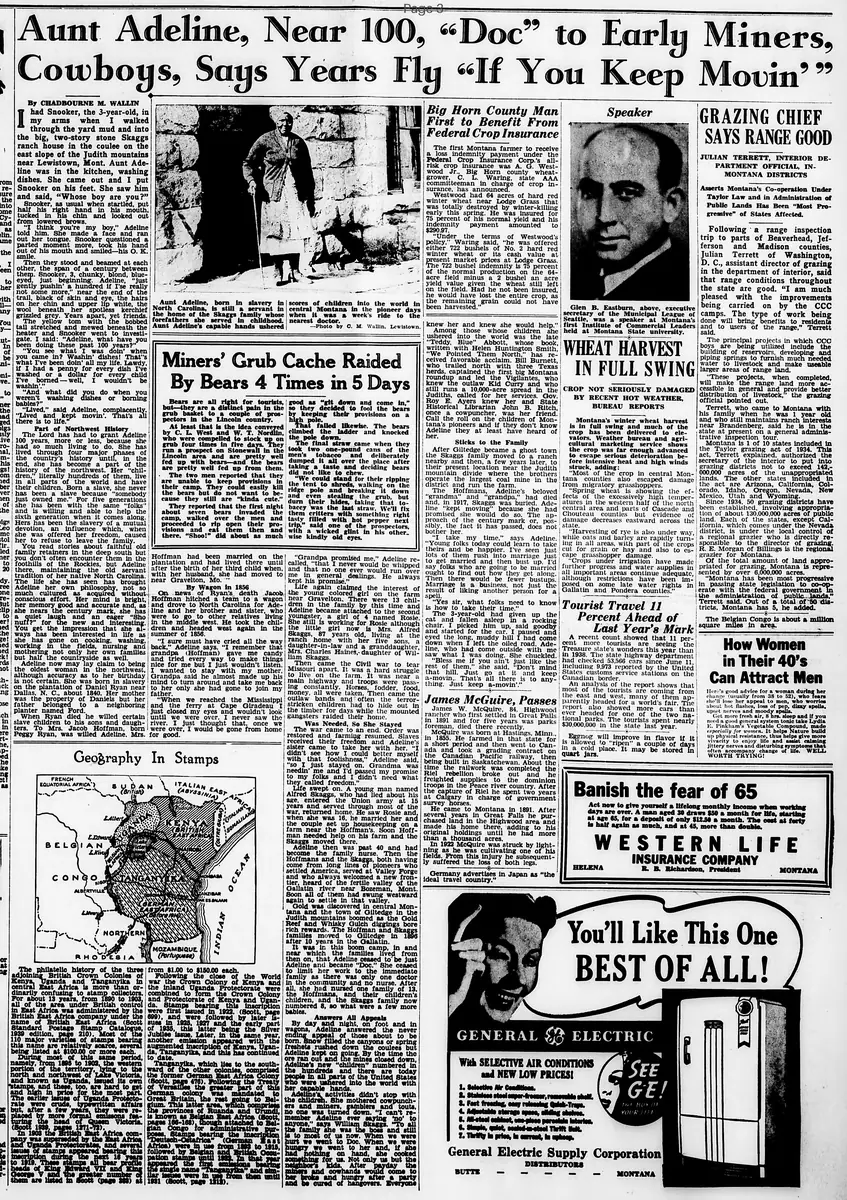
Aunt Adeline, born in slavery in North Carolina, is still a servant in central Montana in the home of the Skaggs family whose forefathers she served in childhood.
In Adeline's capable hands ushered
Photo by C. M. Wallin, Lewistown.
"Grandpa promised me," Adeline recalled, "that I never would be whipped and that no one ever would run over me in general dealings. He always kept his promise."
Life again claimed the interest of the young colored girl on the farm near Gravelton. There were 13 children in the family by this time and Adeline became attached to the second youngster, a girl of 4 named Rosie. She still is working for Rosie although the little girl now is Mrs. Alfred Skaggs, 87 years old, living at the ranch home with her five sons, a daughter-in-law and a granddaughter, Mrs. Charles Haines—daughter of William Skaggs.
Then came the Civil war to tear Missouri apart. It was a hard struggle to live on the farm. It was near a main highway and troops were passing constantly. Horses, fodder, food, money, all were taken. Then came the outlaw bands and often the terror-stricken children had to hide out in the timber for days while the mounted gangsters raided their home.
Was Needed, So She Stayed
The war came to an end. Order was restored and farming resumed. Slaves received their freedom and Adeline's sister came to take her with her. "I didn't see how I could better myself with that foolishness," Adeline said, "so I just stayed on. Grandma was needin' me and I'd passed my promise to my folks and I didn't need what they called freedom."
Life swept on. A young man named Alfred Skaggs, who had lied about his age, entered the Union army at 15 years and served through most of the war, returned home. He saw Rosie and, when she was 16, he married her and the couple set up housekeeping on a farm near the Hoffman's. Soon Hoffman needed help on his farm and the Skaggs moved there.
Adeline then was past 40 and had become the family nurse. Then the Hoffmans and the Skaggs, both having come from long lines of pioneers who settled America, served at Valley Forge and who always welcomed a new frontier, heard of the fertile valley of the Gallatin river near Bozeman, Mont.
Soon all of them had swung westward again to settle in that valley.
Gold was discovered in central Montana and the town of Giltedge in the Judith mountains boomed as the Gold Reef and Whisky Gulch diggings bore rich rewards. The Hoffman and Skaggs families moved to Giltedge in 1896 after 10 years in the Gallatin.
It was in this boom camp, in and near which the families lived from then on, that Adeline ceased to be just Adeline and became "Doc." She ceased to limit her work to the immediate family as there was only one doctor in the community and no nurse. After all, she had nursed one family of 13, the Hoffmans, and their children's children, and the Skaggs family now numbered 8, so what were a few more babies.
Answers All Appeals
By day and night, on foot and in wagons, Adeline answered the never ending appeal of those about to be born. Snow filled the canyons or spring freshets rushed down the coulees but Adeline kept on going. By the time the ore ran out and the mines closed down, Adeline's new "children" numbered in the hundreds and there are today people in all parts of the United States who were ushered into the world with her capable hands.
Adeline's activities didn't stop with the children. She mothered cowpunchers and miners, gamblers and touts, no one was turned down. "I can't remember Adeline ever saying 'no' to anyone," says William Skaggs. "To all the family she was the boss and still is to most of us now. When we were hurt we went to Doc. When we were hungry we went to her and, if she had nothing on hand, she cooked something for us. Not only us but the poor doctor's kids. After payday miners and cowhands would come to her broke and hungry after a and be cured of hangovers.
What sub-type of article is it?
What themes does it cover?
What keywords are associated?
What entities or persons were involved?
Where did it happen?
Story Details
Key Persons
Location
North Carolina, Missouri, Montana (Judith Mountains, Giltedge, Gallatin Valley Near Bozeman, Lewistown)
Event Date
Born About 1840; 1856 Wagon Trip; Civil War; 1896 To Giltedge
Story Details
Born into slavery in North Carolina around 1840, Adeline was taken to Missouri at age 16 by the Hoffman family, whom she served loyally through generations despite emancipation. She moved west to Montana with the Skaggs family, becoming a renowned midwife 'Doc' in gold rush towns, delivering hundreds of babies and caring for miners and cowboys, embodying lifelong devotion and resilience.