Thank you for visiting SNEWPapers!
Sign up free
The Waco Daily Examiner
Waco, Mclennan County, Texas
What is this article about?
Prof. Asa Gray describes the loco or crazy weed, a poisonous leguminous plant (Astragalus Mollissimus) in the far West from Indian Nation to California, which causes madness, illness, and death in livestock like horses, cattle, and sheep, especially in spring.
Clipping
OCR Quality
Full Text
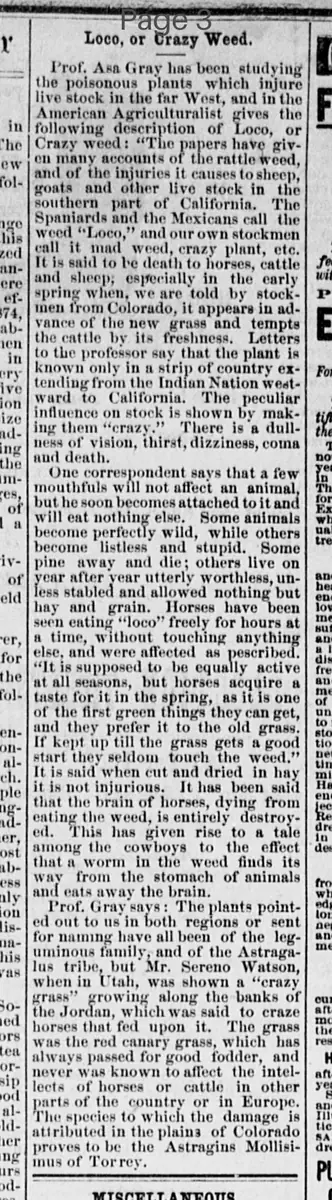
Prof. Asa Gray has been studying the poisonous plants which injure live stock in the far West, and in the American Agriculturalist gives the following description of Loco, or Crazy weed: "The papers have given many accounts of the rattle weed, and of the injuries it causes to sheep, goats and other live stock in the southern part of California. The Spaniards and the Mexicans call the weed "Loco," and our own stockmen call it mad weed, crazy plant, etc. It is said to be death to horses, cattle and sheep: especially in the early spring when, we are told by stock men from Colorado, it appears in advance of the new grass and tempts the cattle by its freshness. Letters to the professor say that the plant is known only in a strip of country extending from the Indian Nation westward to California. The peculiar influence on stock is shown by making them "crazy." There is a dullness of vision, thirst, dizziness, coma and death.
One correspondent says that a few mouthfuls will not affect an animal but he soon becomes attached to it and will eat nothing else. Some animals become perfectly wild, while others become listless and stupid. Some pine away and die; others live on year after year utterly worthless, unless stabled and allowed nothing but hay and grain. Horses have been seen eating "loco" freely for hours at a time, without touching anything else, and were affected as prescribed.
"It is supposed to be equally active at all seasons, but horses acquire a taste for it in the spring, as it is one of the first green things they can get, and they prefer it to the old grass. If kept up till the grass gets a good start they seldom touch the weed."
It is said when cut and dried in hay it is not injurious. It has been said that the brain of horses, dying from eating the weed, is entirely destroyed. This has given rise to a tale among the cowboys to the effect that a worm in the weed finds its way from the stomach of animals and eats away the brain.
Prof. Gray says: The plants pointed out to us in both regions or sent for naming have all been of the leguminous family, and of the Astragalus tribe, but Mr. Sereno Watson, when in Utah, was shown a "crazy grass" growing along the banks of the Jordan, which was said to craze horses that fed upon it. The grass was the red canary grass, which has always passed for good fodder, and never was known to affect the intellects of horses or cattle in other parts of the country or in Europe.
The species to which the damage is attributed in the plains of Colorado proves to be the Astragalus Mollissimus of Torrey.
What sub-type of article is it?
What keywords are associated?
What entities or persons were involved?
Where did it happen?
Domestic News Details
Primary Location
Far West
Key Persons
Outcome
livestock affected by dullness of vision, thirst, dizziness, coma, death; some become wild, listless, stupid, or worthless; brain destruction in fatal cases
Event Details
Prof. Asa Gray describes loco or crazy weed as a poisonous plant in the far West that injures livestock, causing craziness and death, especially in spring; identified as Astragalus Mollissimus; animals develop addiction and prefer it over other forage