Thank you for visiting SNEWPapers!
Sign up free
The Ottawa Free Trader
Ottawa, La Salle County County, Illinois
What is this article about?
In a letter from Fargo, D.T., dated August 3, 1879, John H. Hosford praises the Red River Valley's fertile soil for grains and vegetables, notes large-scale farming operations like the Dalrymple Farm, moderate quality emigration, land values, and future as a wheat region, despite wood and water shortages.
Clipping
OCR Quality
Full Text
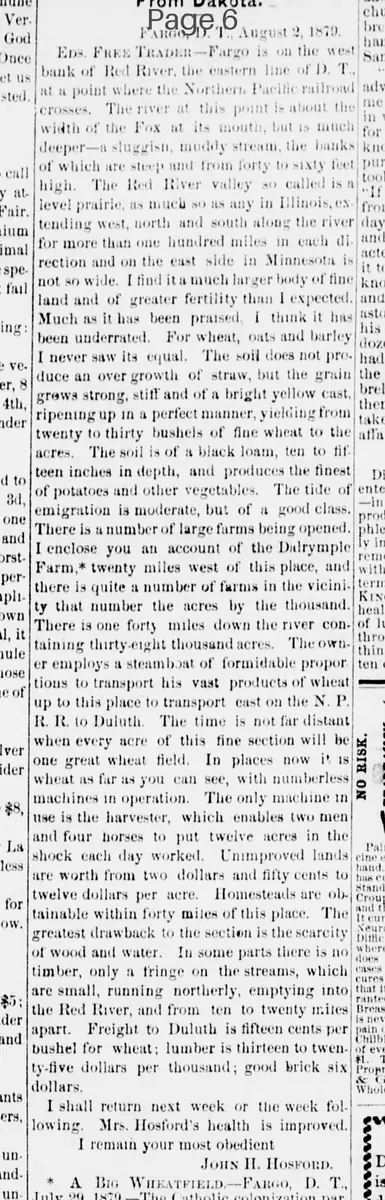
EDS. FREE TRADER—Fargo is on the west bank of Red River, the eastern line of D. T., at a point where the Northern Pacific railroad crosses. The river at this point is about the width of the Fox at its mouth, but is much deeper—a sluggish, muddy stream, the banks of which are steep and from forty to sixty feet high. The Red River valley so called is a level prairie, as much so as any in Illinois, extending west, north and south along the river for more than one hundred miles in each direction and on the east side in Minnesota is not so wide. I find it a much larger body of fine land and of greater fertility than I expected. Much as it has been praised, I think it has been underrated. For wheat, oats and barley I never saw its equal. The soil does not produce an over growth of straw, but the grain grows strong, stiff and of a bright yellow cast, ripening up in a perfect manner, yielding from twenty to thirty bushels of fine wheat to the acre. The soil is of a black loam, ten to fifteen inches in depth, and produces the finest of potatoes and other vegetables. The tide of emigration is moderate, but of a good class. There is a number of large farms being opened. I enclose you an account of the Dalrymple Farm, twenty miles west of this place, and there is quite a number of farms in the vicinity that number the acres by the thousand. There is one forty miles down the river containing thirty-eight thousand acres. The owner employs a steamboat of formidable proportions to transport his vast products of wheat up to this place to transport east on the N. P. R. R. to Duluth. The time is not far distant when every acre of this fine section will be one great wheat field. In places now it is wheat as far as you can see, with numberless machines in operation. The only machine in use is the harvester, which enables two men and four horses to put twelve acres in the shock each day worked. Unimproved lands are worth from two dollars and fifty cents to twelve dollars per acre. Homesteads are obtainable within forty miles of this place. The greatest drawback to the section is the scarcity of wood and water. In some parts there is no timber, only a fringe on the streams, which are small, running northerly, emptying into the Red River, and from ten to twenty miles apart. Freight to Duluth is fifteen cents per bushel for wheat; lumber is thirteen to twenty-five dollars per thousand; good brick six dollars.
I shall return next week or the week following. Mrs. Hosford's health is improved.
I remain your most obedient
JOHN H. HOSFORD.
What sub-type of article is it?
What keywords are associated?
What entities or persons were involved?
Where did it happen?
Domestic News Details
Primary Location
Fargo, D. T.
Event Date
August 3, 1879
Key Persons
Event Details
John H. Hosford reports on Fargo's location on the Red River, describing the valley's level prairie land, fertility for wheat, oats, barley, potatoes, and vegetables. Notes moderate emigration of good class, large farms like Dalrymple Farm (20 miles west, thousands of acres), another 38,000-acre farm downriver using steamboat for wheat transport to N.P.R.R. at Duluth. Predicts entire section becoming wheat field. Harvesters used. Unimproved lands $2.50-$12/acre. Homesteads within 40 miles. Drawbacks: scarcity of wood and water. Freight rates: wheat 15¢/bushel to Duluth, lumber $13-25/thousand, brick $6. Mrs. Hosford's health improved.