Thank you for visiting SNEWPapers!
Sign up free
Story
October 14, 1922
The Gazette
Cleveland, Cuyahoga County, Ohio
What is this article about?
Innovative 'split crown' concrete road construction method paves half the road at a time, allowing traffic on the other half to avoid detours. Tested successfully in Connecticut's Litchfield county foothills, reducing costs, danger, and cracks.
Clipping
OCR Quality
98%
Excellent
Full Text
SOUND DEATH KNELL OF DETOUR IN NEW PROCESS OF BUILDING
Elimination of the "detour bogey," the bane of every touring motorist's life, is seen as the successful outcome of recent experiments in what may be termed "split crown" construction of concrete roads.
The new method lies simply in laying paving over but half of the roadbed at one time, keeping the remaining half open to traffic as the work progresses. This method has been found particularly effective in rough and hilly country where detours are practically impossible, but urgent appeals from automobile owners who have experienced the torture of detouring by night, may bring it into general use.
Co-operation Essential
Careful co-operation between the motoring public and the contractor is, however, essential. By stationing responsible guards at each end of the open strip, traffic may be sent over the route, first in one direction and then in the other, without danger.
Great care must be exercised by the contractor in order to avoid settlement of dust particles on the freshly-laid paving. In order to insure the proper curing of the concrete it is necessary that he keeps the unimproved side of the road well sprinkled at all times. Failure to do this would affect the concrete to an extent that might cause "scaling" in later years.
Following the completion of the first section of paving, it must be permitted to harden under expert "curing" supervision for at least 30 days. At the end of this period it may then be opened to traffic while work is begun upon the second strip.
Two Principal Virtues.
Although a slight increase in original cost may be charged against this method, it has two principal virtues which commend it to the taxpayer and the motorist alike. Doing away as it does with the detour, it cuts cost of motor operation more than half aside from the big item of decreased danger and loss of time and patience. Secondly, it eliminates the cross-wise cracks which appear in some hard-surface roads through letting down of the grading after the paving is completed. The joint where the two sides come together leaves an almost imperceptible line in the exact center of the roadway. This is known as a construction joint and allows just sufficient "play" to obviate the chance that imperfect grading or poor designing on the part of the contractor might result in unsightly cracks.
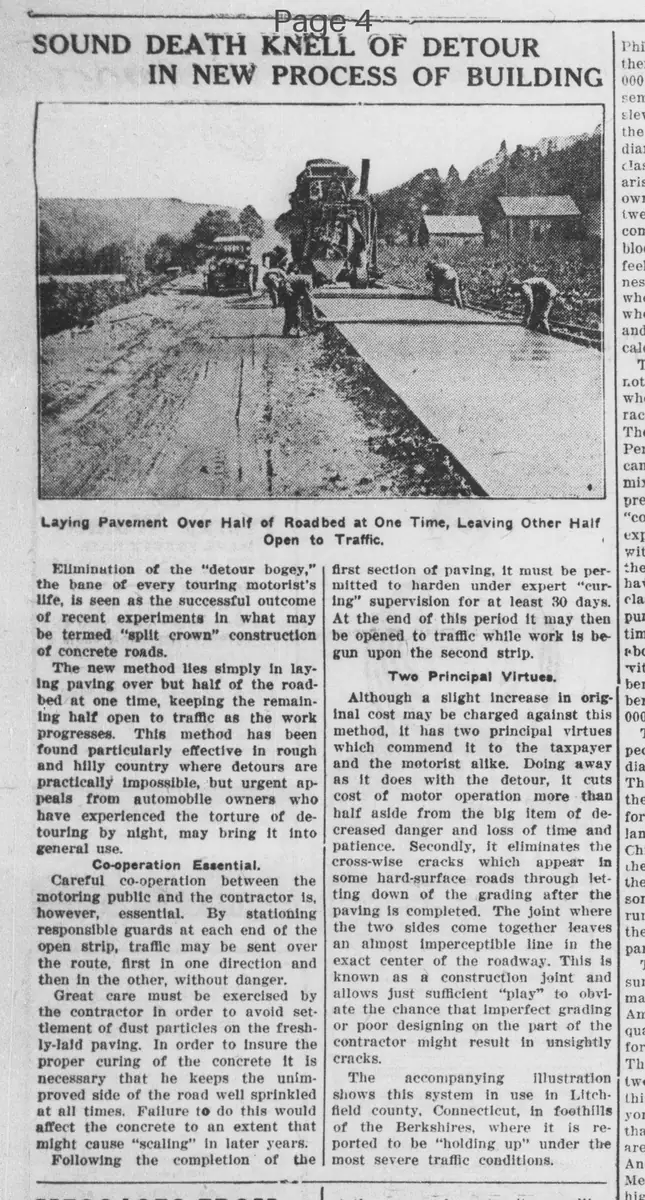
The accompanying illustration shows this system in use in Litchfield county, Connecticut, in foothills of the Berkshires, where it is reported to be "holding up" under the most severe traffic conditions.
Elimination of the "detour bogey," the bane of every touring motorist's life, is seen as the successful outcome of recent experiments in what may be termed "split crown" construction of concrete roads.
The new method lies simply in laying paving over but half of the roadbed at one time, keeping the remaining half open to traffic as the work progresses. This method has been found particularly effective in rough and hilly country where detours are practically impossible, but urgent appeals from automobile owners who have experienced the torture of detouring by night, may bring it into general use.
Co-operation Essential
Careful co-operation between the motoring public and the contractor is, however, essential. By stationing responsible guards at each end of the open strip, traffic may be sent over the route, first in one direction and then in the other, without danger.
Great care must be exercised by the contractor in order to avoid settlement of dust particles on the freshly-laid paving. In order to insure the proper curing of the concrete it is necessary that he keeps the unimproved side of the road well sprinkled at all times. Failure to do this would affect the concrete to an extent that might cause "scaling" in later years.
Following the completion of the first section of paving, it must be permitted to harden under expert "curing" supervision for at least 30 days. At the end of this period it may then be opened to traffic while work is begun upon the second strip.
Two Principal Virtues.
Although a slight increase in original cost may be charged against this method, it has two principal virtues which commend it to the taxpayer and the motorist alike. Doing away as it does with the detour, it cuts cost of motor operation more than half aside from the big item of decreased danger and loss of time and patience. Secondly, it eliminates the cross-wise cracks which appear in some hard-surface roads through letting down of the grading after the paving is completed. The joint where the two sides come together leaves an almost imperceptible line in the exact center of the roadway. This is known as a construction joint and allows just sufficient "play" to obviate the chance that imperfect grading or poor designing on the part of the contractor might result in unsightly cracks.
The accompanying illustration shows this system in use in Litchfield county, Connecticut, in foothills of the Berkshires, where it is reported to be "holding up" under the most severe traffic conditions.
What sub-type of article is it?
Curiosity
What themes does it cover?
Triumph
What keywords are associated?
Split Crown Construction
Concrete Roads
Detour Elimination
Road Building
Hilly Terrain
Traffic Management
Where did it happen?
Litchfield County, Connecticut, In Foothills Of The Berkshires
Story Details
Location
Litchfield County, Connecticut, In Foothills Of The Berkshires
Story Details
Experiments in 'split crown' construction of concrete roads pave half the roadbed at a time, keeping the other half open to traffic, eliminating detours especially in hilly areas. Requires cooperation, dust control, and 30-day curing. Reduces costs, danger, and cracks.