Thank you for visiting SNEWPapers!
Sign up free
Alexandria Daily Gazette, Commercial & Political
Alexandria, Virginia
What is this article about?
Reports from West Indies detail French frigates Amphitrite, Arethuse, and Venus evading British blockade of Martinique, delivering troops and provisions. Captures of British ships Lord Cranstoun and Lydia; reinforcements to Martinique and Guadeloupe noted, with British Admiral Cochrane concentrating forces.
Merged-components note: Continuation of the foreign naval news article from the Barbadoes Gazette.
Clippings
1 of 2
OCR Quality
Full Text
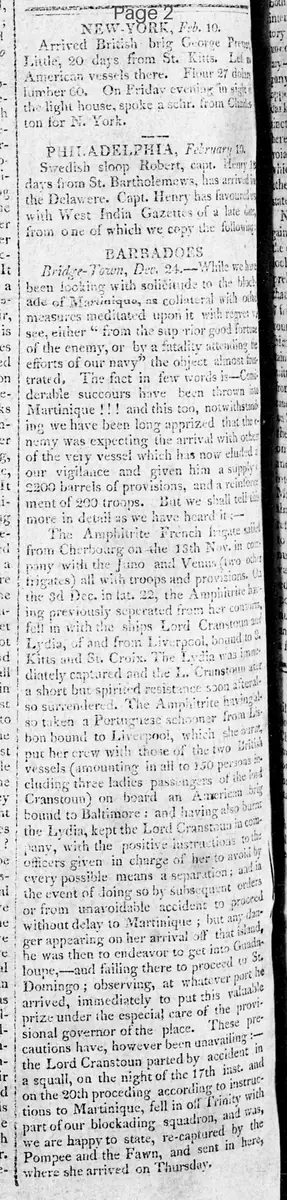
Arrived British brig George Price, Little, 20 days from St. Kitts. Left American vessels there. Flour 27 dolls. Lumber 60. On Friday evening in sight of the light house, spoke a schr. from Charleston for N. York.
PHILADELPHIA, February 10.
Swedish sloop Robert, capt. Henry, 14 days from St. Bartholemews, has arrived in the Delaware. Capt. Henry has favoured with West India Gazettes of a late date, from one of which we copy the following
BARBADOES.
Bridge-Town, Dec. 24.--While we have been looking with solicitude to the blockade of Martinique, as collateral with other measures meditated upon it with regret we see, either "from the superior good fortune of the enemy, or by a fatality attending the efforts of our navy" the object almost frustrated, The fact in few words is-Considerable succours have been thrown into Martinique !!! and this too, notwithstanding we have been long apprized that the enemy was expecting the arrival with other of the very vessel which has now eluded our vigilance and given him a supply of 200 barrels of provisions. and a reinforcement of 200 troops. But we shall tell this more in detail as we have heard it. The Amphitrite French frigate sailed from Cherbourg on the 13th Nov. in company with the Arethuse and Venus (two other frigates) all with troops and provisions. On the 3d Dec. in lat. 22. the Amphitrite having previously separated from her consorts, fell in with the ships Lord Cranstoun and Lydia, of and from Liverpool, bound to St. Kitts and St. Croix. The Lydia was immediately captured and the L. Cranstoun also surrendered. The Amphitrite having also taken a Portuguese schooner from Lisbon, put her crew with those of the two British vessels (amounting in all to 150 persons in Cranstoun) on board an American brig bound to Baltimore : and having also burnt the Lydia, kept the Lord Cranstoun in company, with the positive instructions to the officers given in charge of her to avoid by every possible means a separation; and in the event of losing so by subsequent orders the ger appearing on her arrival off that island, without delay to Martinique ; but any danger or from unavoidable accident to proceed to St. Domingo; observing, at whatever port he was then to endeavor to get into Guadeloupe,--and failing there to proceed to St. Domingue. prize under the especial care of the provisional governor of the place. These precautions have, however been unavailing :- the Lord Cranstoun parted by accident in a squall, on the night of the 17th inst. and tions to Martinique, fell in off Trinidad with on the 20th proceeding according to instructions we are happy to state, re-captured by the blockading squadron, and was, Pompee and the Fawn, and sent in here, where she arrived on Thursday.
The facility with which the enemy continues to elude our navy adds still increased regret to that which, already, we have had cause to express. We cannot contemplate the uninterrupted success with which he daily, as it were, throws succors into his islands, without a conviction of there being either a want of judgment in the disposition of our blockading squadron, or a too great negligence in carrying it into effect. To one or other of these causes, or to a peculiarly favoring Providence, we can alone attribute the uninterupted success of arrivals at Martinique and Guadaloupe, when we have been previously apprised, not merely of their being previously expected, but of their actual approach. Thus has it been with the Juno (consort with the Amphitrite) which has slipped into Martinique, landed both troops and provisions. Information of this is derived from Dominico, where, on Thursday last, a French cartel from Guadaloupe gave the intelligence; stating that the Juno was safe in Port-Louis-Petre, having on board 900 bbls. of provisions, a large supply of ammunition, and 260 troops. It evidently seems, too, that other succors and supplies besides the above, and what we have before known to have been thrown into those islands, are now actually near at hand, if not already arrived. The Sir Christopher sloop of war, Capt. Halliday, having the packet lately from hence under convoy fell in on the night of the 19th inst. with a small squadron to windward of Montserrat, the headmost of which after hailing several times without receiving an answer, she exchanged broadsides with, both pursuing their course; the enemy more intent to gain his party, than atchieve a victory; and the St. Christopher, avoiding the unequal contest with so superior an adversary—the vessels (four in number) in company with the one engaged en passant also appeared to be frigates, although from the darkness of the night it could not be distinctly ascertained. It is however imagined here, that this frigate and compagnons de voiage are the convoy from Cherbourg, which are understood to be expected among others at Martinique; and a loose report states them to have since arrived. Nor are these, according to reports which gain confidence by their frequent repetition, the only succors that the enemy is anxiously looking for, to rescue him from present apprehended subjugation. We now have it that Ganthume with 12 sail of the line and 7 frigates, are actually at sea, bending their course circuitously and cautiously towards Martinique. Be it as it may, there certainly have been some late accounts transmitted here, which hastened the admiral from this anchorage. Sir Alexander Cochrane, in the Neptune, left Carlisle Bay early on Sunday, preceded the evening before by the Ulysses, ordered to sea unexpectedly on a destination not originally intended; and we understand that it is the admiral's intention to concentrate his whole force off Martinique, to meet the enemy before he shall reach his port. We look to such a rencontre with confidence, having nothing to fear but in the too great superiority of numbers of the enemy; even with the advantage of which he has once already evaded the anxiously sought battle. Other reports, however, diminish the strength and number of the enemy's expected squadron, and even reduce it to one three decker, and few frigates and brigs.
What sub-type of article is it?
What keywords are associated?
What entities or persons were involved?
Where did it happen?
Foreign News Details
Primary Location
Martinique
Event Date
Dec. 24
Key Persons
Outcome
french amphitrite captured british lydia (burnt) and lord cranstoun (later recaptured by british); delivered 200 barrels provisions and 200 troops to martinique; juno delivered 900 bbls. provisions, ammunition, 260 troops to martinique; sir christopher exchanged shots with french squadron; british forces concentrating off martinique.
Event Details
French frigate Amphitrite, separated from Arethuse and Venus, captured British ships Lord Cranstoun and Lydia, burnt Lydia, put crews on American brig, instructed prize to proceed to Martinique but it separated in squall and was recaptured by British squadron including Pompee and Fawn. Juno slipped into Martinique with supplies and troops. Sir Christopher sloop engaged unknown squadron near Montserrat. Reports of larger French fleet under Ganthume approaching. Admiral Cochrane concentrating forces off Martinique.