Thank you for visiting SNEWPapers!
Sign up free
Gazette Of The United States, & Philadelphia Daily Advertiser
Philadelphia, Philadelphia County, Pennsylvania
What is this article about?
Reports from the French Army of Italy detail victories over Austrian forces led by Generals Alvinzy and Davidovich in November 1796 near Verona and Arcole. Key battles resulted in 5,000 Austrian prisoners, significant casualties, and capture of flags and artillery. Pursuit to Vicenza; Mantua's fall anticipated. French losses include wounded generals and killed aides.
Merged-components note: These components continue the same article on the Italian campaign battles; text flows directly from one to the other.
Clipping
OCR Quality
Full Text
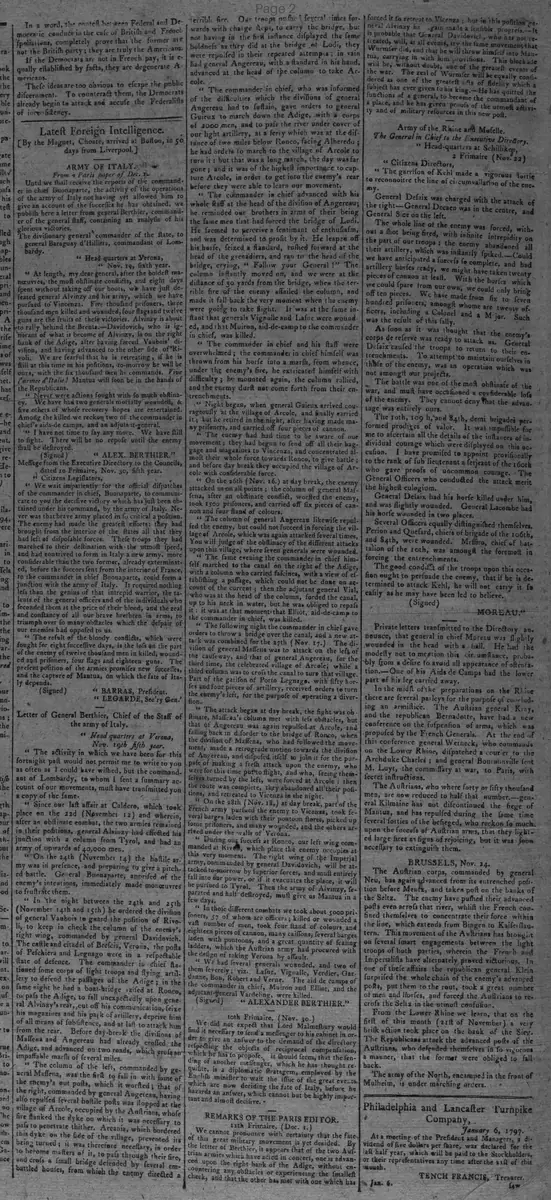
[By the Magnet, Choate, arrived at Boston, in 50 days from Liverpool.]
ARMY OF ITALY
From a Paris paper of Dec. 1.
Until we shall receive the reports of the commander in chief Buonaparte, the activity of the operations of the army of Italy not having yet allowed him to give an account of the successes he has obtained, we publish here a letter from general Berthier, commander of the general staff, containing an analysis of his glorious victories.
The divisional general commander of the staff, to general Baraguay d'Hilliers, commandant of Lombardy.
"Head-quarters at Verona,
Nov. 19, sixth year.
At length, my dear general, after the boldest manoeuvres, the most obstinate conflicts, and eight days spent without taking off our boots, we have just defeated general Alvinzy and his army, which we have pursued to Vicenza. Five thousand prisoners, three thousand men killed and wounded, four flags and twelve guns are the fruits of these victories. Alvinzy is about to rally behind the Brenta.—Davidovich, who is ignorant of what is become of Alvinzy, is on the right bank of the Adige, after having forced Vaubois' division, and having advanced to the other side of Rivali. We are fearful that he is retreating, if he is still at this time in his positions, to-morrow he will be ours, with the six thousand men he commands. Vive l'armée d'Italie! Mantua will soon be in the hands of the Republicans.
Never were actions fought with so much obstinacy. We have had two generals mortally wounded, & five others of whose recovery hopes are entertained.
Among the killed we reckon two of the commander in chief's aids-de-camps, and an adjutant-general.
I have not time to say any more. We have still to fight. There will be no repose until the enemy shall be destroyed."
(Signed)
ALEX. BERTHIER.
Message from the Executive Directory to the Councils, dated 10 Frimaire, Nov. 30, fifth year.
Citizens Legislators,
We wait impatiently for the official dispatches of the commander in chief, Buonaparte, to communicate to you the decisive victory which has just been obtained under his command, by the army of Italy. Never was that brave army placed in so critical a position.
The enemy had made the greatest efforts: they had brought from the interior of the states all that they had left of disposable forces. These troops they had marched to their destination with the utmost speed, and had contrived to form in Italy a new army, more considerable than the two former, already exterminated, before the succors sent from the interior of France, to the commander in chief Buonaparte, could form a junction with the army of Italy. It required nothing less than the genius of that intrepid warrior, the talents of the general officers and of the individuals who seconded them at the price of their blood, and the zeal and constancy of all our brave brethren in arms, to triumph over so many obstacles which the despair of our enemies had opposed to us.
The result of the bloody conflicts, which were fought for eight successive days, is the loss on the part of the enemy of twelve thousand men in killed, wounded and prisoners, four flags and eighteen guns. The present position of the armies promises new successes, and the capture of Mantua, on which the fate of Italy depends.
(Signed)
BARRAS, President.
LEGARDE, Sec'ry Gen.
Letter of General Berthier, Chief of the Staff of the army of Italy.
Head quarters at Verona,
Nov. 19th fifth year.
The activity in which we have been for this fortnight past would not permit me to write to you as often as I could have wished, but the commandant of Lombardy, to whom I sent a summary account of our movements, must have transmitted you a copy of the same—
Since our last affair at Caldero, which took place on the 22d (November 12) and wherein, after an obstinate combat, the two armies remained in their positions, general Alvinzy had effected his junction with a column from Tyrol, and had an army of upwards of 40,000 men.
On the 24th (November 14) the hostile army was in presence, — and preparing to give a pitched battle. General Buonaparte; apprised of the enemy's intentions, immediately made manoeuvres to frustrate them.
In the night between the 24th and 25th (November 14th and 15th) he ordered the division of general Vaubois to guard the position of Rivoli, to keep in check the column of the enemy's right wing, commanded by general Davidovich.
The castle and citadel of Brescia, Verona, the posts of Peschiera and Legnago were in a respectable state of defence. The commander in chief stationed some corps of light troops and flying artillery to defend the passages of the Adige; in the same night he had a boat-bridge raised at Ronco, to pass the Adige, to fall unexpectedly upon general Alvinzy's rear, cut off his communication, seize his magazines and his park of artillery, deprive him of all means of subsistence, and at last to attack him from the rear. Before day-break this division of Massena and Augereau had already crossed the Adige, and advanced on two roads, which crossed impassable marsh of several miles.
The column of the left, commanded by general Massena, was the first to fall in with some of the enemy's out posts, which it worsted; that of the right, commanded by general Augereau, having also repulsed several hostile posts was stopped at the village of Arcole, occupied by the Austrians, whose fire flanked the dyke on which it was necessary to pass to penetrate thither. Arcania, which bordered this dyke on the side of the village, prevented its being turned; it was therefore necessary, in order to become masters of it, to pass through their fire, and cross a small bridge defended by several embattled houses, from which the enemy directed a terrible fire. Our troops pushed several times forwards with charge bayonets, to carry the bridge, but not having in the first instance displayed the same boldness as they did at the bridge of Lodi, they were repulsed in their repeated attempts; in vain had general Augereau, with a standard in his hand, advanced at the head of the column to take Arcole.
The commander in chief, who was informed of the difficulties which the divisions of general Augereau had to sustain, gave orders to general Guieux to march down the Adige, with a corps of 2000 men, and to pass the river under cover of our light artillery, at a ferry which was at the distance of two miles below Ronco, facing Alberedo; he had orders to march to the village of Arcole to turn it : but that was a long march, the day was far gone; and it was of the highest importance to capture Arcole, in order to get into the enemy's rear before they were able to learn our movement.
The commander in chief advanced with his whole staff at the head of the division of Augereau; he reminded our brothers in arms of their being the same men that had forced the bridge of Lodi. He seemed to perceive a sentiment of enthusiasm, and was determined to profit by it. He leaped off his horse, seized a standard, rushed forward at the head of the grenadiers, and ran to the head of the bridge, crying, "Follow your General!" The column instantly moved on, and we were at the distance of 20 yards from the bridge, when the terrible fire of the enemy assailed the column, and made it fall back the very moment when the enemy were going to take flight. It was at the same instant that generals Vignolle and Lannes were wounded, and that Muiron, aid-de-camp to the commander in chief, was killed.
The commander in chief and his staff were overwhelmed; the commander in chief himself was thrown from his horse into a marsh, from whence, under the enemy's fire, he extricated himself with difficulty; he mounted again, the column rallied, and the enemy durst not come forth from their entrenchments.
Night began, when general Guieux arrived courageously at the village of Arcole, and finally carried it; but he retired in the night, after having made many prisoners, and carried off four pieces of cannon.
The enemy had had time to be aware of our movement; they had begun to send off all their baggage and magazines to Vicenza, and concentrated almost their whole force towards Ronco, to give battle; and before day break they occupied the village of Arcole with considerable force.
On the 26th (Nov. 16.) at day break, the enemy attacked us on all points; the column of general Massena, after an obstinate conflict, worsted the enemy, took 1500 prisoners, and carried off six pieces of cannon and four stand of colours.
The column of general Augereau likewise repulsed the enemy, but could not succeed in forcing the village of Arcole, which was again attacked several times,
You will judge of the obstinacy of the different attacks upon this village, where even generals were wounded.
The same evening the commander in chief himself marched to the canal on the right of the Adige, with a column who carried fascines, with a view of establishing a passage, which could not be done on account of the current ; then the adjutant general Vial, who was at the head of the column, forded the canal, up to his neck in water, but he was obliged to repass it : it was at that moment that Elliot, aid-de-camp to the commander in chief, was killed.
The following night the commander in chief gave orders to throw a bridge over the canal, and a new attack was combined for the 27th (Nov. 17.). The division of general Massena was to attack on the left of the causeway, and that of general Augereau, for the third time, the celebrated village of Arcole, while a third column was to cross the canal to turn that village.
Part of the garrison of Porto Legnago, with fifty horses and four pieces of artillery, received orders to turn the enemy's left, for the purpose of operating a diversion.
The attack began at day break, the fight was obstinate, Massena's column met with less obstacles, but that of Augereau was again repulsed at Arcole, and falling back in disorder to the bridge of Ronco, when the division of Massena, who had followed the movement, made a retrograde motion towards the division of Augereau, and disposed itself to join it for the purpose of making a fresh attack upon the enemy, who were or this time put to flight, and who, seeing themselves turned by the left, were forced at Arcole ; then the rout was complete, they abandoned all their positions, and retreated to Vicenza in the night.
On the 28th (Nov. 18,) at day break, part of the French army pursued the enemy to Vicenza, took several barges laden with their pontoon stores, picked up some prisoners, and many wounded, and the others arrived under the walls of Verona.
During our success at Ronco, our left wing commanded at Rivoli, which place the enemy occupies at this very moment. The right wing of the Imperial army, commanded by general Davidovich, will be attacked to-morrow by superior forces, and must entirely fall into our power, or if it evacuates the place, it will be pursued to Tyrol. Then the army of Alvinzy, separated and half destroyed, must give us Mantua in a few days.
In those different combats we took about 5000 prisoners, 57 of whom are officers; killed or wounded a vast number of men, took four stand of colours and eighteen pieces of cannon, many caissons, several barges laden with pontoons, and a great quantity of scaling ladders, which the Austrian army had procured with the design of taking Verona by assault.
We had several generals wounded, and two of them severely; 'viz. Lannes, Vignolle, Verdier, Gardingne, Bon, Robert and Verne. The aid de camps of the commander in chief, Muiron and Elliot, and the adjutant-general Werdeling, were killed.
(Signed)
ALEXANDER BERTHIER.
10th Frimaire, (Nov. 30.)
We did not expect that Lord Malmesbury would find it necessary to send a messenger to his cabinet in order to give an answer to the demand of the directory respecting the objects of reciprocal compensation, which he has to propose. It should seem, that the sending of another messenger, which he has thought requisite, is a diplomatic stratagem, employed by the English minister to wait the issue of the great events which are now deciding the fate of Italy, before he hazards an answer, which cannot but be highly important and almost decisive.
REMARKS OF THE PARIS EDITOR.
11th Frimaire, (Dec. 1.)
We cannot pronounce with certainty that the fate of this great military movement is yet decided. By the letter of Berthier, it appears that of the two Austrian armies which have acted in concert, one is advanced upon the right bank of the Adige, without encountering any obstacles or experiencing the smallest check, and that the other has met with one which has forced it to retreat to Vicenza ; but in this position general Alvinzy has again made a sensible progress.—It is probable that General Davidovich, who has not retreated, will, at all events, try the same movement that Wurmser did, and that he will throw himself into Mantua, carrying in with him provisions, This blockade will be, without doubt, one of the greatest events of the war. The zeal of Wurmser will be equally considered as one of the greatest acts of fidelity which a subject has ever given to his king. —He has quitted the functions of a general, to become the commandant of a place, and he has given proofs of the utmost activity and of military resources in this new post.
What sub-type of article is it?
What keywords are associated?
What entities or persons were involved?
Where did it happen?
Foreign News Details
Primary Location
Italy
Event Date
November 12 18, 1796
Key Persons
Outcome
austrian losses: 5,000 prisoners (57 officers), thousands killed/wounded, 4 flags, 18 guns, caissons, pontoons, scaling ladders. french losses: generals lannes, vignolle, verdier, gardingne, bon, robert, verne wounded (two severely); aides muiron, elliot killed; adjutant-general werdeling killed. austrian army pursued to vicenza; davidovich's forces to be attacked; mantua expected to fall soon.
Event Details
French Army of Italy under Buonaparte defeats Austrian forces led by Alvinzy near Arcole and Ronco after eight days of battles starting November 12, 1796. Maneuvers include crossing Adige at Ronco, assaults on Arcole bridge, repulses and rallies. Massena and Augereau's divisions engage; Buonaparte leads charge. Enemy routed to Vicenza; 1,500 prisoners and artillery taken on Nov. 16. Pursuit on Nov. 18. Simultaneous actions against Davidovich at Rivoli. Reports from Berthier (Nov. 19) and Directory (Nov. 30). Paris editor notes ongoing uncertainty and potential relief for Mantua.