Thank you for visiting SNEWPapers!
Sign up free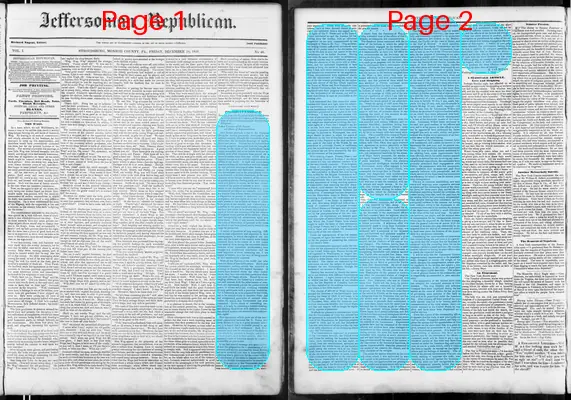
Jeffersonian Republican
Stroudsburg, East Stroudsburg, Milford, Monroe County, Pike County, Pennsylvania
What is this article about?
President Martin Van Buren's annual message to Congress on December 5, 1840, reviews national blessings of health, plenty, and peace; foreign relations and treaties; boundary disputes with Britain; Indian removal with over 40,000 relocated and ongoing Seminole War in Florida; naval expeditions and discoveries; postal service status; and anti-slave trade efforts.
Merged-components note: Continuation of the President's Message to Congress across pages 1 and 2; relabeled from 'story' for the second component as it is official domestic political content.
Clippings
1 of 2
OCR Quality
Full Text
Message from the President of the United States to the two Houses of Congress, at the commencement of the second session of the Twenty-Sixth Congress.
Fellow Citizens of the Senate and House of Representatives:
Our devout gratitude is due to the Supreme Being for having graciously continued to our beloved country, through the vicissitudes of another year, the invaluable blessings of health, plenty and peace. Seldom has this favored land been so generally exempted from the ravages of disease, or the labor of the husbandman more amply rewarded; and never before have our relations with other countries been placed on a more favorable basis than that which they so happily occupy at this critical conjuncture in the affairs of the world. A rigid and persevering abstinence from all interference with the domestic and political relations of other States, alike due to the genius and distinctive character of our Government and to the principles by which it is directed; a faithful observance, in the management of our foreign relations, of the practice of speaking plainly, dealing justly, and requiring truth and justice in return, as the best conservatives of the peace of nations; a strict impartiality in our manifestations of friendship, in the commercial privileges we concede, and those we require from others: these, accompanied by a disposition as prompt to maintain, in every emergency, our own rights, as we are from principle averse to the invasion of those of others, have given to our country and Government a standing in the great family of nations, of which we have just cause to be proud, and the advantages of which are experienced by our citizens throughout every portion of the earth to which their enterprising and adventurous spirit may carry them. Few, if any, remaining insensible to the value of friendship, or ignorant of the terms on which it can be acquired, and by which it can alone be preserved.
A series of questions of long standing, difficult in their adjustment, and important in their consequences, in which the rights of our citizens and the honor of the country were deeply involved, have, in the course of a few years, (the most of them during the successful administration of my immediate predecessor,) been brought to a satisfactory conclusion; and the most important of those remaining are, I am happy to believe, in a fair way of being speedily and satisfactorily adjusted.
With all the Powers of the world our relations are those of honorable peace. Since your adjournment, nothing serious has occurred to interrupt or threaten this desired harmony. If clouds have lowered above the other hemisphere, they have not cast their portentous shadows upon our happy shores. Bound by no entangling alliances, yet linked by a common nature and interest with the other nations of mankind, our aspirations are for the preservation of peace, in whose solid and civilizing triumphs all may participate with a generous emulation. Yet it behooves us to be prepared for any event, and to be always ready to maintain those just and enlightened principles of national intercourse, for which this Government has ever contended. In the shock of contending empires, it is only by assuming a resolute bearing, and clothing themselves with defensive armor, that neutral nations can maintain their independent rights.
The excitement which grew out of the territorial controversy between the U. States and Great Britain having in a great measure subsided, it is hoped that a favorable period is approaching for its final settlement. Both Governments must now be convinced of the dangers with which the question is fraught; and it must be their desire, as it is their interest, that this perpetual cause of irritation should be removed as speedily as practicable.
In my last annual message you were informed that the proposition for a commission of exploration and survey promised by Great Britain had been received, and that a counterproject, including also a provision for the certain and final adjustment of the limits in dispute, was then before the British Government for its consideration. The answer of that Government, accompanied by additional propositions of its own, was received, through its minister here, since
your separation. These were promptly considered; such as were deemed correct in principle, and consistent with a due regard to the just rights of the United States and of the State of Maine, concurred in: and the reasons for dissenting from the residue, with an additional suggestion on our part, communicated by the Secretary of State to Mr. Fox. That minister, not feeling himself sufficiently instructed upon some of the points raised in the discussion, felt it to be his duty to refer the matter to his own Government for its further decision. Having now been for some time under its advisement, a speedy answer may be confidently expected. From the character of the points still in difference, and the undoubted disposition of both parties to bring the matter to an early conclusion, I look with entire confidence to a prompt and satisfactory termination of the negotiation.
Three commissioners were appointed shortly after the adjournment of Congress, under the act of the last session providing for the exploration and survey of the line which separates the States of Maine and New Hampshire from the British Provinces; they have been actively employed until their progress was interrupted by the inclemency of the season, and will resume their labors as soon as practicable in the ensuing year.
It is understood that their respective examinations will throw new light upon the subject in controversy, and serve to remove any erroneous impressions which may have been made elsewhere prejudicial to the rights of the United States. It was, among other reasons, with a view of preventing the embarrassments which, in our peculiar system of government, impede and complicate negotiations involving the territorial rights of a State, that I thought it my duty, as you have been informed on a previous occasion, to propose to the British Government, through its minister at Washington, that early steps should be taken to adjust the points of difference on the line of boundary from the entrance of Lake Superior to the most northwestern point of the Lake of the Woods, by the arbitration of a friendly Power, in conformity with the seventh article of the treaty of Ghent. No answer has yet been returned by the British Government to this proposition.
With Austria, France, Prussia, Russia, and the remaining Powers of Europe, I am happy to inform you that our relations continue to be of the most friendly character. With Belgium, a treaty of commerce and navigation, based upon liberal principles of reciprocity and equality, was concluded in March last, and, having been ratified by the Belgian Government, will be duly laid before the Senate. It is a subject of congratulation that it provides for the satisfactory adjustment of a long standing question of controversy; thus removing the only obstacle which could obstruct the friendly and mutually advantageous intercourse between the two nations. A messenger has been despatched with the Hanoverian treaty to Berlin, where, according to stipulation, the ratifications are to be exchanged. I am happy to announce to you that, after many delays and difficulties, a treaty of commerce and navigation between the United States and Portugal, was concluded and signed at Lisbon, on the 26th of August last, by the plenipotentiaries of the two Governments. Its stipulations are founded upon those principles of mutual liberality and advantage which the United States have always sought to make the basis of their intercourse with foreign Powers, and it is hoped they will tend to foster and strengthen the commercial intercourse of the two countries.
Under the appropriation of the last session of Congress, an agent has been sent to Germany, for the purpose of promoting the interests of our tobacco trade.
The commissioners appointed under the convention for the adjustment of claims of citizens of the United States upon Mexico having met and organized at Washington, in August last, the papers in the possession of the Government, relating to those claims, were communicated to the board. The claims not embraced by that convention are now the subject of negotiation between the two Governments, through the medium of our minister at Mexico.
Nothing has occurred to disturb the harmony of our relations with different Governments of S. America. I regret, however, to be obliged to inform you that the claims of our citizens upon the late Republic of Columbia have not yet been satisfied by the separate Governments into which it has been resolved.
The charge d'affaires of Brazil having expressed the intention of his Government not to prolong the treaty of 1828, it will cease to be obligatory upon either party on the 12th day of December, 1841, when the extensive commercial intercourse between the United States and that vast empire will no longer be regulated by express stipulations.
It affords me pleasure to communicate to you that the Government of Chili has entered into an agreement to indemnify the claimants in the case of the Macedonian, for American property seized in 1819; and to add, that information has also been received which justifies the hope of an early adjustment of the remaining claims upon that Government.
The commissioners appointed in pursuance of the convention between the United States and Texas for making the boundary between them, have, according to the last report received from our commissioner, surveyed and established the whole extent of the boundary north along the western bank of the Sabine river, from its entrance into the Gulf of Mexico to the thirty-second degree of north latitude. The commission adjourned on the sixteenth of June last to reassemble on the 1st of November, for the purpose of establishing accurately the intersection of the thirty-second degree of latitude with the western bank of the Sabine, and the meridian line thence to Red river. It is presumed that the work will be concluded in the present season.
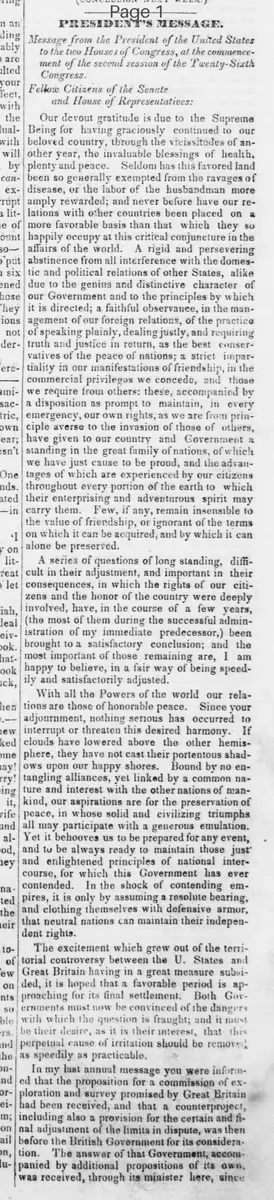
A report from the Secretary of War, presenting a detailed view of the affairs of that department, accompanies this communication. The desultory duties connected with the removal of the Indians, in which the army has been constantly engaged on the northern and western frontiers, and in Florida, have rendered it impracticable to carry into full effect the plan recommended by the Secretary for improving its discipline. In every instance where the regiments have been concentrated, they have made great progress; and the best results may be anticipated from a continuance of this system.
During the last season, a part of the troops have been employed in removing Indians from the interior to the territory assigned them in the West—a duty which they have performed efficiently and with praiseworthy humanity; and that portion of them which has been stationed in Florida continued active operations throughout the heat of summer.
The policy of the United States in regard to the Indians, of which a sufficient account is given in my message of 1838, and of the wisdom and expediency of which I am fully satisfied, has been continued in active operation throughout the whole period of my administration. Since the spring of 1837 more than forty thousand Indians have been removed to their new homes west of the Mississippi and I am happy to add that all accounts concur in representing the result of this measure as eminently beneficial to that people.
The emigration of the Seminoles alone has been attended with serious difficulty, and occasioned bloodshed; hostilities having been commenced by the Indians in Florida, under the apprehension that they would be compelled, by force, to comply with their treaty stipulations. The execution of the treaty of Payne's Landing, signed in 1832, but not ratified until 1834, was postponed, at the solicitation of the Indians, until 1836, when they again renewed their agreement to remove peaceably to their new homes in the West. In the face of this solemn and renewed compact, they broke their faith, and commenced hostilities by the massacre of Major Dade's command, the murder of their agent, General Thompson, and other acts of cruel treachery.
When this alarming and unexpected intelligence reached the seat of Government, every effort appears to have been made to reinforce General Clinch, who commanded the troops then in Florida. Gen. Eustis was despatched with reinforcements from Charleston; troops were called out from Alabama, Tennessee, and Georgia; and Gen. Scott was sent to take the command, with ample powers and ample means.
At the first alarm, Gen. Gaines organized a force at New Orleans, and without waiting for orders, landed in Florida; where he delivered over the troops he had brought with him to General Scott.
Gen. Call was subsequently appointed to conduct a summer campaign, and at the close of it, was replaced by Gen. Jesup. These events and changes took place under the administration of my predecessor. Notwithstanding the exertions of the experienced officers who had command there for eighteen months, on entering upon the administration of the Government I found the Territory of Florida a prey to Indian atrocities.
A strenuous effort was immediately made to bring these hostilities to a close; and the army under Gen. Jesup, was reinforced until it amounted to ten thousand men, and furnished with abundant supplies of every description. In this campaign a great number of the enemy were captured and destroyed; but the character of the contest only was changed. The Indians, having been defeated in every engagement, dispersed in small bands throughout the country, and became an enterprising, formidable and ruthless banditti.
Gen. Taylor, who succeeded Gen. Jesup, used his best exertions to subdue them, and was seconded in his efforts by the officers under his command; he too failed to protect the Territory from their depredations. By act of signal and cruel treachery, they broke the truce made with them by Gen. Macomb, who was sent from Washington for the purpose of carrying into effect the expressed wishes of Congress, and have continued their devastations ever since. Gen. Armistead, who was in Florida when Gen. Taylor left the Army, by permission assumed the command, and, after active summer operations, was met by propositions for peace; and from the fortunate coincidence of the arrival in Florida, at the same period, of a delegation from the Seminoles who are happily settled west of the Mississippi, and are now anxious to persuade their countrymen to join them there, hopes were for some time entertained that the Indians might be induced to leave the territory without further difficulty.
These hopes have proved fallacious, and hostilities have been renewed throughout the whole of the territory. That this contest has endured so long, is to be attributed to causes beyond the control of the Government. Experienced generals have had the command of the troops; officers and soldiers have alike distinguished themselves for their activity, patience, and enduring courage; the army has been constantly furnished with supplies of every description; and we must look for the causes which have so long procrastinated the issue of the contest, in the vast extent of the theatre of hostilities, the almost insurmountable obstacles presented by the nature of the country, the climate, and the wily character of the savages.
The sites for marine hospitals on the rivers and lakes, which I was authorized to select and caused to be purchased, have all been designated; but, the appropriation not proving sufficient, conditional arrangements only have been made for their acquisition. It is for Congress to decide whether those conditional purchases shall be sanctioned, and the humane intentions of the law carried into full effect.
The Navy, as will appear from the accompanying report of the Secretary, has been usefully and honorably employed in the protection of our commerce and citizens in the Mediterranean, the Pacific, on the coast of Brazil, and in the Gulf of Mexico. A small squadron, consisting of the frigate Constellation and the sloop-of-war Boston, under Commodore Kearney, is now on its way to the China and Indian seas, for the purpose of attending to our interests in that quarter; and Commander Aulick, in the sloop-of-war Yorktown, has been instructed to visit the Sandwich and Society Islands, the coasts of New Zealand and Japan, together with other ports and islands frequented by our whale ships, for the purpose of giving them countenance and protection, should they be required. Other smaller vessels have been, and still are, employed in prosecuting the surveys of the coast of the United States, directed by various acts of Congress; and those which have been completed will shortly be laid before you.
The exploring expedition, at the latest date, was preparing to leave the Bay of Islands, New Zealand, in further prosecution of objects which have thus far been successfully accomplished. The discovery of a new continent, which was first seen in latitude 66 deg. 2 min. south, longitude 154 deg. 27 min. east, and afterwards in latitude 66 deg. 31 min. south, longitude 153 deg. 40 min. east, by Lieutenants Wilkes and Hudson, for an extent of eighteen hundred miles, but on which they were prevented from landing by vast bodies of ice which encompassed it, is one of the honorable results of the enterprise. Lieutenant Wilkes bears testimony to the zeal and good conduct of his officers and men; and it is but justice to that officer to state that he appears to have performed the duties assigned him with an ardor, ability, and perseverance which give every assurance of an honorable issue to the undertaking.
The report of the Postmaster General, herewith transmitted, will exhibit the service of the department the past year, and its present condition. The transportation has been maintained during the year to the full extent authorized by the existing laws, some improvements have been effected, which the public interest seemed urgently to demand but not involving any material additional expenditure; the contractors have generally performed their engagements with fidelity; the postmasters with few exceptions, have rendered their accounts and paid their quarterly balances with promptitude; and the whole service of the department has maintained the efficiency for which it has for several years been distinguished.
The act of congress establishing new mail routes and requiring more expensive services on others and the increasing wants of the country, have, for three years past, carried the expenditures something beyond the revenues; excesses having been met, until the past year, by the surplus which had previously accumulated. That surplus having been exhausted, and the anticipated increase in the revenue not having been realized, owing to the depression in the commercial business of the country, the finances of the department exhibited a small deficiency at the close of the last fiscal year. Its resources however, are ample; and the reduced rates of compensation for the transportation service, which may be expected on the future lettings, from the general reduction of prices, with the increase of revenue that may reasonably be anticipated from the revival of commercial activity, must soon place the finances of the department in a prosperous condition.
Considering the unfavourable circumstances that existed during the past year, it is a gratifying result that the revenue has not declined, as compared with the preceding year, but on the contrary, exhibits a small increase; the circumstances referred to having no other effects than to check the expected income.
It will be seen that the Postmaster General suggests certain improvements in the establishment, designed to reduce the weight of the mails, cheapen the transportation, ensure greater regularity in the service, and secure a considerable reduction in the rates of letter postage—an object highly desirable. The subject is one of general interest to the community, and is respectfully recommended to your consideration.
The suppression of the African slave trade has received the continued attention of Government. The brig Dolphin and schooner Grampus have been employed during the last season on the coast of Africa, for the purpose of preventing such portions of that trade as was said to be prosecuted under the American flag. After cruising off those parts of the coast most usually resorted to by slavers, until the commencement of the rainy season, these vessels returned to the United States for supplies, and have since been dispatched on a similar service.
From the reports of the commanding officer, it appears that the trade is now principally carried on under Portuguese colors; and they express the opinion that the apprehension of their presence on the slave coast has, in a great degree, arrested the prostitution of the American flag to this inhuman purpose. It is hoped that, by continuing to maintain this force in that quarter, and by the exertions of the officers in command, much will be done to put a stop to whatever portion of this traffic may have been carried on under the American flag, and to prevent its use in a trade which, while it violates the laws is equally an outrage on the rights of others and the feelings of humanity. The efforts of the several Governments who are anxiously seeking to suppress this traffic, must however, be directed against the facilities afforded by what are now recognized as legitimate commercial pursuits, before that object can be fully accomplished. Supplies of provisions, water-casks, merchandise, and articles connected with the prosecution of the slave trade, are, it is understood, freely carried by vessels of different nations to the slave factories, and the effects of the factors are transported from one slave station to another, without interruption or punishment by either of the nations to which they belong, engaged in the commerce of that region. I submit to your judgments whether this government, having been the first to prohibit, by adequate penalties the slave trade—the first to declare it piracy—should not be first, also to forbid to its citizens all trade with the slave factories on the coast of Africa, giving an example to all nations in this respect which, if fairly followed, cannot fail to produce the most effective results in breaking up those dens of iniquity.
M. VAN BUREN.
Washington, December 5, 1840.
What sub-type of article is it?
What keywords are associated?
What entities or persons were involved?
Where did it happen?
Domestic News Details
Primary Location
Washington
Event Date
December 5, 1840
Key Persons
Outcome
over 40,000 indians removed west of mississippi since 1837; seminole hostilities ongoing in florida with many indians captured and dispersed into banditti; naval expedition discovers antarctic continent; postal department shows small financial deficiency but expects recovery; slave trade suppression efforts continue with u.s. vessels patrolling african coast.
Event Details
President Van Buren addresses Congress on the state of the union, expressing thanks for peace and prosperity, detailing amicable foreign relations and ongoing boundary negotiations with Britain, reporting on Indian removal policy successes and the protracted Seminole War in Florida involving multiple generals and treaty violations, naval protections and explorations including Antarctic discovery, postal service operations and suggestions for improvements, and U.S. efforts to suppress the African slave trade through patrols and proposed trade restrictions.