Thank you for visiting SNEWPapers!
Sign up free
Story
December 28, 1962
The Catholic Times
Columbus, Franklin County, Ohio
What is this article about?
At the Second Vatican Council's first session, fathers approve vernacular use in liturgy on regional basis, as detailed by expert Fr. Vagaggini in L'Osservatore Romano. Constitution preserves Latin but allows adaptations and promotes active participation.
Clipping
OCR Quality
98%
Excellent
Full Text
Council approves liturgical changes on regional basis
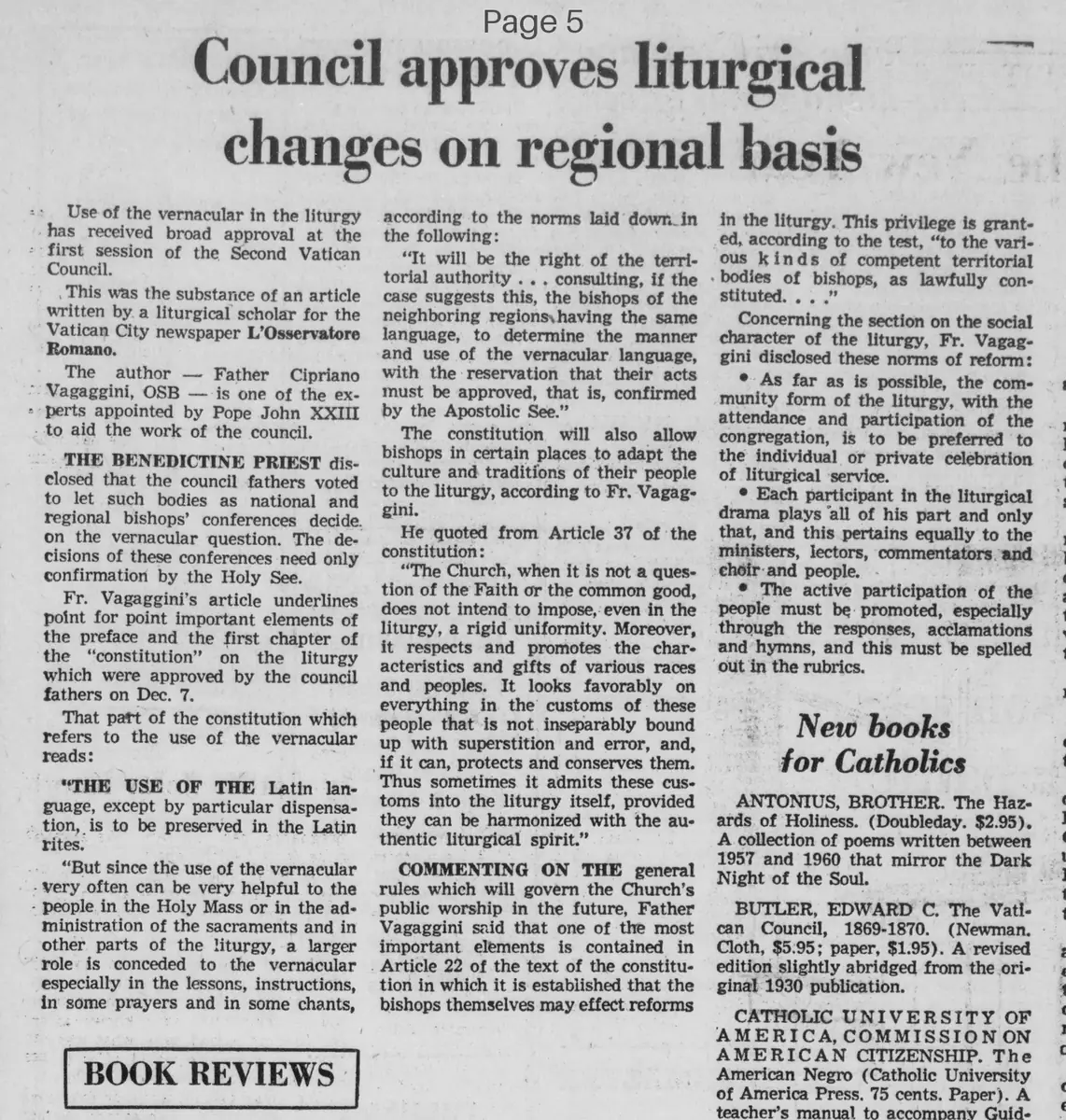
Use of the vernacular in the liturgy has received broad approval at the first session of the Second Vatican Council. This was the substance of an article written by a liturgical scholar for the Vatican City newspaper L'Osservatore Romano. The author - Father Cipriano Vagaggini, OSB - is one of the experts appointed by Pope John XXIII to aid the work of the council. The Benedictine priest disclosed that the council fathers voted to let such bodies as national and regional bishops' conferences decide on the vernacular question. The decisions of these conferences need only confirmation by the Holy See. Fr. Vagaggini's article underlines point for point important elements of the preface and the first chapter of the "constitution" on the liturgy which were approved by the council fathers on Dec. 7. That part of the constitution which refers to the use of the vernacular reads: "THE USE OF THE Latin language, except by particular dispensation, is to be preserved in the Latin rites. "But since the use of the vernacular very often can be very helpful to the people in the Holy Mass or in the administration of the sacraments and in other parts of the liturgy, a larger role is conceded to the vernacular especially in the lessons, instructions, in some prayers and in some chants, according to the norms laid down in the following: "It will be the right of the territorial authority ... consulting, if the case suggests this, the bishops of the neighboring regions having the same language, to determine the manner and use of the vernacular language, with the reservation that their acts must be approved, that is, confirmed by the Apostolic See." The constitution will also allow bishops in certain places to adapt the culture and traditions of their people to the liturgy, according to Fr. Vagaggini. He quoted from Article 37 of the constitution: "The Church, when it is not a question of the Faith or the common good, does not intend to impose, even in the liturgy, a rigid uniformity. Moreover, it respects and promotes the characteristics and gifts of various races and peoples. It looks favorably on everything in the customs of these people that is not inseparably bound up with superstition and error, and, if it can, protects and conserves them. Thus sometimes it admits these customs into the liturgy itself, provided they can be harmonized with the authentic liturgical spirit." COMMENTING ON THE general rules which will govern the Church's public worship in the future. Father Vagaggini said that one of the most important elements is contained in Article 22 of the text of the constitution in which it is established that the bishops themselves may effect reforms in the liturgy. This privilege is granted, according to the text, "to the various kinds of competent territorial bodies of bishops, as lawfully constituted..." Concerning the section on the social character of the liturgy, Fr. Vagaggini disclosed these norms of reform: As far as is possible, the community form of the liturgy, with the attendance and participation of the congregation, is to be preferred to the individual or private celebration of liturgical service. Each participant in the liturgical drama plays all of his part and only that, and this pertains equally to the ministers, lectors, commentators and choir and people. The active participation of the people must be promoted, especially through the responses, acclamations and hymns, and this must be spelled out in the rubrics.
Use of the vernacular in the liturgy has received broad approval at the first session of the Second Vatican Council. This was the substance of an article written by a liturgical scholar for the Vatican City newspaper L'Osservatore Romano. The author - Father Cipriano Vagaggini, OSB - is one of the experts appointed by Pope John XXIII to aid the work of the council. The Benedictine priest disclosed that the council fathers voted to let such bodies as national and regional bishops' conferences decide on the vernacular question. The decisions of these conferences need only confirmation by the Holy See. Fr. Vagaggini's article underlines point for point important elements of the preface and the first chapter of the "constitution" on the liturgy which were approved by the council fathers on Dec. 7. That part of the constitution which refers to the use of the vernacular reads: "THE USE OF THE Latin language, except by particular dispensation, is to be preserved in the Latin rites. "But since the use of the vernacular very often can be very helpful to the people in the Holy Mass or in the administration of the sacraments and in other parts of the liturgy, a larger role is conceded to the vernacular especially in the lessons, instructions, in some prayers and in some chants, according to the norms laid down in the following: "It will be the right of the territorial authority ... consulting, if the case suggests this, the bishops of the neighboring regions having the same language, to determine the manner and use of the vernacular language, with the reservation that their acts must be approved, that is, confirmed by the Apostolic See." The constitution will also allow bishops in certain places to adapt the culture and traditions of their people to the liturgy, according to Fr. Vagaggini. He quoted from Article 37 of the constitution: "The Church, when it is not a question of the Faith or the common good, does not intend to impose, even in the liturgy, a rigid uniformity. Moreover, it respects and promotes the characteristics and gifts of various races and peoples. It looks favorably on everything in the customs of these people that is not inseparably bound up with superstition and error, and, if it can, protects and conserves them. Thus sometimes it admits these customs into the liturgy itself, provided they can be harmonized with the authentic liturgical spirit." COMMENTING ON THE general rules which will govern the Church's public worship in the future. Father Vagaggini said that one of the most important elements is contained in Article 22 of the text of the constitution in which it is established that the bishops themselves may effect reforms in the liturgy. This privilege is granted, according to the text, "to the various kinds of competent territorial bodies of bishops, as lawfully constituted..." Concerning the section on the social character of the liturgy, Fr. Vagaggini disclosed these norms of reform: As far as is possible, the community form of the liturgy, with the attendance and participation of the congregation, is to be preferred to the individual or private celebration of liturgical service. Each participant in the liturgical drama plays all of his part and only that, and this pertains equally to the ministers, lectors, commentators and choir and people. The active participation of the people must be promoted, especially through the responses, acclamations and hymns, and this must be spelled out in the rubrics.
What sub-type of article is it?
Historical Event
What themes does it cover?
Providence Divine
Moral Virtue
What keywords are associated?
Vatican Council
Liturgical Changes
Vernacular Language
Bishops Conferences
Church Reform
What entities or persons were involved?
Father Cipriano Vagaggini
Pope John Xxiii
Where did it happen?
Vatican City
Story Details
Key Persons
Father Cipriano Vagaggini
Pope John Xxiii
Location
Vatican City
Event Date
Dec. 7
Story Details
The Second Vatican Council approves liturgical changes allowing regional bishops' conferences to decide on using vernacular in liturgy, with Holy See confirmation. The constitution preserves Latin but concedes larger role to vernacular in certain parts. It also allows adaptation of local customs and promotes community participation in worship.