Thank you for visiting SNEWPapers!
Sign up free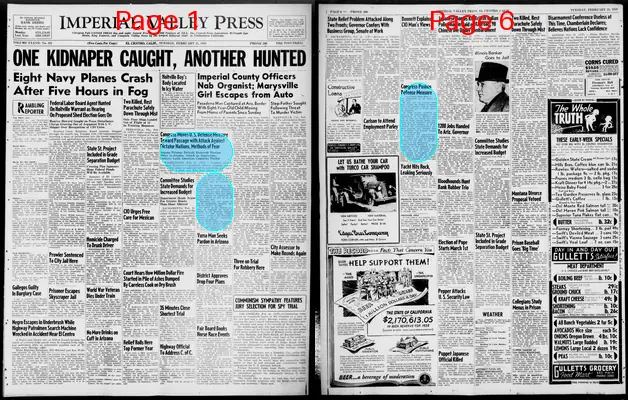
Imperial Valley Press
El Centro, Imperial County, California
What is this article about?
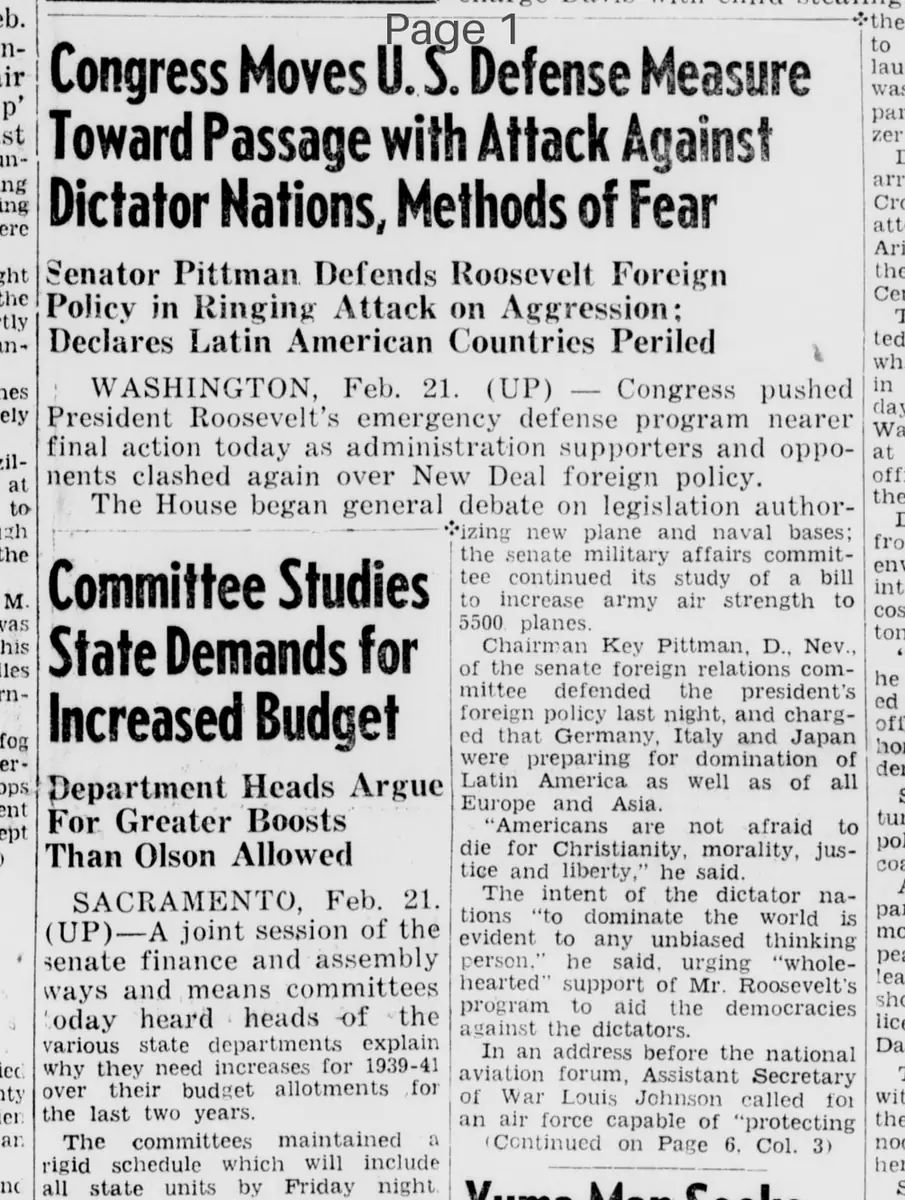
On Feb. 21, Congress advanced President Roosevelt's emergency defense program amid debates on foreign policy. The House approved new plane and naval bases; the Senate studied increasing army air strength to 5500 planes. Sen. Key Pittman defended Roosevelt's policy against Germany, Italy, and Japan, while Sen. H. Styles Bridges criticized it as risking war.
Merged-components note: Merged page 1 component with its continuation on page 6 into a single domestic news article about Congress and the U.S. defense measure.
Clippings
1 of 2
OCR Quality
Full Text
Senator Pittman Defends Roosevelt Foreign Policy in Ringing Attack on Aggression:
Declares Latin American Countries Periled
WASHINGTON, Feb. 21. (UP) - Congress pushed President Roosevelt's emergency defense program nearer final action today as administration supporters and opponents clashed again over New Deal foreign policy.
The house completed action on legislation authorizing new plane and naval bases; the senate military affairs committee continued its study of a bill to increase army air strength to 5500 planes.
Chairman Key Pittman, D., Nev., of the senate foreign relations committee defended the president's foreign policy last night, and charged that Germany, Italy and Japan were preparing for domination of Latin America as well as of all Europe and Asia.
"Americans are not afraid to die for Christianity, morality, justice and liberty," he said.
The intent of the dictator nations "to dominate the world is evident to any unbiased thinking person," he said, urging "wholehearted" support of Mr. Roosevelt's program to aid the democracies against the dictators.
In an address before the national aviation forum, Assistant Secretary of War Louis Johnson called for an air force capable of "protecting
(Continued on Page 6. Col. 3)
Congress Pushes Defense Measure
(Continued From Page 1)
our hemisphere on all fronts at any time."
He said that this country must arm to meet the threats of nations which are building huge air forces "to terrorize and to attack peaceful neighbors."
"Is there anyone anywhere so naive in his understanding of the significance of the Munich pact that he does not realize the price paid by those nations which neglected their air defenses?" he asked.
Sen. H. Styles Bridges, R., N. H., attacked the administration's defense program and charged that the president has brought us close to the brink of war."
He accused the administration of "mislaying" the traditional policy of peace and said the reestablishment of this ideal is the crying need of the generation".
"Our manifest destiny is to keep unspoiled the best example in our civilization of a democracy that works—free from the plots, plans and diseases of European politics.
That destiny can best be met by formulating a foreign policy based upon the processes of peace—and sticking to it."
What sub-type of article is it?
What keywords are associated?
What entities or persons were involved?
Where did it happen?
Domestic News Details
Primary Location
Washington
Event Date
Feb. 21
Key Persons
Outcome
congress advanced defense legislation toward passage; house completed action on plane and naval bases; senate committee studied army air strength increase to 5500 planes.
Event Details
Congress pushed Roosevelt's emergency defense program amid clashes over foreign policy. Sen. Pittman defended policy, charging Germany, Italy, Japan with plans to dominate Latin America, Europe, Asia; urged support to aid democracies. Louis Johnson called for strong air force to protect hemisphere. Sen. Bridges attacked program as nearing war, advocated peace policy.