Thank you for visiting SNEWPapers!
Sign up free
Edwardsville Spectator
Edwardsville, Madison County, Illinois
What is this article about?
Joseph Buchanan proposes an improved capillary steam engine using coiled thin tubes heated to extreme temperatures for superior efficiency over Perkins' design, claiming 100 times more power per weight. He envisions applications including a lightweight flying machine for human flight. Dated Oct. 20, 1823, from Hopkinsville, Ky.
Clipping
OCR Quality
Full Text
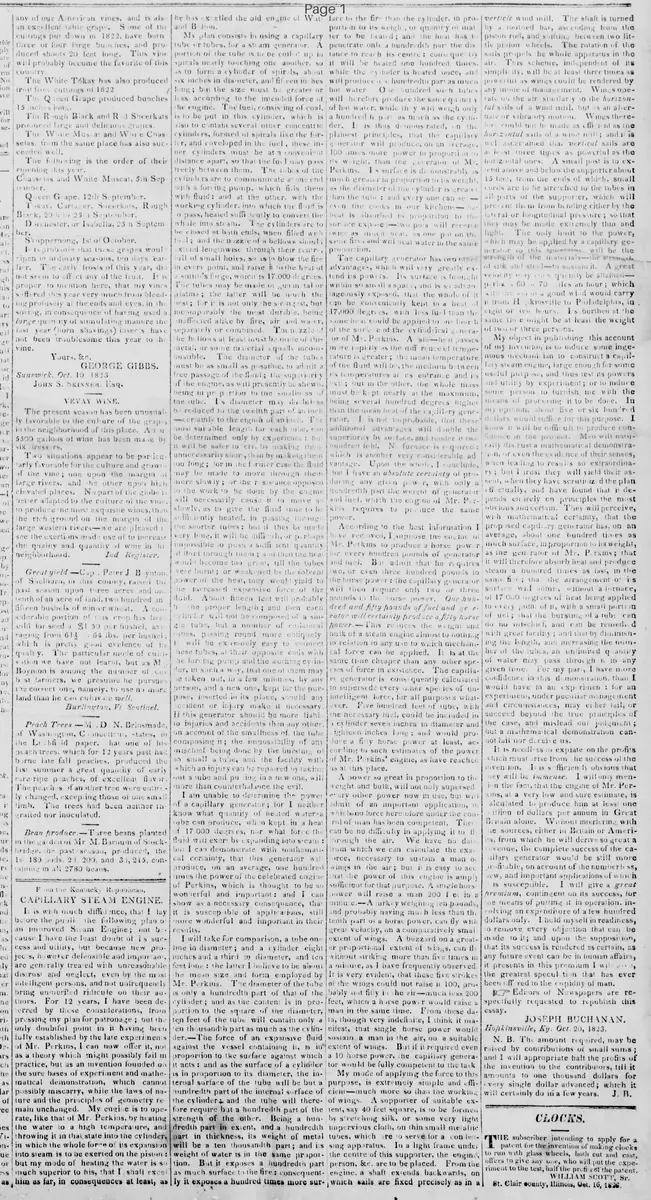
It is with much diffidence, that I lay before the public the following plan of an Improved Steam Engine; not because I have the least doubt of its success and utility, but because new projects, however defensible and important, are generally treated with unreasonable distrust and neglect, even by the most intelligent persons, and not unfrequently bring unmerited ridicule on their authors. For 12 years, I have been deterred by these considerations, from pressing my plan for patronage; but the only doubtful point in it having been fully established by the late experiments of Mr. Perkins, I can now offer it, not as a theory which might possibly fail in practice, but as an invention founded on the sure bases of experiment and mathematical demonstration, which cannot possibly miscarry, while the laws of nature and the principles of geometry remain unchanged.
My engine is to operate, like that of Mr. Perkins, by heating the water to a high temperature, and throwing it in that state into the cylinder, in which the whole force of its expansion into steam is to be exerted on the piston: but my mode of heating the water is so much superior to his, that I shall exceed him as far, in consequences at least, as he has excelled the old engine of Watt and Bolton.
My plan consists in using a capillary tube or tubes, for a steam generator. A portion of the tube is to be coiled up in spirals nearly touching one another, so as to form a cylinder of spirals, about six inches in diameter, and fifteen in length; but the size must be greater or less, according to the intended force of the engine. The fuel, consisting of coal, is to be put in this cylinder, which is also to contain several other concentric cylinders, formed of spirals like the former, and enveloped in the fuel, these inner cylinders must be at a convenient distance apart, so that the fuel may pass freely between them. The tubes of the cylinders are to communicate at one end with a forcing pump, which fills them with fluid: and at the other, with the working cylinder, into which the fluid is to pass, heated sufficiently to convert the whole into steam. The cylinders are to be closed at both ends, when filled with fuel; and the nozzle of a bellows should extend lengthwise through their center, full of small holes, so as to blow the fire in every point, and raise it to the heat of smith's forge, which is 17,000 degrees.
The tubes may be made of any metal or platina; the latter will be much the best; for it is not only the strongest, but incomparably the most durable, being unaffected alike by fire, air and water, separately or combined. The nozzle of the bellows at least must be made of this metal, or some material equally incombustible. The diameter of the tubes must be as small as possible, to admit a free passage of the fluid; the superiority of the engine, as will presently be shown, being in proportion to the smallness of the tube. Its diameter may doubtless be reduced to the twelfth part of an inch—certainly to the eighth of an inch. The most suitable length for each tube, can be determined only by experience: but it will be safer to err, by making them unnecessarily short, than by making them too long; for in the former case the fluid may be made to move through them more slowly; or the resistance opposed to the work to be done by the engine will necessarily cause it to move so slowly, as to give the fluid time to be sufficiently heated, in passing through the shorter tubes: but if they be made very long, it will be difficult, or perhaps impossible to push a sufficient quantity of fluid through them; and then the heat would become too great, till the tubes were burnt; or weakened by the solvent power of the heat, they would yield to the increased expansive force of the fluid. About fifteen feet will probably be the proper length; and then each cylinder will not be composed of a single tube, but a number of collateral tubes, passing round more obliquely.
It will be extremely easy to connect these tubes, at their opposite ends with the forcing pump and the working cylinder, in such a way, that one of them may be taken out, in a few minutes, by any person, and a new one, kept for the purpose, inserted in its place, should any accident or injury make it necessary. If this generator should be more liable to injuries and accidents than any other, on account of the smallness of the tubes composing it; the impossibility of any mischief being done by the bursting of so small a tube, and the facility with which an injury can be repaired by taking out a tube and putting in a new one, will more than counterbalance the evil.
I am unable to determine the power of a capillary generator; for I neither know what quantity of heated water a tube can produce, when kept in a heat of 17,000 degrees, nor what force the fluid will exert by expanding into steam: but I can demonstrate with mathematical certainty, that this generator will produce, on an average, one hundred times the power of the celebrated engine of Perkins, which is thought to be so wonderful and important: and I can show as a necessary consequence, that it is susceptible of applications, still more wonderful and important in their results.
I will take for comparison, a tube one line in diameter; and a cylinder eight inches and a third in diameter, and ten feet long: the latter I believe to be about the mean size and form employed by Mr. Perkins. The diameter of the tube is only a hundredth part of that of the cylinder; and as the content is in proportion to the square of the diameter, ten feet of the tube will contain only a ten thousandth part as much as the cylinder. The force of an expansive fluid against the vessel containing it, is in proportion to the surface against which it acts: and as the surface of a cylinder is in proportion to its diameter, the internal surface of the tube will be but a hundredth part of the internal surface of the cylinder: and the tube will therefore require but a hundredth part of the strength of the other. Being a hundredth part in extent, and a hundredth part in thickness, its weight of metal will be a ten thousandth part; and its weight of water is in the same proportion. But it exposes a hundredth part as much surface to the fire: consequently it exposes a hundred times more surface to the fire than the cylinder, in proportion to its weight, or quantity of water to be heated; and the heat has to penetrate only a hundredth part the distance to reach its centre: consequently it will be heated one hundred times, while the cylinder is heated once, and will produce one hundredth part as much hot water. One hundred such tubes will therefore produce the same quantity of hot water, while they will weigh only a hundredth part as much as the cylinder. It is thus demonstrated, in the plainest principles, that the capillary generator will produce, on an average, 100 times more power in proportion to its weight, than the generator of Mr. Perkins. Its surface is demonstrably as much greater in proportion to its weight, as the diameter of the cylinder is greater than the tube: and every one can see—from the cooks in one kitchen—that heat is absorbed in proportion to the surface exposed—two pots will receive twice as much heat, as one pot on the same fire, and will heat water in the same proportion.
The capillary generator has two other advantages, which will very greatly extend its powers. Its surface is brought within so small a space, and is so advantageously exposed, that the whole of it can be conveniently kept in a heat of 17,000 degrees, with less fuel than the same heat could be applied to one fourth of the surface of the cylindrical generator of Mr. Perkins. A hot blast passes more rapidly as the difference of temperature is greater; the mean temperature of the fluid will be, the medium between its temperatures at its entrance and its exit; but in the other, the whole mass must be kept nearly at the maximum, being several hundred degrees higher than the mean heat of the capillary generator. It is not improbable, that these additional advantages will double the superiority by surface, and render it two hundred fold. No furnace is required: which is another very considerable advantage. Upon the whole, I conclude, that I have an absolute certainty of producing any given power, with only a hundredth part the weight of generator and fuel, which the engine of Mr. Perkins requires to produce the same power.
According to the best information I have received, I suppose the engine of Mr. Perkins to produce a horse power for every hundred pounds of generator and fuel. But admit that he requires two, or even three hundred pounds to the horse power: the Capillary generator will then require only two or three pounds to the horse power. One hundred and fifty pounds of fuel and generator will certainly produce a fifty horse power,—This reduces the weight and bulk of a steam engine almost to nothing in relation to any use to which mechanical force can be applied. It is at the same time cheaper than any other species of force in existence. The capillary generator is consequently calculated to supersede every other species of unintelligent force, for all purposes whatever. Five hundred feet of tube, with the necessary fuel, could be included in a cylinder seven inches in diameter and eighteen inches long; and would produce a fifty horse power at least, according to such estimates of the power of Mr. Perkins' engine, as have reached us at this place.
A power so great in proportion to the weight and bulk, will not only supersede every other power now in use, but will admit of an important application, to which no force heretofore under the control of man has been competent. There can be no difficulty in applying it to flight through the air. We have no data from which we can calculate the exact force, necessary to sustain a man on wings in the air; but it is easy to see that the power of this engine is amply sufficient for that purpose. A single horse power will raise a man 200 feet in a minute.—A turkey weighing ten pounds, and probably having much less than the tenth part of a horse power, can fly with great velocity, on a comparatively small extent of wings. A buzzard on a greater proportional extent of wings, can fly without striking more than five times in a minute, as I have frequently observed. It is very evident, that these five strokes of the wings could not raise it 100, probably not fifty feet in the air—much less 200 feet, which a horse power would raise a man in the same time. From these data, though very indefinite, I think it manifest, that single horse power would sustain a man in the air, on a suitable extent of wings. But if it required even ten horse power, the capillary generator would be fully competent to the task.
My mode of applying the force to this purpose, is extremely simple and efficient—much more so than the working of wings. A supporter of suitable extent, say 40 feet square, is to be formed by stretching silk, or some very light impervious cloth, on thin small metallic tubes, which are to serve for a condensing apparatus. In a light frame under the centre of this supporter, the engine, person, &c. are to be placed. From the engine, a shaft extends backwards, on which sails are fixed precisely as in a vertical wind mill. The shaft is turned by a toothed bar, ascending from the piston rod, and it runs between two little pinion wheels. The rotation of the sails propels the whole apparatus in the air. This scheme, independent of its simplicity, will be at least three times as powerful as wings could be rendered by any mode of management. Wings operate on the air similarly to the horizontal sails of a wind mill, but in an alternate or vibratory motion. Wings therefore could not be made as efficient as the horizontal sails of a wind mill; and it is well ascertained that vertical sails are at least three times as powerful as the horizontal ones. A small post is to extend above and below the supporter about 15 feet, from the ends of which, small cords are to be stretched to the tubes in all parts of the supporter, which will prevent them from bending either by the lateral or longitudinal pressure; so that they may be made extremely thin and light. The only limit to the power, which may be applied by a capillary generator to this apparatus will be the strength of the materials—the strength of silk and steel—to sustain it. A great velocity may easily be attained—perhaps 60 or 70 miles an hour; which although not a good road would carry from Hopkinsville to Philadelphia, in eight or ten hours. Its burthen at the same time might be at least the weight of two or three persons.
My object in publishing this account of my invention is to induce some ingenious mechanic to construct a capillary steam engine, large enough for some useful purpose, and thus test its powers and utility by experiment; or to induce some person to furnish me with the means of procuring it to be done. In my opinion, about five or six hundred dollars would suffice for this purpose. I know it will be difficult to produce confidence in the project. Men will naturally distrust a mathematical demonstration, or even the evidence of their senses, when leading to results so extraordinary; but I trust they will yield their assent, when they have scrutinized the plan actually, and have found that it depends entirely on principles the most obvious and certain. They will perceive, with mathematical certainty, that the proposed capillary generator has, on an average, about one hundred times as much surface, in proportion to its weight, as the generator of Mr. Perkins; that it will therefore absorb heat and produce steam a hundred times as fast, in the same fire; that the arrangement of its surface will admit, without a furnace, of 17,000 degrees of heat being applied to every point, with a small portion of fuel; that the bursting of a tube can do no mischief, and can be remedied with great facility: and that by diminishing the length, and merely increasing the number of the tubes, an unlimited quantity of water may pass through it in any given time. For my part, I have more confidence in this demonstration, than I would have in an experiment: for an experiment, under peculiar management and circumstances, may either fail, or succeed beyond the true principles of the case, and mislead our judgment; but a mathematical demonstration cannot fail nor deceive us.
It is needless to expatiate on the profits which must arise from the success of the invention. It is sufficiently obvious that they will be immense. I will only mention the fact, that the engine of Mr. Perkins, at a very low and sure estimate, is calculated to produce him at least one million of dollars per annum in Great Britain alone. Without interfering with the sources, either in Britain or America, from which he will derive so great a revenue, the complete success of the capillary generator would be still more profitable, on account of the numberless, new, and important applications of which it is susceptible. I will give a great premium, contingent on its success, for the means of putting it in operation, involving an expenditure of a few hundred dollars only. I hold myself in readiness, to remove every objection that can be made to it; and upon the supposition, that its success is rendered as certain, as any future event can be in human affairs, it presents in this premium I will give, the greatest speculation that has ever been offered to the cupidity of man.
Editors of Newspapers are respectfully requested to republish this essay.
JOSEPH BUCHANAN.
Hopkinsville, Ky. Oct. 20, 1823.
N. B. The amount required, may be raised by contributions of small sums; and I will appropriate half the profits of the invention to the contributors, till it amounts to one thousand dollars for every single dollar advanced; which it will certainly do in a few years.
J. B.
What sub-type of article is it?
What themes does it cover?
What keywords are associated?
What entities or persons were involved?
Where did it happen?
Story Details
Key Persons
Location
Hopkinsville, Ky.
Event Date
Oct. 20, 1823
Story Details
Joseph Buchanan describes his capillary steam engine invention using coiled thin tubes for efficient high-temperature water heating, claiming 100 times the power-to-weight ratio of Perkins' engine, with applications including a propeller-driven flying machine for human flight.