Thank you for visiting SNEWPapers!
Sign up free
Editorial
July 9, 1848
The New York Herald
New York, New York County, New York
What is this article about?
Editorial discusses President Polk's message on the ratified U.S.-Mexico peace treaty, praising war outcomes for elevating U.S. status but criticizing Polk's bungled initiation for political gain, which backfired by elevating Gen. Taylor to presidency. Urges post-war economy, debt reduction, and reforms under Taylor.
Clipping
OCR Quality
95%
Excellent
Full Text
President's Message on
the
Treaty
of
Peace.
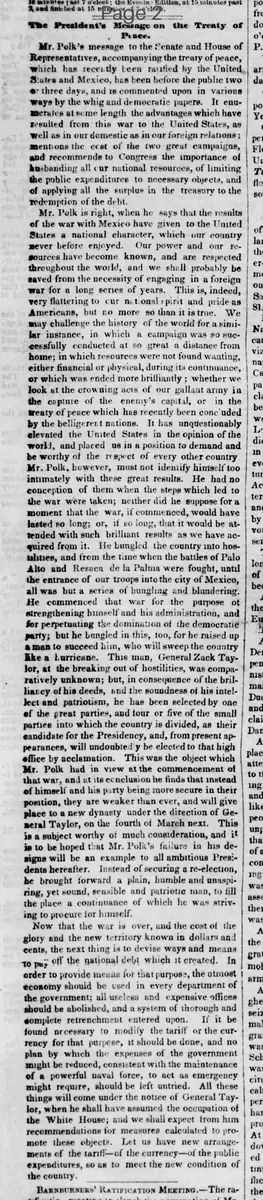
Mr. Polk's message to the Senate and House of
Representatives, accompanying the treaty of peace,
which has recently been ratified by the United
States and Mexico, has been before the public two
three days, and is commented upon in various
ways by the whig and democratic papers. It enu-
merates at some length the advantages which have
resulted from this war to the United States, as
well as in our domestic as in our foreign relations;
mentions the cost of the two great campaigns.
and recommends to Congress the importance of
husbanding all our national resources, of limiting
the public expenditures to necessary objects, and
of applying all the surplus in the treasury to the
redemption of the debt.
Mr. Polk is right, when he says that the results
of the war with Mexico have given to the United
States a national character, which our country
never before enjoyed. Our power and our re-
sources have become known, and are respected
throughout the world, and we shall probably be
saved from the necessity of engaging in a foreign
war for a long series of years. This is, indeed,
very flattering to our national spirit and pride as
Americans, but no more so than it is true. We
may challenge the history of the world for a simi-
lar instance, in which a campaign was so suc-
cessfully conducted at so great a distance from
home; in which resources were not found wanting.
either financial or physical, during its continuance.
or which was ended more brilliantly; whether we
look at the crowning acts of our gallant army in
The capture of the enemy's capital. or in the
treaty of peace which has recently been concluded
by the belligerent nations. It has unquestionably
elevated the United States in the opinion of the
world, and placed us in a position to demand and
be worthy of the respect of every other country
Mr. Polk, however, must not identify himself too
intimately with these great results. He had no
conception of them when the steps which led to
the war were taken; neither did he suppose for a
moment that the war, if commenced, would have
lasted so long; or, if so long, that it would be at-
tended with such brilliant results as we have ac-
quired from it. He bungled the country into hos-
tilities, and from the time when the battles of Palo
Alto and Resaca de la Palma were fought, until
the entrance of our troops into the city of Mexico,
all was but a series of bungling and blundering.
He commenced that war for the purpose of
strengthening himself and his administration, and
for perpetuating the domination of the democratic
party; but he bungled in this, too, for he raised up
a man to succeed him, who will sweep the country
like a hurricane. This man, General Zack Tay-
lor, at the breaking out of hostilities, was compa-
ratively unknown; but, in consequence of the bril-
liancy of his deeds, and the soundness of his intel-
lect and patriotism, he has been selected by one
of the great parties, and four or five of the small
parties into which the country is divided, as their
candidate for the Presidency, and, from present ap-
pearances, will undoubtedly be elected to that high
office by acclamation. This was the object which
Mr. Polk had in view at the commencement of
that war, and at its conclusion he finds that instead
of himself and his party being more secure in their
position, they are weaker than ever, and will give
place to a new dynasty under the direction of Ge-
eral Taylor, on the fourth of March next. This
is a subject worthy of much consideration, and it
is to be hoped that Mr. Polk's failure in his de-
signs will be an example to all ambitious Pres
dents hereafter. Instead of securing a re-election,
he brought forward a plain, humble and unaspi-
ring, yet sound, sensible and patriotic man, to fill
the place a continuance of which he was striy-
ing to procure for himself.
Now that the war is over, and the cost of the
glory and the new territory known in dollars and
cents, the next thing is to devise ways and means
to pay off the national debt which it created. In
order to provide means for that purpose, the utmost
economy should be used in every department of
the government; all useless and expensive offices
should be abolished, and a system of thorough and
complete retrenchment entered upon. If it be
found necessary to modify the tariff or the cur-
rency for that purpose, it should be done, and no
plan by which the expenses of the government
might be reduced, consistent with the maintenance
of a powerful naval force, to act as emergency
might require, should be left untried. All these
things will come under the notice of General Tay-
lor, when he shall have assumed the occupation of
the White House; and we shall expect from him
recommendations for measures calculated to pro-
mote these objects. Let us have new arrange-
ments of the tariff-of the currency-of the public
expenditures, so as to meet the new condition of
the country.
the
Treaty
of
Peace.
Mr. Polk's message to the Senate and House of
Representatives, accompanying the treaty of peace,
which has recently been ratified by the United
States and Mexico, has been before the public two
three days, and is commented upon in various
ways by the whig and democratic papers. It enu-
merates at some length the advantages which have
resulted from this war to the United States, as
well as in our domestic as in our foreign relations;
mentions the cost of the two great campaigns.
and recommends to Congress the importance of
husbanding all our national resources, of limiting
the public expenditures to necessary objects, and
of applying all the surplus in the treasury to the
redemption of the debt.
Mr. Polk is right, when he says that the results
of the war with Mexico have given to the United
States a national character, which our country
never before enjoyed. Our power and our re-
sources have become known, and are respected
throughout the world, and we shall probably be
saved from the necessity of engaging in a foreign
war for a long series of years. This is, indeed,
very flattering to our national spirit and pride as
Americans, but no more so than it is true. We
may challenge the history of the world for a simi-
lar instance, in which a campaign was so suc-
cessfully conducted at so great a distance from
home; in which resources were not found wanting.
either financial or physical, during its continuance.
or which was ended more brilliantly; whether we
look at the crowning acts of our gallant army in
The capture of the enemy's capital. or in the
treaty of peace which has recently been concluded
by the belligerent nations. It has unquestionably
elevated the United States in the opinion of the
world, and placed us in a position to demand and
be worthy of the respect of every other country
Mr. Polk, however, must not identify himself too
intimately with these great results. He had no
conception of them when the steps which led to
the war were taken; neither did he suppose for a
moment that the war, if commenced, would have
lasted so long; or, if so long, that it would be at-
tended with such brilliant results as we have ac-
quired from it. He bungled the country into hos-
tilities, and from the time when the battles of Palo
Alto and Resaca de la Palma were fought, until
the entrance of our troops into the city of Mexico,
all was but a series of bungling and blundering.
He commenced that war for the purpose of
strengthening himself and his administration, and
for perpetuating the domination of the democratic
party; but he bungled in this, too, for he raised up
a man to succeed him, who will sweep the country
like a hurricane. This man, General Zack Tay-
lor, at the breaking out of hostilities, was compa-
ratively unknown; but, in consequence of the bril-
liancy of his deeds, and the soundness of his intel-
lect and patriotism, he has been selected by one
of the great parties, and four or five of the small
parties into which the country is divided, as their
candidate for the Presidency, and, from present ap-
pearances, will undoubtedly be elected to that high
office by acclamation. This was the object which
Mr. Polk had in view at the commencement of
that war, and at its conclusion he finds that instead
of himself and his party being more secure in their
position, they are weaker than ever, and will give
place to a new dynasty under the direction of Ge-
eral Taylor, on the fourth of March next. This
is a subject worthy of much consideration, and it
is to be hoped that Mr. Polk's failure in his de-
signs will be an example to all ambitious Pres
dents hereafter. Instead of securing a re-election,
he brought forward a plain, humble and unaspi-
ring, yet sound, sensible and patriotic man, to fill
the place a continuance of which he was striy-
ing to procure for himself.
Now that the war is over, and the cost of the
glory and the new territory known in dollars and
cents, the next thing is to devise ways and means
to pay off the national debt which it created. In
order to provide means for that purpose, the utmost
economy should be used in every department of
the government; all useless and expensive offices
should be abolished, and a system of thorough and
complete retrenchment entered upon. If it be
found necessary to modify the tariff or the cur-
rency for that purpose, it should be done, and no
plan by which the expenses of the government
might be reduced, consistent with the maintenance
of a powerful naval force, to act as emergency
might require, should be left untried. All these
things will come under the notice of General Tay-
lor, when he shall have assumed the occupation of
the White House; and we shall expect from him
recommendations for measures calculated to pro-
mote these objects. Let us have new arrange-
ments of the tariff-of the currency-of the public
expenditures, so as to meet the new condition of
the country.
What sub-type of article is it?
Partisan Politics
Foreign Affairs
Economic Policy
What keywords are associated?
Mexican War
Polk Message
Peace Treaty
Zach Taylor
National Debt
Economic Reform
Partisan Politics
What entities or persons were involved?
President Polk
General Zack Taylor
United States
Mexico
Democratic Party
Whig Party
Editorial Details
Primary Topic
Critique Of Polk's Mexican War Initiation And Support For Taylor's Presidency
Stance / Tone
Critical Of Polk, Patriotic On War Results, Optimistic For Taylor's Economic Reforms
Key Figures
President Polk
General Zack Taylor
United States
Mexico
Democratic Party
Whig Party
Key Arguments
War With Mexico Elevated U.S. National Character And Respect Worldwide.
Polk Bungled The Country Into War For Political Gain Without Foreseeing Its Success.
War Unintentionally Elevated Gen. Taylor To Presidential Candidacy And Likely Election.
Polk's Ambitions Backfired, Weakening His Party.
Post War, Utmost Economy Needed To Pay National Debt.
Abolish Useless Offices, Retrench Expenditures, Modify Tariff Or Currency If Necessary.
Maintain Powerful Naval Force.
Expect Reforms From Taylor On Tariff, Currency, Expenditures.