Thank you for visiting SNEWPapers!
Sign up free
The Enquirer
Richmond, Henrico County, Virginia
What is this article about?
Transcript of U.S. House of Representatives debates in January 1806 on fortifying ports and harbors, naval expenditures, violations of neutral rights by belligerents especially Britain, impressment of seamen, and proposals for non-importation measures to seek redress. Resolutions passed for information from executive; committees discharged to committee of the whole.
Merged-components note: Merged continuation of congressional proceedings on defense of ports and harbors, navy estimates across pages 1, 2, and 4 based on sequential reading order and text flow; relabeled one domestic_news segment to story as it is a full narrative article.
Clippings
1 of 3
OCR Quality
Full Text
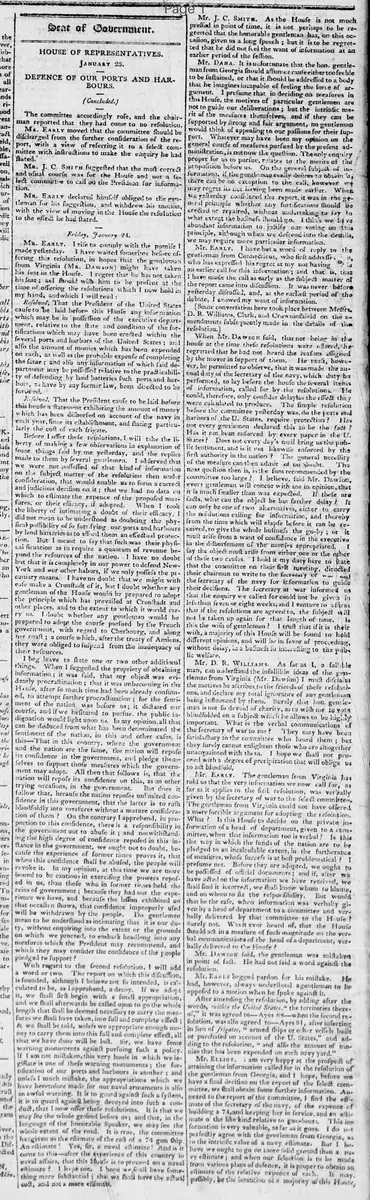
HOUSE OF REPRESENTATIVES.
January 25.
DEFENCE OF OUR PORTS AND HARBOURS.
(Concluded.)
The committee accordingly rose, and the chairman reported that they had come to no resolution.
Mr. Early moved that the committee should be discharged from the further consideration of the report, with a view of referring it to a select committee with instructions to make the enquiry he had stated.
MR. J. C. Smith suggested that the most correct and usual course was for the House and not a select committee to call on the President for information.
MR. Early declared himself obliged to the gentleman for his suggestion, and withdrew his motion, with the view of moving in the House the resolution to the effect he had stated.
Friday, January 24.
Mr. Early. I rise to comply with the promise I made yesterday. I have waited some time before offering this resolution, in hopes that the gentleman from Virginia (Mr. Dawson) might have taken his seat in the House. I regret that he has not taken his seat: as I should wish him to be present at the time of offering the resolutions which I now hold in my hand, and which I will read:
Resolved, That the President of the United States be requested to cause to be laid before this House any information which may be in possession of the executive department, relative to the state and condition of the fortifications which may have been erected within the several ports and harbors of the United States; and also the amount of monies which has been expended on each, as well as the probable expense of completing the same; and also any information of which said department may be possessed relative to the practicability of defending by land batteries such ports and harbors, as have by any former law, been directed to be fortified.
Resolved, That the President cause to be laid before this house a statement exhibiting the amount of money which has been disbursed on account of the navy in each year, since its establishment, and stating particularly the cost of each frigate.
Before I offer these resolutions, I will take the liberty of making a few observations in explanation of some things said by me yesterday, and the replies made to them by several gentlemen. I observed that we were not possessed of that kind of information on the subject matter of the resolution then under consideration, that would enable us to form a correct and judicious decision on it; that we had no data on which to estimate the expense of the proposed measures, or their efficacy, if adopted. When I took the liberty of intimating a doubt of their efficacy, I did not mean to be understood as doubting the physical possibility of so fortifying our ports and harbours by land batteries as to afford them an effectual protection. But I meant to say that such was their physical situation as to require a quantum of revenue beyond the resources of the nation. I have no doubt but that it is completely in our power to defend New-York and our other harbors, if we only possess the pecuniary means. I have no doubt that we might with ease make a Cronstadt of it, but I doubt whether any gentleman of the House would be prepared to adopt the principle which has prevailed at Cronstadt and other places, and to the extent to which it would carry us. I doubt whether any gentleman would be prepared to adopt the course pursued by the French government, with regard to Cherbourg, and along her coast; a course which, after the treaty of Amiens, they were obliged to suspend from the inadequacy of their resources.
I beg leave to state one or two other additional things. When I suggested the propriety of obtaining information; it was said, that my object was evidently procrastination; that it was unbecoming in the House, after so much time had been already consumed, to attempt further procrastination; for the sentiment of the nation was before us; it dictated our course, and if we hesitated to pursue, the public indignation would light upon us. In my opinion, all that can be deduced from what has been denominated the sentiment of the nation, in this and other cases, is this--That in this country, where the government and the nation are the same, the nation will repose its confidence in the government, and pledge themselves to support those measures which the government may adopt. All then that follows is, that the nation will repose its confidence on this, as on other trying occasions, in the government.
But does it follow that, because the nation reposes unlimited confidence in this government, that the latter is to rush blindfoldly into measures without a mature consideration of them? On the contrary I apprehend, in proportion to this confidence, there is a responsibility in the government not to abuse it; and notwithstanding the high degree of confidence reposed in this instance in the government, we ought not to doubt, because the experience of former times proves it, that when this confidence shall be abused, the people will revoke it. In my opinion, at this time we are more bound to be cautious in exercising the powers reposed in us, than those who in former times held the reins of government; because they had not the experience we have, and because the lesson exhibited on that occasion shows, that confidence improperly used will be withdrawn by the people. Do gentlemen mean to be understood as intimating that it is our duty, without enquiring into the extent or the grounds on which we proceed, to embark headlong into any measures which the President may recommend, and which they may consider the confidence of the people pledged to support?
With regard to the second resolution, I will add a word or two. The report on which this discussion, is founded, although I believe not so intended, is calculated to be, as I apprehend, a decoy. If we adopt it, we shall first begin with a small appropriation, and we shall afterwards be called upon to go the whole length that shall be deemed necessary to carry the measures we shall have taken, into full and complete effect; & we shall be told, unless we appropriate enough money to carry them into this full and complete effect, all that we have done will be lost. Sir, we have some warning monuments against pursuing such a policy. If I am not mistaken, this very house in which we legislate is one of these warning monuments; the fortification of our ports and harbours is another; and unless I much mistake, the appropriations which we have heretofore made for our naval armaments is also an awful warning. It is to guard against such a system, it is to guard against being decoyed into such a conduct, that I now offer these resolutions. It is that we may see the whole ground before us; and that, in the language of the honorable Speaker, we may see the whole extent of the road. It is true, the committee had given us the estimate of the cost of a 74 gun ship. An estimate! Yes, sir, a naval estimate! And is it come to this--after the experience of this country in naval affairs, that this House is to proceed on a naval estimate? I hope not. I hope we shall have something more substantial; that we shall have the actual cost, and not a mere estimate.
Mr. J. C. Smith. As the House is not much pressed in point of time, it is not perhaps to be regretted that the honorable gentleman has, on this occasion, given us a long speech; but it is to be regretted that he did not feel the want of information at an earlier period of the session.
Mr. Dana. It is unfortunate that the hon. gentleman from Georgia should assume a cause either too feeble to be sustained, or that it should be addressed to a body that he imagines incapable of feeling the force of argument. I presume that in deciding on measures in this House, the motives of particular gentlemen are not to guide our deliberations; but the intrinsic merit of the measures themselves, and if they can be supported by strong and fair argument, no gentleman would think of appealing to our passions for their support. Whatever may have been my opinion on the general course of measures pursued by the present administration, is not now the question. The only enquiry proper for us to pursue, relates to the merits of the proposition before us. On the general subject of information. if the gentleman really desires to obtain it, there can be no exception to the call, however we may regret its not having been made earlier. When we yesterday considered the report, it was in the general principle whether any fortifications should be erected or repaired, without undertaking to say to what extent the business should go. I think we have abundant information to justify our voting on this principle, although when we descend into the details, we may require more particular information.
Mr. Early. I have but a word of reply to the gentleman from Connecticut, who first addresses us, who has expressed his regret at my not having made an earlier call for this information; and that is, that I have made the call as early as the subject matter of the report came into discussion. It was never before yesterday discussed, and, at the earliest period of the debate, I avowed my want of information.
Some conversation here took place between Messrs. D. R. Williams, Clark, and Crowninshield on the amendments subsequently made in the details of the resolution.]
When Mr. Dawson said, that not being in the house at the time these resolutions were offered,he regretted that he had not heard the reasons assigned by the mover in support of them. He must, however, be permitted to observe, that it was made the annual duty of the secretary of the navy, which duty he has performed, to lay before the house the several items of information, called for by the resolutions.He could, therefore, only consider delay as the effect they were calculated to produce. The simple resolution before the committee yesterday was, do the ports and harbors of the U. States, require protection? Has not every gentleman declared this to be the fact? Has it not been enforced by every paper in the U. States? Does not every day's mail bring us the public sentiment, and is it not likewise enforced by the first authority in the nation? The general necessity of the measure can then admit of no doubt. The next question then is, is the sum recommended by the committee too large? I believe, said Mr. Dawson, every gentleman will concur with me in opinion, that it is much smaller than was expected. If these are facts, what can the object be but farther delay? It can only be one of two alternatives, either to carry the resolutions calling for information, and thereby from the time which will elapse before it can be received, to give the whole business the go-by; or it must arise from a want of confidence in the executive in the disbursement of the monies appropriated. I say the object must arise from either one or the other of these two causes. I hold it my duty here to state that the committee on their first meeting, directed their chairman to write to the secretary of w. and the secretary of the navy for information to guide their decisions. The secretary at war informed us that the enquiry we called for could not be given in less than seven or eight weeks, and I venture to affirm that if the resolutions are agreed to, the subject will not be taken up again for that length of time. Is this the wish of gentlemen? I trust that if it is their wish, a majority of this House will be found to hold different opinions, and will be in favor of proceeding, without delay, in a business so interesting to the public welfare.
Mr. D. R. Williams. As far as I. a fallible man, can understand the infallible ideas of the gentleman from Virginia (Mr. Dawson) I must disclaim the motives he ascribes to the friends of these resolutions, and declare my total ignorance of any gentleman being influenced by them. Surely that hon. gentleman is not so devoid of charity, as to wish me to vote blindfolded on a subject which he allows to be highly important. What is the verbal communications of the secretary of war to me? They may have been satisfactory to the committee who heard them; but they surely cannot enlighten those who are altogether unacquainted with them. I hope we shall not proceed with a degree of precipitation that will oblige us to act blindfold.
Mr. Early. The gentleman from Virginia has told us that the very information we now call for,as far as it applies to the first resolution, was verbally given by the secretary of war to the select committee. The gentleman from Virginia could not have offered a more forcible argument for adopting the resolution. What? Is this House to decide on the private information of a head of department, given to a committee, when that information too is verbal? is this the way in which the funds of the nation are to be pledged to an incalculable extent, in the furtherance of measures, whose success is at best problematical? I presume not. Before they are adopted, we ought to be possessed of official documents; and if, after we have acted on the information we have received, we shall find it incorrect, we shall know whom to blame, and on whom to fix the responsibility. But would that be the case, when information was verbally given by a head of department to a committee and verbally delivered by that committee to the House? Surely not. Was it ever heard of, that the House should act in a measure of such magnitude on the verbal communications of the head of a department, verbally delivered to the House?
Mr. Dawson said, the gentleman was mistaken in point of fact. He had not said a word against the resolution.
Mr. Early begged pardon for his mistake. He had, however, always understood a gentleman to be opposed to a motion when he spoke against it.
After amending the resolution, by adding after the words, within the United States, the territories thereof, it was agreed to--Ayes 88--when the second resolution, was also agreed to--Ayes 81, after inserting in lieu of frigates, armed ships or other vessels built or purchased on account of the U. States, and adding to the resolution, and also the amount of monies that has been expended on each navy yard.
Mr. Elliot. I am very happy at the prospect of attaining the information called for in the resolution of the gentleman from Georgia, and I hope, before we have a final decision on the report of the select committee, we shall obtain some further information. Annexed to the report of the committee, I find the estimate of the secretary of the navy, of the expense of building a 74, and keeping her in service, and an estimate of the like kind relative to gun-boats. This information is very valuable, as far as it goes. I do not perfectly agree with the gentleman from Georgia, as to the intrinsic value of a navy estimate. But I believe we ought to go on more solid ground than a navy estimate; and when our selection is to be made from various plans of defence, it is proper to obtain an estimate of the relative expense of each. It may. possibly, be the intention of a majority of this House,to vote several millions for the building of 74's--while
they are disposed to suffer our present naval armament
to remain idle. This may be the views of a majority of this House, but I am not yet convinced that it is.
There appears to me to be a chasm in the details called for, to fill which I move the following resolution:
Resolved, That the Secretary of the navy be directed to lay before this House, estimates of the expense of repairing, and of the annual expense of manning, &
of supporting in actual service the whole of the frigates and smaller vessels of war belonging to the U.
States.
This resolution was agreed to without a division.
Mr. Dawson said, that believing the information called for in the resolution just agreed to, could not be had, without the previous lapse of a long time, and
considering the state of the country, he held it his duty to move that the House should again resolve itself into a committee of the whole on the state of the
union.
This motion having prevailed--Ayes 60--Mr.
Gargo took the chair.
The chairman stated, that when the committee before rose, the resolution under consideration was for appropriating 150,000 dolls. for the better protection of
our ports and harbors.
Mr. Thomas renewed the motion to strike out this sum, in order to leave it blank.
Mr. Conrad said he was at a loss to know how to
act in this business. A few minutes ago we agreed to a call for information, and now we are required to
give a vote in the dark. It was impossible for him,
under these circumstances, to act understandingly on
the subject. He must therefore, move that the committee rise.
Mr. Smilie hoped that the committee would rise,
and that the business would be postponed for some time. He thought, from the beginning of this business they had been proceeding incorrectly; that they
should be going on in measures of protection, before
they determined on the propriety of resorting to warlike measures, appeared to him to be beginning with
the wrong end of the business. If they determined
on peaceable measures, there would be no necessity for
gun boats, or the defending our ports and harbors.
If, on the contrary, measures of war were adopted, or
such measures as would lead to war, there might be
such necessity.
I do not, said Mr. S. certainly know, but as far as
I have conversed with the members of this House,
there is not a disposition to go to war. Why, then,
pursue war measures? I hope the House will not
be of opinion, that war is necessary; and if so, what
reason is there at present for adopting warlike measures? Why go into details, whose fitness must depend on higher measures? When I say this, I assure
the gentleman, if it shall be necessary to take measures
of war, or measures leading to it, I shall be willing to
adopt effectual measures. One thing is certain.
That if we take such measures, we must go much
further than the report of the select committee. Before this great question is decided, the determination
of all subordinate matters will be useless. I therefore think it best that the committee should rise, and
that the subject now under consideration should be
laid asleep for some time.
The question being taken, the committee agreed to
rise--Ayes 52--Noes 55--
When the chairman reported, that the committee
of the whole House had had the State of the union
under consideration, and had come to no resolution
thereon.
CONGRESS,
HOUSE OF REPRESENTATIVES.
Wednesday, Jan. 29.
Mr. Jackson called for a consideration of the unfinished business of yesterday, viz. the motion of Mr. Smilie to discharge the committee of Ways and Means from the further consideration of so much of the President's message as relates to the invasion of neutral rights by some of the belligerent powers.
On taking up this business the House divided--Ayes 57--Carried.
The motion having been submitted from the chair--Mr. Dawson opposed it. He said the wish of the gentleman from Pennsylvania to bring this subject under the view of the committee of the whole on the state of the union might at any time be gratified by going into that committee and moving any resolution he might see fit, as the message generally was referred to the committee of the whole on the state of the union. He believed, however, that the floor of the House was not the proper place to make declarations of what is the law of nations. He believed that a volume of such declarations would be of no avail; it was their duty to act and not to declare on such subjects; and whenever the gentleman from Pennsylvania or any other gentleman would bring forward measures calculated to prevent an infraction of our neutral rights, they should receive his support. At present he must be against adopting the resolution.
Mr. Smilie said he did not expect any opposition to the motion he had made. If the committee of Ways and Means should be discharged from the business, it would consequently come before the committee of the whole on the state of the union without any motion, as the message was generally before that committee.
In reply to the remark that this motion would be treating the committee of Ways and Means with disrespect, Mr. Smilie said, he thought the ground on which he had placed the business would have removed every idea of the kind. He did not say the committee of Ways and Means were not as competent to the business as any other select or standing committee; but he had declared from the beginning that in his opinion, in point of principle, the reference ought to have been made to the committee of the whole. This is the ninth week of the session, and gentlemen charge us with having done nothing. Do not gentlemen see, from the deranged state of the committee of Ways and Means, that this course has become absolutely necessary? Shall a business, of the first importance that can occur during the session, be neglected on this account? Not only the eyes of all America, but likewise of all Europe are looking with anxiety on the steps which we shall take in this business. For all the maritime powers of Europe are interested in this great question relative to neutral rights. Are we, then, in consequence of the deranged situation of a select committee, to remain with our hands tied? No? For myself I do think, that the interests of our country call upon us to take immediate steps. I repeat it, that on a similar occasion with this, a similar course was pursued. Gentlemen will remember, that in the third Congress, when we before suffered from the misconduct of Great-Britain, certain resolutions which became the subject of discussion originated in a committee of the whole House. What, indeed, are we to expect from the committee of Ways and Means? Are they in possession of the general sense of the House on this subject, as a guide in making their report? This is not the case, as we have had no discussion of the subject; and until it shall be brought under a view of a committee of the whole House, it is impossible to tell in what the opinions of members will centre.
Mr. Jackson. I have but a single observation to make in addition to those which have fallen from the gentleman from Pennsylvania. So far as relates to myself, it is not my object to discuss in committee of the whole, the abstract question of the law of nations, but to adopt measures for the effectual resistance and punishment of the infraction of those laws, as far as we can. If, according to the course pointed out by my colleague, any resolution should be submitted on this subject in committee of the whole, it will be objected that the subject is before a standing committee, and it will be said to be disrespectful to act on it until they shall have reported. If my colleague, therefore, be of opinion, that we should adopt any efficient and prompt measures, the better and speedier way will be for him to join in the motion. I hope that motion will prevail. In the name of Heaven, if we are not disposed to do any thing, let us tell the people so.
Mr. Crowninshield. From the beginning I was opposed to referring this subject to the Committee of Ways and Means. I saw no reason for its going to a standing committee. Without meaning to cast any censure on the Committee of Ways and Means, I am in favor of the motion. We have been in session seven or eight weeks--the reference was made as early as the 6th of Dec. and we have yet no report. The question is perhaps as interesting a one as has been presented since the establishment of our national government. What is our situation? Our ships are plundered in every sea, our seamen are impressed, 3000 of them are in the service of one nation. We are a neutral nation, and it is not proper that any belligerent nation should employ them in this manner. Like the gentleman from Virginia, I am ready to act--I want no report to guide my decision. I am prepared--not for war-measures, but for a non-intercourse act with Great Britain. I am willing to suspend all intercourse with G. Britain until she shall give back the ships she has stolen from us, and the seamen she forcibly detains. I shall not be more ready to take this step after a report from the Committee of Ways and Means than I am now. The simple question is, whether we shall abandon trade altogether, or resist the unjust aggressions made upon it. But it was not my object in rising, to go any length into the subject; I only rose to express my opinion in favor of the course pointed out by the motion. The Committee of Ways and Means is deranged, disorganized; two members are absent, and the Chairman unfortunately is sick--We have no expectation of a report; it may not come till the end of the session.
Mr. Gregg. I rise to express a similar opinion with the gentleman just set down. I am in favor of the motion for the reasons which he has assigned, and for another reason; for the sake of consistency. Though the subject be referred to the Committee of Ways & Means, it is likewise referred to the committee of the whole on the state of the union. The memorials from the merchants of New-York & Philadelphia have taken this latter course. This brings the subject before a committee of the whole; We are under the same obligation to take up the business of our constituents as the message, and as the business is of the greatest importance. I hope the whole subject will be transferred to a committee of the whole.
The gentleman from Pennsylvania has anticipated me in an idea which I meant to have expressed. As the principal document on this subject is the message of the President. I think it proper that that should be placed with the same committee charged with the memorials of merchants from different towns. Another reason may be mentioned in favor of this course of procedure. At the commencement of the session there was a strong reason for referring the subject to a special committee. It was a principal object at that time to inquire into the extent and degree of the injuries received from belligerent nations; as since that time we have received full information on these points from the executive department, that reason is done away, and there is no necessity for any investigation by a select committee.
The motion to discharge the Committee of Ways and Means was then agreed to--Ayes 68.
On motion of Mr. Smillie, the select committee to whom was referred so much of the message of the President of the United States of the 17th inst. as relates to the impressment of our seamen, was discharged from its further consideration, and the subject referred to a committee of the whole on the state of the union without a division.
On motion of Mr. Thomas, the Committee of Ways and Means were discharged from the consideration of so much of the message of the President as relates to depredations committed on our colonial trade, and the subject referred to a committee of the whole House on the state of the union without a division.
NON-IMPORTATION WITH GREAT BRITAIN.
Mr. Gregg said, that he considered the insults offered to our government, and the injuries done to our citizens by some of the belligerent nations, to be of such a nature, as to demand the interposition of government to obtain redress. It appeared from the memorials and remonstrances of the merchants of New-York, Philadelphia, and other of our seaport towns, now on our table, as well as from executive communications, that vessels the bona fide property of citizens of the U. S. have been seized by their cruisers, and they and their cargoes condemned, contrary to our rights as a neutral nation, and to what has long been considered as the law of nations on this subject. Great numbers of our fellow citizens have been impressed, and notwithstanding our repeated remonstrances, they are cruelly retained in bondage, and compelled to act in a service, perhaps very abhorrent from their feelings, far from their country and their friends. To these insults and injuries, said Mr. G. we can no longer submit, unless we are willing to surrender that independence which has been, and I trust always will be our pride and our boast. So great are these injuries and aggressions, and so unremittingly are they persevered in, that I do not know but they might be considered as a sufficient cause, on which to ground a declaration of war. That however is not my object. I deprecate war, and will not agree to resort to it, until other means which we have in our power are tried in vain. We do, I think, possess means, which if properly used, cannot fail of accomplishing the object. To these I hope we will now resort, and for the purpose of bringing them into view, I will submit a resolution to the consideration of the House, reserving any further observations on the subject, until the resolution shall be taken up in committee of the whole on the state of the union, to which I intend moving its reference.
Mr. Gregg then offered the following resolution:
Whereas Great Britain impresses citizens of the U. S. and compels them to serve on board her ships of war, and also seizes and condemns vessels belonging to citizens of the U. S. and their cargoes being the bona fide property of American citizens, not contraband of war, and not proceeding to places besieged or blockaded, under the pretext of their being engaged in time of war in a trade with her enemies which was not allowed in time of peace:
And whereas the government of the U. S. has repeatedly remonstrated to the British government against these injuries, and demanded satisfaction therefor, but without effect:
Therefore, Resolved, That until equitable and satisfactory arrangements on these points shall be made between the two governments, it is expedient that from and after the---day of---no goods, wares, or merchandise, of the growth, product, or manufacture of G. Britain, or of any of the colonies or dependencies thereof ought to be imported into the United States.
Provided, however, that whenever arrangements deemed satisfactory by the President of the U. S. shall take place, it shall be lawful for him by proclamation to fix a day on which the prohibition aforesaid shall cease.
The House having agreed to consider this resolution:
Mr. Thomas said he had seconded the motion of the gentleman from Pennsylvania and should give it his decided support--It would however have suited him better, had it gone still further, and interdicted all commercial intercourse with that nation, until she should cease to commit depredations on our commerce, impress our citizens on the high seas into her service, and abandon the new principle which she had lately interpolated in the maritime code, and which he considered as unjust as they were unauthorized by the acknowledged law of nations.
But as unanimity in the legislature of the nation was desirable at all times, and particularly so on great national questions, he was disposed, in order to produce that result on the present occasion, to yield a part of his own opinion to meet the views of other gentlemen.
The present was an important question, and he hoped the honorable mover would consent that it should be laid on the table a day or two for consideration, and moved that it be printed.
Mr. Gregg said his wish was to refer the resolution to a committee of the whole on the state of the union, and made a motion to that effect which was agreed to without a division, and the resolution ordered to be printed.
On motion of Mr. Thompson, the House again resolved itself into a committee of the whole--Mr. J. C. Smith in the chair--on the report of a select committee in favor of authorizing the erection of a bridge over the Potomac.
Messrs. Thompson, Clark and Elmer advocated; and Messrs. Early, Sloan and Findly opposed the report: when the committee rose, without coming to a decision, and obtained leave to sit again.
A message was received from the President of the U. S. enclosing a memorial from the merchants of Baltimore, on the depredations committed on the commerce of the U. S. which was referred to a committee of the whole on the state of the union.
The Speaker laid before the House a letter from the treasurer of the U. S. rendering a general statement of the civil accounts, as well as those of the navy and war departments from October 1, 1804, to October 1, 1805.
Thursday, Jan. 30.
Mr. J. Randolph said it would be recollected that so much of the message of the President of the U. S. as relates to the invasion of neutral rights by belligerent powers, had been referred to the committee of Ways and Means. It would also be recollected that another message on the same subject, or on one connected with it, had been referred to the same committee of Ways and Means. I understand, said Mr. R. (for my indisposition has not permitted me for some days past to attend to the duties of my seat) that a motion has prevailed to discharge the committee of Ways and Means from the consideration of that subject. Inasmuch as this discharge may have been effected under an impression that the committee have been delinquent in executing the duty devolved upon them. I feel it my duty, before I surrender the papers connected with this subject, to give some account of the proceedings of the committee. On the 11th of Dec. the committee instructed their chairman to write a letter to the secretary of state, which I will read. Mr. R. here read the letter as follows:
COMMITTEE ROOM Dec. 11, 1806.
SIR,
The Committee of Ways and Means have instructed me to request you will cause to be laid before them such information, on the subject of the enclosed resolution, as the department of state can furnish.
The peculiar objects of our research are--
1. What new principles, or constructions, of the law of nations have been adopted by the belligerent powers of Europe, to the prejudice of neutral rights?
2. The governments asserting those principles and constructions?
3. The extent to which the commerce of the U. S. has been thereby injured?
I am, with very great respect,
Sir,
Yours,
JOHN RANDOLPH.
The Secretary of State.
On Saturday night the 28th inst. the Committee of Ways and Means received an answer to this letter, which I will deliver to the clerk, in order that it may go to the new committee, to which this business has been referred. It is unnecessary for me to add any thing more. The House must be sensible that while the Committee of Ways and Means were in the dark they could not proceed in the discharge of the duties assigned them, and that after receiving information from the secretary of state so late in the day, it was impossible for them to have made a report by this day; and if I am not mistaken, the motion to discharge the Committee of Ways and Means was made before the answer of the secretary of state was received.
The Clerk accordingly read the letter of the Secretary of State, as follows:
ANSWER.
The Secretary of State presents his respects to Mr. Randolph, and has the honour to transmit him a copy of a report this day made to the President of the United States, respecting interpolations by foreign powers, of new and injurious principles, in the law of nations. This report, with the communications made by the President to Congress, particularly that of the 17th inst. will, it is hoped, afford the information requested, for the Committee of Ways and Means, by Mr. Randolph's letter of the 11th inst.
Department of State,
Jan. 25, 1806.
When on motion of Mr. J. Randolph, the papers laid by him on the table, were referred to a committee of the whole on the state of the union.
The Speaker laid before the House the following letter from the secretary of the navy addressed to the House:
SIR,
In obedience to the resolution of the House of Representatives of the 27th inst. directing the Secretary of the Navy "to lay before the House a report on the condition of the frigates, and other public armed vessels, belonging to the U. S, distinguishing such as require repair, and the sum necessary for repairing each; and distinguishing also such as it may be the interest of the U. S. to dispose of rather than repair," I have the honour to state,
That the frigate Constitution is now in a state of thorough repair, and in all respects prepared for service.
That the frigate Chesapeake has lately been repaired and is fit for service.
That the frigates Adams, Essex, and John Adams are also fit for service.
That the brigs Siren, Hornet, Argus, and Vixen, the schooners Nautilus and Enterprize, the bombs Spitfire and Vengeance, and all the gun-boats are fit for service.
That the frigates President, United States, Congress, Constellation, New-York, and Boston, require to be repaired; but it is utterly impossible to form an accurate estimate of the "sum necessary for repairing each."
I know of no vessel belonging to the navy, which I consider it would be "the interest of the United States to dispose of, rather than repair."
On the motion of Mr. J. Randolph, the 1st and 3d sections of the bill to repeal so much of an act as authorizes the evidences of the public debt to be received in payment for public lands, and for other purposes, was referred to a committee of the whole House.
The discussion which ensued on the details of this bill occupied nearly the whole of the residue of the day, of which we shall hereafter take a more particular notice.
The committee having reported the bill, with sundry amendments, it was ordered to a third reading to-morrow.
Mr. Stanford reported a bill for altering the time for holding the circuit court for the district of North-Carolina, which was referred to a committee of the whole to-morrow.
Mr. Crowninshield presented an energetic & comprehensive memorial from the merchants of Salem. (Mass.) representing the embarrassed situation of trade; their deep anxiety at the impressment of American seamen; the severe injuries received from the recent principles assumed by Great-Britain, and pledging their lives and property in support of such measures as may be taken by the government to defend and protect their rights.
Referred to a committee of the whole on the state of the union.
What sub-type of article is it?
What themes does it cover?
What keywords are associated?
What entities or persons were involved?
Where did it happen?
Story Details
Key Persons
Location
House Of Representatives
Event Date
January 1806
Story Details
Debates on resolutions requesting executive information on port fortifications, naval costs, and conditions; discharge of committees on neutral rights violations, impressment, and depredations; proposal of non-importation resolution against Great Britain for redress of grievances; reports from executive departments.