Thank you for visiting SNEWPapers!
Sign up free
Editorial
September 14, 1840
Alexandria Gazette
Alexandria, Alexandria County, District Of Columbia
What is this article about?
An anonymous editorial (signed 'Z.') sharply criticizes Virginia Court of Appeals President Henry St. George Tucker for engaging in partisan Democratic politics, arguing it undermines judicial impartiality and public confidence in the courts. It quotes and dissects Tucker's 1840 letter supporting Van Buren Democrats and contrasts his views with those of esteemed Republican judges like Brooke, Cabell, and Stanard, now Whigs.
Clipping
OCR Quality
95%
Excellent
Full Text
TO HENRY ST. GEORGE TUCKER,
President of the Court of Appeals, of Va.
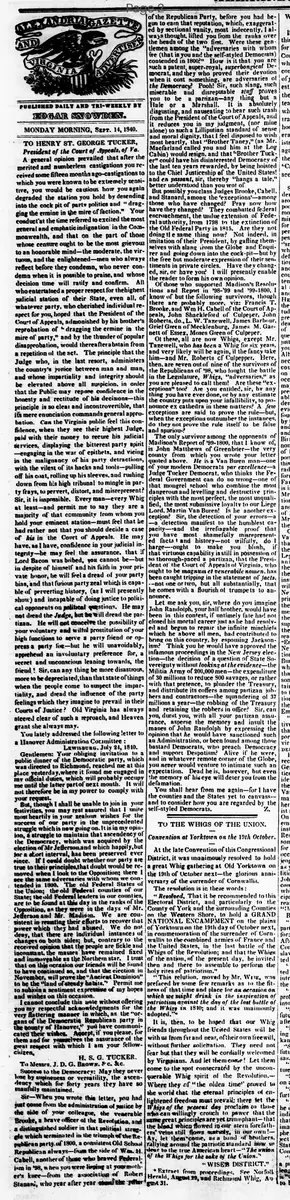
A general opinion prevailed that after the merited and numberless castigations you received some fifteen months ago—castigations to which you were known to be extremely sensitive, you would be cautious how you again degraded the station you hold by descending into the cock-pit of party politics and "dragging the ermine in the mire of faction." Your conduct at the time referred to excited the most general and emphatic indignation in the Commonwealth, and that on the part of those whose censure ought to be the most grievous to an honorable mind—the moderate, the virtuous, and the enlightened—men who always reflect before they condemn, who never condemn when it is possible to praise, and whose decisions time will ratify and confirm. All who entertained a proper respect for the highest judicial station of their State, even all, of whatever party, who cherished individual respect for you, hoped that the President of the Court of Appeals, admonished by his brother's reprobation of "dragging the ermine in the mire of party," and by the thunder of popular disapprobation, would thereafter abstain from a repetition of the act. The principle that the Judge who, in the last resort, administers the country's justice between man and man, and whose impartiality and integrity should be elevated above all suspicion, in order that the public may repose confidence in the honesty and rectitude of his decisions—this principle is so clear and incontrovertible, that its mere enunciation commands general approbation. Can the Virginia public feel this confidence, when they see their highest Judge, paid with their money to secure his judicial services, displaying the bitterest party spirit—engaging in the war of epithets, and vying in the malignancy of his party detractions, with the vilest of its hacks and tools—pulling off his coat, rolling up his sleeves, and rushing down from his high tribunal to mingle in party frays, to pervert, distort, and misrepresent? Sir, it is impossible. Every man—every Whig at least—and permit me to say they are a majority of that community from whom you hold your eminent station—must feel that he had rather not that you should decide a case of his in the Court of Appeals. He may have, as I have, confidence in your judicial integrity—he may feel the assurance that if Lord Bacon was bribed, you cannot be—but in despite of himself and his faith in your private honor, he will feel a dread of your party bias, and that furious party zeal which is capable of perverting history, (as I will presently show) and incapable of doing justice to political opponents on political questions. He may not dread the Judge, but he will dread the partisan. He will not conceive the possibility of your voluntary and wilful prostitution of your high functions to serve a party friend or oppress a party foe—but he will unavoidably apprehend an involuntary preference or, a secret and unconscious leaning towards, the friend! Sir, can any thing be more disastrous, more to be deprecated, than that state of things when the people come to suspect the impartiality, and dread the influence of the party feelings which they imagine to prevail in their Courts of Justice? Old Virginia has always steered clear of such a reproach, and Heaven grant she always may.
You lately addressed the following letter to a Hanover Administration Committee:
LEWISBURG, July 24, 1840.
Gentlemen: Your obliging invitation to a public dinner of the Democratic party, which was directed to Richmond, reached me at this place yesterday, where it found me engaged in my official duties, which will probably occupy me until the latter part of next month. It will not therefore be in my power to comply with your request.
But, though I shall be unable to join in your festivities, you may rest assured that I unite most heartily in your zealous wishes for the success of our party in the unprecedented struggle which is now going on. It is in my opinion, a struggle to maintain that ascendency of the Democracy, which was acquired by the election of Mr. Jefferson, and which happily, but for a short interval, has been preserved ever since. If I could doubt whether our party are true to their principles, that doubt would be removed when I look to the Opposition; there I see the same adversaries with whom we contended in 1800. The old Federal States of the Union; the old Federal counties of our State; the old Federal leaders in our counties, are to be found at this day in the ranks of the Opposition, as they were in the days of Mr. Jefferson and Mr. Madison. We are consistent in resisting their efforts to recover that power which they had abused. We do not deny, that there are individual instances of changes on both sides; but, contrary to the received opinion that the people are fickle and inconstant, the masses have remained fixed and immoveable as the Northern star. I trust that on this occasion our friends will be found to have continued so, and that the election in November, will prove the "Ancient Dominion" to be the "land of steady habits." Permit me to subjoin a sentiment expressive of my hopes and wishes on this occasion.
I cannot conclude this note without offering you my respectful acknowledgments for the very flattering manner in which, as the "organs of the Democratic Republican party in the county of Hanover," you have communicated their wishes. Accept, if you please, for them and for yourselves the assurance of the great respect with which I am your fellow-citizen,
H. S. G. TUCKER.
To Messrs. J. D. G. Brown, &c. &c.
Success to the Democracy: May they never lose by supineness or versatility, the ascendency which for forty years they have so manfully maintained.
Sir—When you wrote this letter, you had just come from the administration of justice by the side of your colleague, the venerable Brooke, a brave officer of the Revolution, and a distinguished soldier in that political struggle which terminated in the triumph of the Republican party of 1800, a consistent Old School Republican always—from the side of Wm. H. Cabell, another of those who braved Federalism in '98, when you were lisping at your mother's knee—from the association of Robert Stanard, who year after year shot the polar star of the Republican Party, before you had begun to earn that reputation, which, exaggerated by sectional vanity, most indecently, I always thought, lifted you from the ranks over the heads of the two first. Were these gentlemen among the "adversaries with whom we (that is you and the self-styled Democrats) contended in 1800?" How is it that you are such a patent, super-royal, superbongical Democrat, and they who proved their devotion when it cost something, are adversaries of the Democracy? Pooh! Sir, such slang, such miserable and disreputable stuff proves you to be a partisan—any thing but a Hale or a Marshall. It is absolutely disgusting, and nauseating to hear such trash from the President of the Court of Appeals, and it reduces you in my judgment, (nor mine alone) to such a Lilliputian standard of sense and moral dignity, that I feel disposed to wish most heartily, that "Brother Taney," (as Mr. Macfarland called you and him at the Log Cabin) would resign, and that "Brother Tucker" could have his disinterested Democracy of the last ten years rewarded, by being hoisted to the Chief Justiceship of the United States! and en passant, sir, thereby "hangs a tale," better understood than you wot of.
But possibly you class Judges Brooke, Cabell, and Stanard, among the 'exceptions'—among those who have changed? Pray now how have they changed? They combatted federal encroachment, the undue extension of Federal authority, from 1798 to the extinction of the Old Federal Party in 1815. Are they not doing the same thing now? Not indeed, in imitation of their President, by grafting themselves with slang from the Globe and Enquirer and going down into the cock-pit—but by the free but moderate expression of their sentiments in private circles. Have they changed, sir, or have you? I will presently enable the reader to form his own opinion.
Of those who supported Madison's Resolutions and Report in '98-'99 and '99-1800, I know of but the following survivors, though there are probably more, viz: Francis T. Brooke, and Wm. H. Cabell of the Court of Appeals, John Shackleford of Culpeper, John Roberts, do., L. W. Tazewell, James Barbour, Greil Green of Mecklenburg, James M. Garnett of Essex, Moses Green of Culpeper.
Of these, all are now Whigs, except Mr. Tazewell, who has been a Whig for six years, and very likely will be again, if the fancy take him—and Mr. Roberts of Culpepper. Here, then, are seven out of nine of the survivors of the Republicans of '98, who fought the battle in the Legislature, Whigs, "adversaries," as you are pleased to call them! Are these "exceptions" too? Are you entitled, sir, by any thing you have ever done, or by any estimate the country puts upon your infallibility, to pronounce ex cathedra in these matters? A few exceptions are said to prove the rule—but, when the exceptions outnumber the instances, do they not prove the rule itself to be false and spurious?
The only survivor among the opponents of Madison's Report of '99-1800, that I know of, is John Matthews of Greenbrier—the very county from which you wrote your letter quoted above. He is a Van Buren man—one of your modern Democrats par excellence—a Judge Tucker Democrat, who thinks the Federal Government can do no wrong—one of that mongrel school who combine the most dangerous and levelling and destructive principles with the most perfect, the most unqualified, the most submissive loyalty to our Liege Lord, Martin Van Buren! Is he another exception? Sir, the detection of your errors—a detection manifest to the humblest capacity—and the irrefutable proof that you have most shamefully misrepresented facts and history—not wilfully, do I charge—ought to make you blush, if that virtuous capability is still in possession of so thorough-paced a partisan, that the President of the Court of Appeals of Virginia, who ought to be magnum et venerabile nomen, has been caught tripping in the statement of facts,—not one or two, but all substantially, that he comes with a flourish of trumpets to announce.
Let me ask you, sir, where do you imagine John Randolph, your half brother, would have been in this contest, if untimely fate had not closed his mortal career just as he had resolved and begun to repair the infinite mischiefs which he above all men, had contributed to bring on this country, by espousing Jacksonism? Think you he would have approved the infamous proceedings in the New Jersey election—the decision of a question of State Sovereignty without looking at the evidence—the Militia Army of 200,000 men—the expenditure of 30 millions to reduce 500 savages, or rather with that pretence, to plunder the Treasury, and distribute its coffers among partisan jobbers and contractors—the squandering of 37 millions a year—the robbing of the Treasury and retaining the robbers in office? Sir, can you, durst you, with all your partisan assurance, asperse the memory and insult the manes of John Randolph by expressing the opinion that he would have sanctioned such an Administration, or been found among those bastard Democrats, who preach Democracy and support Despotism? Alive if he were, and in whatever remote corner of the Globe you never would venture to intimate such an expectation. Dead he is, however, but even the memory of his eye will deter you from the defamation.
You shall hear from me again—or I have the counties and the States yet to canvass—and to consider how you are regarded by the self-styled Democrats.
Z.
President of the Court of Appeals, of Va.
A general opinion prevailed that after the merited and numberless castigations you received some fifteen months ago—castigations to which you were known to be extremely sensitive, you would be cautious how you again degraded the station you hold by descending into the cock-pit of party politics and "dragging the ermine in the mire of faction." Your conduct at the time referred to excited the most general and emphatic indignation in the Commonwealth, and that on the part of those whose censure ought to be the most grievous to an honorable mind—the moderate, the virtuous, and the enlightened—men who always reflect before they condemn, who never condemn when it is possible to praise, and whose decisions time will ratify and confirm. All who entertained a proper respect for the highest judicial station of their State, even all, of whatever party, who cherished individual respect for you, hoped that the President of the Court of Appeals, admonished by his brother's reprobation of "dragging the ermine in the mire of party," and by the thunder of popular disapprobation, would thereafter abstain from a repetition of the act. The principle that the Judge who, in the last resort, administers the country's justice between man and man, and whose impartiality and integrity should be elevated above all suspicion, in order that the public may repose confidence in the honesty and rectitude of his decisions—this principle is so clear and incontrovertible, that its mere enunciation commands general approbation. Can the Virginia public feel this confidence, when they see their highest Judge, paid with their money to secure his judicial services, displaying the bitterest party spirit—engaging in the war of epithets, and vying in the malignancy of his party detractions, with the vilest of its hacks and tools—pulling off his coat, rolling up his sleeves, and rushing down from his high tribunal to mingle in party frays, to pervert, distort, and misrepresent? Sir, it is impossible. Every man—every Whig at least—and permit me to say they are a majority of that community from whom you hold your eminent station—must feel that he had rather not that you should decide a case of his in the Court of Appeals. He may have, as I have, confidence in your judicial integrity—he may feel the assurance that if Lord Bacon was bribed, you cannot be—but in despite of himself and his faith in your private honor, he will feel a dread of your party bias, and that furious party zeal which is capable of perverting history, (as I will presently show) and incapable of doing justice to political opponents on political questions. He may not dread the Judge, but he will dread the partisan. He will not conceive the possibility of your voluntary and wilful prostitution of your high functions to serve a party friend or oppress a party foe—but he will unavoidably apprehend an involuntary preference or, a secret and unconscious leaning towards, the friend! Sir, can any thing be more disastrous, more to be deprecated, than that state of things when the people come to suspect the impartiality, and dread the influence of the party feelings which they imagine to prevail in their Courts of Justice? Old Virginia has always steered clear of such a reproach, and Heaven grant she always may.
You lately addressed the following letter to a Hanover Administration Committee:
LEWISBURG, July 24, 1840.
Gentlemen: Your obliging invitation to a public dinner of the Democratic party, which was directed to Richmond, reached me at this place yesterday, where it found me engaged in my official duties, which will probably occupy me until the latter part of next month. It will not therefore be in my power to comply with your request.
But, though I shall be unable to join in your festivities, you may rest assured that I unite most heartily in your zealous wishes for the success of our party in the unprecedented struggle which is now going on. It is in my opinion, a struggle to maintain that ascendency of the Democracy, which was acquired by the election of Mr. Jefferson, and which happily, but for a short interval, has been preserved ever since. If I could doubt whether our party are true to their principles, that doubt would be removed when I look to the Opposition; there I see the same adversaries with whom we contended in 1800. The old Federal States of the Union; the old Federal counties of our State; the old Federal leaders in our counties, are to be found at this day in the ranks of the Opposition, as they were in the days of Mr. Jefferson and Mr. Madison. We are consistent in resisting their efforts to recover that power which they had abused. We do not deny, that there are individual instances of changes on both sides; but, contrary to the received opinion that the people are fickle and inconstant, the masses have remained fixed and immoveable as the Northern star. I trust that on this occasion our friends will be found to have continued so, and that the election in November, will prove the "Ancient Dominion" to be the "land of steady habits." Permit me to subjoin a sentiment expressive of my hopes and wishes on this occasion.
I cannot conclude this note without offering you my respectful acknowledgments for the very flattering manner in which, as the "organs of the Democratic Republican party in the county of Hanover," you have communicated their wishes. Accept, if you please, for them and for yourselves the assurance of the great respect with which I am your fellow-citizen,
H. S. G. TUCKER.
To Messrs. J. D. G. Brown, &c. &c.
Success to the Democracy: May they never lose by supineness or versatility, the ascendency which for forty years they have so manfully maintained.
Sir—When you wrote this letter, you had just come from the administration of justice by the side of your colleague, the venerable Brooke, a brave officer of the Revolution, and a distinguished soldier in that political struggle which terminated in the triumph of the Republican party of 1800, a consistent Old School Republican always—from the side of Wm. H. Cabell, another of those who braved Federalism in '98, when you were lisping at your mother's knee—from the association of Robert Stanard, who year after year shot the polar star of the Republican Party, before you had begun to earn that reputation, which, exaggerated by sectional vanity, most indecently, I always thought, lifted you from the ranks over the heads of the two first. Were these gentlemen among the "adversaries with whom we (that is you and the self-styled Democrats) contended in 1800?" How is it that you are such a patent, super-royal, superbongical Democrat, and they who proved their devotion when it cost something, are adversaries of the Democracy? Pooh! Sir, such slang, such miserable and disreputable stuff proves you to be a partisan—any thing but a Hale or a Marshall. It is absolutely disgusting, and nauseating to hear such trash from the President of the Court of Appeals, and it reduces you in my judgment, (nor mine alone) to such a Lilliputian standard of sense and moral dignity, that I feel disposed to wish most heartily, that "Brother Taney," (as Mr. Macfarland called you and him at the Log Cabin) would resign, and that "Brother Tucker" could have his disinterested Democracy of the last ten years rewarded, by being hoisted to the Chief Justiceship of the United States! and en passant, sir, thereby "hangs a tale," better understood than you wot of.
But possibly you class Judges Brooke, Cabell, and Stanard, among the 'exceptions'—among those who have changed? Pray now how have they changed? They combatted federal encroachment, the undue extension of Federal authority, from 1798 to the extinction of the Old Federal Party in 1815. Are they not doing the same thing now? Not indeed, in imitation of their President, by grafting themselves with slang from the Globe and Enquirer and going down into the cock-pit—but by the free but moderate expression of their sentiments in private circles. Have they changed, sir, or have you? I will presently enable the reader to form his own opinion.
Of those who supported Madison's Resolutions and Report in '98-'99 and '99-1800, I know of but the following survivors, though there are probably more, viz: Francis T. Brooke, and Wm. H. Cabell of the Court of Appeals, John Shackleford of Culpeper, John Roberts, do., L. W. Tazewell, James Barbour, Greil Green of Mecklenburg, James M. Garnett of Essex, Moses Green of Culpeper.
Of these, all are now Whigs, except Mr. Tazewell, who has been a Whig for six years, and very likely will be again, if the fancy take him—and Mr. Roberts of Culpepper. Here, then, are seven out of nine of the survivors of the Republicans of '98, who fought the battle in the Legislature, Whigs, "adversaries," as you are pleased to call them! Are these "exceptions" too? Are you entitled, sir, by any thing you have ever done, or by any estimate the country puts upon your infallibility, to pronounce ex cathedra in these matters? A few exceptions are said to prove the rule—but, when the exceptions outnumber the instances, do they not prove the rule itself to be false and spurious?
The only survivor among the opponents of Madison's Report of '99-1800, that I know of, is John Matthews of Greenbrier—the very county from which you wrote your letter quoted above. He is a Van Buren man—one of your modern Democrats par excellence—a Judge Tucker Democrat, who thinks the Federal Government can do no wrong—one of that mongrel school who combine the most dangerous and levelling and destructive principles with the most perfect, the most unqualified, the most submissive loyalty to our Liege Lord, Martin Van Buren! Is he another exception? Sir, the detection of your errors—a detection manifest to the humblest capacity—and the irrefutable proof that you have most shamefully misrepresented facts and history—not wilfully, do I charge—ought to make you blush, if that virtuous capability is still in possession of so thorough-paced a partisan, that the President of the Court of Appeals of Virginia, who ought to be magnum et venerabile nomen, has been caught tripping in the statement of facts,—not one or two, but all substantially, that he comes with a flourish of trumpets to announce.
Let me ask you, sir, where do you imagine John Randolph, your half brother, would have been in this contest, if untimely fate had not closed his mortal career just as he had resolved and begun to repair the infinite mischiefs which he above all men, had contributed to bring on this country, by espousing Jacksonism? Think you he would have approved the infamous proceedings in the New Jersey election—the decision of a question of State Sovereignty without looking at the evidence—the Militia Army of 200,000 men—the expenditure of 30 millions to reduce 500 savages, or rather with that pretence, to plunder the Treasury, and distribute its coffers among partisan jobbers and contractors—the squandering of 37 millions a year—the robbing of the Treasury and retaining the robbers in office? Sir, can you, durst you, with all your partisan assurance, asperse the memory and insult the manes of John Randolph by expressing the opinion that he would have sanctioned such an Administration, or been found among those bastard Democrats, who preach Democracy and support Despotism? Alive if he were, and in whatever remote corner of the Globe you never would venture to intimate such an expectation. Dead he is, however, but even the memory of his eye will deter you from the defamation.
You shall hear from me again—or I have the counties and the States yet to canvass—and to consider how you are regarded by the self-styled Democrats.
Z.
What sub-type of article is it?
Partisan Politics
Constitutional
Moral Or Religious
What keywords are associated?
Judicial Impartiality
Party Politics
Virginia Court Of Appeals
Democratic Partisanship
Whig Opposition
Henry Tucker
Republican Survivors
Van Buren Administration
What entities or persons were involved?
Henry St. George Tucker
Francis T. Brooke
Wm. H. Cabell
Robert Stanard
John Randolph
L. W. Tazewell
Martin Van Buren
James Madison
Thomas Jefferson
Editorial Details
Primary Topic
Criticism Of Judicial Partisanship Undermining Impartiality
Stance / Tone
Strongly Critical Of Partisan Involvement By Judges
Key Figures
Henry St. George Tucker
Francis T. Brooke
Wm. H. Cabell
Robert Stanard
John Randolph
L. W. Tazewell
Martin Van Buren
James Madison
Thomas Jefferson
Key Arguments
Judges Must Maintain Impartiality Above Party Politics To Ensure Public Confidence In Justice.
Tucker's Partisan Letter To Democrats Degrades His Judicial Office And Echoes Past Condemnations.
Esteemed Republican Judges Like Brooke, Cabell, And Stanard Are Now Whigs, Contradicting Tucker's Claim Of Unchanging Party Lines.
Survivors Of 1798 Republicans Mostly Became Whigs, Disproving Democratic Continuity From Jefferson's Era.
Tucker's History Misrepresentations And Partisan Zeal Pervert Facts And History.
John Randolph Would Oppose Van Buren Administration's Abuses If Alive.
Public Dread Of Party Bias In Courts Is Disastrous For Virginia's Justice System.