Thank you for visiting SNEWPapers!
Sign up free
Minneapolis Spokesman
Minneapolis, Hennepin County, Minnesota
What is this article about?
In a 1954 interview, NAACP executive secretary Walter White discusses the Supreme Court's school desegregation decision, predicting implementation by fall 1955, Southern resistance tactics, enforcement through legal action, benefits for education, and broader impacts on housing and politics.
Clipping
OCR Quality
Full Text
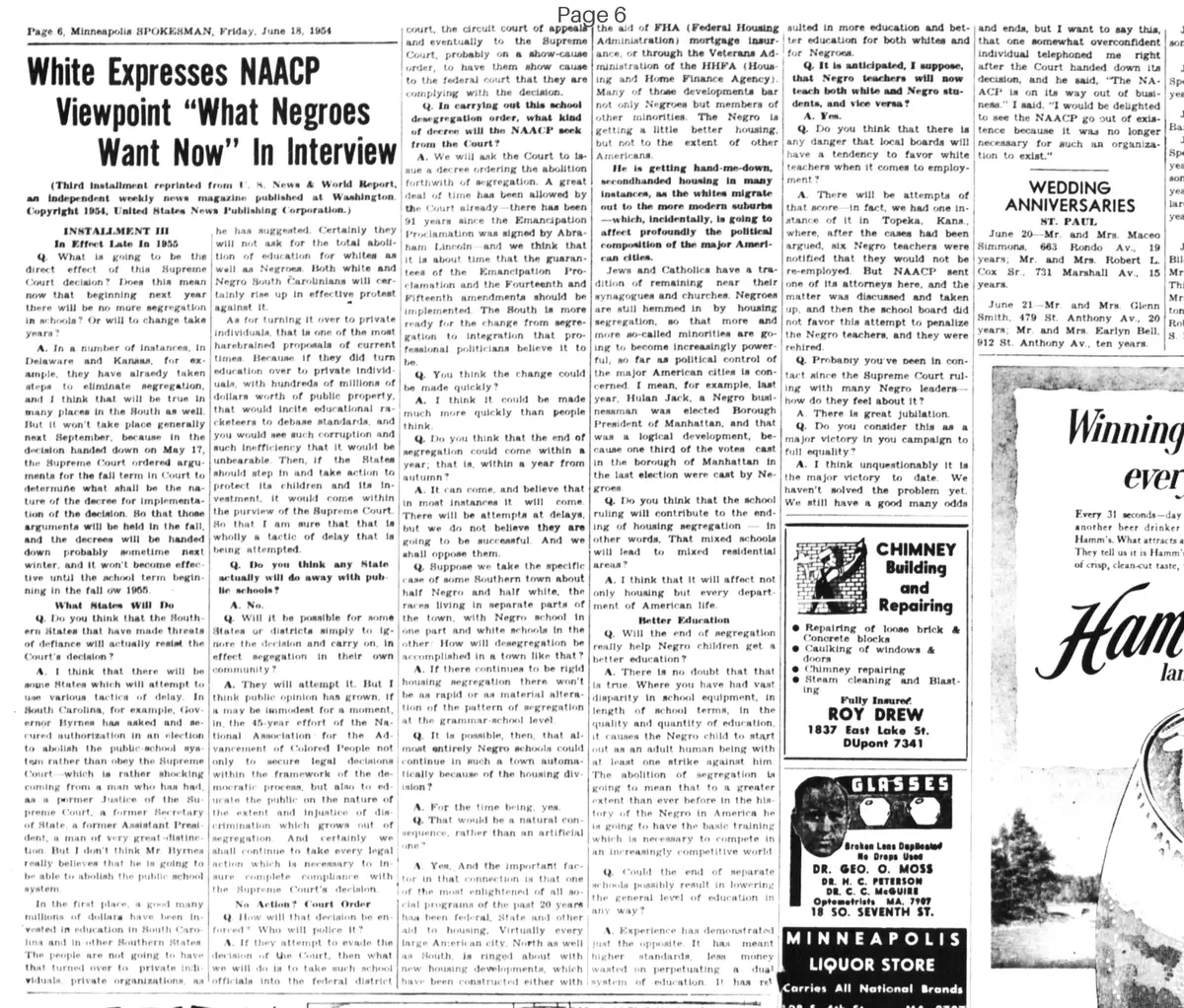
White Expresses NAACP Viewpoint "What Negroes Want Now" In Interview
(Third Installment reprinted from U. S. News & World Report an independent weekly news magazine published at Washington
Copyright 1954, United States News Publishing Corporation.)
Q. What is going to be the direct effect of this Supreme Court decision? Does this mean now that beginning next year there will be no more segregation in schools? Or will to change take years?
A. In a number of instances, in Delaware and Kansas, for example, they have already taken steps to eliminate segregation, and I think that will be true in many places in the South as well. But it won't take place generally next September, because in the decision handed down on May 17 the Supreme Court ordered arguments for the fall term in Court to determine what shall be the nature of the decree for implementation of the decision. So that those arguments will be held in the fall, and the decree will be handed down probably sometime next winter, and it won't become effective until the school term beginning in the fall of 1955.
What States Will Do
Q. Do you think that the Southern States that have made threats of defiance will actually resist the Court's decision?
A. I think that there will be some States which will attempt to use various tactics of delay. In South Carolina, for example, Governor Byrnes has asked and secured authorization in an election to abolish the public-school system rather than obey the Supreme Court—which is rather shocking coming from a man who has had as a former Justice of the Supreme Court, a former Secretary of State, a former Assistant President, a man of very great distinction. But I don't think Mr. Byrnes really believes that he is going to be able to abolish the public school system.
In the first place, a good many millions of dollars have been invested in education in South Carolina and in other Southern States. The people are not going to have that turned over to private individuals, private organizations, as he has suggested. Certainly they will not ask for the total abolition of education for whites as well as Negroes. Both white and Negro South Carolinians will certainly rise up in effective protest against it.
And for turning it over to private individuals, that is one of the most harebrained proposals of current times. Because if they did turn education over to private individuals, with hundreds of millions of dollars worth of public property, that would invite educational racketeers to debase standards, and you would see such corruption and such inefficiency that it would be unbearable. Then, if the States should step in and take action to protect its children and its investment, it would come within the purview of the Supreme Court. So that I am sure that that is wholly a tactic of delay that is being attempted.
Q. Do you think any State actually will do away with public schools?
A. No.
Q. Will it be possible for some States or districts simply to ignore the decision and carry on, in effect segregation in their own community?
A. They will attempt it. But I think public opinion has grown. If I may be immodest for a moment, in the 45-year effort of the National Association for the Advancement of Colored People not only to secure legal decisions within the framework of the democratic process, but also to educate the public on the nature of the extent and influence of discrimination which grows out of segregation. And certainly we shall continue to take every legal action which is necessary to insure complete compliance with the Supreme Court's decision.
No Action? Court Order
Q. How will that decision be enforced? Who will police it?
A. If they attempt to evade the decision of the Court, then what we will do is to take such school officials into the federal district court, the circuit court of appeals and eventually to the Supreme Court, probably on a show-cause order, to have them show cause to the federal court that they are complying with the decision.
Q. In carrying out this school desegregation order, what kind of decree will the NAACP seek from the Court?
A. We will ask the Court to issue a decree ordering the abolition forthwith of segregation. A great deal of time has been allowed by the Court already—there has been 91 years since the Emancipation Proclamation was signed by Abraham Lincoln and we think that it is about time that the guarantees of the Emancipation Proclamation and the Fourteenth and Fifteenth amendments should be implemented. The South is more ready for the change from segregation to integration that professional politicians believe it to be.
Q. You think the change could be made quickly?
A. I think it could be made much more quickly than people think.
Q. Do you think that the end of segregation could come within a year, that is, within a year from autumn?
A. It can come, and believe that in most instances it will come. There will be attempts at delays, but we do not believe they are going to be successful. And we shall oppose them.
Q. Suppose we take the specific case of some Southern town about half Negro and half white, the races living in separate parts of the town, with Negro school in one part and white schools in the other: How will desegregation be accomplished in a town like that?
A. If there continues to be rigid housing segregation there won't be as rapid or as material alteration of the pattern of segregation at the grammar-school level.
Q. It is possible, then, that almost entirely Negro schools could continue in such a town automatically because of the housing situation?
A. For the time being, yes.
Q. That would be a natural consequence, rather than an artificial one?
A. Yes. And the important factor in that connection is that one of the most enlightened of all social programs of the past 20 years has been federal, state and other aid to housing. Virtually every large American city, North as well as South, is ringed about with new housing developments, which have been constructed either with the aid of FHA (Federal Housing Administration) mortgage insurance, or through the Veterans Administration of the HHFA (Housing and Home Finance Agency). Many of those developments bar not only Negroes but members of other minorities. The Negro is getting a little better housing, but not to the extent of other Americans.
He is getting hand-me-down, secondhanded housing in many instances, as the whites migrate out to the more modern suburbs—which, incidentally, is going to affect profoundly the political composition of the major American cities.
Jews and Catholics have a tradition of remaining near their synagogues and churches. Negroes are still hemmed in by housing segregation, so that more and more so-called minorities are going to become increasingly powerful, so far as political control of the major American cities is concerned. I mean, for example, last year, Hulan Jack, a Negro businessman was elected Borough President of Manhattan, and that was a logical development, because one third of the votes cast in the borough of Manhattan in the last election were cast by Negroes.
Q. Do you think that the school ruling will contribute to the ending of housing segregation—in other words, that mixed schools will lead to mixed residential areas?
A. I think that it will affect not only housing but every department of American life.
Better Education
Q. Will the end of segregation really help Negro children get a better education?
A. There is no doubt that that is true. Where you have had vast disparity in school equipment, in length of school terms, in the quality and quantity of education, it causes the Negro child to start out as an adult human being with at least one strike against him. The abolition of segregation is going to mean that to a greater extent than ever before in the history of the Negro in America he is going to have the basic training which is necessary to compete in an increasingly competitive world.
Q. Could the end of separate schools possibly result in lowering the general level of education in any way?
A. Experience has demonstrated just the opposite. It has meant higher standards, less money wasted on perpetuating a dual system of education. It has resulted in more education and better education for both whites and for Negroes.
Q. It is anticipated, I suppose, that Negro teachers will now teach both white and Negro students, and vice versa?
A. Yes.
Q. Do you think that there is any danger that local boards will have a tendency to favor white teachers when it comes to employment?
A. There will be attempts of that score. In fact, we had one instance of it in Topeka, Kans., where, after the cases had been argued, six Negro teachers were notified that they would not be re-employed. But NAACP sent one of its attorneys here, and the matter was discussed and taken up, and then the school board did not favor this attempt to penalize the Negro teachers, and they were rehired.
Q. Probably you've been in contact since the Supreme Court ruling with many Negro leaders. How do they feel about it?
A. There is great jubilation.
Q. Do you consider this as a major victory in your campaign to full equality?
A. I think unquestionably it is the major victory to date. We haven't solved the problem yet. We still have a good many odds and ends, but I want to say this, that one somewhat overconfident individual telephoned me right after the Court handed down its decision, and he said, "The NAACP is on its way out of business." I said, "I would be delighted to see the NAACP go out of existence because it was no longer necessary for such an organization to exist."
What sub-type of article is it?
What themes does it cover?
What keywords are associated?
What entities or persons were involved?
Where did it happen?
Story Details
Key Persons
Location
United States, Southern States, South Carolina
Event Date
1954 05 17
Story Details
Walter White, NAACP executive secretary, outlines the expected implementation of the Supreme Court's school desegregation decision by fall 1955, discusses Southern resistance tactics like delaying or abolishing public schools, enforcement via legal actions, impacts on housing and politics, educational benefits, and views it as a major victory toward equality.