Thank you for visiting SNEWPapers!
Sign up free
Editorial
October 28, 1801
The National Intelligencer And Washington Advertiser
Washington, District Of Columbia
What is this article about?
This editorial defends the editor of the National Intelligencer against a grand jury's libel presentment for publishing a piece critical of the judiciary's enforcement of the unconstitutional Sedition Law. It argues for the printer's right to publish opinions without liability for their accuracy, emphasizing constitutional press freedom.
Clipping
OCR Quality
98%
Excellent
Full Text
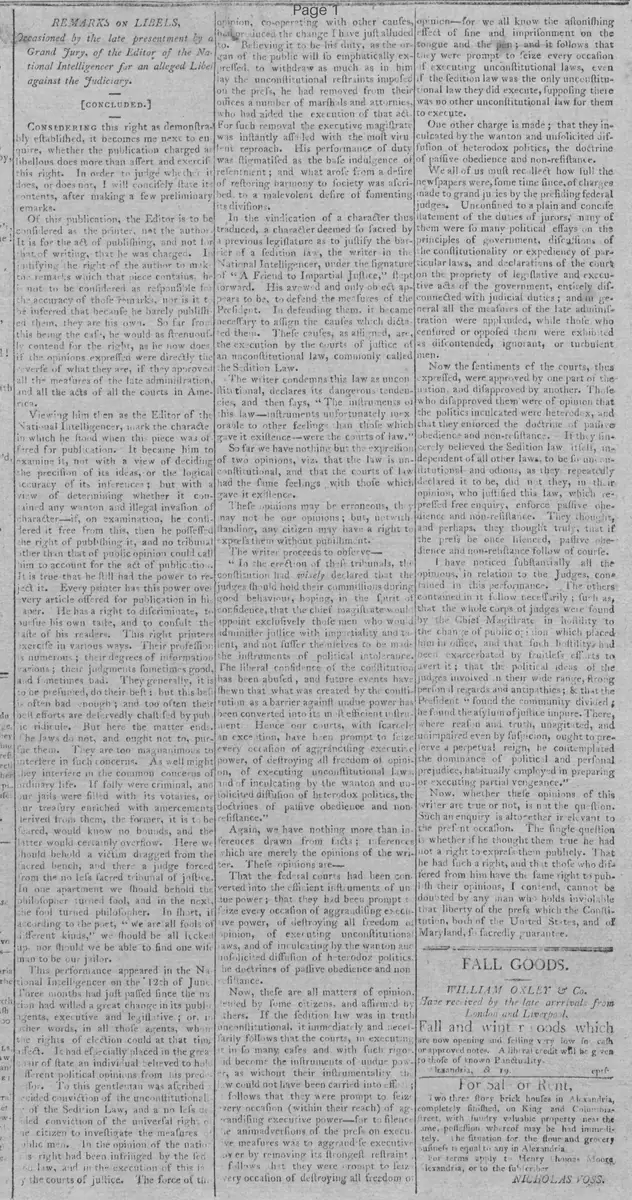
REMARKS ON LIBELS.
Occasioned by the late presentment by a Grand Jury, of the Editor of the National Intelligencer for an alleged Libel against the Judiciary.
[CONCLUDED.]
CONSIDERING this right as demonstrably established, it becomes me next to enquire, whether the publication charged as libellous does more than assert and exercise this right. In order to judge whether it does, or does not, I will concisely state its contents, after making a few preliminary remarks.
Of this publication, the Editor is to be considered as the printer, not the author. It is for the act of publishing, and not for that of writing, that he was charged. In justifying the right of the author to make the remarks which that piece contains, he is not to be considered as responsible for the accuracy of those remarks, nor is it to be inferred that because he barely publishes them, they are his own. So far from this being the case, he would as strenuously contend for the right, as he now does, if the opinions expressed were directly the reverse of what they are, if they approved all the measures of the late administration, and all the acts of all the courts in America.
Viewing him then as the Editor of the National Intelligencer, mark the character in which he stood when this piece was offered for publication. It became him to examine it, not with a view of deciding the precision of its ideas, or the logical accuracy of its inferences; but with a view of determining whether it contained any wanton and illegal invasion of character—if, on examination, he considered it free from this, then he possessed the right of publishing it, and no tribunal other than that of public opinion could call him to account for the act of publication.
It is true that he still had the power to reject it. Every printer has this power over every article offered for publication in his paper. He has a right to discriminate, to pursue his own taste, and to consult the taste of his readers. This right printers exercise in various ways. Their profession is numerous; their degrees of information various; their judgments sometimes good, and sometimes bad. They generally, it is to be presumed, do their best: but this best is often bad enough: and too often their best efforts are deservedly chastised by public ridicule. But here the matter ends. The laws do not, and ought not to, punish them. They are too magnanimous to interfere in such concerns. As well might they interfere in the common concerns of ordinary life. If folly were criminal, and our jails were filled with its votaries, or our treasury enriched with amercements derived from them, the former, it is to be feared, would know no bounds, and the latter would certainly overflow. Here we should behold a victim dragged from the sacred bench, and there a judge forced from the no less sacred tribunal of justice. In one apartment we should behold the philosopher turned fool, and in the next, the fool turned philosopher. In short, if according to the poet, "we are all fools of different kinds," we should be all locked up, nor should we be able to find one wise man to be our jailor.
This performance appeared in the National Intelligencer on the 12th of June. Three months had just passed since the nation had willed a great change in its public agents, executive and legislative; or, in other words, in all those agents, whom the rights of election could at that time affect. It had especially placed in the great chair of state an individual believed to hold different political opinions from his predecessor. To this gentleman was ascribed decided conviction of the unconstitutional of the Sedition Law, and a no less decided conviction of the universal right of a free citizen to investigate the measures of public men. In the opinion of the nation this right had been infringed by the sedition law, and in the execution of this law by the courts of justice. The force of this opinion, co-operating with other causes had produced the change I have just alluded to. Believing it to be his duty, as the organ of the public will so emphatically expressed, to withdraw as much as in him lay the unconstitutional restraints imposed on the press, he had removed from their offices a number of marshals and attorneys, who had aided the execution of that act. For such removal the executive magistrate was instantly assailed with the most virulent reproach. His performance of duty was stigmatised as the base indulgence of resentment: and what arose from a desire of restoring harmony to society was ascribed to a malevolent desire of fomenting its divisions.
In the vindication of a character thus traduced, a character deemed so sacred by a previous legislature as to justify the barrier of a sedition law, the writer in the National Intelligencer, under the signature of "A Friend to Impartial Justice," stepped forward. His avowed and only object appears to be, to defend the measures of the President. In defending them, it became necessary to assign the causes which dictated them. These causes, as assigned, are, the execution by the courts of justice of an unconstitutional law, commonly called the Sedition Law. The writer condemns this law as unconstitutional, declares its dangerous tendencies, and then says, "The instruments of this law—instruments unfortunately inexorable to other feelings than those which gave it existence—were the courts of law."
So far we have nothing but the expression of two opinions, viz. that the law is unconstitutional, and that the courts of law had the same feelings with those which gave it existence. These opinions may be erroneous, they may not be our opinions; but, notwithstanding, any citizen may have a right to express them without punishment.
The writer proceeds to observe—
In the erection of the tribunals, the constitution had wisely declared that the judges should hold their Commissions during good behaviour, hoping, in the spirit of confidence, that the chief magistrate would appoint exclusively those men who would administer justice with impartiality and talent, and not suffer themselves to be made the instruments of political intolerance. The liberal confidence of the constitution has been abused, and future events have shewn that what was created by the constitution as a barrier against undue power has been converted into its most efficient instrument. Hence our courts, with scarce an exception, have been prompt to seize every occasion of aggrandising executive power, of destroying all freedom of opinion, of executing unconstitutional laws, and of inculcating by the wanton and unsolicited diffusion of heterodox politics, the doctrines of passive obedience and non resistance.
Again, we have nothing more than inferences drawn from facts; inferences which are merely the opinions of the writer. These opinions are—
That the federal courts had been converted into the efficient instruments of undue power; that they had been prompt to seize every occasion of aggrandising executive power, of destroying all freedom of opinion, of executing unconstitutional laws, and of inculcating by the wanton and unsolicited diffusion of heterodox politics the doctrines of passive obedience and non resistance.
Now, these are all matters of opinion. Denied by some citizens, and affirmed by others. If the sedition law was in truth unconstitutional, it immediately and necessarily follows that the courts, in executing it in so many cases and with such rigor, had become the instruments of undue power, as without their instrumentality the law could not have been carried into effect; it follows that they were prompt to seize every occasion (within their reach) of aggrandising executive power—for to silence the animadversions of the press on executive measures was to aggrandize the executive power by removing its strongest restraint; it follows that they were prompt to seize every occasion of destroying all freedom of opinion—for we all know the astonishing effect of fine and imprisonment on the tongue and the pen; and it follows that they were prompt to seize every occasion of executing unconstitutional laws, even if the sedition law was the only unconstitutional law they did execute, supposing there was no other unconstitutional law for them to execute.
One other charge is made; that they inculcated by the wanton and unsolicited diffusion of heterodox politics, the doctrine of passive obedience and non-resistance. We all of us must recollect how full the newspapers were, some time since, of charges made to grand juries by the presiding federal judges. Unconfined to a plain and concise statement of the duties of jurors, many of them were so many political essays on the principles of government, discussions of the constitutionality or expediency of particular laws, and declarations of the court on the propriety of legislative and executive acts of the government, entirely disconnected with judicial duties; and in general all the measures of the late administration were applauded, while those who censured or opposed them were exhibited as discontented, ignorant, or turbulent men.
Now the sentiments of the courts, thus expressed, were approved by one part of the nation, and disapproved by another. Those who disapproved them were of opinion that the politics inculcated were heterodox, and that they enforced the doctrine of passive obedience and non-resistance. If they sincerely believed the Sedition law itself, independent of all other laws, to be so unconstitutional and odious, as they repeatedly declared it to be, did not they, in their opinion, who justified this law, which repressed free enquiry, enforce passive obedience and non-resistance. They thought, and perhaps, they thought truly, that if the press be once silenced, passive obedience and non-resistance follow of course.
I have noticed substantially all the opinions, in relation to the Judges, contained in this performance. The others contained in it follow necessarily; such as, that the whole corps of judges were found by the Chief Magistrate in hostility to the change of public opinion which placed him in office, and that such hostility had been exacerbated by fruitless efforts to avert it; that the political ideas of the judges involved in their wide range, strong personal regards and antipathies; & that the President "found the community divided he found the asylum of justice impure. There, where reason and truth, unagitated, and unimpaired even by suspicion, ought to preserve a perpetual reign, he contemplated the dominance of political and personal prejudice, habitually employed in preparing or executing partial vengeance."
Now, whether these opinions of this writer are true or not, is not the question. Such an enquiry is altogether irrelevant to the present occasion. The single question is, whether if he thought them true he had not a right to express them publicly. That he had such a right, and that those who differ from him have the same right to publish their opinions, I contend, cannot be doubted by any man who holds inviolable that liberty of the press which the Constitution, both of the United States, and of Maryland, sacredly guarantee.
Occasioned by the late presentment by a Grand Jury, of the Editor of the National Intelligencer for an alleged Libel against the Judiciary.
[CONCLUDED.]
CONSIDERING this right as demonstrably established, it becomes me next to enquire, whether the publication charged as libellous does more than assert and exercise this right. In order to judge whether it does, or does not, I will concisely state its contents, after making a few preliminary remarks.
Of this publication, the Editor is to be considered as the printer, not the author. It is for the act of publishing, and not for that of writing, that he was charged. In justifying the right of the author to make the remarks which that piece contains, he is not to be considered as responsible for the accuracy of those remarks, nor is it to be inferred that because he barely publishes them, they are his own. So far from this being the case, he would as strenuously contend for the right, as he now does, if the opinions expressed were directly the reverse of what they are, if they approved all the measures of the late administration, and all the acts of all the courts in America.
Viewing him then as the Editor of the National Intelligencer, mark the character in which he stood when this piece was offered for publication. It became him to examine it, not with a view of deciding the precision of its ideas, or the logical accuracy of its inferences; but with a view of determining whether it contained any wanton and illegal invasion of character—if, on examination, he considered it free from this, then he possessed the right of publishing it, and no tribunal other than that of public opinion could call him to account for the act of publication.
It is true that he still had the power to reject it. Every printer has this power over every article offered for publication in his paper. He has a right to discriminate, to pursue his own taste, and to consult the taste of his readers. This right printers exercise in various ways. Their profession is numerous; their degrees of information various; their judgments sometimes good, and sometimes bad. They generally, it is to be presumed, do their best: but this best is often bad enough: and too often their best efforts are deservedly chastised by public ridicule. But here the matter ends. The laws do not, and ought not to, punish them. They are too magnanimous to interfere in such concerns. As well might they interfere in the common concerns of ordinary life. If folly were criminal, and our jails were filled with its votaries, or our treasury enriched with amercements derived from them, the former, it is to be feared, would know no bounds, and the latter would certainly overflow. Here we should behold a victim dragged from the sacred bench, and there a judge forced from the no less sacred tribunal of justice. In one apartment we should behold the philosopher turned fool, and in the next, the fool turned philosopher. In short, if according to the poet, "we are all fools of different kinds," we should be all locked up, nor should we be able to find one wise man to be our jailor.
This performance appeared in the National Intelligencer on the 12th of June. Three months had just passed since the nation had willed a great change in its public agents, executive and legislative; or, in other words, in all those agents, whom the rights of election could at that time affect. It had especially placed in the great chair of state an individual believed to hold different political opinions from his predecessor. To this gentleman was ascribed decided conviction of the unconstitutional of the Sedition Law, and a no less decided conviction of the universal right of a free citizen to investigate the measures of public men. In the opinion of the nation this right had been infringed by the sedition law, and in the execution of this law by the courts of justice. The force of this opinion, co-operating with other causes had produced the change I have just alluded to. Believing it to be his duty, as the organ of the public will so emphatically expressed, to withdraw as much as in him lay the unconstitutional restraints imposed on the press, he had removed from their offices a number of marshals and attorneys, who had aided the execution of that act. For such removal the executive magistrate was instantly assailed with the most virulent reproach. His performance of duty was stigmatised as the base indulgence of resentment: and what arose from a desire of restoring harmony to society was ascribed to a malevolent desire of fomenting its divisions.
In the vindication of a character thus traduced, a character deemed so sacred by a previous legislature as to justify the barrier of a sedition law, the writer in the National Intelligencer, under the signature of "A Friend to Impartial Justice," stepped forward. His avowed and only object appears to be, to defend the measures of the President. In defending them, it became necessary to assign the causes which dictated them. These causes, as assigned, are, the execution by the courts of justice of an unconstitutional law, commonly called the Sedition Law. The writer condemns this law as unconstitutional, declares its dangerous tendencies, and then says, "The instruments of this law—instruments unfortunately inexorable to other feelings than those which gave it existence—were the courts of law."
So far we have nothing but the expression of two opinions, viz. that the law is unconstitutional, and that the courts of law had the same feelings with those which gave it existence. These opinions may be erroneous, they may not be our opinions; but, notwithstanding, any citizen may have a right to express them without punishment.
The writer proceeds to observe—
In the erection of the tribunals, the constitution had wisely declared that the judges should hold their Commissions during good behaviour, hoping, in the spirit of confidence, that the chief magistrate would appoint exclusively those men who would administer justice with impartiality and talent, and not suffer themselves to be made the instruments of political intolerance. The liberal confidence of the constitution has been abused, and future events have shewn that what was created by the constitution as a barrier against undue power has been converted into its most efficient instrument. Hence our courts, with scarce an exception, have been prompt to seize every occasion of aggrandising executive power, of destroying all freedom of opinion, of executing unconstitutional laws, and of inculcating by the wanton and unsolicited diffusion of heterodox politics, the doctrines of passive obedience and non resistance.
Again, we have nothing more than inferences drawn from facts; inferences which are merely the opinions of the writer. These opinions are—
That the federal courts had been converted into the efficient instruments of undue power; that they had been prompt to seize every occasion of aggrandising executive power, of destroying all freedom of opinion, of executing unconstitutional laws, and of inculcating by the wanton and unsolicited diffusion of heterodox politics the doctrines of passive obedience and non resistance.
Now, these are all matters of opinion. Denied by some citizens, and affirmed by others. If the sedition law was in truth unconstitutional, it immediately and necessarily follows that the courts, in executing it in so many cases and with such rigor, had become the instruments of undue power, as without their instrumentality the law could not have been carried into effect; it follows that they were prompt to seize every occasion (within their reach) of aggrandising executive power—for to silence the animadversions of the press on executive measures was to aggrandize the executive power by removing its strongest restraint; it follows that they were prompt to seize every occasion of destroying all freedom of opinion—for we all know the astonishing effect of fine and imprisonment on the tongue and the pen; and it follows that they were prompt to seize every occasion of executing unconstitutional laws, even if the sedition law was the only unconstitutional law they did execute, supposing there was no other unconstitutional law for them to execute.
One other charge is made; that they inculcated by the wanton and unsolicited diffusion of heterodox politics, the doctrine of passive obedience and non-resistance. We all of us must recollect how full the newspapers were, some time since, of charges made to grand juries by the presiding federal judges. Unconfined to a plain and concise statement of the duties of jurors, many of them were so many political essays on the principles of government, discussions of the constitutionality or expediency of particular laws, and declarations of the court on the propriety of legislative and executive acts of the government, entirely disconnected with judicial duties; and in general all the measures of the late administration were applauded, while those who censured or opposed them were exhibited as discontented, ignorant, or turbulent men.
Now the sentiments of the courts, thus expressed, were approved by one part of the nation, and disapproved by another. Those who disapproved them were of opinion that the politics inculcated were heterodox, and that they enforced the doctrine of passive obedience and non-resistance. If they sincerely believed the Sedition law itself, independent of all other laws, to be so unconstitutional and odious, as they repeatedly declared it to be, did not they, in their opinion, who justified this law, which repressed free enquiry, enforce passive obedience and non-resistance. They thought, and perhaps, they thought truly, that if the press be once silenced, passive obedience and non-resistance follow of course.
I have noticed substantially all the opinions, in relation to the Judges, contained in this performance. The others contained in it follow necessarily; such as, that the whole corps of judges were found by the Chief Magistrate in hostility to the change of public opinion which placed him in office, and that such hostility had been exacerbated by fruitless efforts to avert it; that the political ideas of the judges involved in their wide range, strong personal regards and antipathies; & that the President "found the community divided he found the asylum of justice impure. There, where reason and truth, unagitated, and unimpaired even by suspicion, ought to preserve a perpetual reign, he contemplated the dominance of political and personal prejudice, habitually employed in preparing or executing partial vengeance."
Now, whether these opinions of this writer are true or not, is not the question. Such an enquiry is altogether irrelevant to the present occasion. The single question is, whether if he thought them true he had not a right to express them publicly. That he had such a right, and that those who differ from him have the same right to publish their opinions, I contend, cannot be doubted by any man who holds inviolable that liberty of the press which the Constitution, both of the United States, and of Maryland, sacredly guarantee.
What sub-type of article is it?
Press Freedom
Constitutional
Legal Reform
What keywords are associated?
Press Freedom
Libel
Sedition Law
Judiciary Criticism
Constitutional Rights
Federal Courts
Political Opinions
What entities or persons were involved?
National Intelligencer
Editor Of The National Intelligencer
Grand Jury
Judiciary
President
Sedition Law
Federal Courts
Late Administration
Editorial Details
Primary Topic
Defense Against Libel Charge For Publishing Criticism Of Judiciary And Sedition Law
Stance / Tone
Strongly Supportive Of Press Liberty And Right To Criticize Public Institutions
Key Figures
National Intelligencer
Editor Of The National Intelligencer
Grand Jury
Judiciary
President
Sedition Law
Federal Courts
Late Administration
Key Arguments
Printers Are Not Liable For Accuracy Of Published Opinions, Only For Wanton Invasions Of Character
Citizens Have Right To Express Opinions On Constitutionality Of Laws Without Punishment
Sedition Law Is Unconstitutional And Courts Enforced It As Instruments Of Undue Power
Federal Judges Abused Constitutional Confidence By Aggrandizing Executive Power And Destroying Freedom Of Opinion
Judges Inculcated Doctrines Of Passive Obedience Through Political Charges To Grand Juries
Liberty Of The Press Is Guaranteed By Us And Maryland Constitutions
Publication Defends President's Removal Of Officials Involved In Sedition Law Enforcement