Thank you for visiting SNEWPapers!
Sign up free
Literary
September 2, 1839
Alexandria Gazette
Alexandria, Alexandria County, District Of Columbia
What is this article about?
An explanatory article from the Philadelphia North American defining key Turkish terms such as Sultan, Ottoman Porte, Divan, Grand Vizier, Mufti, Reis Effendi, Pasha, and Mussulman, aimed at clarifying Ottoman political and religious concepts for newspaper readers amid current events.
Clipping
OCR Quality
98%
Excellent
Full Text
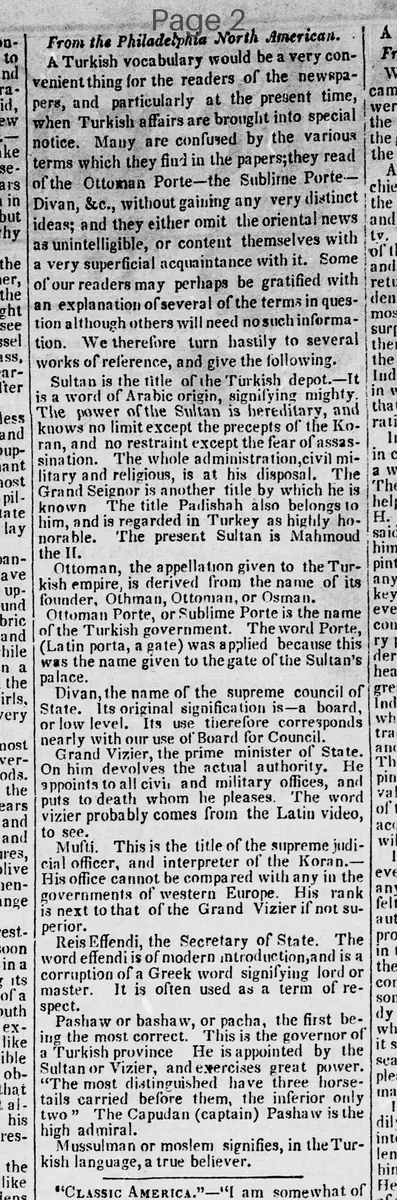
From the Philadelphia North American.
A Turkish vocabulary would be a very convenient thing for the readers of the newspapers, and particularly at the present time, when Turkish affairs are brought into special notice. Many are confused by the various terms which they find in the papers; they read of the Ottoman Porte—the Sublime Porte—Divan, &c., without gaining any very distinct ideas; and they either omit the oriental news as unintelligible, or content themselves with a very superficial acquaintance with it. Some of our readers may perhaps be gratified with an explanation of several of the terms in question although others will need no such information. We therefore turn hastily to several works of reference, and give the following.
Sultan is the title of the Turkish despot.—It is a word of Arabic origin, signifying mighty. The power of the Sultan is hereditary, and knows no limit except the precepts of the Koran, and no restraint except the fear of assassination. The whole administration, civil military and religious, is at his disposal. The Grand Seignor is another title by which he is known The title Padishah also belongs to him, and is regarded in Turkey as highly honorable. 'The present Sultan is Mahmoud the II.
Ottoman, the appellation given to the Turkish empire, is derived from the name of its founder, Othman, Ottoman, or Osman.
Ottoman Porte, or Sublime Porte is the name of the Turkish government. The word Porte, (Latin porta, a gate) was applied because this was the name given to the gate of the Sultan's palace.
Divan, the name of the supreme council of State. Its original signification is—a board, or low level. Its use therefore corresponds nearly with our use of Board for Council.
Grand Vizier, the prime minister of State. On him devolves the actual authority. He appoints to all civil and military offices, and puts to death whom he pleases. 'The word vizier probably comes from the Latin video, to see.
Mufti. This is the title of the supreme judicial officer, and interpreter of the Koran.— His office cannot be compared with any in the governments of western Europe. His rank is next to that of the Grand Vizier if not superior.
Reis Effendi, the Secretary of State. The word effendi is of modern introduction, and is a corruption of a Greek word signifying lord or master. It is often used as a term of respect.
Pashaw or bashaw, or pacha, the first being the most correct. This is the governor of a Turkish province He is appointed by the Sultan or Vizier, and exercises great power. "The most distinguished have three horse-tails carried before them, the inferior only two" The Capudan (captain) Pashaw is the high admiral.
Mussulman or moslem signifies, in the Turkish language, a true believer.
A Turkish vocabulary would be a very convenient thing for the readers of the newspapers, and particularly at the present time, when Turkish affairs are brought into special notice. Many are confused by the various terms which they find in the papers; they read of the Ottoman Porte—the Sublime Porte—Divan, &c., without gaining any very distinct ideas; and they either omit the oriental news as unintelligible, or content themselves with a very superficial acquaintance with it. Some of our readers may perhaps be gratified with an explanation of several of the terms in question although others will need no such information. We therefore turn hastily to several works of reference, and give the following.
Sultan is the title of the Turkish despot.—It is a word of Arabic origin, signifying mighty. The power of the Sultan is hereditary, and knows no limit except the precepts of the Koran, and no restraint except the fear of assassination. The whole administration, civil military and religious, is at his disposal. The Grand Seignor is another title by which he is known The title Padishah also belongs to him, and is regarded in Turkey as highly honorable. 'The present Sultan is Mahmoud the II.
Ottoman, the appellation given to the Turkish empire, is derived from the name of its founder, Othman, Ottoman, or Osman.
Ottoman Porte, or Sublime Porte is the name of the Turkish government. The word Porte, (Latin porta, a gate) was applied because this was the name given to the gate of the Sultan's palace.
Divan, the name of the supreme council of State. Its original signification is—a board, or low level. Its use therefore corresponds nearly with our use of Board for Council.
Grand Vizier, the prime minister of State. On him devolves the actual authority. He appoints to all civil and military offices, and puts to death whom he pleases. 'The word vizier probably comes from the Latin video, to see.
Mufti. This is the title of the supreme judicial officer, and interpreter of the Koran.— His office cannot be compared with any in the governments of western Europe. His rank is next to that of the Grand Vizier if not superior.
Reis Effendi, the Secretary of State. The word effendi is of modern introduction, and is a corruption of a Greek word signifying lord or master. It is often used as a term of respect.
Pashaw or bashaw, or pacha, the first being the most correct. This is the governor of a Turkish province He is appointed by the Sultan or Vizier, and exercises great power. "The most distinguished have three horse-tails carried before them, the inferior only two" The Capudan (captain) Pashaw is the high admiral.
Mussulman or moslem signifies, in the Turkish language, a true believer.
What sub-type of article is it?
Essay
What themes does it cover?
Political
Religious
What keywords are associated?
Turkish Vocabulary
Ottoman Empire
Sultan
Divan
Grand Vizier
Mufti
Pasha
Mussulman
Literary Details
Subject
Explanation Of Turkish Terms For Newspaper Readers Amid Current Turkish Affairs