Thank you for visiting SNEWPapers!
Sign up free
Story
May 20, 1817
Richmond Enquirer
Richmond, Richmond County, Virginia
What is this article about?
Article describes the Virginia State Penitentiary in Richmond, established in 1800, its operations, prisoner statistics from 1800-1816 totaling 721 convictions, various crimes, employment of inmates in trades, and its moral influence on public reform.
Clipping
OCR Quality
95%
Excellent
Full Text
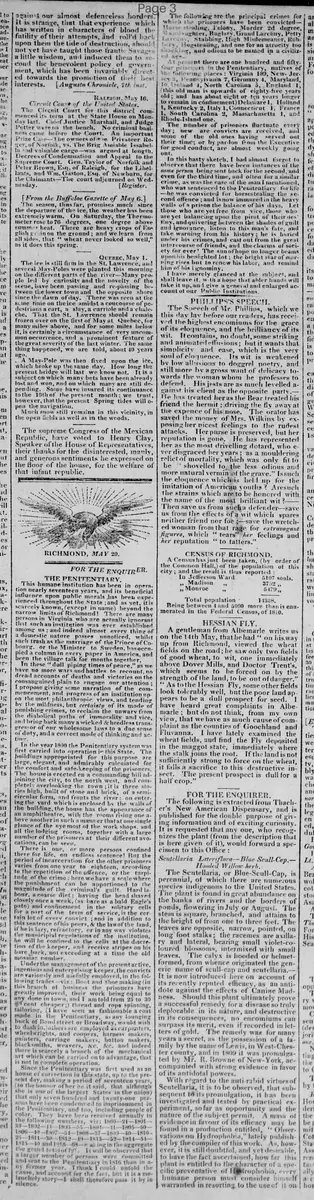
RICHMOND, MAY 20.
FOR THE ENQUIRER.
THE PENITENTIARY
This humane institution has been in operation nearly seventeen years, and its beneficial influence upon public morals has been experienced throughout the State; and as yet, it is scarcely known, (except in name) beyond the narrow limits of Richmond! There are many persons in Virginia who are actually ignorant that such an institution was ever established among us; and indeed almost every thing of a domestic nature passes unnoticed, whilst such trash as the marriage of the Prince of Cobourg, or the Minister to Sweden, has occupied a column in every paper in America, and been the village talk for months together.
In these "dull piping times of peace," as we have no more wars and battles to recount, no dread accounts of deaths and victories on the sanguined plain to engage our attention; I propose giving some narration of the commencement, and progress of an institution upon the most philanthropic views, and tending by the mildness, but certainty of its mode of punishing crimes, to reclaim the unwary from the diabolical paths of immorality and vice, and bring back many a wicked & heedless transgressor of our wholesome laws to a due sense of duty, and a correct mode of thinking and acting.
In the year 1800 the Penitentiary system was first carried into operation in this State. The buildings appropriated for this purpose are large, elegant, and admirably calculated for the comfort and safe-keeping of the prisoners. The house is erected on a commanding hill adjoining the city, to the north west, and completely overlooking the town; it is three stories high, built of stone and brick, of a semi-circular form, and fronts the river: on entering the yard which is enclosed by the walls of the building, the house has the appearance of an amphitheatre, with the rooms rising one above another in such a manner that at one single glance of the eye most of the work shops, and all the lodging rooms, together with a large number of the prisoners at their different avocations, can be seen.
There is one, or more persons confined there for life, on endless sentence! But the period of incarceration for the other prisoners varies from one year to eighteen, according to the repetition of the offence, or the turpitude of the crime: here we have a scale where the punishment can be apportioned to the magnitude of the criminal's guilt. Hard labour, a coarse diet; having the head shaved closely once a week, (as bare as a bald Eagle's pate) and confinement in the solitary cells for a part of the term of service, is the certain lot of every convict: and in addition to this sentence of his peers, & the law of the land, if he is lazy, refractory, or in any way violates the municipal regulations of the institution, he will be confined to the cells at the discretion of the keeper, and receive stripes on his bare back, not exceeding at a time the old Mosaic number.
Under the management of the present active, ingenious and enterprising keeper, the convicts are variously and usefully employed, in the following trades - viz: Boot and Shoe making (in this branch of business the prisoners have greatly improved, their work being equal to any done in town, and I am told from 25 to 30 per cent cheaper; thread and rope spinning, tailoring, (I have seen as fashionable a coat made in the Penitentiary, as any lounging buck of Bond street or Broadway, would wish to dash in,) others are employed as carpenters, wheelwrights, and coopers, harness makers, painters, carriage makers, button makers, blacksmiths, weavers, &c. &c. and indeed there is scarcely a branch of the mechanical art which can be carried on to advantage, that is not in complete operation.
Since the Penitentiary was first used as a house of correction in this state, up to the present day, making a period of seventeen years, (to the honour of her be it said, that although she is one of the largest States in the union) that only seven hundred and twenty-one persons have been condemned to imprisonment in the Penitentiary, and too, including people of color. They have been received annually in the following numbers, viz: 1800—21—1801—33—1802—11—1803—55—1804—11—1805—50—1806—10—1807—51—1808—37—1809—40—1810—25—1811—30—1812—19—1813—52—1814—54—1815—10 and 1816—69—Making in the aggregate the grand total of 721. It will be observed that a larger number of persons were committed and sent to the Penitentiary in 1816 than in any former year. I think I could unfold the cause, and account for the fact, but it is a melancholy story—I shall therefore pass it by in silence.
The following are the principal crimes for which the prisoners have been convicted—Horse stealing. Felony. Murder 2d degree, Manslaughter, Burglary. Grand Larceny. Petty Larceny, Stabbing, High Misdemeanor, Robbery, Hogstealing. and one for an atrocity too shocking, and odious to be named in a civilized age.
At present there are one hundred and fifty-four prisoners in the Penitentiary, natives of the following places: Virginia 109, New-Jersey 3, Pennsylvania 7, Germany 4, Maryland, 10. Ireland 4. North Carolina 5. England 1, (this old man is upwards of eighty-five years old; and has about eight or ten years longer to remain in confinement) Delaware 1. Holland 1, Kentucky 2. Italy 1, Connecticut 1, France 1, South Carolina 2. Massachusetts 1, and Rhode-Island one.
The number of prisoners fluctuate every day; new convicts are received, and some of the old ones having served out their time; or by pardon from the Executive for good conduct, are almost weekly going out.
In this hasty sketch, I had almost forgot to observe that there have been instances of the same person being sent back for the second, and even for the third time, and often for a similar crime, as was the case of the man I mentioned, who was sentenced to the Penitentiary for life—he was convicted for horse-stealing the second offence; and is now immured in the heavy walls of a prison the balance of his days. Let those who are yet free from vice, those who are yet balancing upon the pivot of their destiny, and quivering between the shades of guilt and innocence, listen to this man's fate, and take warning from his history; he is buried under his crimes, and cast out from the great intercourse of friends, and the charms of society for ever! The sun of hope no longer beams upon his benighted lot; the bright star of morning rises but to renew his labor, and remind him of his ignominy.
I have merely glanced at the subject, and shall leave it, with a hope that abler hands will take it up, and give a general and enlarged account of our Public Institutions.
FOR THE ENQUIRER.
THE PENITENTIARY
This humane institution has been in operation nearly seventeen years, and its beneficial influence upon public morals has been experienced throughout the State; and as yet, it is scarcely known, (except in name) beyond the narrow limits of Richmond! There are many persons in Virginia who are actually ignorant that such an institution was ever established among us; and indeed almost every thing of a domestic nature passes unnoticed, whilst such trash as the marriage of the Prince of Cobourg, or the Minister to Sweden, has occupied a column in every paper in America, and been the village talk for months together.
In these "dull piping times of peace," as we have no more wars and battles to recount, no dread accounts of deaths and victories on the sanguined plain to engage our attention; I propose giving some narration of the commencement, and progress of an institution upon the most philanthropic views, and tending by the mildness, but certainty of its mode of punishing crimes, to reclaim the unwary from the diabolical paths of immorality and vice, and bring back many a wicked & heedless transgressor of our wholesome laws to a due sense of duty, and a correct mode of thinking and acting.
In the year 1800 the Penitentiary system was first carried into operation in this State. The buildings appropriated for this purpose are large, elegant, and admirably calculated for the comfort and safe-keeping of the prisoners. The house is erected on a commanding hill adjoining the city, to the north west, and completely overlooking the town; it is three stories high, built of stone and brick, of a semi-circular form, and fronts the river: on entering the yard which is enclosed by the walls of the building, the house has the appearance of an amphitheatre, with the rooms rising one above another in such a manner that at one single glance of the eye most of the work shops, and all the lodging rooms, together with a large number of the prisoners at their different avocations, can be seen.
There is one, or more persons confined there for life, on endless sentence! But the period of incarceration for the other prisoners varies from one year to eighteen, according to the repetition of the offence, or the turpitude of the crime: here we have a scale where the punishment can be apportioned to the magnitude of the criminal's guilt. Hard labour, a coarse diet; having the head shaved closely once a week, (as bare as a bald Eagle's pate) and confinement in the solitary cells for a part of the term of service, is the certain lot of every convict: and in addition to this sentence of his peers, & the law of the land, if he is lazy, refractory, or in any way violates the municipal regulations of the institution, he will be confined to the cells at the discretion of the keeper, and receive stripes on his bare back, not exceeding at a time the old Mosaic number.
Under the management of the present active, ingenious and enterprising keeper, the convicts are variously and usefully employed, in the following trades - viz: Boot and Shoe making (in this branch of business the prisoners have greatly improved, their work being equal to any done in town, and I am told from 25 to 30 per cent cheaper; thread and rope spinning, tailoring, (I have seen as fashionable a coat made in the Penitentiary, as any lounging buck of Bond street or Broadway, would wish to dash in,) others are employed as carpenters, wheelwrights, and coopers, harness makers, painters, carriage makers, button makers, blacksmiths, weavers, &c. &c. and indeed there is scarcely a branch of the mechanical art which can be carried on to advantage, that is not in complete operation.
Since the Penitentiary was first used as a house of correction in this state, up to the present day, making a period of seventeen years, (to the honour of her be it said, that although she is one of the largest States in the union) that only seven hundred and twenty-one persons have been condemned to imprisonment in the Penitentiary, and too, including people of color. They have been received annually in the following numbers, viz: 1800—21—1801—33—1802—11—1803—55—1804—11—1805—50—1806—10—1807—51—1808—37—1809—40—1810—25—1811—30—1812—19—1813—52—1814—54—1815—10 and 1816—69—Making in the aggregate the grand total of 721. It will be observed that a larger number of persons were committed and sent to the Penitentiary in 1816 than in any former year. I think I could unfold the cause, and account for the fact, but it is a melancholy story—I shall therefore pass it by in silence.
The following are the principal crimes for which the prisoners have been convicted—Horse stealing. Felony. Murder 2d degree, Manslaughter, Burglary. Grand Larceny. Petty Larceny, Stabbing, High Misdemeanor, Robbery, Hogstealing. and one for an atrocity too shocking, and odious to be named in a civilized age.
At present there are one hundred and fifty-four prisoners in the Penitentiary, natives of the following places: Virginia 109, New-Jersey 3, Pennsylvania 7, Germany 4, Maryland, 10. Ireland 4. North Carolina 5. England 1, (this old man is upwards of eighty-five years old; and has about eight or ten years longer to remain in confinement) Delaware 1. Holland 1, Kentucky 2. Italy 1, Connecticut 1, France 1, South Carolina 2. Massachusetts 1, and Rhode-Island one.
The number of prisoners fluctuate every day; new convicts are received, and some of the old ones having served out their time; or by pardon from the Executive for good conduct, are almost weekly going out.
In this hasty sketch, I had almost forgot to observe that there have been instances of the same person being sent back for the second, and even for the third time, and often for a similar crime, as was the case of the man I mentioned, who was sentenced to the Penitentiary for life—he was convicted for horse-stealing the second offence; and is now immured in the heavy walls of a prison the balance of his days. Let those who are yet free from vice, those who are yet balancing upon the pivot of their destiny, and quivering between the shades of guilt and innocence, listen to this man's fate, and take warning from his history; he is buried under his crimes, and cast out from the great intercourse of friends, and the charms of society for ever! The sun of hope no longer beams upon his benighted lot; the bright star of morning rises but to renew his labor, and remind him of his ignominy.
I have merely glanced at the subject, and shall leave it, with a hope that abler hands will take it up, and give a general and enlarged account of our Public Institutions.
What sub-type of article is it?
Historical Event
What themes does it cover?
Crime Punishment
Moral Virtue
Justice
What keywords are associated?
Penitentiary
Richmond
Virginia
Prisoners
Crimes
Reform
Historical Institution
Convict Labor
Where did it happen?
Richmond, Virginia
Story Details
Location
Richmond, Virginia
Event Date
1800 To 1817
Story Details
The Virginia Penitentiary, established in 1800, houses prisoners for various crimes with terms from one to eighteen years or life; inmates work in trades like shoemaking and tailoring; 721 convicts received from 1800-1816, currently 154 from multiple states and countries; aims to reform through labor and punishment.