Thank you for visiting SNEWPapers!
Sign up free
The Watchman And Southron
Sumter, Sumter County, South Carolina
What is this article about?
Senator James M. Richardson of Greenville County, South Carolina, shares views on state tax commission efficiency, need for tax law changes, opposition to indirect taxes, and recommendations for state institutions and education funding ahead of the general assembly session on Jan. 5.
Clipping
OCR Quality
Full Text
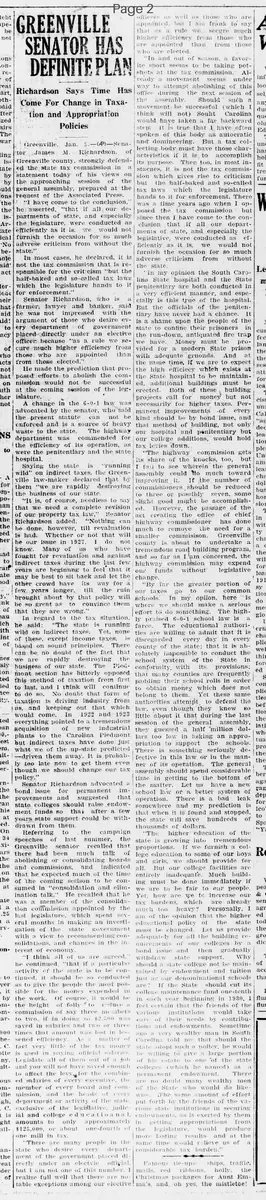
SENATOR HAS
DEFINITE PLAN
Richardson Says Time Has
Come For Change in Taxa-
tion and Appropriation
Policies
Greenville. Jan. 5.-(A)--Sena-
tor James M. Richardson, of
Greenville county, strongly defend-
ed the state tax commission in a
statement today of his views on
the approaching session of the
general assembly, prepared at the
request of the Associated Press.
"I have come to the conclusion,"
he asserted, "that if all our de-
partments of state, and especially
the legislature. were conducted as
efficiently as it is. we would not
furnish the occasion for so much
adverse criticism from without the
state."
In most cases. he declared. it is
not the tax commission that is re-
ponsible for the criticism but the
half-baked and so-called tax laws
which the legislature hands to it
for enforcement."
Senator Richardson, who is a
farmer. lawyer and banker, said
he was not impressed with the
argument of those who desire ev-
ery department of government
placed directly under an elective
officer because "as a rule we se-
cure much higher efficiency from
those who are appointed than
from those elected."
He made the prediction that pro-
posed efforts to abolish the com-
mission would not be successful
at the coming session of the leg-
islature.
A change in the 6-0-1 law was
advocated by the senator, who said
the present statute can not be
enforced and is a source of heavy
waste to the state.
The highway
department was commended for
the efficiency of its operation, as
were the penitentiary and the state
hospital.
Saying the state is "running
wild" on indirect taxes, the Green-
ville law-maker declared that by
them "we are rapidly destroying
the business of our state.
"It is, of course, needless to say
that we need a complete revision
of our property tax law." Senator
Richardson added. "Nothing can
be done. however, till revaluation
is had. whether or not that will
be our issue in 1927. I do not
know. Many of us who have
fought for revaluation and against
indirect taxes during the last few
years are beginning to feel that it
may be best to sit back and let the
other crowd have its way for a
few years longer. till the ruin
brought about by that policy will
be so great as to convince them
that they are wrong."
In regard to the tax situation,
he said: "The state is running
wild on indirect taxes. Yet, none
of these, except income taxes, is
based on sound principles. There
can be no doubt of the fact that
we are rapidly destroying the
business of our state. The Pied-
mont section has bitterly opposed
this method of taxation from first
to last, and I think will continue
to do so. No doubt that form of
taxation is driving industry from
us, and keeping out that which
would come. In 1922 and 1923
everything pointed to a tremendous
acquisition
of new industrial
plants to the Carolina Piedmont
but indirect taxes have done just
what we of the up-state predicted
--driven them away. It is probab-
ly too late now to get them even
though we should change our tax
policy."
Senator Richardson advocated a
bond issue for permanent
im-
provements and suggested
that
state colleges should raise endow-
ment funds so that after a few
years state support could be with-
drawn from them.
Referring to the campaign
speeches of last summer, the
Greenville senator recalled that
there had been much talk of
abolishing or consolidating boards
and commissions, and indicated
that he expected much of the time
of the coming session to be con-
sumed in "consolidation and elim-
ination talk." He recalled that he
was a member of the consolida-
tion commission appointed by the
last legislature, which spent sev-
eral months in making an investi-
gation of the state government
with a view to recommending con-
solidations, and changes in the in-
terest of economy.
"I think all of us are agreed."
he continued, "that if a particular
activity of the state is to be con-
tinued. it should be so conducted
as to give the people the most pos-
sible for the money expended in
the work. Of course. it would be
the height of folly to reduce a
commission of say three members
to two. if in doing so $2,500 was
saved in salaries and two or three
times that amount was lost in les-
sened efficiency. As a matter of
fact. very little of the tax money
is used in paying official salaries.
Legislate all of them out of a job
and you will not have saved enough
to affect the levy, for the combin-
ed salaries of every executive. the
member of every board and com-
mission, and the heads of every
department or activity of the state
exclusive of the legislative, judic-
ial and college educational.
amounts to only approximately
$125,000, or about one-fourth of
one mill in tax.
"There are many people in the
state who desire
every depart-
ment of the government placed di-
rectly under an elective official.
but I am not one of this number. I
realize full well that there are no
table exceptions among our elective
officers as well as those who are
appointed. but I am frank to say
that as a rule we secure much
higher efficiency from those who
are appointed than from those
who are elected
"In and out of season. a favor-
ite sport seems to be taking pot-
shots at the tax commission. Al-
ready a movement seems under
way to attempt abolishing of this
office during the next session of
the assembly.
Should such a
movement be successful (which I
think will not South Carolina
would have taken a far backward
step. It is true that I have often
spoken of this body as autocratic
and domineering. But a tax col-
lecting body must have those char-
acteristics if it is to accomplish
its purpose. Then too. in most in-
stanes. it is not the tax commis-
sion which gives rise to criticism
but the half-baked and so-called
tax laws which the legislature
hands to it for enforcement. There
was a time years ago when I op-
posed the tax commission but
since then I have come to the con-
clusion that if all our depart-
ments of state, and especially the
legislative. were conducted as ef-
fiently as it is, we would not
furnish the occasion for so much
adverse criticism from without
the state.
In my opinion the South Caro-
lina State hospital and the State
penitentiary are both conducted in
a very efficient manner. and espe-
cially is this true of the hospital.
But the officials of the peniten-
tiary have never had a chance. It
is a shame upon the people of the
state to confine their prisoners in
the run-down, antiquated fire trap
we have. Money must be pro-
vided for a modern State prison
with adequate grounds. And at
the same time, if we are to expect
the high efficiency which exists at
the State hospital to be maintain-
ed. additional buildings must be
erected. Both of these building
projects call for money but not
necessarily for higher taxes. Per-
manent improvements of every
kind should be by bond issue, and
that method of building. not only
our hospital and penitentiary but
our college additions. would hold
tax levies down.
"The highway commission gets
its share of the knocks. too. but
I fail to see wherein the general
assembly could do much toward
improving it. If the number of
commissioners should be reduced
to three or possibly seven, some
slight good might be accomplish-
ed. However. the passage of the
act creating the office of chief
highway commissioner has done
much to remove the need for a
smaller commission. Greenville
county is about to undertake a
tremendous road building program,
and so far as I am concerned, the
highway commission may expend
our
funds
without
legislative
change.
"By far the greater portion of
our taxes go to our common
schools. In my opinion, here is
where we should make a serious
effort to do something. The high-
ly praised 6-0-1 school law is a
farce. The educational authori-
ties are willing to admit that it is
disregarded every day in every
county of the state; that it is ab-
solutely impossible to conduct the
school system of the State in
conformity with its provisions;
that many counties are frequently
padding their school rolls in order
to obtain money which does not
belong to them. Yet these same
authorities attempt to defend the
law. even though they knew so
little about it that during the last
session of the general assembly.
they guessed a half million dol-
lars too low in asking an appro-
priation to support the schools.
There is something seriously de-
fective in this law or in the man-
ner of its operation. The general
assembly should spend considerable
time in getting to the bottom of
the matter. Let us have a new
school law or a better system of
operation. There is a bad leak
somewhere and my prediction is
that when it is found and stopped,
the state will save hundreds of
thousands of dollars.
"The higher education of the
state is growing into tremendous
proportions. If we furnish a col-
lege education to some of our boys
and girls, we should provide for
all. But our college facilities are
entirely inadequate. Much build-
ing must be done immediately if
we are to be fair to our people.
Yet, how are we to increase our
tax burdens, which are already
much too heavy? Personally. I
am of the opinion that the higher
educational policy of the state
must be changed. Let us provide
adequately for all the building re-
quirements of our colleges by a
bond issue and then gradually
withdraw state support.
Why
should a state college not be main-
tained by endowment and tuition
just as our denominational schools
are? If the State should cut its
college maintenance fund one-tenth
in each year beginning in 1930. I
feel certain that the friends of the
various institutions would take
care of their needs by contribu-
tions and endowments. Sometime
ago a very wealthy man in South
carolina told me that should the
state adopt such a policy, he would
be willing to give a large portion
of his estate to one of the state
colleges (which he named) as a
permanent endowment. There
are no doubt many wealthy men
of the State who would do like-
wise. The same amount of effort
put forth by the friends of the va-
rious state institutions in securing
endowments, as is exerted by them
in getting appropriations from
the legislature, would produce
more lasting results and at the
same time would relieve us of a
considerable tax burden."
Famous tie-ups: ships. traffic.
mails, red ribbons, holly, the
Christmas packages for Aunt Em-
ma's. and oh yes. the mistletoe!
What sub-type of article is it?
What keywords are associated?
What entities or persons were involved?
Where did it happen?
Domestic News Details
Primary Location
Greenville, South Carolina
Event Date
Jan. 5
Key Persons
Event Details
Senator James M. Richardson defends the state tax commission, advocates changes to tax laws including the 6-0-1 law, opposes indirect taxes, commends highway department, penitentiary, and state hospital, suggests bond issues for improvements, and proposes shifting state college funding to endowments.