Thank you for visiting SNEWPapers!
Sign up free
Literary
November 4, 1890
Waterbury Evening Democrat
Waterbury, New Haven County, Connecticut
What is this article about?
An essay arguing that Shakespeare believed in ghosts like his contemporaries, making his portrayals in plays like Hamlet natural, while modern skepticism attributes ghost sightings to imagination and natural laws, as verified by psychical research.
Clipping
OCR Quality
95%
Excellent
Full Text
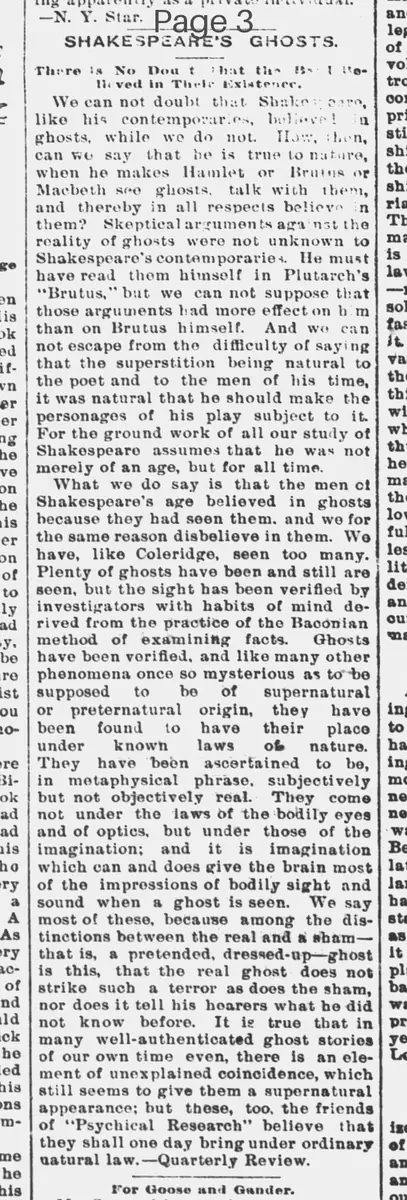
SHAKESPEARE'S GHOSTS.
There is No Doubt That the Bard Believed in Their Existence.
We can not doubt that Shakespeare, like his contemporaries, believed in ghosts, while we do not. How, then, can we say that he is true to nature, when he makes Hamlet or Brutus or Macbeth see ghosts, talk with them, and thereby in all respects believe in them? Skeptical arguments against the reality of ghosts were not unknown to Shakespeare's contemporaries. He must have read them himself in Plutarch's "Brutus," but we can not suppose that those arguments had more effect on him than on Brutus himself. And we can not escape from the difficulty of saying that the superstition being natural to the poet and to the men of his time, it was natural that he should make the personages of his play subject to it.
For the ground work of all our study of Shakespeare assumes that he was not merely of an age, but for all time. What we do say is that the men of Shakespeare's age believed in ghosts because they had seen them, and we for the same reason disbelieve in them. We have, like Coleridge, seen too many.
Plenty of ghosts have been and still are seen, but the sight has been verified by investigators with habits of mind derived from the practice of the Baconian method of examining facts.
Ghosts have been verified, and like many other phenomena once so mysterious as to be supposed to be of supernatural or preternatural origin, they have been found to have their place under known laws of nature.
They have been ascertained to be, in metaphysical phrase, subjectively but not objectively real. They come not under the laws of the bodily eyes and of optics, but under those of the imagination; and it is imagination which can and does give the brain most of the impressions of bodily sight and sound when a ghost is seen. We say most of these, because among the distinctions between the real and a sham-that is, a pretended, dressed-up-ghost is this, that the real ghost does not strike such a terror as does the sham, nor does it tell his hearers what he did not know before. It is true that in many well-authenticated ghost stories of our own time even, there is an element of unexplained coincidence, which still seems to give them a supernatural appearance: but these, too, the friends of "Psychical Research" believe that they shall one day bring under ordinary natural law.
-Quarterly Review.
There is No Doubt That the Bard Believed in Their Existence.
We can not doubt that Shakespeare, like his contemporaries, believed in ghosts, while we do not. How, then, can we say that he is true to nature, when he makes Hamlet or Brutus or Macbeth see ghosts, talk with them, and thereby in all respects believe in them? Skeptical arguments against the reality of ghosts were not unknown to Shakespeare's contemporaries. He must have read them himself in Plutarch's "Brutus," but we can not suppose that those arguments had more effect on him than on Brutus himself. And we can not escape from the difficulty of saying that the superstition being natural to the poet and to the men of his time, it was natural that he should make the personages of his play subject to it.
For the ground work of all our study of Shakespeare assumes that he was not merely of an age, but for all time. What we do say is that the men of Shakespeare's age believed in ghosts because they had seen them, and we for the same reason disbelieve in them. We have, like Coleridge, seen too many.
Plenty of ghosts have been and still are seen, but the sight has been verified by investigators with habits of mind derived from the practice of the Baconian method of examining facts.
Ghosts have been verified, and like many other phenomena once so mysterious as to be supposed to be of supernatural or preternatural origin, they have been found to have their place under known laws of nature.
They have been ascertained to be, in metaphysical phrase, subjectively but not objectively real. They come not under the laws of the bodily eyes and of optics, but under those of the imagination; and it is imagination which can and does give the brain most of the impressions of bodily sight and sound when a ghost is seen. We say most of these, because among the distinctions between the real and a sham-that is, a pretended, dressed-up-ghost is this, that the real ghost does not strike such a terror as does the sham, nor does it tell his hearers what he did not know before. It is true that in many well-authenticated ghost stories of our own time even, there is an element of unexplained coincidence, which still seems to give them a supernatural appearance: but these, too, the friends of "Psychical Research" believe that they shall one day bring under ordinary natural law.
-Quarterly Review.
What sub-type of article is it?
Essay
What themes does it cover?
Death Mortality
What keywords are associated?
Shakespeare
Ghosts
Belief
Superstition
Hamlet
Brutus
Macbeth
Psychical Research
What entities or persons were involved?
Quarterly Review
Literary Details
Title
Shakespeare's Ghosts.
Author
Quarterly Review
Subject
There Is No Doubt That The Bard Believed In Their Existence.
Key Lines
We Can Not Doubt That Shakespeare, Like His Contemporaries, Believed In Ghosts, While We Do Not.
How, Then, Can We Say That He Is True To Nature, When He Makes Hamlet Or Brutus Or Macbeth See Ghosts, Talk With Them, And Thereby In All Respects Believe In Them?
Ghosts Have Been Verified, And Like Many Other Phenomena Once So Mysterious As To Be Supposed To Be Of Supernatural Or Preternatural Origin, They Have Been Found To Have Their Place Under Known Laws Of Nature.
They Have Been Ascertained To Be, In Metaphysical Phrase, Subjectively But Not Objectively Real.