Thank you for visiting SNEWPapers!
Sign up free
Literary
March 3, 1827
Phenix Gazette
Alexandria, Virginia
What is this article about?
In Casanova's memoirs, he recounts a severe practical joke at a country estate where a bridge plank is sawed, causing him to fall into mud. Seeking revenge on the perpetrator, Mr. Demetrius, Casanova uses a severed arm from a grave to scare him at night, resulting in the Greek's paralysis and lasting debilitation.
Clipping
OCR Quality
95%
Excellent
Full Text
[From Casanova de Seingalt's Memoirs]
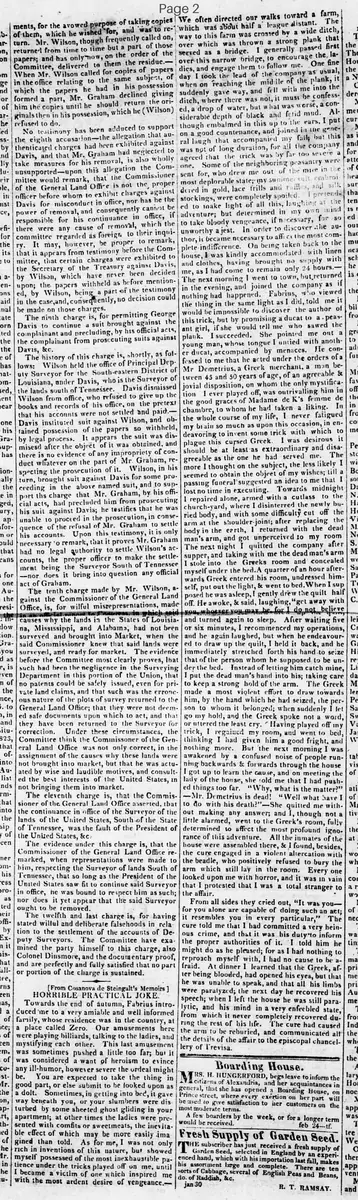
HORRIBLE PRACTICAL JOKE.
Towards the end of autumn, Fabrius introduced me to a very amiable and well informed family, whose residence was in the country, at a place called Zero. Our amusements here were playing billiards, talking to the ladies, and mystifying each other. This last amusement was sometimes pushed a little too far; but it was considered a want of heroism to evince any ill-humor, however severe the ordeal might be. You are expected to take the thing in good part, or else submit to be looked upon as a dolt. Sometimes, in getting into bed, it gave way beneath you, or your slumbers were disturbed by some sheeted ghost gliding in your apartment; at other times the ladies were presented with comfits or sweetmeats, the inevitable effect of which may be more easily imagined than told. As for me, I was not only rich in inventions of this nature, but showed myself possessed of the most inexhaustible patience under the tricks played off on me, until I became a victim of one which inspired me with the most ardent desire of vengeance.
We often directed our walks toward a farm which was about half a league distant. The way to this farm was crossed by a wide ditch, over which was thrown a strong plank that served as a bridge. I generally passed first over this narrow bridge, to encourage the ladies, and engage them to follow me. One fine day I took the lead of the company as usual, when on reaching the middle of the plank, it suddenly gave way, and fell with me into the ditch, where there was not, it must be confessed, a drop of water, but what was worse, a considerable depth of black and fetid mud. Although embalmed in this op to the ears, I put on a good countenance, and joined in the general laugh that accompanied my fall; but this was not of long duration, for all the company agreed that the trick was by far too severe a one. Some of the neighboring peasantry were sent for, who drew me out of the mire in the most deplorable state; my summer suit embroidered in gold, lace frills and ruffles, and silk stockings, were completely spoiled. I pretended to make light of all this, laughing at the adventure; but determined in my own mind to take bloody vengeance, if necessary, for so unworthy a jest. In order to discover the author, it became necessary to affect the most complete indifference. On being taken back to the house, I was kindly accommodated with linen and clothes, having brought no supply with me, as I had come to remain only 24 hours. The next morning I went to town, but returned in the evening, and joined the company as if nothing had happened. Fabrius, who viewed the thing in the same light as I did, told me it would be impossible to discover the author of this trick, but by promising a ducat to a peasant girl, if she would tell me who sawed the plank. I succeeded. She pointed me out a young man, whose tongue I untied with another ducat, accompanied by menaces. He confessed to me that he acted under the orders of a Mr Demetrius, a Greek merchant, a man between 45 and 50 years of age, of an agreeable and jovial disposition, on whom the only mystification I ever played off, was outrivalling him in the good graces of Madame de K's femme de chambre, to whom he had taken a liking. In the whole course of my life, I never fatigued my brain so much as upon this occasion, in endeavoring to invent some trick with which to plague this cursed Greek. I was desirous it should be at least as extraordinary and disagreeable as the one he had served me. The more I thought on the subject, the less likely I seemed to obtain the object of my wishes; till a passing funeral suggested an idea to me that I lost no time in executing. Towards midnight I repaired alone, armed with a cutlass to the church-yard, where I disinterred the newly buried body, and with some difficulty cut off the arm at the shoulder-joint; after replacing the body in the earth, I returned with the dead man's arm, and got unperceived to my room. The next night I quitted the company after supper, and taking with me the dead man's arm I stole into the Greek's room and concealed myself under the bed. A quarter of an hour afterwards Greek entered his room, undressed himself, put out the light, & went to bed. When I supposed he was asleep, I gently drew the quilt half off. He awoke, & said, laughing, "get away with you whoever you may be for I do not believe in ghosts," and turned again to sleep. After waiting five or six minutes, I recommenced my operations, and he again laughed, but when he endeavored to draw up the quilt, I held it back, and he immediately stretched forth his hand to seize that of the person whom he supposed to be under the bed. Instead of letting him catch mine, I put the dead man's hand into his; taking care to keep a strong hold of the arm. The Greek made a most violent effort to draw towards him, by the hand which he had seized, the person to whom it belonged; when suddenly I let go my hold, and the Greek spoke not a word, or uttered the least cry. Having played off my trick, I regained my room, and went to bed, thinking I had given him a good fright, and nothing more. But the next morning I was awakened by a confused noise of people running backwards & forwards through the house I got up to learn the cause, and on meeting the lady of the house, she told me that I had pushed things too far. "Why, what is the matter?" -"Mr. Demetrius is dead!" "Well what have I to do with his death?"-She quitted me without making any answer; and I, though not a little alarmed, went to the Greek's room, fully determined to affect the most profound ignorance of this adventure. All the inmates of the house were assembled there, & I found, besides, the cure engaged in a violent altercation with the beadle, who positively refused to bury the arm which still lay in the room. Every one looked upon me with horror, and it was in vain that I protested that I was a total stranger to the affair. From all sides they cried out, "It was you—for you alone are capable of doing such an act; it resembles you in every particular," The cure told me that I had committed a very heinous crime, and that it was his duty to inform the proper authorities of it. I told him he might do as he pleased; for as I had nothing to reproach myself with, I had no cause to be afraid. At dinner I learned that the Greek, after being blooded, had opened his eyes, but that he was unable to speak, and that all his limbs were paralyzed; the next day he recovered his speech; when I left the house he was still paralytic, and his mind in a very enfeebled state, from which it never completely recovered during the rest of his life. The cure had caused the arm to be reburied, and communicated all the details of the affair to the episcopal chancellery of Trevisa.
HORRIBLE PRACTICAL JOKE.
Towards the end of autumn, Fabrius introduced me to a very amiable and well informed family, whose residence was in the country, at a place called Zero. Our amusements here were playing billiards, talking to the ladies, and mystifying each other. This last amusement was sometimes pushed a little too far; but it was considered a want of heroism to evince any ill-humor, however severe the ordeal might be. You are expected to take the thing in good part, or else submit to be looked upon as a dolt. Sometimes, in getting into bed, it gave way beneath you, or your slumbers were disturbed by some sheeted ghost gliding in your apartment; at other times the ladies were presented with comfits or sweetmeats, the inevitable effect of which may be more easily imagined than told. As for me, I was not only rich in inventions of this nature, but showed myself possessed of the most inexhaustible patience under the tricks played off on me, until I became a victim of one which inspired me with the most ardent desire of vengeance.
We often directed our walks toward a farm which was about half a league distant. The way to this farm was crossed by a wide ditch, over which was thrown a strong plank that served as a bridge. I generally passed first over this narrow bridge, to encourage the ladies, and engage them to follow me. One fine day I took the lead of the company as usual, when on reaching the middle of the plank, it suddenly gave way, and fell with me into the ditch, where there was not, it must be confessed, a drop of water, but what was worse, a considerable depth of black and fetid mud. Although embalmed in this op to the ears, I put on a good countenance, and joined in the general laugh that accompanied my fall; but this was not of long duration, for all the company agreed that the trick was by far too severe a one. Some of the neighboring peasantry were sent for, who drew me out of the mire in the most deplorable state; my summer suit embroidered in gold, lace frills and ruffles, and silk stockings, were completely spoiled. I pretended to make light of all this, laughing at the adventure; but determined in my own mind to take bloody vengeance, if necessary, for so unworthy a jest. In order to discover the author, it became necessary to affect the most complete indifference. On being taken back to the house, I was kindly accommodated with linen and clothes, having brought no supply with me, as I had come to remain only 24 hours. The next morning I went to town, but returned in the evening, and joined the company as if nothing had happened. Fabrius, who viewed the thing in the same light as I did, told me it would be impossible to discover the author of this trick, but by promising a ducat to a peasant girl, if she would tell me who sawed the plank. I succeeded. She pointed me out a young man, whose tongue I untied with another ducat, accompanied by menaces. He confessed to me that he acted under the orders of a Mr Demetrius, a Greek merchant, a man between 45 and 50 years of age, of an agreeable and jovial disposition, on whom the only mystification I ever played off, was outrivalling him in the good graces of Madame de K's femme de chambre, to whom he had taken a liking. In the whole course of my life, I never fatigued my brain so much as upon this occasion, in endeavoring to invent some trick with which to plague this cursed Greek. I was desirous it should be at least as extraordinary and disagreeable as the one he had served me. The more I thought on the subject, the less likely I seemed to obtain the object of my wishes; till a passing funeral suggested an idea to me that I lost no time in executing. Towards midnight I repaired alone, armed with a cutlass to the church-yard, where I disinterred the newly buried body, and with some difficulty cut off the arm at the shoulder-joint; after replacing the body in the earth, I returned with the dead man's arm, and got unperceived to my room. The next night I quitted the company after supper, and taking with me the dead man's arm I stole into the Greek's room and concealed myself under the bed. A quarter of an hour afterwards Greek entered his room, undressed himself, put out the light, & went to bed. When I supposed he was asleep, I gently drew the quilt half off. He awoke, & said, laughing, "get away with you whoever you may be for I do not believe in ghosts," and turned again to sleep. After waiting five or six minutes, I recommenced my operations, and he again laughed, but when he endeavored to draw up the quilt, I held it back, and he immediately stretched forth his hand to seize that of the person whom he supposed to be under the bed. Instead of letting him catch mine, I put the dead man's hand into his; taking care to keep a strong hold of the arm. The Greek made a most violent effort to draw towards him, by the hand which he had seized, the person to whom it belonged; when suddenly I let go my hold, and the Greek spoke not a word, or uttered the least cry. Having played off my trick, I regained my room, and went to bed, thinking I had given him a good fright, and nothing more. But the next morning I was awakened by a confused noise of people running backwards & forwards through the house I got up to learn the cause, and on meeting the lady of the house, she told me that I had pushed things too far. "Why, what is the matter?" -"Mr. Demetrius is dead!" "Well what have I to do with his death?"-She quitted me without making any answer; and I, though not a little alarmed, went to the Greek's room, fully determined to affect the most profound ignorance of this adventure. All the inmates of the house were assembled there, & I found, besides, the cure engaged in a violent altercation with the beadle, who positively refused to bury the arm which still lay in the room. Every one looked upon me with horror, and it was in vain that I protested that I was a total stranger to the affair. From all sides they cried out, "It was you—for you alone are capable of doing such an act; it resembles you in every particular," The cure told me that I had committed a very heinous crime, and that it was his duty to inform the proper authorities of it. I told him he might do as he pleased; for as I had nothing to reproach myself with, I had no cause to be afraid. At dinner I learned that the Greek, after being blooded, had opened his eyes, but that he was unable to speak, and that all his limbs were paralyzed; the next day he recovered his speech; when I left the house he was still paralytic, and his mind in a very enfeebled state, from which it never completely recovered during the rest of his life. The cure had caused the arm to be reburied, and communicated all the details of the affair to the episcopal chancellery of Trevisa.
What sub-type of article is it?
Prose Fiction
What themes does it cover?
Social Manners
Moral Virtue
What keywords are associated?
Practical Joke
Vengeance
Ghost Prank
Mud Fall
Severed Arm
Paralysis
Casanova Memoirs
What entities or persons were involved?
From Casanova De Seingalt's Memoirs
Literary Details
Title
Horrible Practical Joke.
Author
From Casanova De Seingalt's Memoirs
Form / Style
Narrative Anecdote From Memoirs
Key Lines
"Get Away With You Whoever You May Be For I Do Not Believe In Ghosts,"
"Mr. Demetrius Is Dead!"
"It Was You—For You Alone Are Capable Of Doing Such An Act; It Resembles You In Every Particular,"