Thank you for visiting SNEWPapers!
Sign up free
Editorial
December 7, 1951
The Catholic Times
Columbus, Franklin County, Ohio
What is this article about?
Gretta Palmer's editorial reflects on the Reformation's destruction of unified Catholic Christendom, contrasting its natural 'One World' with modern fragmented international efforts and the loss of shared religious life rhythms in society.
Clipping
OCR Quality
95%
Excellent
Full Text
GRETTA PALMER
The Real One World'
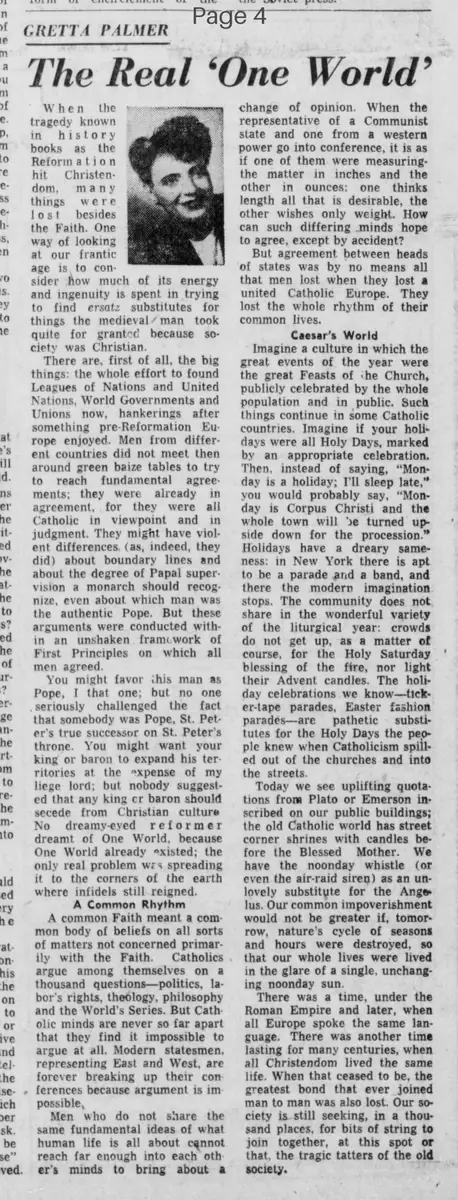
When the tragedy known in history books as the Reformation hit Christendom, many things were lost besides the Faith. One way of looking at our frantic age is to consider how much of its energy and ingenuity is spent in trying to find ersatz substitutes for things the medieval man took quite for granted because society was Christian.
There are, first of all, the big things: the whole effort to found Leagues of Nations and United Nations, World Governments and Unions now, hankerings after something pre-Reformation Europe enjoyed. Men from different countries did not meet then around green baize tables to try to reach fundamental agreements; they were already in agreement, for they were all Catholic in viewpoint and in judgment. They might have violent differences (as, indeed, they did) about boundary lines and about the degree of Papal supervision a monarch should recognize, even about which man was the authentic Pope. But these arguments were conducted within an unshaken framework of First Principles on which all men agreed.
You might favor this man as Pope, I that one; but no one seriously challenged the fact that somebody was Pope. St. Peter's true successor on St. Peter's throne. You might want your king or baron to expand his territories at the expense of my liege lord; but nobody suggested that any king or baron should secede from Christian culture. No dreamy-eyed reformer dreamt of One World, because One World already existed; the only real problem was spreading it to the corners of the earth where infidels still reigned.
A Common Rhythm
A common Faith meant a common body of beliefs on all sorts of matters not concerned primarily with the Faith. Catholics argue among themselves on a thousand questions-politics, labor's rights, theology, philosophy and the World's Series. But Catholic minds are never so far apart that they find it impossible to argue at all. Modern statesmen, representing East and West, are forever breaking up their conferences because argument is impossible.
Men who do not share the same fundamental ideas of what human life is all about cannot reach far enough into each other's minds to bring about a change of opinion. When the representative of a Communist state and one from a western power go into conference, it is as if one of them were measuring the matter in inches and the other in ounces: one thinks length all that is desirable, the other wishes only weight. How can such differing minds hope to agree, except by accident?
But agreement between heads of states was by no means all that men lost when they lost a united Catholic Europe. They lost the whole rhythm of their common lives.
Caesar's World
Imagine a culture in which the great events of the year were the great Feasts of the Church, publicly celebrated by the whole population and in public. Such things continue in some Catholic countries. Imagine if your holidays were all Holy Days, marked by an appropriate celebration. Then, instead of saying, "Monday is a holiday; I'll sleep late," you would probably say, "Monday is Corpus Christi and the whole town will be turned upside down for the procession."
Holidays have a dreariness sameness: in New York there is apt to be a parade and a band, and there the modern imagination stops. The community does not share in the wonderful variety of the liturgical year: crowds do not get up, as a matter of course, for the Holy Saturday blessing of the fire, nor light their Advent candles. The holiday celebrations we know-ticker-tape parades, Easter fashion parades-are pathetic substitutes for the Holy Days the people knew when Catholicism spilled out of the churches and into the streets.
Today we see uplifting quotations from Plato or Emerson inscribed on our public buildings; the old Catholic world has street corner shrines with candles before the Blessed Mother. We have the noonday whistle (or even the air-raid sirens an unlovely substitute for the Angelus. Our common impoverishment would not be greater if, tomorrow, nature's cycle of seasons and hours were destroyed, so that our whole lives were lived in the glare of a single, unchanging noonday sun.
There was a time, under the Roman Empire and later, when all Europe spoke the same language. There was another time lasting for many centuries, when all Christendom lived the same life. When that ceased to be, the greatest bond that ever joined man to man was also lost. Our society is still seeking, in a thousand places, for bits of string to join together, at this spot or that, the tragic tatters of the old society.
The Real One World'
When the tragedy known in history books as the Reformation hit Christendom, many things were lost besides the Faith. One way of looking at our frantic age is to consider how much of its energy and ingenuity is spent in trying to find ersatz substitutes for things the medieval man took quite for granted because society was Christian.
There are, first of all, the big things: the whole effort to found Leagues of Nations and United Nations, World Governments and Unions now, hankerings after something pre-Reformation Europe enjoyed. Men from different countries did not meet then around green baize tables to try to reach fundamental agreements; they were already in agreement, for they were all Catholic in viewpoint and in judgment. They might have violent differences (as, indeed, they did) about boundary lines and about the degree of Papal supervision a monarch should recognize, even about which man was the authentic Pope. But these arguments were conducted within an unshaken framework of First Principles on which all men agreed.
You might favor this man as Pope, I that one; but no one seriously challenged the fact that somebody was Pope. St. Peter's true successor on St. Peter's throne. You might want your king or baron to expand his territories at the expense of my liege lord; but nobody suggested that any king or baron should secede from Christian culture. No dreamy-eyed reformer dreamt of One World, because One World already existed; the only real problem was spreading it to the corners of the earth where infidels still reigned.
A Common Rhythm
A common Faith meant a common body of beliefs on all sorts of matters not concerned primarily with the Faith. Catholics argue among themselves on a thousand questions-politics, labor's rights, theology, philosophy and the World's Series. But Catholic minds are never so far apart that they find it impossible to argue at all. Modern statesmen, representing East and West, are forever breaking up their conferences because argument is impossible.
Men who do not share the same fundamental ideas of what human life is all about cannot reach far enough into each other's minds to bring about a change of opinion. When the representative of a Communist state and one from a western power go into conference, it is as if one of them were measuring the matter in inches and the other in ounces: one thinks length all that is desirable, the other wishes only weight. How can such differing minds hope to agree, except by accident?
But agreement between heads of states was by no means all that men lost when they lost a united Catholic Europe. They lost the whole rhythm of their common lives.
Caesar's World
Imagine a culture in which the great events of the year were the great Feasts of the Church, publicly celebrated by the whole population and in public. Such things continue in some Catholic countries. Imagine if your holidays were all Holy Days, marked by an appropriate celebration. Then, instead of saying, "Monday is a holiday; I'll sleep late," you would probably say, "Monday is Corpus Christi and the whole town will be turned upside down for the procession."
Holidays have a dreariness sameness: in New York there is apt to be a parade and a band, and there the modern imagination stops. The community does not share in the wonderful variety of the liturgical year: crowds do not get up, as a matter of course, for the Holy Saturday blessing of the fire, nor light their Advent candles. The holiday celebrations we know-ticker-tape parades, Easter fashion parades-are pathetic substitutes for the Holy Days the people knew when Catholicism spilled out of the churches and into the streets.
Today we see uplifting quotations from Plato or Emerson inscribed on our public buildings; the old Catholic world has street corner shrines with candles before the Blessed Mother. We have the noonday whistle (or even the air-raid sirens an unlovely substitute for the Angelus. Our common impoverishment would not be greater if, tomorrow, nature's cycle of seasons and hours were destroyed, so that our whole lives were lived in the glare of a single, unchanging noonday sun.
There was a time, under the Roman Empire and later, when all Europe spoke the same language. There was another time lasting for many centuries, when all Christendom lived the same life. When that ceased to be, the greatest bond that ever joined man to man was also lost. Our society is still seeking, in a thousand places, for bits of string to join together, at this spot or that, the tragic tatters of the old society.
What sub-type of article is it?
Moral Or Religious
What keywords are associated?
Reformation Loss
Catholic Unity
One World
Christian Society
Liturgical Year
Medieval Europe
Modern Substitutes
What entities or persons were involved?
Reformation
Catholic Church
Pope
Medieval Europe
United Nations
Editorial Details
Primary Topic
Loss Of Catholic Unity After The Reformation
Stance / Tone
Nostalgic Praise For Pre Reformation Christian Society
Key Figures
Reformation
Catholic Church
Pope
Medieval Europe
United Nations
Key Arguments
Reformation Caused Loss Of Unified Christian Worldview
Modern International Efforts Seek Substitutes For Pre Reformation Unity
Catholic Faith Provided Common Framework For Agreements Despite Differences
Loss Of Common Faith Leads To Impossible Modern Conferences
Pre Reformation Life Had Shared Rhythm Through Church Feasts And Holy Days
Modern Holidays Are Poor Substitutes For Liturgical Celebrations
Catholic World Had Shared Language Of Faith Binding Society