Thank you for visiting SNEWPapers!
Sign up free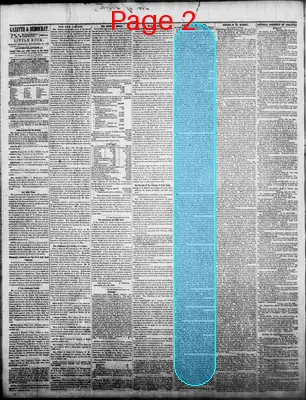
Editorial
November 26, 1852
Arkansas State Gazette And Democrat
Little Rock, Pulaski County, Arkansas
What is this article about?
In the Arkansas House of Representatives on the 18th inst., Mr. Turner of Franklin County opposes a tax exemption in the bill to incorporate Oil Trough Academy, arguing it is unconstitutional, promotes class legislation, and burdens other taxpayers amid state financial woes.
Clipping

OCR Quality
95%
Excellent
Full Text
Remarks on Mr. Turner.
Of Franklin county, in the House of Representatives, on the 18th inst., on the subject of special legislation.
The bill introduced by Mr. Saffold, to be entitled, "An act to incorporate Oil Trough Academy, in Oil Trough Bottom, Arkansas," being under consideration upon its third reading, Mr. Turner moved to amend the bill, by striking out that portion which exempts the property to be held by the corporation, from a State tax. The amount to be exempted by the bill, was $25,000, exclusive of the lot, buildings, &c. Mr. Turner said:
Mr. Speaker—In offering this amendment, I desire to make a few explanatory remarks. I shall not attempt to make a speech, for speech-making is not my trade. But, I rise to state to this house, as briefly as I can, the reason why I am opposed to a portion of this bill; for I do not wish to be understood as being opposed to the general objects had in view, by the mover of this measure. On the contrary, I feel a deep interest in this, and all similar bills, having for their object, the establishment of institutions of learning, or, the promulgation of useful knowledge. It is only to that portion of the bill which exempts the property of the corporation from a State tax, that I object.
Sir, this exemption, to my mind, smacks a little of the ancient mode of class legislation, a mode long since exploded, at least in theory, if not in practice, by the democracy of our country.
By the provisions of this bill, we are asked to give our sanction to a measure, which, to my mind, is directly at war with the spirit of our system of government, and in derogation of our Constitution; a measure inexpedient and uncalled for by any known necessity, and in direct opposition to the decisions of our Supreme Court.
Begin, sir, by exempting $25,000 worth of property in Oil Trough Bottom, an area, as I am informed, of about the size of a congressional township, and you lay the foundation for at least six such exemptions in each county in this State.—The people would have a right to demand it at your hands, nor could you reasonably refuse their demands. Multiply the 53 counties in this State by six, (the number of exemptions each county may reasonably claim), and the amount by $25,000, and you have the enormous sum of $7,950,000 of the taxable property of this State to be exempted from taxation—nearly one-third of the taxable property of the State—and that, too, at a time, when the state of our finances are at the lowest ebb; when every patriot should be employed in devising means to extricate the State from her embarrassments. More than this; if you exempt a certain amount from taxation, it follows as a matter of course, that you must raise the ratio upon that portion left unexempted; for we all know that a certain amount of revenue is indispensable to the maintenance and support of our government.
This leads us to the enquiry as to what are the objects for which our government was created?—Now sir, I am no lawyer, as is very obvious to the members present; but though not "learned in the law," I may be pardoned for giving what I understand to be the objects had in view, by the framers of our government. Their primary object was, to protect us in the peaceable enjoyment of life, liberty, and property. To have this protection, we must have laws and officers to execute them, and these officers must be paid; for by the due exercise of the authority vested in them, we receive and are secured in that protection for which we have agreed to form a government. To raise this revenue, the most reasonable, just and equitable way, is to levy a direct tax. But the question is: what shall we tax? To my mind the answer is clear, and that answer is: to tax all property according to its value, in the enjoyment of which we are protected by our government. This conclusion I deem incontrovertible, and one which, I am persuaded, all candid and impartial minds that investigate the subject, are bound, at last, to come.
Now sir, is this corporation willing to come up to this standard: Are they willing to bear an equal share of the burdens, while they enjoy the equal benefits of a good government? If so, let them strike out that odious feature of the bill, which would claim all the benefits, but refuses to submit to any of the burdens, and I am with them heart and hand. If not, here, on this floor, I enter my solemn protest against the passage of a law containing a feature so repugnant to the spirit of liberty!
We are told, by the advocates of this bill, that it is our duty to encourage these institutions by all legitimate means in our power. To this sentiment I heartily subscribe. But, sir, does it follow as a necessary consequence, that because we deem their property a fit subject for taxation, that therefore we wish not to encourage them? Assuredly not. According to that mode of argument, all the great interests of agriculture, commerce, and manufactures, would be equally discouraged if we taxed them. We are bound by the constitution to encourage one as well as the other, and should exempt all or exempt none.
Why is it, sir, that the poor, the laboring, hard handed men, a class to which I claim to belong, are never found besieging these halls and asking for exemptions? Why is it, that you are never troubled with any demands from them to be exempt from taxation? No sir, all they ask is even-handed justice. We are willing that every species of property we possess on earth should be taxed according to its value; provided, that all others who enjoy the blessings of our free government shall be taxed in the same manner. But we exclaim and protest against your taxing all the property we may possess, and by the passage of a bill like this, exempting the property of others to an amount greater than many of us combined, are able to possess.
In behalf of the hard fisted yeomanry of the country, I will make this proposition, to those who may think that they are entitled to more in the sphere of "the upper ten." My proposition is this: As our State is almost hopelessly in debt—our finances at a very low ebb—the interest on our State debt increasing, and a great necessity existing to increase our revenue by some means, that we all submit to a rate of tax being levied, say one-sixth of one per cent., on all our property, and nothing of value to be exempted. If gentlemen are willing to measure their patriotism by this just and equitable rule, let them come up to the mark—face the music—stand up to the rack, and tell the assessor, once a year, on oath, to the best of their knowledge and belief, what they are really worth. Let nothing be kept back, nothing exempted, and my word for it, our sky will begin to clear, we shall soon have enough to pay the ordinary expenses of our government, and perhaps, some left to pay a moiety of the accruing interest on our State debt! But so long as we make one half pay the piper, while all are equal in the dance, so long will the frowns of offended Justice be upon us.
But to return to this bill. I said, in the outset, that it was unconstitutional, and opposed to the decisions of our Supreme Court. The 2d sec. of art. 7, of the constitution of the State of Arkansas, under the head of "Revenue," says:
"All property subject to taxation, shall be taxed according to its value—that value to be ascertained in such manner as the General Assembly shall direct; making the same equal and uniform throughout the State."
Upon which clause in our constitution, our Supreme Court has decided as follows:
"No portion of any distinct genus or species of property, on which such tax is imposed, can ever be exempt from it. If any improvements on land are taxed, all improvements of like kind must be taxed equally, according to value, in all parts of the State."
I presume that Oil Trough Bottom is in this State, and this decision, to my mind, is just to the point covering all the ground, and leaving not the smallest corner for the advocates of this bill to stand upon. In view of all these facts, I cannot help indulging the hope, that by a vote of this House, we shall strike this odious feature from the face of the bill, and then pass it.
I am well aware, that gentlemen will say that this is a small affair, and that all the revenue we can raise by taxing corporations, will amount to but little. "But I would remind them, that, if this be the case, it would take but little to pay it, and besides, it is the principle, not the amount, for which I am contending. If I am cited to charters granted by former legislatures, exempting such property, I would answer that they are plainly proven to be bad precedents, and should no longer be followed.
I am well aware of my inability to do justice to this subject, and I indulge the hope that some gentleman of enlarged patriotism and with qualifications equal to the importance of the principles here maintained, will take up this discussion, and show these principles in their native beauty truth and simplicity. Let him show, too, that this partial legislation is insidious in its encroachments and like the silent water undermining the rock, will undermine the fair fabric of our constitution and laws. And let him show, that the principle here reprobated, is deceitful, treacherous, and false and though it be clothed in this bill for the advancement of education, it is like a snake clothed in an 'argument'—it perfume it, disguise it as you will, if the poison remains it will kill. With it in it still.
Of Franklin county, in the House of Representatives, on the 18th inst., on the subject of special legislation.
The bill introduced by Mr. Saffold, to be entitled, "An act to incorporate Oil Trough Academy, in Oil Trough Bottom, Arkansas," being under consideration upon its third reading, Mr. Turner moved to amend the bill, by striking out that portion which exempts the property to be held by the corporation, from a State tax. The amount to be exempted by the bill, was $25,000, exclusive of the lot, buildings, &c. Mr. Turner said:
Mr. Speaker—In offering this amendment, I desire to make a few explanatory remarks. I shall not attempt to make a speech, for speech-making is not my trade. But, I rise to state to this house, as briefly as I can, the reason why I am opposed to a portion of this bill; for I do not wish to be understood as being opposed to the general objects had in view, by the mover of this measure. On the contrary, I feel a deep interest in this, and all similar bills, having for their object, the establishment of institutions of learning, or, the promulgation of useful knowledge. It is only to that portion of the bill which exempts the property of the corporation from a State tax, that I object.
Sir, this exemption, to my mind, smacks a little of the ancient mode of class legislation, a mode long since exploded, at least in theory, if not in practice, by the democracy of our country.
By the provisions of this bill, we are asked to give our sanction to a measure, which, to my mind, is directly at war with the spirit of our system of government, and in derogation of our Constitution; a measure inexpedient and uncalled for by any known necessity, and in direct opposition to the decisions of our Supreme Court.
Begin, sir, by exempting $25,000 worth of property in Oil Trough Bottom, an area, as I am informed, of about the size of a congressional township, and you lay the foundation for at least six such exemptions in each county in this State.—The people would have a right to demand it at your hands, nor could you reasonably refuse their demands. Multiply the 53 counties in this State by six, (the number of exemptions each county may reasonably claim), and the amount by $25,000, and you have the enormous sum of $7,950,000 of the taxable property of this State to be exempted from taxation—nearly one-third of the taxable property of the State—and that, too, at a time, when the state of our finances are at the lowest ebb; when every patriot should be employed in devising means to extricate the State from her embarrassments. More than this; if you exempt a certain amount from taxation, it follows as a matter of course, that you must raise the ratio upon that portion left unexempted; for we all know that a certain amount of revenue is indispensable to the maintenance and support of our government.
This leads us to the enquiry as to what are the objects for which our government was created?—Now sir, I am no lawyer, as is very obvious to the members present; but though not "learned in the law," I may be pardoned for giving what I understand to be the objects had in view, by the framers of our government. Their primary object was, to protect us in the peaceable enjoyment of life, liberty, and property. To have this protection, we must have laws and officers to execute them, and these officers must be paid; for by the due exercise of the authority vested in them, we receive and are secured in that protection for which we have agreed to form a government. To raise this revenue, the most reasonable, just and equitable way, is to levy a direct tax. But the question is: what shall we tax? To my mind the answer is clear, and that answer is: to tax all property according to its value, in the enjoyment of which we are protected by our government. This conclusion I deem incontrovertible, and one which, I am persuaded, all candid and impartial minds that investigate the subject, are bound, at last, to come.
Now sir, is this corporation willing to come up to this standard: Are they willing to bear an equal share of the burdens, while they enjoy the equal benefits of a good government? If so, let them strike out that odious feature of the bill, which would claim all the benefits, but refuses to submit to any of the burdens, and I am with them heart and hand. If not, here, on this floor, I enter my solemn protest against the passage of a law containing a feature so repugnant to the spirit of liberty!
We are told, by the advocates of this bill, that it is our duty to encourage these institutions by all legitimate means in our power. To this sentiment I heartily subscribe. But, sir, does it follow as a necessary consequence, that because we deem their property a fit subject for taxation, that therefore we wish not to encourage them? Assuredly not. According to that mode of argument, all the great interests of agriculture, commerce, and manufactures, would be equally discouraged if we taxed them. We are bound by the constitution to encourage one as well as the other, and should exempt all or exempt none.
Why is it, sir, that the poor, the laboring, hard handed men, a class to which I claim to belong, are never found besieging these halls and asking for exemptions? Why is it, that you are never troubled with any demands from them to be exempt from taxation? No sir, all they ask is even-handed justice. We are willing that every species of property we possess on earth should be taxed according to its value; provided, that all others who enjoy the blessings of our free government shall be taxed in the same manner. But we exclaim and protest against your taxing all the property we may possess, and by the passage of a bill like this, exempting the property of others to an amount greater than many of us combined, are able to possess.
In behalf of the hard fisted yeomanry of the country, I will make this proposition, to those who may think that they are entitled to more in the sphere of "the upper ten." My proposition is this: As our State is almost hopelessly in debt—our finances at a very low ebb—the interest on our State debt increasing, and a great necessity existing to increase our revenue by some means, that we all submit to a rate of tax being levied, say one-sixth of one per cent., on all our property, and nothing of value to be exempted. If gentlemen are willing to measure their patriotism by this just and equitable rule, let them come up to the mark—face the music—stand up to the rack, and tell the assessor, once a year, on oath, to the best of their knowledge and belief, what they are really worth. Let nothing be kept back, nothing exempted, and my word for it, our sky will begin to clear, we shall soon have enough to pay the ordinary expenses of our government, and perhaps, some left to pay a moiety of the accruing interest on our State debt! But so long as we make one half pay the piper, while all are equal in the dance, so long will the frowns of offended Justice be upon us.
But to return to this bill. I said, in the outset, that it was unconstitutional, and opposed to the decisions of our Supreme Court. The 2d sec. of art. 7, of the constitution of the State of Arkansas, under the head of "Revenue," says:
"All property subject to taxation, shall be taxed according to its value—that value to be ascertained in such manner as the General Assembly shall direct; making the same equal and uniform throughout the State."
Upon which clause in our constitution, our Supreme Court has decided as follows:
"No portion of any distinct genus or species of property, on which such tax is imposed, can ever be exempt from it. If any improvements on land are taxed, all improvements of like kind must be taxed equally, according to value, in all parts of the State."
I presume that Oil Trough Bottom is in this State, and this decision, to my mind, is just to the point covering all the ground, and leaving not the smallest corner for the advocates of this bill to stand upon. In view of all these facts, I cannot help indulging the hope, that by a vote of this House, we shall strike this odious feature from the face of the bill, and then pass it.
I am well aware, that gentlemen will say that this is a small affair, and that all the revenue we can raise by taxing corporations, will amount to but little. "But I would remind them, that, if this be the case, it would take but little to pay it, and besides, it is the principle, not the amount, for which I am contending. If I am cited to charters granted by former legislatures, exempting such property, I would answer that they are plainly proven to be bad precedents, and should no longer be followed.
I am well aware of my inability to do justice to this subject, and I indulge the hope that some gentleman of enlarged patriotism and with qualifications equal to the importance of the principles here maintained, will take up this discussion, and show these principles in their native beauty truth and simplicity. Let him show, too, that this partial legislation is insidious in its encroachments and like the silent water undermining the rock, will undermine the fair fabric of our constitution and laws. And let him show, that the principle here reprobated, is deceitful, treacherous, and false and though it be clothed in this bill for the advancement of education, it is like a snake clothed in an 'argument'—it perfume it, disguise it as you will, if the poison remains it will kill. With it in it still.
What sub-type of article is it?
Economic Policy
Education
Constitutional
What keywords are associated?
Tax Exemption
Special Legislation
Oil Trough Academy
Arkansas Constitution
Uniform Taxation
State Finances
Education Incorporation
What entities or persons were involved?
Mr. Turner
Mr. Saffold
Oil Trough Academy
House Of Representatives
Supreme Court Of Arkansas
Editorial Details
Primary Topic
Opposition To Tax Exemption In Oil Trough Academy Incorporation Bill
Stance / Tone
Strong Opposition To Special Tax Exemptions As Unconstitutional And Unfair
Key Figures
Mr. Turner
Mr. Saffold
Oil Trough Academy
House Of Representatives
Supreme Court Of Arkansas
Key Arguments
Exemption Promotes Class Legislation Contrary To Democratic Principles
Violates Arkansas Constitution Requiring Uniform Taxation
Opposes Supreme Court Decisions On Equal Taxation
Would Exempt Nearly One Third Of State Property, Worsening Finances
All Property Should Share Burdens Equally For Government Protection
Encouraging Education Does Not Justify Tax Exemptions For Specific Institutions
Proposes Uniform Low Tax Rate On All Property Without Exemptions