Thank you for visiting SNEWPapers!
Sign up free
The Kentucky Gazette
Lexington, Fayette County, Kentucky
What is this article about?
On January 2, 1789, the Prince of Wales delivered a paper to the Lord Chancellor responding to Mr. Pitt's proposals for Regency limitations during King George III's illness, objecting to restrictions that would weaken government, divide the royal family, and undermine the crown's prerogatives.
Clipping
OCR Quality
Full Text
(Continued from our Last.)
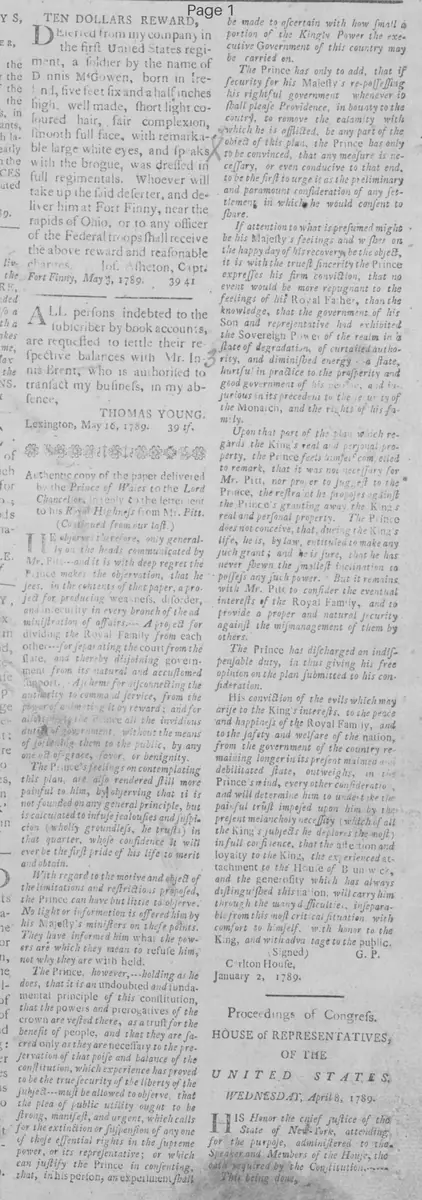
He observes therefore, only generally on the heads communicated by Mr. Pitt—and it is with deep regret the Prince makes the observation, that he sees, in the contents of that paper, a project for producing weakness, disorder, and insecurity in every branch of the administration of affairs. A project for dividing the Royal Family from each other—for separating the court from the Cate, and thereby disjoining government from its natural and accustomed support. A scheme for disconnecting the authority to command service, from the power of animating it by reward; and for assigning to the Prince all the invidious duties of government, without the means of sweetening them to the public, by any one act of grace, favor, or benignity.
The Prince's feelings on contemplating this plan, are also rendered still more painful to him, by observing that it is not founded on any general principle, but is calculated to infuse jealousies and suspicion (wholly groundless, he trusts) in that quarter, whose confidence it will ever be the first pride of his life to merit and obtain.
With regard to the motive and object of the limitations and restrictions proposed, the Prince can have but little to observe. No light or information is offered him by his Majesty's ministers on these points. They have informed him what the powers are which they mean to refuse him, not why they are withheld.
The Prince, however,—holding as he does, that it is an undoubted and fundamental principle of this constitution, that the powers and prerogatives of the crown are vested there, as a trust for the benefit of the people, and that they are sacred only as they are necessary to the preservation of that poise and balance of the constitution, which experience has proved to be the true security of the liberty of the subject—must be allowed to observe, that the plea of public utility ought to be strong, manifest, and urgent, which calls for the extinction or suspension of any one of those essential rights in the supreme power, or its representative; or which can justify the Prince in consenting, that, in his person, an experiment shall be made to ascertain with how small a portion of the Kingly Power the executive Government of this country may be carried on.
The Prince has only to add, that if security for his Majesty's re-possessing his rightful government whenever it shall please Providence, in bounty to the country, to remove the calamity with which he is afflicted, be any part of the object of this plan, the Prince has only to be convinced, that any measure is necessary, or even conducive to that end, to be the first to urge it as the preliminary and paramount consideration of any settlement in which he would consent to share.
If attention to what is presumed might be his Majesty's feelings and wishes on the happy day of his recovery, be the object, it is with the truest sincerity the Prince expresses his firm conviction, that no event would be more repugnant to the feelings of his Royal Father, than the knowledge, that the government of his Son and representative had exhibited the Sovereign Power of the realm in a state of degradation, of curtailed authority, and diminished energy—a state, hurtful in practice to the prosperity and good government of his realm, and injurious in its precedent to the equity of the Monarch, and the rights of his family.
Upon that part of the plan which regards the King's real and personal property, the Prince feels himself compelled to remark, that it was not necessary for Mr. Pitt, nor proper to suggest to the Prince, the restraint he proposes against the Prince's granting away the King's real and personal property. The Prince does not conceive, that, during the King's life, he is, by law, entitled to make any such grant; and he is sure, that he has never shewn the smallest inclination to possess any such power. But it remains with Mr. Pitt to consider the eventual interests of the Royal Family, and to provide a proper and natural security against the mismanagement of them by others.
The Prince has discharged an indispensable duty, in thus giving his free opinion on the plan submitted to his consideration. His conviction of the evils which may arise to the King's interests, to the peace and happiness of the Royal Family, and to the safety and welfare of the nation, from the government of the country remaining longer in its present maimed and debilitated state, outweighs, in the Prince's mind, every other consideration, and will determine him to undertake the painful trust imposed upon him by the present melancholy necessity (which of all the King's subjects he deplores the most) in full confidence, that the affection and loyalty to the King, the experienced attachment to the House of Brunswick, and the generosity which has always distinguished this nation, will carry him through the arduous difficulties, inseparable from this most critical situation with comfort to himself, with honor to the King, and with advantage to the public.
(Signed) G. P.
Carlton House,
January 2, 1789.
What sub-type of article is it?
What keywords are associated?
What entities or persons were involved?
Where did it happen?
Foreign News Details
Primary Location
Carlton House
Event Date
January 2, 1789
Key Persons
Event Details
The Prince of Wales expresses objections to Mr. Pitt's proposed limitations on Regency powers during the King's illness, arguing they would weaken government, divide the royal family, and undermine constitutional principles. He affirms willingness to accept the Regency if necessary for the King's recovery and national welfare.