Thank you for visiting SNEWPapers!
Sign up free
Berkeley And Jefferson Intelligencer
Martinsburg, Berkeley County, Virginia
What is this article about?
Extracts from Alexander Stephens' 'A History of the Late European War' reflect on the French Revolution's crimes, heroism, and impacts. It details war's horrors, advancements in military art and sciences, territorial changes, and outcomes for nations like France, Russia, and others, critiquing the era's political shifts.
Merged-components note: Continuation of extracts from the history of the late European war across pages 1 and 2; original label of third component was editorial, changed to literary.
Clippings
1 of 2
OCR Quality
Full Text
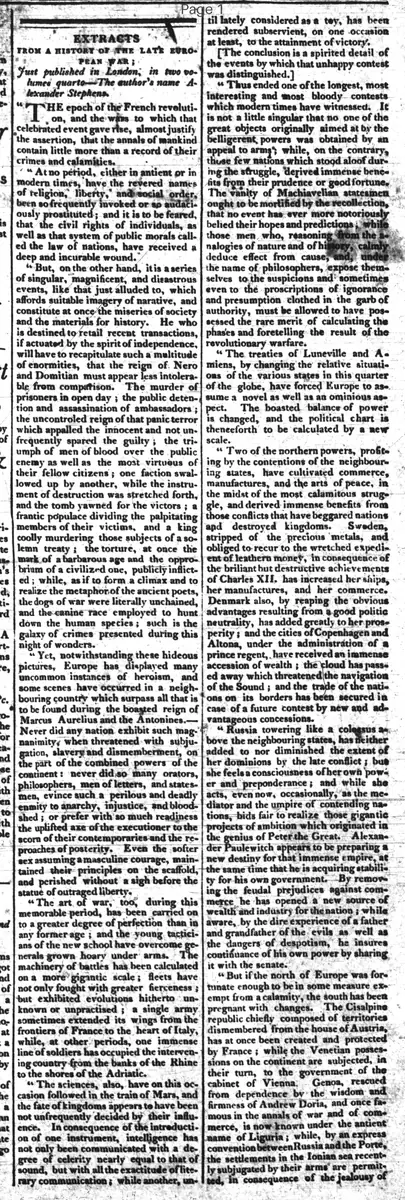
FROM A HISTORY OF THE LATE EUROPEAN WAR;
First published in London; in two volumes quarto. The author's name Alexander Stephens.
"THE epoch of the French revolution celebrated event gave rise, almost justify the assertion, that the annals of mankind contain little more than a record of their crimes and calamities.
"At no period, either in antient or in modern times, have the revered names of religion, liberty, and social order, been so frequently invoked or so audaciously prostituted; and it is to be feared, that the civil rights of individuals, as well as that system of public morals called the law of nations, have received a deep and incurable wound.
But, on the other hand, it is a series of singular, magnificent, and disastrous events, like that just alluded to, which affords suitable imagery of narrative, and constitute at once the miseries of society and the materials for history." He who is destined to retail recent transactions, if actuated by the spirit of independence, will have to recapitulate such a multitude of enormities, that the reign of Nero and Domitian must appear less intolerable from comparison. The murder of prisoners in open day; the public detention and assassination of ambassadors; the uncontrolled reign of that panic terror which appalled the innocent and not unfrequently spared the guilty; the triumph of men of blood over the public enemy as well as the most virtuous of their fellow citizens; one faction swallowed up by another, while the instrument of destruction was stretched forth, and the tomb yawned for the victors; a frantic populace dividing the palpitating members of their victims, and a king coolly murdering those subjects of a solemn treaty; the torture, at once the mark of a barbarous age and the opprobrium of a civilized one, publicly inflicted; while, as if to form a climax and to realize the metaphor of the ancient poets, the dogs of war were literally unchained, and the canine race employed to hunt down the human species; such is the galaxy of crimes presented during this night of wonders.
"Yet, notwithstanding these hideous pictures, Europe has displayed many uncommon instances of heroism, and some scenes have occurred in a neighbouring country which surpass all that is to be found during the boasted reign of Marcus Aurelius and the Antonines. Never did any nation exhibit such magnanimity, when threatened with subjugation, slavery and dismemberment, on the part of the combined powers of the continent: never did so many orators, philosophers, men of letters, and statesmen, evince such a perilous and deadly enmity to anarchy, injustice, and bloodshed; or prefer with so much readiness the uplifted axe of the executioner to the scorn of their contemporaries—and the reproaches of posterity. Even the softer sex assuming a masculine courage, maintained their principles on the scaffold; and perished without a sigh before the statue of outraged liberty.
"The art of war, too, during this memorable period, has been carried on to a greater degree of perfection than in any former age; and the young tacticians of the new school have overcome generals grown hoary under arms. The machinery of battles has been calculated on a more gigantic scale; fleets have not only fought with greater fierceness; but exhibited evolutions hitherto unknown or unpractised; a single army sometimes extended its wings from the frontiers of France to the heart of Italy, while, at other periods, one immense line of soldiers has occupied the intervening country from the banks of the Rhine to the shores of the Adriatic.
"The sciences, also, have on this occasion followed in the train of Mars, and the fate of kingdoms appears to have been not unfrequently decided by their influence. In consequence of the introduction of one instrument, intelligence has not only been communicated with a degree of celerity nearly equal to that of sound, but with all the exactitude of literary communication; while another, until lately considered as a toy, has been rendered subservient, on one occasion at least, to the attainment of victory. The conclusion is a spirited detail of the events by which that unhappy contest was distinguished.]
"Thus ended one of the longest, most interesting and most bloody contests which modern times have witnessed. It is not a little singular that no one of the great objects originally aimed at by the belligerent powers was obtained by an appeal to arms; while, on the contrary, those few nations which stood aloof during the struggle, derived immense benefits from their prudence or good fortune. The vanity of Machiavellian statesmen ought to be mortified by the recollection, that no event has ever more notoriously belied their hopes and predictions while those men, who, reasoning from the analogies of nature and of history calmly deduce effect from cause, and, under the name of philosophers, expose themselves to the suspicions and sometimes even to the proscriptions of ignorance and presumption clothed in the garb of authority, must be allowed to have possessed the rare merit of calculating the phases and foretelling the result of the revolutionary warfare.
"The treaties of Luneville and Amiens, by changing the relative situations of the various states in this quarter of the globe, have forced Europe to assume a novel as well as an ominous aspect. The boasted balance of power is changed, and the political chart is thenceforth to be calculated by a new scale.
"Two of the northern powers, profiting by the contentions of the neighbouring states, have cultivated commerce, manufactures, and the arts of peace, in the midst of the most calamitous struggle, and derived immense benefits from those conflicts that have beggared nations and destroyed kingdoms. Sweden, stripped of the precious metals, and obliged to recur to the wretched expedient of leathern money, in consequence of the brilliant but destructive achievements of Charles XII, has increased her ships, her manufactures, and her commerce. Denmark also, by reaping the obvious advantages resulting from a good politic neutrality, has added greatly to her prosperity; and the cities of Copenhagen and Altona, under the administration of a prince regent, have received an immense accession of wealth; the cloud has passed away which threatened the navigation of the Sound; and the trade of the nations on its borders has been secured in case of a future contest by new and advantageous concessions.
"Russia towering like a colossus above the neighbouring states, has neither added to nor diminished the extent of her dominions by the late conflict; but she feels a consciousness of her own power and preponderance; and while she acts, even now, occasionally, as the mediator and the umpire of contending nations, bids fair to realize those gigantic projects of ambition which originated in the genius of Peter the Great. Alexander Paulewitch appears to be preparing a new destiny for that immense empire, at the same time that he is acquiring stability for his own government. By removing the feudal prejudices against commerce, he has opened a new source of wealth and industry for the nation; while aware, by the dire experience of a father and grandfather of the evils as well as the dangers of despotism, he insures continuance of his own power by sharing it with the senate.
"But if the north of Europe was fortunate enough to be in some measure exempt from a calamity, the south has been pregnant with changes. The Cisalpine republic chiefly composed of territories dismembered from the house of Austria, has at once been created and protected by France; while the Venetian possessions on the continent are subjected, in their turn, to the government of the cabinet of Vienna. Genoa, rescued from dependence by the wisdom and firmness of Andrew Doria, and once famous in the annals of war and of commerce, is now known under the ancient name of Liguria; while, by an express convention between Russia and the Porte, the settlements in the Ionian sea recently subjugated by their arms are permitted, in consequence of the jealousy of two of the most arbitrary governments of Europe to assume the name and outward forms of a commonwealth. To add to this singularity by a solecism in politics, it is expressly stipulated by treaty that the Republic of the Seven Isles is to be at once free and independent; to be regulated by no superior, and yet to be tributary to the Grand Sultan."
"The prelate who has ascended the pontificial throne under the name of Pius VII. retains but a small portion of the patrimony of St. Peter, and in state and grandeur scarcely equals a cardinal during those times when the terrors of the triple crown appalled the most powerful sovereigns of Europe. Chiaromonti, more politic, more sage, and more humble than his predecessor Braschi, is, at the same time better acquainted with the spirit of the age in which he lives; and in imitation of the primitive fathers of the church, knows how to bend like a willow beneath that storm which would root up the opposing oak and scatter its branches in the air.
"France, at first persecuted into greatness, has, on the contrary, obtained every object which can be coveted by a great people, save that for which she originally contended. With the exception of one single nation alone, she has either terrified or overpowered every foe with her devouring armies; while countries hitherto accustomed only to the shouts of triumph have shrunk and withered up beneath the ardour of her innumerable warriors. The Alps, the Appenines, the Pyrenees, have been scaled; the Rhine, the Trebia, the Inn, and the Danube, have been crossed by her adventurous legions.
"The battles of Fleurus, of Lodi, of Marengo, and of Hohenlinden, have added a population of thirteen millions to an empire which, during the early part of the reign of Louis XIV. had nearly wrested the sceptre of Independence from Europe, associated against it. The narrow seas, the Pyrenees, the Mediterranean, and the utmost frontiers of Piedmont, convey but a feeble idea of the limits of Consular France armed against every opponent in the north, and wielding the new republic of Italy against its enemies in the south of Europe. But this colossal state, great in arts and in arms, is still defective in her social institutions; and with the barren name of a republic, inherits no portion of that freedom which alone can confer real happiness on individuals, or true greatness on nations.
"While the scanty sacrifices at the peace were made at the cost of two of her confederates, all the new acquisitions became her own; the catalogue of French conquest has been thus swelled at the expense of both her enemies and her allies.
"From the house of Austria she has obtained the country of Falkenstein, the Frickthal, a portion of the isle of Elba, and the whole of the Belgic provinces. The empire surrendered all that important tract of country situated on the left bank of the Rhine, including the Duchies of Deux-ponts, Juliers, and the Bavarian Palatinate; even Prussia was obliged to yield a portion of her territories in the same quarter. The King of the Two Sicilies had ceded Porto Ferrajo; his brother the king of Spain, besides some advantageous arrangements for the extension of the French frontiers in Europe, relinquished part of St. Domingo, together with the whole of Louisiana. The Ottoman Porte, notwithstanding the recent outrages against its territories, granted certain commercial privileges; and in addition to similar ones on the part of Portugal, the prince regent has agreed, that the dominions of that crown in Guiana should in future be limited by the river Carapanatuba. The Batavian republic has surrendered Dutch Flanders, the right side of the Hondt, together with Maestricht and Venlo; France has also obtained an equal claim with Holland to the port of Flushing; and, in case of future hostilities, her garrisons are to be admitted in Breda, Bois-le-Duc, and Bergen op Zoom.
"From the crown of Sardinia, the republic acquired Piedmont, Savoy, in short every thing valuable appertaining to the fallen monarch: she has also been enabled to confer part of her spoils on the kings and commonwealths which she had designed to associate in her fortune: Tuscany, together with the presidial states and the territory of Piombino, were accordingly transferred to the hereditary prince of Parma, at the expense of the grand duke and the court of Naples; while the Cisalpine republic carried out of the Italian dominions of the
The sum of 70,000 piastres is to be transmitted annually to Constantinople by a solemn embassy.
Pope and the Emperor, is swayed by the same sceptre, or rather by the same sword, that regulates the destinies of France. All the possessions of the house of Austria on the left bank of the Rhine, between Basle and Andernach, have been ceded to the Helvetic republic; in return for this, a new constitution has been sketched out in the cabinet of the consular palace, recommended by an imperious mandate, and enforced by republican bayonets. Such are the triumphs of a people whose territories are liberated from feudal bondage, whose agriculture is unfettered by ecclesiastical imposts, whose measure of military glory is complete, and who want civil liberty alone to rival the splendour and happiness of the most famous nations of antiquity.
"But although the herd of mankind is generally governed by events and considers nothing unjust provided it be successful, it may be necessary to discriminate, and endeavour, if possible, like an enlightened and impartial posterity, to deliberate before we presume either to censure or to praise. The recent history of France presents no less than five grand epochs, all of which are interesting, but each varies in shape and feature from that which precedes, as well as that which follows it. The characters too are entirely different; for while one confers honor on man, considered as a social being, another covers the human species with opprobrium and disgrace. The gentle reign of orators, statesmen, and legislators is soon forced to yield to the brutal sway of demagogues and men of blood; the warriors, accustomed to rule by the sword, and alike content in every age and country, then push the executioners encircled with civic oak from the scaffolds on which they sit enthroned, and almost obliterate their own misdeeds by the splendor of their victories.
"The first period exhibits a numerous body of men long retained in thraldom by the despotism of their monarchs, arousing from the slumber of ages, indignantly bursting their manacles, and declaring themselves free. The despots of the continent, decked in the recent spoils of violated Poland, immediately associate, under pretence of assisting a prince more gentle, more amiable, and consequently more beloved, than themselves; a war ensues; the shock of arms takes place, and the forests of Argonne and the heights of Valmy decide a campaign pregnant with the fate of France and of Europe. How glorious the struggle of a liberated nation! how resplendent the victory of a confederated people against so many combined kings! But a sudden transition takes place, and all the horrors of a civil seem fated to accompany all the disasters of a foreign war. A sovereign, revered as a martyr by one portion of the nation, and detested as a traitor by another, perishes by a violent death: monarchy itself is annihilated with Louis XVI. & a republic proclaimed upon his tomb. The founders of the commonwealth are doomed to perish in their turn, and that too by the same instrument employed for the decollation of the last of the Bourbon kings. Robespierre, adored by the populace during his life, and Marat, deified after his assassination, are then wafted along a sanguinary torrent to the possession of supreme power, and rule for a while by means of spies and executioners.
"A less unfavorable epoch now presents itself, and the directorial government promises to repair the errors and the crimes of the tyrant. Immense armies take the field, decisive battles are fought, great victories are achieved, and Germany is prepared for dismemberment and Italy for subjugation. At length a military leader arises, and conquers, first for the republic, and then for himself. In consequence of a peace, as brilliant as the war which he had achieved, he seems to consider Europe as too small a theatre for his ambition; and arriving with a powerful fleet and a numerous army in Africa, he meditates to imitate the Macedonian hero, and finish his career of conquests by the subjugation of Asia. After gaining many victories over the degenerate Turks and warlike Mamelukes, he at length experiences a repulse before an ill fortified city, garrisoned by the half-disciplined troops of a rebel Pacha, and is reduced to the mortifying necessity of treating with the Ottoman Porte, whose faith he had spoiled. Uncertain of his destiny, he leaves Egypt, and his army, by stealth, arrives suddenly in Europe, takes advantage of the corrupt and feeble government of those who happened to be invested with the Gallic purple, surrounds himself with a mercenary soldiery, and uniting the treachery of Monk with the decisive conduct and victorious
What sub-type of article is it?
What themes does it cover?
What keywords are associated?
What entities or persons were involved?
Literary Details
Title
Extracts From A History Of The Late European War
Author
Alexander Stephens
Subject
The French Revolution And European War
Form / Style
Historical Prose Reflection
Key Lines