Thank you for visiting SNEWPapers!
Sign up free
Story
January 15, 1882
New York Tribune
New York, New York County, New York
What is this article about?
Article discusses 'drawing-room malaria,' a subtle illness from moist vapors of potted plants in overheated rooms, theorized in 1879 and confirmed in a Russian case where symptoms vanished after removing plants; warns of similar risks in London.
Clipping
OCR Quality
98%
Excellent
Full Text
DRAWING-ROOM MALARIA.
From The London Globe.
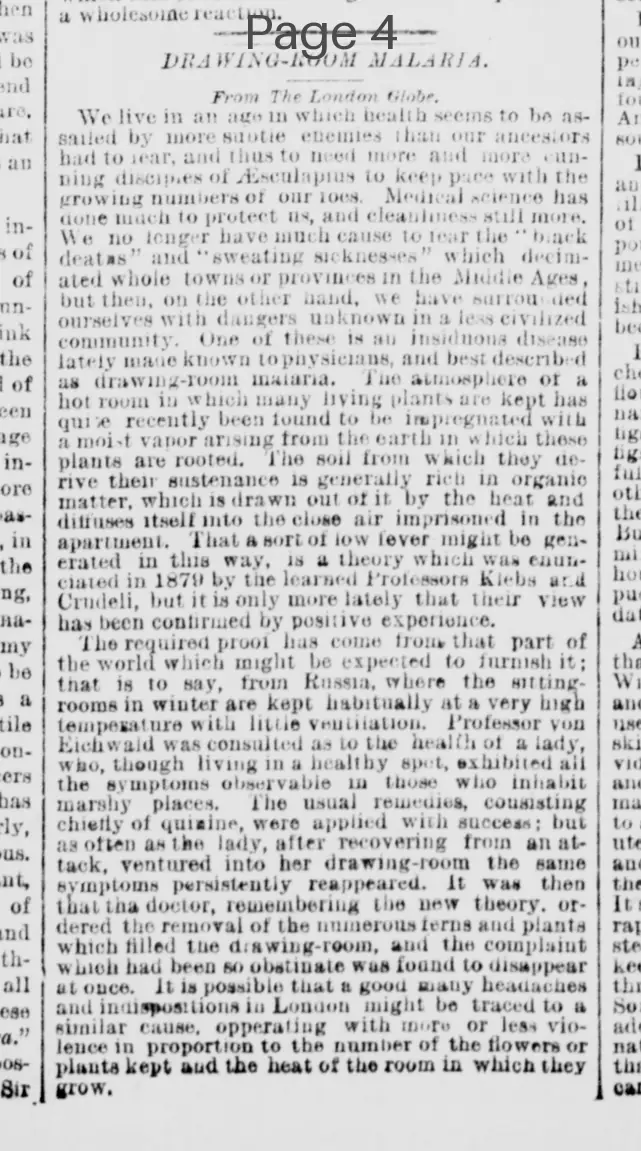
We live in an age in which health seems to be assailed by more subtle schemes than our ancestors had to fear, and thus to need more and more attending disciples of AEsculapius to keep pace with the growing numbers of our foes. Medical science has done much to protect us, and cleanliness still more. We no longer have much cause to fear the "Black Death" and "sweating sicknesses" which decimated whole towns or provinces in the Middle Ages, but then, on the other hand, we have surrounded ourselves with dangers unknown in a less civilized community. One of these is an insidious disease lately made known to physicians, and best described as drawing-room malaria. The atmosphere of a hot room in which many living plants are kept has quite recently been found to be impregnated with a moist vapor arising from the earth in which these plants are rooted. The soil from which they derive their sustenance is generally rich in organic matter, which is drawn out of it by the heat and diffuses itself into the close air imprisoned in the apartment. That a sort of low fever might be generated in this way, is a theory which was enunciated in 1879 by the learned Professors Klebs and Crudeli, but it is only more lately that their view has been confirmed by positive experience. The required proof has come from that part of the world which might be expected to furnish it; that is to say, from Russia, where the sitting-rooms in winter are kept habitually at a very high temperature with little ventilation. Professor von Eichwald was consulted as to the health of a lady, who, though living in a healthy spot, exhibited all the symptoms observable in those who inhabit marshy places. The usual remedies, consisting chiefly of quinine, were applied with success: but as often as the lady, after recovering from an attack, ventured into her drawing-room the same symptoms persistently reappeared. It was then that the doctor, remembering the new theory, ordered the removal of the numerous ferns and plants which filled the drawing-room, and the complaint which had been so obstinate was found to disappear at once. It is possible that a good many headaches and indispositions in London might be traced to a similar cause, operating with more or less violence in proportion to the number of the flowers or plants kept and the heat of the room in which they grow.
From The London Globe.
We live in an age in which health seems to be assailed by more subtle schemes than our ancestors had to fear, and thus to need more and more attending disciples of AEsculapius to keep pace with the growing numbers of our foes. Medical science has done much to protect us, and cleanliness still more. We no longer have much cause to fear the "Black Death" and "sweating sicknesses" which decimated whole towns or provinces in the Middle Ages, but then, on the other hand, we have surrounded ourselves with dangers unknown in a less civilized community. One of these is an insidious disease lately made known to physicians, and best described as drawing-room malaria. The atmosphere of a hot room in which many living plants are kept has quite recently been found to be impregnated with a moist vapor arising from the earth in which these plants are rooted. The soil from which they derive their sustenance is generally rich in organic matter, which is drawn out of it by the heat and diffuses itself into the close air imprisoned in the apartment. That a sort of low fever might be generated in this way, is a theory which was enunciated in 1879 by the learned Professors Klebs and Crudeli, but it is only more lately that their view has been confirmed by positive experience. The required proof has come from that part of the world which might be expected to furnish it; that is to say, from Russia, where the sitting-rooms in winter are kept habitually at a very high temperature with little ventilation. Professor von Eichwald was consulted as to the health of a lady, who, though living in a healthy spot, exhibited all the symptoms observable in those who inhabit marshy places. The usual remedies, consisting chiefly of quinine, were applied with success: but as often as the lady, after recovering from an attack, ventured into her drawing-room the same symptoms persistently reappeared. It was then that the doctor, remembering the new theory, ordered the removal of the numerous ferns and plants which filled the drawing-room, and the complaint which had been so obstinate was found to disappear at once. It is possible that a good many headaches and indispositions in London might be traced to a similar cause, operating with more or less violence in proportion to the number of the flowers or plants kept and the heat of the room in which they grow.
What sub-type of article is it?
Medical Curiosity
Curiosity
What themes does it cover?
Misfortune
Recovery
What keywords are associated?
Drawing Room Malaria
Hot Room Plants
Low Fever
Quinine Treatment
Plant Vapor Disease
What entities or persons were involved?
Professors Klebs And Crudeli
Professor Von Eichwald
Where did it happen?
Russia; London
Story Details
Key Persons
Professors Klebs And Crudeli
Professor Von Eichwald
Location
Russia; London
Event Date
1879
Story Details
Theory of drawing-room malaria from plants in hot rooms proposed in 1879 by Klebs and Crudeli; confirmed in Russia where a lady's marsh-like symptoms recurred in her plant-filled drawing-room and resolved after removing plants.