Thank you for visiting SNEWPapers!
Sign up free
Literary
February 11, 1848
New Hampshire Statesman
Concord, Merrimack County, New Hampshire
What is this article about?
An essay reflecting on the brevity and insecurity of human life, emphasizing death's constant presence through metaphors, statistics, and examples from literature and history, urging awareness of mortality.
Clipping
OCR Quality
98%
Excellent
Full Text
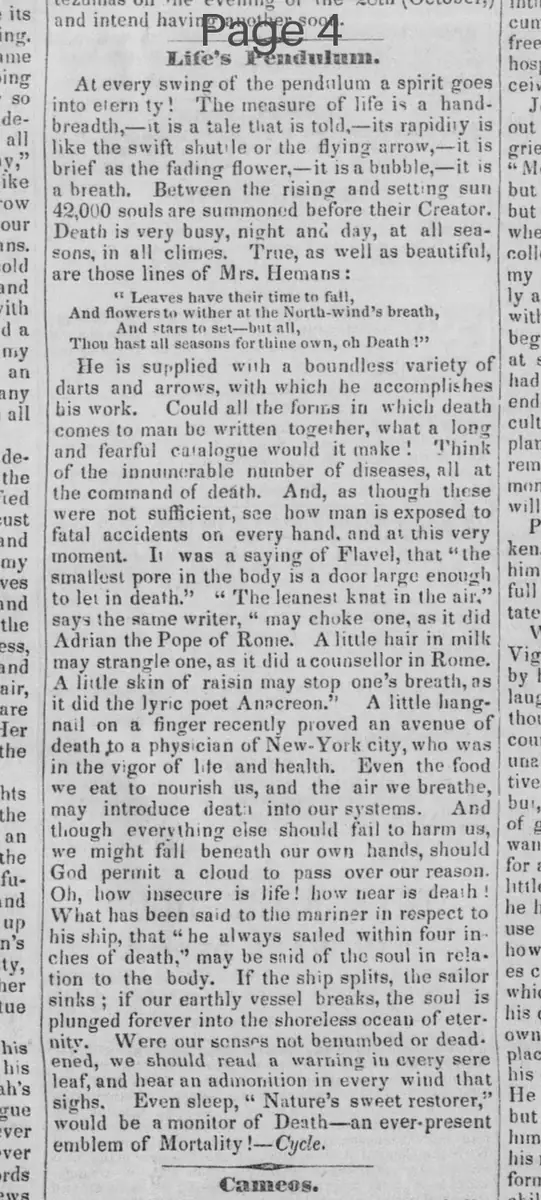
Life's Pendulum.
At every swing of the pendulum a spirit goes into eternity! The measure of life is a hand-breadth,—it is a tale that is told,—its rapidity is like the swift shuttle or the flying arrow.—it is brief as the fading flower,—it is a bubble,—it is a breath. Between the rising and setting sun 42,000 souls are summoned before their Creator. Death is very busy, night and day, at all seasons, in all climes. True, as well as beautiful, are those lines of Mrs. Hemans:
"Leaves have their time to fall,
And flowers to wither at the North-wind's breath,
And stars to set—but all,
Thou hast all seasons for thine own, oh Death!"
He is supplied with a boundless variety of darts and arrows, with which he accomplishes his work. Could all the forms in which death comes to man be written together, what a long and fearful catalogue would it make! Think of the innumerable number of diseases, all at the command of death. And, as though these were not sufficient, see how man is exposed to fatal accidents on every hand, and at this very moment. It was a saying of Flavel, that "the smallest pore in the body is a door large enough to let in death." "The leanest gnat in the air," says the same writer, "may choke one, as it did Adrian the Pope of Rome. A little hair in milk may strangle one, as it did a counsellor in Rome. A little skin of raisin may stop one's breath, as it did the lyric poet Anacreon." A little hang-nail on a finger recently proved an avenue of death to a physician of New-York city, who was in the vigor of life and health. Even the food we eat to nourish us, and the air we breathe, may introduce death into our systems. And though everything else should fail to harm us, we might fall beneath our own hands, should God permit a cloud to pass over our reason.
Oh, how insecure is life! how near is death! What has been said to the mariner in respect to his ship, that "he always sailed within four inches of death," may be said of the soul in relation to the body. If the ship splits, the sailor sinks; if our earthly vessel breaks, the soul is plunged forever into the shoreless ocean of eternity. Were our senses not benumbed or deadened, we should read a warning in every sere leaf, and hear an admonition in every wind that sighs. Even sleep, "Nature's sweet restorer," would be a monitor of Death—an ever-present emblem of Mortality!—Cycle.
At every swing of the pendulum a spirit goes into eternity! The measure of life is a hand-breadth,—it is a tale that is told,—its rapidity is like the swift shuttle or the flying arrow.—it is brief as the fading flower,—it is a bubble,—it is a breath. Between the rising and setting sun 42,000 souls are summoned before their Creator. Death is very busy, night and day, at all seasons, in all climes. True, as well as beautiful, are those lines of Mrs. Hemans:
"Leaves have their time to fall,
And flowers to wither at the North-wind's breath,
And stars to set—but all,
Thou hast all seasons for thine own, oh Death!"
He is supplied with a boundless variety of darts and arrows, with which he accomplishes his work. Could all the forms in which death comes to man be written together, what a long and fearful catalogue would it make! Think of the innumerable number of diseases, all at the command of death. And, as though these were not sufficient, see how man is exposed to fatal accidents on every hand, and at this very moment. It was a saying of Flavel, that "the smallest pore in the body is a door large enough to let in death." "The leanest gnat in the air," says the same writer, "may choke one, as it did Adrian the Pope of Rome. A little hair in milk may strangle one, as it did a counsellor in Rome. A little skin of raisin may stop one's breath, as it did the lyric poet Anacreon." A little hang-nail on a finger recently proved an avenue of death to a physician of New-York city, who was in the vigor of life and health. Even the food we eat to nourish us, and the air we breathe, may introduce death into our systems. And though everything else should fail to harm us, we might fall beneath our own hands, should God permit a cloud to pass over our reason.
Oh, how insecure is life! how near is death! What has been said to the mariner in respect to his ship, that "he always sailed within four inches of death," may be said of the soul in relation to the body. If the ship splits, the sailor sinks; if our earthly vessel breaks, the soul is plunged forever into the shoreless ocean of eternity. Were our senses not benumbed or deadened, we should read a warning in every sere leaf, and hear an admonition in every wind that sighs. Even sleep, "Nature's sweet restorer," would be a monitor of Death—an ever-present emblem of Mortality!—Cycle.
What sub-type of article is it?
Essay
What themes does it cover?
Death Mortality
Moral Virtue
Religious
What keywords are associated?
Life Brevity
Death Inevitability
Mortality Reflection
Eternity
Divine Summons
Fatal Accidents
What entities or persons were involved?
Cycle
Literary Details
Title
Life's Pendulum.
Author
Cycle
Key Lines
"Leaves Have Their Time To Fall,
And Flowers To Wither At The North Wind's Breath,
And Stars To Set—But All,
Thou Hast All Seasons For Thine Own, Oh Death!"
"The Smallest Pore In The Body Is A Door Large Enough To Let In Death."
"The Leanest Gnat In The Air," Says The Same Writer, "May Choke One, As It Did Adrian The Pope Of Rome.
Oh, How Insecure Is Life! How Near Is Death!
Even Sleep, "Nature's Sweet Restorer," Would Be A Monitor Of Death—An Ever Present Emblem Of Mortality!