Thank you for visiting SNEWPapers!
Sign up free
Literary
August 22, 1831
Phenix Gazette
Alexandria, Virginia
What is this article about?
Excerpts from works on ancient Egypt describe the vast circumference and splendid ruins of Thebes, surpassing Rome, with striking accounts by Denon of Napoleon's army's amazement and Lushington's awe at Karnac's pillars and sculptures.
Clipping
OCR Quality
98%
Excellent
Full Text
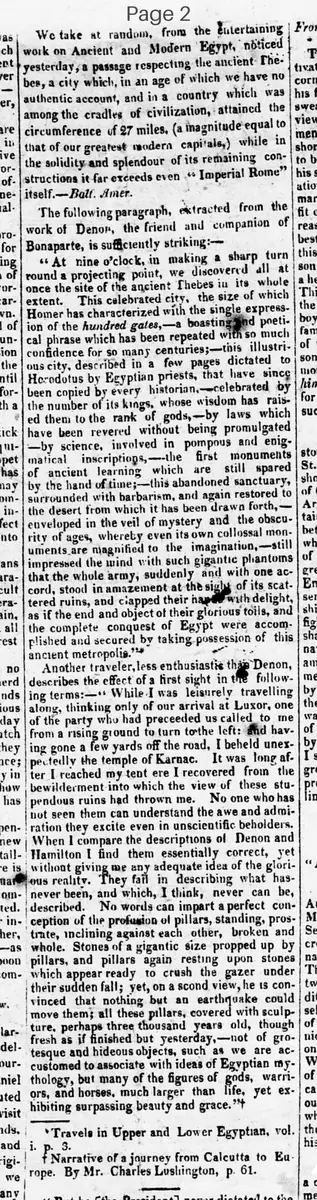
We take at random, from the entertaining work on Ancient and Modern Egypt, noticed yesterday, a passage respecting the ancient Thebes, a city which, in an age of which we have no authentic account, and in a country which was among the cradles of civilization,—attained the circumference of 27 miles, (a magnitude equal to that of our greatest modern capitals,) while in the solidity and splendour of its remaining constructions it far exceeds even "Imperial Rome" itself.—Balt. Amer.
The following paragraph, extracted from the work of Denon, the friend and companion of Bonaparte, is sufficiently striking:——
"At nine o'clock, in making a sharp turn round a projecting point, we discovered all at once the site of the ancient Thebes in its whole extent. This celebrated city, the size of which Homer has characterized with the single expression of the hundred gates,—a boasting and poetical phrase which has been repeated with so much confidence for so many centuries;—this illustrious city, described in a few pages dictated to Herodotus by Egyptian priests, that have since been copied by every historian,—celebrated by the number of its kings, whose wisdom has raised them to the rank of gods,—by laws which have been revered without being promulgated—by science, involved in pompous and enigmatical inscriptions,—the first monuments of ancient learning which are still spared surrounded with barbarism, and again restored to light by the hand of time;—this abandoned sanctuary, the desert from which it has been drawn forth,—enveloped in the veil of mystery and the obscurity of ages, whereby even its own colossal monuments are magnified to the imagination,—still impressed the mind with such gigantic phantoms that the whole army, suddenly and with one accord, stood in amazement at the sight of its scattered ruins, and clapped their hands with delight, as if the end and object of their glorious toils, and the complete conquest of Egypt were accomplished and secured by taking possession of this ancient metropolis."
Another traveler, less enthusiastic than Denon, describes the effect of a first sight in the following terms:——"While I was leisurely travelling along, thinking only of our arrival at Luxor, one of the party who had preceded us called to me from a rising ground to turn to the left: and having gone a few yards off the road, I beheld unexpectedly the temple of Karnac. It was long after I reached my tent ere I recovered from the bewilderment into which the view of these stupendous ruins had thrown me. No one who has not seen them can understand the awe and admiration they excite even in unscientific beholders. When I compare the descriptions of Denon and Hamilton I find them essentially correct, yet without giving me any adequate idea of the glorious reality. They fail in describing what has never been, and which, I think, never can be, described. No words can impart a perfect conception of the profusion of pillars, standing, prostrate, inclining against each other, broken and whole. Stones of a gigantic size propped up by pillars, and pillars again resting upon stones which appear ready to crush the gazer under their sudden fall; yet, on a second view, he is convinced that nothing but an earthquake could move them; all these pillars, covered with sculpture, perhaps three thousand years old, though fresh as if finished but yesterday,—not of grotesque and hideous objects, such as we are accustomed to associate with ideas of Egyptian mythology, but many of the figures of gods, warriors, and horses, much larger than life, yet exhibiting surpassing beauty and grace."
*Travels in Upper and Lower Egypt, vol. i. p. 61.
†Narrative of a journey from Calcutta to Europe. By Mr. Charles Lushington, p. 61.
The following paragraph, extracted from the work of Denon, the friend and companion of Bonaparte, is sufficiently striking:——
"At nine o'clock, in making a sharp turn round a projecting point, we discovered all at once the site of the ancient Thebes in its whole extent. This celebrated city, the size of which Homer has characterized with the single expression of the hundred gates,—a boasting and poetical phrase which has been repeated with so much confidence for so many centuries;—this illustrious city, described in a few pages dictated to Herodotus by Egyptian priests, that have since been copied by every historian,—celebrated by the number of its kings, whose wisdom has raised them to the rank of gods,—by laws which have been revered without being promulgated—by science, involved in pompous and enigmatical inscriptions,—the first monuments of ancient learning which are still spared surrounded with barbarism, and again restored to light by the hand of time;—this abandoned sanctuary, the desert from which it has been drawn forth,—enveloped in the veil of mystery and the obscurity of ages, whereby even its own colossal monuments are magnified to the imagination,—still impressed the mind with such gigantic phantoms that the whole army, suddenly and with one accord, stood in amazement at the sight of its scattered ruins, and clapped their hands with delight, as if the end and object of their glorious toils, and the complete conquest of Egypt were accomplished and secured by taking possession of this ancient metropolis."
Another traveler, less enthusiastic than Denon, describes the effect of a first sight in the following terms:——"While I was leisurely travelling along, thinking only of our arrival at Luxor, one of the party who had preceded us called to me from a rising ground to turn to the left: and having gone a few yards off the road, I beheld unexpectedly the temple of Karnac. It was long after I reached my tent ere I recovered from the bewilderment into which the view of these stupendous ruins had thrown me. No one who has not seen them can understand the awe and admiration they excite even in unscientific beholders. When I compare the descriptions of Denon and Hamilton I find them essentially correct, yet without giving me any adequate idea of the glorious reality. They fail in describing what has never been, and which, I think, never can be, described. No words can impart a perfect conception of the profusion of pillars, standing, prostrate, inclining against each other, broken and whole. Stones of a gigantic size propped up by pillars, and pillars again resting upon stones which appear ready to crush the gazer under their sudden fall; yet, on a second view, he is convinced that nothing but an earthquake could move them; all these pillars, covered with sculpture, perhaps three thousand years old, though fresh as if finished but yesterday,—not of grotesque and hideous objects, such as we are accustomed to associate with ideas of Egyptian mythology, but many of the figures of gods, warriors, and horses, much larger than life, yet exhibiting surpassing beauty and grace."
*Travels in Upper and Lower Egypt, vol. i. p. 61.
†Narrative of a journey from Calcutta to Europe. By Mr. Charles Lushington, p. 61.
What sub-type of article is it?
Essay
What themes does it cover?
Political
Religious
What keywords are associated?
Ancient Thebes
Egyptian Ruins
Traveler Accounts
Monuments
Civilization
Literary Details
Subject
Description Of Ancient Thebes
Form / Style
Descriptive Prose With Traveler Quotations
Key Lines
This Celebrated City, The Size Of Which Homer Has Characterized With The Single Expression Of The Hundred Gates
No One Who Has Not Seen Them Can Understand The Awe And Admiration They Excite Even In Unscientific Beholders.