Thank you for visiting SNEWPapers!
Sign up free
The Midland Journal
Rising Sun, Cecil County, Maryland
What is this article about?
The U.S. Supreme Court upheld an injunction against Indianapolis water rates, ruling utilities deserve at least 7% return based on present and future values. Justice Butler wrote the majority opinion; Brandeis and Stone dissented. Valued Indianapolis Water Co. at $19M+.
Clipping
OCR Quality
Full Text
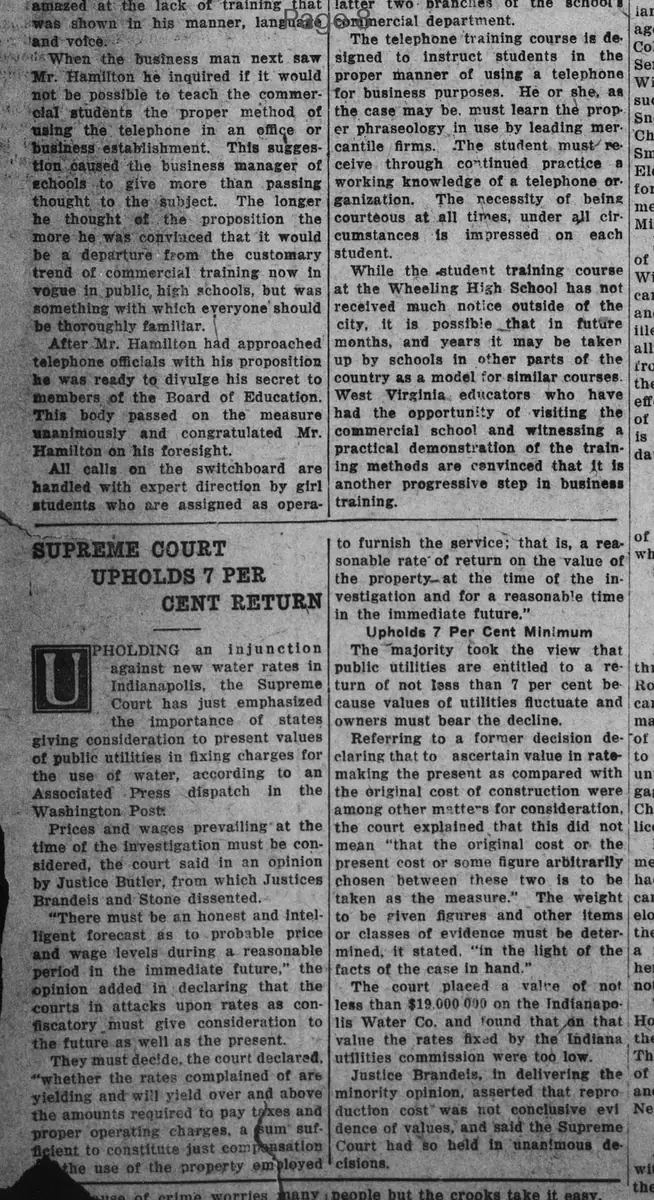
Upholding an injunction against new water rates in Indianapolis, the Supreme Court has just emphasized the importance of states giving consideration to present values of public utilities in fixing charges for the use of water, according to an Associated Press dispatch in the Washington Post.
Prices and wages prevailing at the time of the investigation must be considered, the court said in an opinion by Justice Butler, from which Justices Brandeis and Stone dissented.
"There must be an honest and intelligent forecast as to probable price and wage levels during a reasonable period in the immediate future," the opinion added in declaring that the courts in attacks upon rates as confiscatory must give consideration to the future as well as the present.
They must decide, the court declared, "whether the rates complained of are yielding and will yield over and above the amounts required to pay taxes and proper operating charges, a sum sufficient to constitute just compensation for the use of the property employed."
The court held that the utilities commission must assure the utilities the opportunity to furnish the service; that is, a reasonable rate of return on the value of the property—at the time of the investigation and for a reasonable time in the immediate future.
Upholds 7 Per Cent Minimum
The majority took the view that public utilities are entitled to a return of not less than 7 per cent because values of utilities fluctuate and owners must bear the decline.
Referring to a former decision declaring that to ascertain value in rate-making the present as compared with the original cost of construction were among other matters for consideration, the court explained that this did not mean "that the original cost or the present cost or some figure arbitrarily chosen between these two is to be taken as the measure." The weight to be given figures and other items or classes of evidence must be determined, it stated, in the light of the facts of the case in hand.
The court placed a value of not less than $19,000,000 on the Indianapolis Water Co. and found that at that value the rates fixed by the Indiana utilities commission were too low.
Justice Brandeis, in delivering the minority opinion, asserted that reproduction cost was not conclusive evidence of values, and said the Supreme Court had so held in unanimous decisions.
What sub-type of article is it?
What themes does it cover?
What keywords are associated?
What entities or persons were involved?
Where did it happen?
Story Details
Key Persons
Location
Indianapolis
Story Details
The Supreme Court upheld an injunction against new water rates in Indianapolis, emphasizing consideration of present values and future price levels for public utilities. The court ruled that utilities are entitled to at least a 7% return and valued the Indianapolis Water Co. at not less than $19,000,000, finding the rates too low. Brandeis dissented, arguing reproduction cost is not conclusive.