Thank you for visiting SNEWPapers!
Sign up free
Republican Herald
Providence, Providence County, Rhode Island
What is this article about?
U.S. Congress proceedings from February 15-18: Senate passed bills on patents, armories, railroads, volunteers, copyrights, Cumberland Road, army increase, and fire duty remission; resolutions on telegraph, Mexico, Texas independence, tobacco trade. House focused on trial of Reuben M. Whitney for contempt, with testimony on altercation involving Rep. Peyton.
Clipping
OCR Quality
Full Text
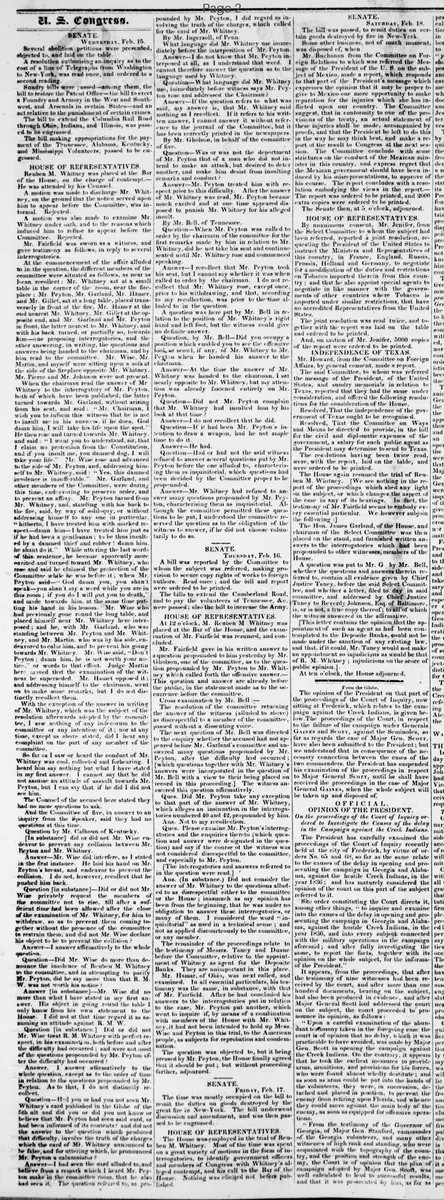
SENATE.
Wednesday, Feb. 15.
Several abolition petitions were presented, subjected to, and laid on the table.
A resolution authorising an inquiry as to the cost of a line of Telegraphs from Washington to New-York, was read once, and ordered to a second reading.
Sundry bills were passed—among them, the bill to restore the Patent Office—the bill to erect a Foundry and Armory in the West and South-west, and Arsenals in certain States—and an act relative to the punishment of certain crimes.
The bill to extend the Columbia Rail Road through Ohio, Indiana, and Illinois, was passed to be engrossed.
The bill making appropriations for the payment of the Tennessee, Alabama, Kentucky, and Mississippi Volunteers, passed to be engrossed.
HOUSE OF REPRESENTATIVES.
Reuben M. Whitney was placed at the Bar of the House, on the charge of contempt.
He was attended by his Counsel.
A motion was made to discharge Mr. Whitney, on the ground that the notice served upon him to appear before the Committee, was informal. Rejected.
A motion was also made to examine Mr. Whitney under oath, as to the reasons which induced him to refuse to appear before the Committee. Rejected.
Mr. Fairfield was sworn as a witness, and gave testimony as follows, in reply to several interrogatories.
At the commencement of the affair alluded to in the question, the different members of the committee were situated as follows, as near as I can recollect: Mr. Whitney sat at a small table in the corner of the room, near the fire-place; Mr. Peyton, Mr. Garland, Mr. Hamer, and Mr. Gillet, sat at a long table, placed transversely in front of the fire, Mr. Hamer at the end nearest Mr. Whitney, Mr. Gillet at the opposite end, and Mr. Garland and Mr. Peyton in front, the latter nearest to Mr. Whitney, and with his back turned, or partially so, towards him—one proposing interrogatories, and the other answering, in writing, the questions and answers being handed to the chairman, and by him read to the committee. Mr. Wise, Mr. Martin, and myself were sitting upon a sofa at the side of the fireplace opposite Mr. Whitney.
Mr. Pierce and Mr. Johnson were not present.
When the chairman read the answer of Mr. Whitney to the interrogatory of Mr. Peyton, both of which have been published, the latter turned towards Mr. Garland, without arising from his seat, and said: "Mr. Chairman, I wish you to inform this witness that he is not to insult me in his answers; if he does, God damn him, I will take his life upon the spot."
He then rose and turned towards Mr. Whitney, and said: "I want you to understand, sir, that I claim no protection from the Constitution, and if you insult me, you damned dog, I will take your life." Mr. Wise rose and advanced to the side of Mr. Peyton, and, addressing himself to Mr. Whitney, said: "Yes, this damned insolence is insufferable." Mr. Garland, and other members of the Committee, were during this time, endeavoring to preserve order, and to prevent an affray. Mr. Peyton turned from Mr. Whitney, and, standing with his back to the fire, said, by way of soliloquy, or without addressing himself to any one in particular, "hitherto, I have treated him with marked respect—damn him—I have treated him just as if he had been a gentleman: to be thus insulted by a damned thief and robber! damn him, he shan't do it." While uttering the last words of this sentence, he became apparently more excited, and turned toward Mr. Whitney, who rose and said he claimed the protection of the Committee while he was before it; when Mr. Peyton said—"God damn you, you shan't speak—you shan't say a word while you are in this room; if you do I will put you to death," and made towards him, at the same time putting his hand in his bosom. Mr. Wise who had previously gone round the long table, and placed himself near Mr. Whitney here interposed; and he, with Mr. Garland, who was standing between Mr. Peyton and Mr. Whitney, and Mr. Martin, who was by his side, endeavored to calm him, and to prevent his going towards Mr. Whitney. Mr. Wise said, "Don't Peyton: damn him, he is not worth your notice," or words to that effect. Judge Martin here moved that the examination of the witness be superseded. Mr. Hamer opposed it and addressing himself to the chairman, went on to make some remarks, but I do not distinctly recollect them.
With the exception of the answer in writing of Mr. Whitney, which was the subject of the resolution afterwards adopted by the committee, I saw nothing of any indecorum to the committee or any intention of it; nor at any time, except as above stated, did I hear any complaint on the part of any member of the committee.
So far as I saw or heard the conduct of Mr. Whitney was cool, collected and forbearing. I heard him say nothing but what I have stated in my first answer. I cannot say that he did not assume an attitude of assault towards Mr. Peyton, but I can say that if he did I did not see him.
The Counsel of the accused here stated they had no more questions to ask.
And the Committee of five, in answer to an inquiry from the Speaker, said they had no questions at this time.
Question by Mr. Calhoun of Kentucky.
[In substance] did or did not Mr. Wise endeavor to prevent any collision between Mr. Peyton and Mr. Whitney.
Answer—Mr. Wise did interfere, as I stated in the first instance. He laid his hand on Mr. Peyton's breast, and endeavor to prevent the collision. I do not, however, recollect that he pushed him back.
Question [in substance]—Did or did not Mr. Wise privately request the members of the committee not to rise, till after a sufficient time had been allowed after the close of the examination of Mr. Whitney, for him to withdraw, so as to prevent them coming together without the presence of the committee to restrain them, and did not Mr. Wise declare his object to be to prevent the collision?
Answer—I answer affirmatively to the whole question.
Question—Did Mr. Wise do more than de-nounce the insolence of Reuben M. Whitney to the committee, and in attempting to pacify Mr. Peyton, did he say more than that R. M. W. was not worth his notice?
Answer [in substance]—Mr. Wise did no more than what I have stated in my first an-swer. His object in going round the table I only know from his own statement to the House. I did not at that time regard it as as-suming an attitude against R. M. W.
Question [in substance.] Did or did not Mr. Wise treat R. M. Whitney with perfect re-spect, in his examination, both before and after the difficulty had occurred; and were not most of the questions propounded by Mr. Peyton af-ter the difficulty had occurred?
Answer. I answer affirmatively to the whole question, except as to the order of time in relation to the questions propounded by Mr. Peyton. As to that, I do not distinctly re-collect.
Question—Had you or had you not seen Mr. Whitney's card published in the Globe of the 5th ult and did you or did you not know or believe that Mr. Peyton had seen said card, or had been informed of its contents? and did not the answer to the question which produced that difficulty, involve the truth of the charges which the card of Mr. Whitney announced to be false, and for uttering which, he pronounced Mr. Peyton a calumniator?
Answer—I had seen the card alluded to, and believe from a remark which I heard Mr. Peyton make in the committee room, that he also had seen it. The question referred to, as pro-pounded by Mr. Peyton, I did regard as in-volving the truth of the charges, which called for the card of Mr. Whitney.
By Mr. Ingersoll, of Penn.
What language did Mr. Whitney use imme-diately before the interposition of Mr. Peyton
Answer—I do not know that Mr. Peyton in-terposed at all, as I understand that word. I cannot therefore answer the question as to the language used by Whitney.
Question—What language did Mr. Whitney use, immediately before witness says Mr. Peyton rose and addressed the Chairman?
Answer—If the question refers to what was said, my answer is, that Mr. Whitney said nothing as I recollect. If it refers to his writ-ten answer, I cannot answer it without refer-ence to the journal of the Committee, but it has been correctly printed in the newspapers.
By Mr. Gholson, in behalf of the committee of five.
Question—Was or was not the deportment of Mr. Peyton that of a man who did not in-tend to make an attack, but desired to deter another, and make him desist from insulting remarks and conduct?
Answer—Mr. Peyton treated him with re-spect prior to this difficulty. After the answer of Mr. Whitney was read, Mr. Peyton became much excited and at one time appeared dis-posed to punish Mr. Whitney for his alleged insult.
By Mr. Bell, of Tennessee.
Question—When Mr. Peyton was called to order by the chairman of the committee for the first remarks made by him in relation to Mr. Whitney, did he not take his seat and continue seated until Mr. Whitney rose and commenced speaking.
Answer—I recollect that Mr. Peyton took his seat, but I cannot say whether it was when called to order by the chairman. I do not re-collect that Mr. Whitney rose, except once, prior to his withdrawing, and that, according to my recollection, was prior to the time al-luded to in the question.
A question was here put by Mr. Bell in re-lation to the position of Mr. Whitney's right hand and left foot, but the witness could give no definite answer.
Question, by Mr. Bell—Did you occupy a position which enabled you to see the offensive look or scowl, if any, of Mr. Whitney to Mr. Peyton when he handed his answer to the chairman.
Answer—At the time the answer of Mr. Whitney was handed to the chairman, I sat nearly opposite to Mr. Whitney, but my atten-tion was already fastened entirely on Mr. Peyton.
Question—Did not Mr. Peyton complain that Mr. Whitney had insulted him by his look at that time?
Answer—I do not recollect that he did.
Question—If it had been Mr. Peyton's in-tention to draw a weapon, had he not ample time to do it.
Answer—He had.
Question—Had or had not the said witness refused to answer several questions put by Mr. Peyton before the one alluded to, characteris-ing them as inquisitorial, which questions had been decided by the Committee proper to be propounded.
Answer—Mr. Whitney had refused to an-swer many questions propounded by Mr. Peyton, characterising them as inquisitorial. Al-though the committee permitted these ques-tions to be put, I understood the committee re-served the question as to the obligation of the witness to answer, if he did not choose volun-tarily to do so.
SENATE.
Thursday, Feb. 16.
A bill was reported by the Committee to whom the subject was referred, making pro-vision to secure copy rights of works to foreign authors. Read once; and the bill and report were ordered to be printed.
The bills to extend the Cumberland Road, and to pay the volunteers of Tennessee, &c. were passed; also the bill to increase the Army.
HOUSE OF REPRESENTATIVES,
At 12 o'clock, M. Reuben M. Whitney was placed at the Bar of the House, and the exam-ination of Mr. Fairfield was resumed, and con-cluded.
Mr. Fairfield gave in his written answer to a question propounded to him yesterday by Mr. Gholson, one of the committee, as to the ques-tion propounded by Mr. Peyton to Mr. Whitney which called forth the offensive answer.— This question and answer are already before the public, in the statement made as to the oc-currence before the committee.
Cross examination by Mr. Bell :
The resolution of the committee returning the answer of the witness (alluded to above) as disrespectful to a member of the committee, passed without a dissenting voice.
The next question of Mr. Bell was directed to the enquiry whether the accused had not ap-peared before Mr. Garland's committee and an-swered many questions propounded by Mr. Peyton, after the difficulty had occurred; [which questions together with Mr. Whitney's answers were incorporated in the question of Mr. Bell with a view to their being placed on record in this proceeding.] The witness an-swered this question affirmatively.
Ques. Did Mr. Peyton take any exception to that part of the answer of Mr. Whitney, which alleges an insinuation in the interrogatories numbered 40 and 42, propounded by him.
Ans. Not to my recollection.
Ques. Please examine Mr. Peyton's interrog-atories and the enquiries thereto (which ques-tion and answer were designated in the ques-tion) and say if the course of the witness was not considered disrespectful to the committee, and especially to Mr. Peyton.
[The interrogatories and answers referred to in the question were read.]
Ans. (In substance.) Did not consider the answer of Mr. Whitney to the questions allud-ed to as disrespectful either to the committee or the House: inasmuch as my opinion has been from the beginning, that he was under no obligation to answer these interrogatories, or many of them. I considered the word "in-quisitorial'' as used in a technical sense; and not as applied discourteously to the committee, or any member.
The remainder of the proceedings relate to the testimony of Messrs. Taney and Duane before the Committee, relative to the appointment of Whitney as agent for the Deposite Banks. They are unimportant in this place.
Mr. Hamer, of Ohio, was next called, and examined. In all essential particulars, his tes-timony was the same, in substance, with that of Mr. Fairfield. After he had concluded his answers to the interrogatories put in relation to the case, Mr. Peyton put another, which went to inquire if, by means of a combination with members of the House with Mr. Whitney, it had not been intended to hold up Mess. Wise and Peyton in this trial, to the American people, as subjects for reprobation and condem-nation.
The question was objected to, but it being pressed by Mr. Peyton, the House finally agreed that it should be put; but without proceeding farther, adjourned.
SENATE.
Friday, Feb. 17.
The time was mostly occupied on the bill to remit the duties on goods destroyed by the great fire in New-York. The bill underwent discussion and amendment, and was then passed to be engrossed.
HOUSE OF REPRESENTATIVES.
The House was employed in the trial of Reuben M. Whitney. Most of the time was spent on a great variety of motions in the form of in-terrogatories, to identify government officers and members of Congress with Whitney's al-leged contempt, and his call to the Bar of the House. Nothing was elicited not before pub-lished.
SENATE.
Saturday, Feb. 18.
The bill was passed, to remit duties on cer-tain goods destroyed by fire in New-York.
Some other business, not of much moment was disposed of, when Mr. Buchanan from the Committee on Foreign Relations to which was referred the Message of the President of the U. S. on the subject of Mexico, made a report, which responds to that part of the President's message which expresses the opinion that it may be proper to give to Mexico one more opportunity to make reparation for the injuries which she has in-flicted upon our country. The Committee suggest, that in conformity to one of the pro-visions of the treaty, an actual statement of these injuries shall be made, accompanied by proofs, and that the President be left to do this in the way he may think best, and make a re-port of the result to Congress at the next ses-sion. The Committee conclude with some strictures on the conduct of the Mexican minister in this country, and express regret that the Mexican government should have been in-duced by his misrepresentations, to approve of his course. The report concludes with a reso-lution embodying the views in the report.— The report was ordered to be printed, and 2000 extra copies were ordered to be printed.
The Senate then, at 5 o'clock, adjourned.
HOUSE OF REPRESENTATIVES.
By unanimous consent, Mr. Jenifer, from the Select Committee to whom the subject had been referred, reported a joint resolution, re-questing the President of the United States to instruct the Ministers and Representatives of this country, in France, England, Russia, Prussia, Holland and Germany, to negotiate for a modification of the duties and restrictions on Tobacco imported therein from this coun-try; and that he also appoint special agents to negotiate in like manner with the govern-ments of other countries where Tobacco is imported under similar restrictions, that have no accredited Representatives from the United States.
The joint resolution was read twice, and to-gether with the report was laid on the table and ordered to be printed.
And, on motion of Mr. Jenifer, 5000 copies of the report were ordered to be printed.
INDEPENDENCE OF TEXAS.
Mr. Howard, from the Committee on Foreign Affairs, by general consent, made a report. The said Committee, to whom was referred the message of the President, of the United States, and sundry memorials in relation to Texas, reported that they had the same under consideration, and offered the following resolu-tions for the consideration of the House.
Resolved, That the independence of the gov-ernment of Texas ought to be recognised.
Resolved, That the Committee on Ways and Means be directed to provide, in the bill for the civil and diplomatic expenses of the government, a salary for such public agent as the President may determine to send to Texas.
The resolutions having been twice read, were, with the report, laid on the table, and were ordered to be printed.
The House again resumed the trial of Reuben M. Whitney. [We see nothing in the re-port of the proceedings which shed any light on the subject, or which changes the aspect of the case in any of its bearings. In fact, the testimony of Mr. Fairfield seems to embody every essential particular. We however subjoin the following:]
The Hon. James Garland, of the House, and chairman of the Select Committee was then placed on the stand, and furnished written answers to the interrogatories which had been propounded to other witnesses, members of the House.
A question was put to Mr. G by Mr. Bell, whether the questions and answers therein re-ferred to, contain all evidence given by Chief Justice Taney, before the said Select Committee, and whether a letter, filed to day in said committee, and addressed by Chief Justice Taney to Reverdy Johnson, Esq. of Baltimore, is, or is not, a true copy thereof; to all of which the witness answered in the affirmative.
This letter contains the opinion that the appointment of such an agent as had been con-templated to the Deposite Banks, could not be made under the sanction of any existing law, and that, if it could, Mr. Taney would not make an appointment so injudicious as would be that of R. M. Whitney; injudicious on the score of public opinion.]
At ten o'clock, the House adjourned.
What sub-type of article is it?
What keywords are associated?
What entities or persons were involved?
Where did it happen?
Domestic News Details
Primary Location
Washington
Event Date
Wednesday, Feb. 15 To Saturday, Feb. 18
Key Persons
Outcome
trial of reuben m. whitney for contempt ongoing; various bills and resolutions passed or ordered printed; no final resolution on trial in text.
Event Details
U.S. Senate and House proceedings: Presentation of abolition petitions; resolution for telegraph inquiry; passage of bills on Patent Office restoration, foundries/armories/arsenals, crime punishment, Columbia Rail Road extension, volunteer payments, copyrights for foreign authors, Cumberland Road extension, army increase, remission of duties on New-York fire-destroyed goods. Reports and resolutions on Mexico reparations, Texas independence recognition, tobacco trade negotiations. Detailed House examination of witnesses in contempt trial of Reuben M. Whitney, recounting altercation with Mr. Peyton during committee hearing, including threats and interventions.