Thank you for visiting SNEWPapers!
Sign up free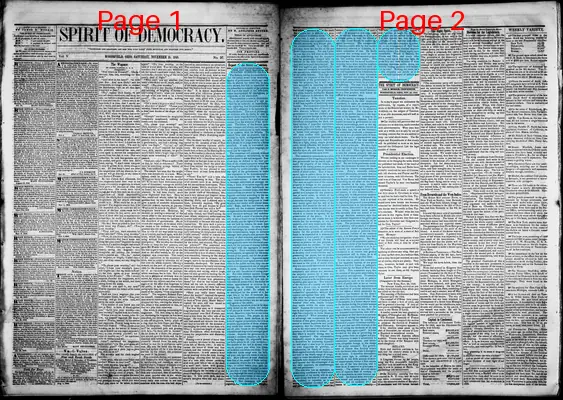
The Spirit Of Democracy
Woodsfield, Monroe County, Ohio
What is this article about?
On February 9, 1848, a Senate Select Committee reports on taxation principles, defining it as the price of social order derived from the social compact. It criticizes using taxes for commercial speculations, advocating limited government to preserve peace and morality, with examples from New York and Illinois.
Merged-components note: This is a continuation of the report on taxation principles across pages; relabeled from 'editorial' to 'domestic_news' as it fits local/national non-story news on government matters.
Clippings

1 of 2
OCR Quality
Full Text
The Senate, taking into consideration that the taxing power is an interesting faculty of government which not only may be abused, but which has, in act been abused, has laid its injunction on the subscriber to consider of the subject and report the result of his reflections, either accompanied by resolutions or otherwise, at his discretion.
The committee proceeds, most cheerfully, to the performance of a task enjoined by an authority so respectable, only regretting that his powers are not more fully adequate to its complete accomplishment. The eye of philosophical criticism will, no doubt, be able to detect many imperfections in the work, which must receive their palliation and excuse from the situation of the workman. The labors of the Senate have been constant and severe, and the committee has participated in their severity, in common with his fellows. To expect from men so situated, attention to style, arrangements or details, which full leisure alone can bestow, would be to judge them by a harsh standard. If men so overtasked can array plain truths in plain language, no more can be expected.
The committee will proceed, without further preface or introduction, to the performance to the task assigned. Taxation may be defined to be, that portion of the citizen's property which the law requires him to yield up to the government, for public purposes. How is the right of the government to make this requisition to be demonstrated? It can be demonstrated by the following considerations. A state of nature is, amongst individuals as amongst nations, a state of complete equality and independence. Such individuals acknowledge no common judge, and their controversies are settled by brute force: Injuries retaliated according to the extravagant measure suggested by revenge, become the instigation to fresh injuries, and render strife almost incessant. Rage, and fear, and hatred, and despair are the dominant passions of savages and barbarians and render their very existence unhappy and undesirable. In such a state of manners, property is never found except in the smallest shreds, and the rights of life and person are held by tenures the most insecure and precarious. As soon as light and knowledge, by means of any favorable circumstances, begin to advance amongst such people, men perceive the misery of their situation, and earnestly desire a superior order of things: They then gradually enter into the social compact, for the purpose of arming individual right with the aggregate of social strength. They constitute states and governments, as agencies for the maintenance of the peace, and for the preservation of social order. Agencies imply agents, and as these agents devote their time to the public service, they are entitled to a remuneration out of the public purse. This is the true foundation, and the only foundation of taxing power. For even defence against foreign aggression or intestine insurrection is but auxiliary to this; for how can social order be preserved, if the nation be either exterminated or overrun by a foreign foe, or thrown into convulsions by civil strife? To submit to be destroyed by the power of a foreign foe, or by that of intestine factions, would be to commit national suicide. And the soldiery are but servants and agents of the public.
Taxation, therefore, is not to be wantonly levied on the citizen, nor levied at all except in return for benefits conferred. RIGHTFUL TAXATION IS THE PRICE OF SOCIAL ORDER. The people do not always reduce these maxims to the form of regular propositions, but it is an intuitive appreciation of these elementary truths that render smuggling and all other frauds on the revenue dishonorable and disgraceful amongst good citizens. Suppose the government to address a recusant taxpayer, in the following language: Oh, ungrateful man, you have peace in all your borders. The mantle of the law is spread over you, to protect you when you sleep and to shield you when you wake. Your flocks and herds range over the hills, and your rich harvests wave in the valleys. How different is your situation from that of the people of those unhappy countries where the law has lost its sway; no robber besets your path by day, and no nocturnal burglar invades the sanctity of your dwelling by night. Do you begrudge the small pittance necessary to the preservation of that social order from which you derive so many blessings? Her reasoning will have cogency, her words will have weight.
and willing obedience will be the result. But suppose her to address the reluctant taxpayer in another style. Oh, obstinate man, I wish to collect an immense treasure, and to spend it in a commercial enterprise in a distant part of the commonwealth. It is likely that you may never see the line of the proposed improvement. Nor can I promise you that you will ever be the better of the undertaking, and the taxpayers may be perpetually charged with the interest on the debt contracted, until they shall have paid the principal. But then you ought to pay cheerfully, for a few men will certainly be enriched by the speculation, whatever may become of the public interest. This logic may convince the taxpayer of the fixed determination of the government to invade his property, but it will not be very successful in removing his reluctance. This is only a translation of the virtual language of the government into plain, homely, intelligible English. If the transcript is deformed, the original is more so. If the theory blushes and cannot bear the light, the practice is still less capable of sustaining examination. The committee hazards nothing in pronouncing that all ideas of the mere abstract, arbitrary right of the government to take the citizen's property for purposes foreign to the preservation of social order, are the mere rude inartificial conceptions, the dark, confused notions of imperfect civilization, which the light of a wider experience, and more perfect civilization, will forever banish from amongst men. They will then confine their government strictly to its appropriate functions as a conservator of the peace; and it will then be a light, cheap, simple government, whose influence will descend like the dews of Heaven, in blessings and benefits upon all, and heavy burdens and rigorous exactions upon none.
The committee announces as a plain consequence of the foregoing principles, that government has no moral right to apply the property of the citizen, by means of the taxing power, to purposes foreign to the establishment and preservation of social order. That it has no moral right to collect taxes to be employed, either directly or indirectly, in speculative and commercial adventures. That such an application of the citizens property is foreign to the purpose of the social compact, and is therefore unjust. The social compact may be regarded as a compact for the preservation of social order, to which all the citizens are parties. As unanimity is impossible amongst large bodies of men they tacitly agree that the will of the majority shall stand for the will of the whole in matters within the purview of the compact, the very end and design of which is to create an agency for the preservation of the peace. It is for this purpose that the citizen has consented that his sovereign, to wit, the majority, shall levy taxes upon him. But when that majority, thus clothed with the faculty of taxation, exerts that faculty for the purpose of collecting funds to be expended in a commercial adventure, is it not guilty of a manifest perversion of its powers? It has received its powers for one purpose, it employs them for another. It has received its powers to be employed like those of a beneficent, legal sovereign, in deciding civil controversies and in preserving the peace, but its powers are, in reality, used to carry on the business of a merchant. The citizen pays his taxes as the price of social order. They are converted into a stock in trade. Sometimes, in order to overawe us completely and silence our murmurs, the majority power, by a new and most ingenious piece of legislative machinery, is made to fix its direct and astounding gaze upon us. The majority of the electors of a county are authorized, by a direct vote, to embark the property of their fellow citizens in a commercial speculation, without their consent and against their will. What right have twenty-six hundred men to vote away the property of twenty-five hundred other men, simply because they reside within the same county lines? Suppose the majority to be correct in their expectations of gain; what right has a majority to force blessings on a minority? What pecuniary gain or advantage can compensate for the violation of that great principle, so essential to human happiness and public prosperity, that the citizen shall be secure in the enjoyment of his honest acquisitions till forfeited by crime? Can that which is morally wrong, ever be truly expedient? Can communities reasonably expect to secure blessings to themselves by practicing injustice? As well might a man hope to promote his own happiness by gluttony, or drunkenness, or fraud, or perjury. Short-sighted mortals, whose vision cannot take in the whole range of things, ought to make the standard of absolute rectitude their standard of expediency, well assured that the advantages of sin are only apparent, its disadvantages real and permanent.
The man who has an unshaken, an unwavering confidence in God's moral government of the world, will as soon expect to see the laws of nature altered, modified, or repealed, as to see wrong or injustice crowned with real and permanent success. It cannot be; nature, and nature's God forbid such a result. A proposition was once made to the ancient Athenians, in a time of profound peace, to burn the navies of the other Greek States, by sudden and secret treachery. The consideration of this proposition was, by that ancient democracy, referred to Aristides, as a select committee of one. He finally reported that nothing could be more advantageous than the measure proposed, but nothing more unjust. Who does not see that the moral faculties of Aristides were wiser than his intellectual? Who does not see that such odious turpitude would not have promoted the real happiness of the Athenians, but might have ended in their extermination? Injustice and wrong will not be really and permanently prosperous. Sin will, sooner or later, be productive of suffering. The man whose faith in God's moral government is fixed and immovable, can hear himself denounced as a false prophet, with bosom unruffled as a summer lake.
As the anxiety to engage in commercial adventures is the chief temptation at present, to make an unwarrantable and inordinate use of the taxing power, that subject deserves to be examined with some care. The committee intends to do perfect justice to the argument of its opponents. It may be objected, it has been objected, that the capital invested by government in commercial undertakings, such as the digging of a canal for instance, has not always been lost, but on the contrary, has sometimes produced a remunerating return in a pecuniary point of view. And to the eye of argumentative zeal, a single instance of the kind assumes an importance sufficient to overturn a well settled principle. We may reply what right have you to put the taxpayer to the risk? What right have you to take the citizens property and employ it in adventures altogether foreign to the design of the social compact? What right have you to trade with a trust fund? But we invite gentlemen to consider the distinction between the immediate and the remote consequences of actions.
Paley's admirable treatise on moral philosophy, certainly was not intended to encourage assassination. Yet, he says that the particular mischief of knocking an old miser on the head, who clenches in his bony, withered hand the wealth that might relieve the infant family of a young heir from want and misery, is very inconsiderable. Looking only to the particular instance the mischief is much overbalanced by the resulting benefit. And it is only by regarding the general consequences, that assassination is in this instance, as in all others, discovered to be an atrocious crime. Another moral writer, who certainly does not intend to encourage dissolute manners, says that the personal happiness of the guilty pair may sometimes be increased by an intrigue. The particular mischief of an act of adultery will be small, if it remain undiscovered. And if any class of vices can receive excuse or palliation from the common frailties of our common nature, it is that class which have their origin in love and gallantry. But who, in the middle of the nineteenth century, is so much a slave of his brutal lusts, as to doubt whether adultery is or is not in reality an enormous crime? The consideration of remote and general consequences will in these, as in all other cases, untie the gordian knot.
It is in vain to point this committee to the apparent success of the great Hudson and Erie Canal, so unhappily undertaken by the State of New York, in 1817. This committee says, that the success of that great undertaking is only partial and apparent. To estimate it correctly we must look at general consequences; such as the intolerable burden of public debt in ten or twelve States of the Union, the degradation of the standard of political morality, and the foul dishonor which pecuniary delinquency has fastened on the American name, theretofore untarnished! But the subscriber has presented this view of the subject, in a former report made to the Senate during the present session and will not, therefore, dilate on the subject further than to say, that after ten thousand experiments, men will at length discover that there is no successful mode of raising the standard of popular happiness, except by raising the standard of popular virtue and morality. But is not true morality shocked at the idea of taking the treasures of all and bestowing them upon a part? Is it not shocked at the idea of perverting the taxing power from its original and proper purposes, to make it subservient to commercial speculations and adventures, altogether foreign to the design of the social compact? The government of Illinois was forcibly struck with the former idea, while it disregarded the latter. It therefore determined, some years ago, to embrace all its counties in one wide scheme of internal improvement, except a few remote and out of the way districts, and to these latter it resolved to give a sum of money. The scheme savored much more of equality than of wisdom. It had a termination at once comical and tragical. Its ditches were everywhere commenced and everywhere left unfinished; and its creditors have had reason to rue their easy credulity.
The follies of mankind might incline a cool observer to laugh, but their consequences are too serious for levity. The well known fact that our petty boroughs of one hundred and twenty families, sometimes contrive to commit sin in the management of their funds, for paving and other internal improvements, renders this Illinois equity more remarkable. Would to Heaven, that Illinois and Ohio, and every other State, could see in their true light, the gross folly and rank injustice of accumulating immense public debts, and thereby loading posterity with burdens not its own! Nothing but stern, inexorable necessity can justify or even palliate such treatment of unborn generations.
[To be continued.]
What sub-type of article is it?
What keywords are associated?
Domestic News Details
Event Date
Feb. 9, 1848
Event Details
The Select Committee reports on taxation principles, arguing it stems from the social compact for preserving social order and peace. It condemns using taxes for commercial ventures like canals, citing moral and practical failures in states such as New York and Illinois, and urges limited government focused on core functions.