Thank you for visiting SNEWPapers!
Sign up free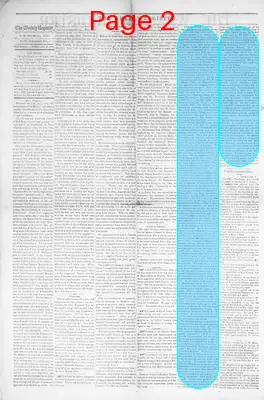
Story
February 12, 1863
The Weekly Register
Point Pleasant, Mason County, West Virginia
What is this article about?
Governor Pierpoint's speech in Wheeling advocates for West Virginia statehood, detailing historical oppressions by eastern Virginia, unequal representation, taxation burdens, and war debts, urging separation for fair governance and economic prosperity.
Clipping
OCR Quality
95%
Excellent
Full Text
Governor Pierpoint's Speech.
He began by saying that from his early youth he had been led to observe the oppressions inflicted by eastern legislation upon Western Virginia, and age and experience had only added to his knowledge and strengthened his convictions.—
He spoke of the early history of the West, and traced its gradual increase from colonial dependence on the East up to the Conventions of 1830, and thence to that of 1850, when it was discovered that the West had an actual numerical majority of 115,000 white inhabitants.—
The great intellects of Western Virginia, such as Phillip Doddridge, were in the Convention of 1830: but with all their efforts and threats of dividing, they were able to get nothing but a slight enlargement of western representation; but to effect this the Convention divided the State into four districts, the Tide-Water, Piedmont, Valley, and Trans-Alleghany, and apportioned the delegates so that the East had about two thirds. In the Convention of 1850 the West began to feel bold, but they did not know their strength and adjourned to await the returns of the census. The census showed that West of the Blue Ridge there were 15,000 majority of white population of the State. The Western Delegates in the Convention then declared they would have equal representation on the white basis. Going on the principle that one white man at least was as good as another. The struggle was long but all they would give us at least was to divide the State again into these four districts, and give the popular branch of the Legislature—representation on the white basis (which gave us ten majority.) but they reserved their power in the Senate. There they gave the Tide water and Piedmont districts 30 representatives and assigned 20 to the whole West, which had fifteen thousand majority of the white population. We are living under that law and inequality to-day, or practically up to the time of this rebellion, and when the rebellion is put down, and we remain attached to the East we go back again under that Constitution and that inequality. Not only that injustice but others. They required exemption from taxation for all negroes under 12 years of age, and all other property taxed ad valorem. Our State debt was then about $12,000,000, but immediately upon their getting that advantage they went into a system of legislation which in ten years raised that debt from $12,000,000, to $45,000,000, for building railroads in the other part of the State, but never appropriating a dollar for such purposes west of the mountains.
Before the war the State was wealthy and able to pay such a debt, but now all its wealth in the East and Valley had been devoured by the war, and there was nothing left to tax. Then if peace was restored to-morrow and found us still connected with the East, this portion of the State north of the Little Kanawha embracing nearly two congressional districts, untouched by the war, the wealthiest portion of the new State, worth some hundreds of millions of dollars, and capable of paying a large amount of taxes, would have an enormous burden of taxation to bear. He would like to see a man in the Northwest who under such circumstances wanted to go back to Eastern Virginia. In Eastern Virginia they have issued about $20,000,000 of scrip, for war debt, receivable at Richmond in payment of taxes. If peace were declared to-morrow and the reorganized Government spread all over the State, how would it be? Suppose the Legislature should refuse to meet that debt, it is the only kind of money the people of the Valley and East have got. They offer it in payment of taxes, and have no other kind to offer. What are you going to do? If you refuse to receive it and assume the debt creating it, the very next Legislature will be elected on that issue and will be elected expressly to do what you refused to do; for they will have the preponderance and can do it in spite of you. To that debt—an additional debt of $20,000,000, will be put right on you at once, if the rebellion were to conclude to-morrow and we go back to Richmond. There is a debt of $65,000,000, which the East in her impoverished condition cannot pay, and which must be taken from the comparatively prosperous West. He recollected that 8 years ago Jim Stephenson of Taylor county, representative in Richmond, had announced there that Northwestern Virginia was sufficient for an empire, and he was for a division. So it is, but that is no reason any one here should want this mountain of taxation piled on her.
The Governor went on to speak of the character of the men who were opposing the creation of a new State. It started with the secessionists, who did "not want to see the 'glorious old Commonwealth' dismembered.' Well he loved the old Commonwealth and its glory, but he hated its oppression and injustice. Who were the leaders of this faction so tenacious about a division of the State? Charley Russell, Jo. Pendleton and Fitzhugh. They have embarked their fortunes with the South. Now trace up.— Come here to Wheeling and go up yonder to Brooke, and we find it is the relations of these men who are leading off in this thing. What interest have they with the laboring men of this city? what care they about the bone and sinew here? They are an exclusive class, with different feelings and aspirations entirely.— They are opposed to free schools, free voting, free speech. They are the aristocracy! If they were going to make brick these aristocrats would use the laboring men to burn them, if they could be had cheaper by the cord than wood.
They would make any other use of the poor man that might be convenient if they could lawfully do so. He wished he could speak to the heart of every Irishman and German in this community, he would lay this thing open to them and try to help them see what their interests were, and their duty as patriots and American citizens. These men were running around telling their tales. [A voice—"Their lies."] They have worked these Germans and Irishmen till they have made fortunes out of them and if ever an opportunity offered they would deprive them of their rights and franchises of citizens.
He would tell them one thing, and it was sure as they were living; that if the New State in Western Virginia was not adopted, the freemen of the North-west would not suffer themselves to be taxed and oppressed by the East and South-western Virginia. Wheeling numbers to-day more inhabitants than it will ever number again, if it is not adopted; for no man is going to settle in a place where everything would be taken from him by a people who antagonized him in every particular. Neither would people already here stay in a place under the same burdens. He had examined the subject of taxation minutely and he found that the current expense for carrying on the New State would not amount to $80,000, allowing liberal appropriations for a Lunatic Asylum and a Penitentiary.
We had been paying to the old State $536,000. They could erect all the buildings necessary to carry on the new State and pay interest on our equitable portion of the State debt, with 60 per cent of the taxes now paid, and do this within the next ten years. He assured them it could be done, and he assured them further, that when the new State should be put in operation they would be in the best condition—the freest from debt, subject to the least taxation, and with the most economical government of any State in the Union. The laboring man would then receive a larger reward for his labor than he receives anywhere in the United States. It was worth being in earnest about; for if it was not done now it never would be done.
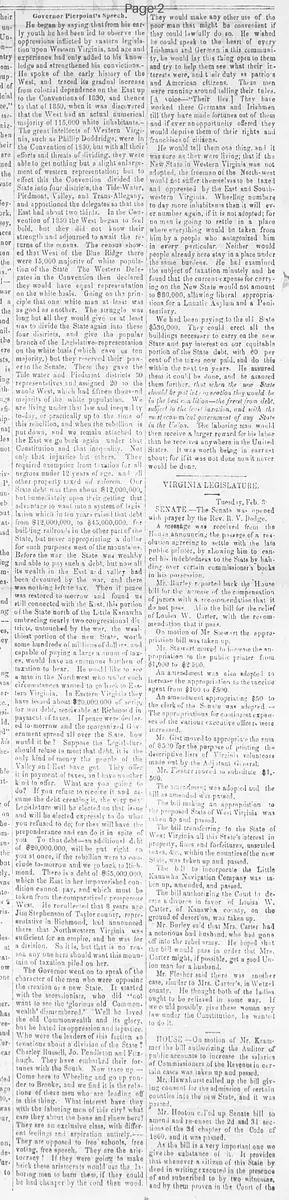
He began by saying that from his early youth he had been led to observe the oppressions inflicted by eastern legislation upon Western Virginia, and age and experience had only added to his knowledge and strengthened his convictions.—
He spoke of the early history of the West, and traced its gradual increase from colonial dependence on the East up to the Conventions of 1830, and thence to that of 1850, when it was discovered that the West had an actual numerical majority of 115,000 white inhabitants.—
The great intellects of Western Virginia, such as Phillip Doddridge, were in the Convention of 1830: but with all their efforts and threats of dividing, they were able to get nothing but a slight enlargement of western representation; but to effect this the Convention divided the State into four districts, the Tide-Water, Piedmont, Valley, and Trans-Alleghany, and apportioned the delegates so that the East had about two thirds. In the Convention of 1850 the West began to feel bold, but they did not know their strength and adjourned to await the returns of the census. The census showed that West of the Blue Ridge there were 15,000 majority of white population of the State. The Western Delegates in the Convention then declared they would have equal representation on the white basis. Going on the principle that one white man at least was as good as another. The struggle was long but all they would give us at least was to divide the State again into these four districts, and give the popular branch of the Legislature—representation on the white basis (which gave us ten majority.) but they reserved their power in the Senate. There they gave the Tide water and Piedmont districts 30 representatives and assigned 20 to the whole West, which had fifteen thousand majority of the white population. We are living under that law and inequality to-day, or practically up to the time of this rebellion, and when the rebellion is put down, and we remain attached to the East we go back again under that Constitution and that inequality. Not only that injustice but others. They required exemption from taxation for all negroes under 12 years of age, and all other property taxed ad valorem. Our State debt was then about $12,000,000, but immediately upon their getting that advantage they went into a system of legislation which in ten years raised that debt from $12,000,000, to $45,000,000, for building railroads in the other part of the State, but never appropriating a dollar for such purposes west of the mountains.
Before the war the State was wealthy and able to pay such a debt, but now all its wealth in the East and Valley had been devoured by the war, and there was nothing left to tax. Then if peace was restored to-morrow and found us still connected with the East, this portion of the State north of the Little Kanawha embracing nearly two congressional districts, untouched by the war, the wealthiest portion of the new State, worth some hundreds of millions of dollars, and capable of paying a large amount of taxes, would have an enormous burden of taxation to bear. He would like to see a man in the Northwest who under such circumstances wanted to go back to Eastern Virginia. In Eastern Virginia they have issued about $20,000,000 of scrip, for war debt, receivable at Richmond in payment of taxes. If peace were declared to-morrow and the reorganized Government spread all over the State, how would it be? Suppose the Legislature should refuse to meet that debt, it is the only kind of money the people of the Valley and East have got. They offer it in payment of taxes, and have no other kind to offer. What are you going to do? If you refuse to receive it and assume the debt creating it, the very next Legislature will be elected on that issue and will be elected expressly to do what you refused to do; for they will have the preponderance and can do it in spite of you. To that debt—an additional debt of $20,000,000, will be put right on you at once, if the rebellion were to conclude to-morrow and we go back to Richmond. There is a debt of $65,000,000, which the East in her impoverished condition cannot pay, and which must be taken from the comparatively prosperous West. He recollected that 8 years ago Jim Stephenson of Taylor county, representative in Richmond, had announced there that Northwestern Virginia was sufficient for an empire, and he was for a division. So it is, but that is no reason any one here should want this mountain of taxation piled on her.
The Governor went on to speak of the character of the men who were opposing the creation of a new State. It started with the secessionists, who did "not want to see the 'glorious old Commonwealth' dismembered.' Well he loved the old Commonwealth and its glory, but he hated its oppression and injustice. Who were the leaders of this faction so tenacious about a division of the State? Charley Russell, Jo. Pendleton and Fitzhugh. They have embarked their fortunes with the South. Now trace up.— Come here to Wheeling and go up yonder to Brooke, and we find it is the relations of these men who are leading off in this thing. What interest have they with the laboring men of this city? what care they about the bone and sinew here? They are an exclusive class, with different feelings and aspirations entirely.— They are opposed to free schools, free voting, free speech. They are the aristocracy! If they were going to make brick these aristocrats would use the laboring men to burn them, if they could be had cheaper by the cord than wood.
They would make any other use of the poor man that might be convenient if they could lawfully do so. He wished he could speak to the heart of every Irishman and German in this community, he would lay this thing open to them and try to help them see what their interests were, and their duty as patriots and American citizens. These men were running around telling their tales. [A voice—"Their lies."] They have worked these Germans and Irishmen till they have made fortunes out of them and if ever an opportunity offered they would deprive them of their rights and franchises of citizens.
He would tell them one thing, and it was sure as they were living; that if the New State in Western Virginia was not adopted, the freemen of the North-west would not suffer themselves to be taxed and oppressed by the East and South-western Virginia. Wheeling numbers to-day more inhabitants than it will ever number again, if it is not adopted; for no man is going to settle in a place where everything would be taken from him by a people who antagonized him in every particular. Neither would people already here stay in a place under the same burdens. He had examined the subject of taxation minutely and he found that the current expense for carrying on the New State would not amount to $80,000, allowing liberal appropriations for a Lunatic Asylum and a Penitentiary.
We had been paying to the old State $536,000. They could erect all the buildings necessary to carry on the new State and pay interest on our equitable portion of the State debt, with 60 per cent of the taxes now paid, and do this within the next ten years. He assured them it could be done, and he assured them further, that when the new State should be put in operation they would be in the best condition—the freest from debt, subject to the least taxation, and with the most economical government of any State in the Union. The laboring man would then receive a larger reward for his labor than he receives anywhere in the United States. It was worth being in earnest about; for if it was not done now it never would be done.
What sub-type of article is it?
Historical Event
What themes does it cover?
Justice
Misfortune
Triumph
What keywords are associated?
Western Virginia
State Division
Taxation Inequality
Governor Pierpoint
Civil War Debt
Representation Convention
What entities or persons were involved?
Governor Pierpoint
Phillip Doddridge
Jim Stephenson
Charley Russell
Jo. Pendleton
Fitzhugh
Where did it happen?
Wheeling, Western Virginia
Story Details
Key Persons
Governor Pierpoint
Phillip Doddridge
Jim Stephenson
Charley Russell
Jo. Pendleton
Fitzhugh
Location
Wheeling, Western Virginia
Event Date
Conventions Of 1830 And 1850, Before The War
Story Details
Governor Pierpoint recounts historical inequalities in Virginia representation and taxation favoring the East, warns of future burdens from war debts if reunited, criticizes aristocratic opponents, and argues for a new prosperous West Virginia state with low taxes and fair governance.