Thank you for visiting SNEWPapers!
Sign up free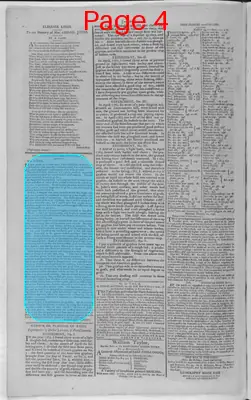
Letter to Editor
March 27, 1790
Gazette Of The United States
New York, New York County, New York
What is this article about?
A letter criticizes the proposed 40:1 ratio for assuming continental bills of credit, arguing it violates public faith and injures early Revolution supporters who held the bills at face value, citing 1775 Congress resolutions promising redemption.
Clipping
OCR Quality
95%
Excellent
Full Text
FOR THE GAZETTE OF THE UNITED STATES.
MR. FENNO,
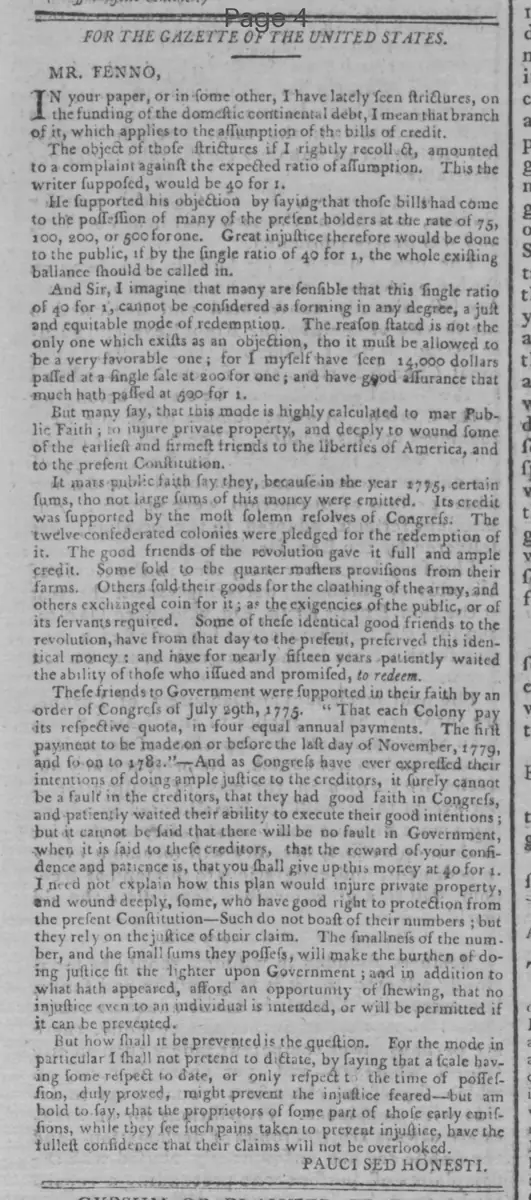
IN your paper, or in some other, I have lately seen strictures, on the funding of the domestic continental debt, I mean that branch of it, which applies to the assumption of the bills of credit.
The object of those strictures if I rightly recollect it, amounted to a complaint against the expected ratio of assumption. This the writer supposed, would be 40 for 1.
He supported his objection by saying that those bills had come to the possession of many of the present holders at the rate of 75, 100, 200, or 300 for one. Great injustice therefore would be done to the public, if by the single ratio of 40 for 1, the whole existing balance should be called in.
And Sir, I imagine that many are sensible that this single ratio of 40 for 1, cannot be considered as forming in any degree, a just and equitable mode of redemption. The reason stated is not the only one which exists as an objection, tho it must be allowed to be a very favorable one; for I myself have seen 14,000 dollars passed at a single sale at 200 for one; and have good assurance that much hath passed at 300 for 1.
But many say, that this mode is highly calculated to mar Public Faith; to injure private property, and deeply to wound some of the earliest and firmest friends to the liberties of America, and to the present Constitution.
It mars public faith as they say, because in the year 1775, certain sums, tho not large sums of this money were emitted. Its credit was supported by the most solemn resolves of Congress. The twelve confederated colonies were pledged for the redemption of it. The good friends of the revolution gave it full and ample credit. Some sold to the quarter masters provisions from their farms. Others sold their goods for the cloathing of the army, and others exchanged coin for it; as the exigencies of the public, or of its servants required. Some of these identical good friends to the revolution, have from that day to the present, preserved this identical money: and have for nearly fifteen years patiently waited the ability of those who issued and promised, to redeem.
These friends to Government were supported in their faith by an order of Congress of July 29th, 1775. "That each Colony pay its respective quota, in four equal annual payments. The first payment to be made on or before the last day of November, 1779, and so on to 1782."--And as Congress have ever expressed their intentions of doing ample justice to the creditors, it surely cannot be a fault in the creditors, that they had good faith in Congress, and patiently waited their ability to execute their good intentions; but it cannot be said that there will be no fault in Government, when it is said to these creditors, that the reward of your confidence and patience is, that you shall give up this money at 40 for 1.
I need not explain how this plan would injure private property, and wound deeply, some, who have good right to protection from the present Constitution—Such do not boast of their numbers; but they rely on the justice of their claim. The smallness of the number, and the small sums they possess, will make the burden of doing justice sit the lighter upon Government; and in addition to what hath appeared, afford an opportunity of shewing, that no injustice even to an individual is intended, or will be permitted if it can be prevented.
But how shall it be prevented is the question. For the mode in particular I shall not pretend to dictate, by saying that a scale having some respect to date, or only respect to the time of possession, duly proved, might prevent the injustice feared—but am bold to say, that the proprietors of some part of those early emissions, while they see such pains taken to prevent injustice, have the fullest confidence that their claims will not be overlooked.
PAUCI SED HONESTI.
MR. FENNO,
IN your paper, or in some other, I have lately seen strictures, on the funding of the domestic continental debt, I mean that branch of it, which applies to the assumption of the bills of credit.
The object of those strictures if I rightly recollect it, amounted to a complaint against the expected ratio of assumption. This the writer supposed, would be 40 for 1.
He supported his objection by saying that those bills had come to the possession of many of the present holders at the rate of 75, 100, 200, or 300 for one. Great injustice therefore would be done to the public, if by the single ratio of 40 for 1, the whole existing balance should be called in.
And Sir, I imagine that many are sensible that this single ratio of 40 for 1, cannot be considered as forming in any degree, a just and equitable mode of redemption. The reason stated is not the only one which exists as an objection, tho it must be allowed to be a very favorable one; for I myself have seen 14,000 dollars passed at a single sale at 200 for one; and have good assurance that much hath passed at 300 for 1.
But many say, that this mode is highly calculated to mar Public Faith; to injure private property, and deeply to wound some of the earliest and firmest friends to the liberties of America, and to the present Constitution.
It mars public faith as they say, because in the year 1775, certain sums, tho not large sums of this money were emitted. Its credit was supported by the most solemn resolves of Congress. The twelve confederated colonies were pledged for the redemption of it. The good friends of the revolution gave it full and ample credit. Some sold to the quarter masters provisions from their farms. Others sold their goods for the cloathing of the army, and others exchanged coin for it; as the exigencies of the public, or of its servants required. Some of these identical good friends to the revolution, have from that day to the present, preserved this identical money: and have for nearly fifteen years patiently waited the ability of those who issued and promised, to redeem.
These friends to Government were supported in their faith by an order of Congress of July 29th, 1775. "That each Colony pay its respective quota, in four equal annual payments. The first payment to be made on or before the last day of November, 1779, and so on to 1782."--And as Congress have ever expressed their intentions of doing ample justice to the creditors, it surely cannot be a fault in the creditors, that they had good faith in Congress, and patiently waited their ability to execute their good intentions; but it cannot be said that there will be no fault in Government, when it is said to these creditors, that the reward of your confidence and patience is, that you shall give up this money at 40 for 1.
I need not explain how this plan would injure private property, and wound deeply, some, who have good right to protection from the present Constitution—Such do not boast of their numbers; but they rely on the justice of their claim. The smallness of the number, and the small sums they possess, will make the burden of doing justice sit the lighter upon Government; and in addition to what hath appeared, afford an opportunity of shewing, that no injustice even to an individual is intended, or will be permitted if it can be prevented.
But how shall it be prevented is the question. For the mode in particular I shall not pretend to dictate, by saying that a scale having some respect to date, or only respect to the time of possession, duly proved, might prevent the injustice feared—but am bold to say, that the proprietors of some part of those early emissions, while they see such pains taken to prevent injustice, have the fullest confidence that their claims will not be overlooked.
PAUCI SED HONESTI.
What sub-type of article is it?
Persuasive
Political
Ethical Moral
What themes does it cover?
Economic Policy
Politics
Morality
What keywords are associated?
Continental Debt
Bills Of Credit
Assumption Ratio
Public Faith
Revolution Creditors
Congress Resolves
What entities or persons were involved?
Pauci Sed Honesti.
Mr. Fenno
Letter to Editor Details
Author
Pauci Sed Honesti.
Recipient
Mr. Fenno
Main Argument
the proposed single 40:1 ratio for redeeming continental bills of credit is unjust, as it harms early holders who preserved the bills at face value based on congress's 1775 promises, and a scaled approach considering date or possession time should be used to uphold public faith and protect revolution supporters.
Notable Details
References Congress Order Of July 29th, 1775, For Redemption In Four Annual Payments From 1779 To 1782.
Examples Of Bills Passing At 200:1 And 300:1.
Pledges By Twelve Colonies And Solemn Resolves Supporting The Bills' Credit.