Thank you for visiting SNEWPapers!
Sign up free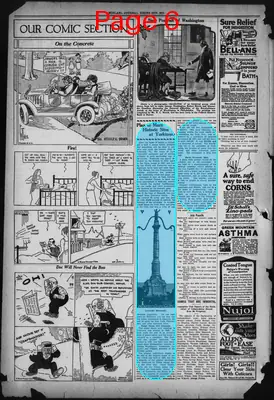
The Midland Journal
Rising Sun, Cecil County, Maryland
What is this article about?
The Colonial Dames are pushing for congressional funding to restore fortifications, build roads, and erect markers at historic Yorktown, Va., site of Cornwallis' 1781 surrender and key events in later wars. Details include landmarks like the oldest house (1699), Nelson House, and existing monuments.
Clipping
OCR Quality
Full Text
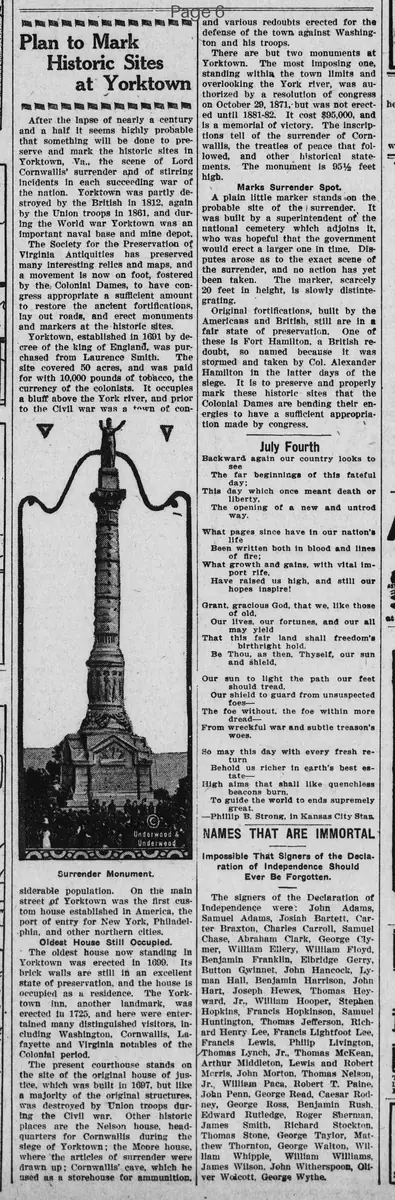
After the lapse of nearly a century and a half it seems highly probable that something will be done to preserve and mark the historic sites in Yorktown, Va., the scene of Lord Cornwallis' surrender and of stirring incidents in each succeeding war of the nation. Yorktown was partly destroyed by the British in 1812, again by the Union troops in 1861, and during the World war Yorktown was an important naval base and mine depot. The Society for the Preservation of Virginia Antiquities has preserved many interesting relics and maps, and a movement is now on foot, fostered by the Colonial Dames, to have congress appropriate a sufficient amount to restore the ancient fortifications, lay out roads, and erect monuments and markers at the historic sites. Yorktown, established in 1691 by decree of the king of England, was purchased from Laurence Smith. The site covered 50 acres, and was paid for with 10,000 pounds of tobacco, the currency of the colonists. It occupies a bluff above the York river, and prior to the Civil war was a town of considerable population. Surrender Monument,
On the main street of Yorktown was the first custom house established in America, the port of entry for New York, Philadelphia, and other northern cities. Oldest House Still Occupied. - The oldest house now standing in Yorktown was erected in 1699. Its brick walls are still in an excellent state of preservation, and the house is occupied as a residence. The Yorktown inn, another landmark, was erected in 1725, and here were entertained many distinguished visitors, including Washington, Cornwallis, Lafayette and Virginia notables of the Colonial period. The present courthouse stands on the site of the original house of justice, which was built in 1697, but like a majority of the original structures, was destroyed by Union troops during the Civil war. Other historic places are the Nelson house, headquarters for Cornwallis during the siege of Yorktown; the Moore house, where the articles of surrender were drawn up; Cornwallis' cave, which he used as a storehouse for ammunition, and various redoubts erected for the defense of the town against Washington and his troops.
There are but two monuments at Yorktown. The most imposing one, standing within the town limits and overlooking the York river, was authorized by a resolution of congress on October 29, 1871, but was not erected until 1881-82. It cost $95,000, and is a memorial of victory. The inscriptions tell of the surrender of Cornwallis, the treaties of peace that followed, and other historical statements. The monument is 95½ feet high.
Marks Surrender Spot. A plain little marker stands on the probable site of the surrender. It was built by a superintendent of the national cemetery which adjoins it, who was hopeful that the government would erect a larger one in time. Disputes arose as to the exact scene of the surrender, and no action has yet been taken. The marker, scarcely 20 feet in height, is slowly disintegrating. Original fortifications, built by the Americans and British, still are in a fair state of preservation. One of these is Fort Hamilton, a British redoubt, so named because it was stormed and taken by Col. Alexander Hamilton in the latter days of the siege. It is to preserve and properly mark these historic sites that the Colonial Dames are bending their energies to have a sufficient appropriation made by congress.
What sub-type of article is it?
What themes does it cover?
What keywords are associated?
What entities or persons were involved?
Where did it happen?
Story Details
Key Persons
Location
Yorktown, Va.
Event Date
Nearly A Century And A Half After 1781
Story Details
Movement led by Colonial Dames to secure congressional appropriation for restoring Yorktown's fortifications, laying out roads, and marking historic sites including the surrender location, Nelson House, Moore House, and existing monuments from the Revolutionary War and later conflicts.