Thank you for visiting SNEWPapers!
Sign up free
The Brunswick News
Brunswick, Glynn County, Georgia
What is this article about?
In Atlanta on July 3, legislative leader Hooper Alexander forecasts passage of key bills in the Georgia session, including anti-lobbying, anti-jug, state road extension, and railroad regulations. Seaborn Wright pushes for municipal control over public utilities.
Clipping
OCR Quality
Full Text
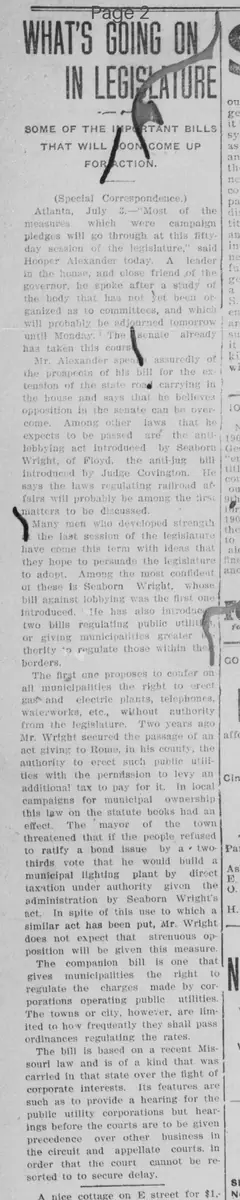
SOME OF THE IMPORTANT BILLS THAT WILL COME UP FOR ACTION.
(Special Correspondence.)
Atlanta, July 3.—"Most of the measures which were campaign pledges will go through at this fifty day session of the legislature," said Hooper Alexander today. A leader in the house, and close friend of the governor, he spoke after a study of the body that has not yet been organized as to committees, and which will probably be adjourned tomorrow until Monday. The senate already has taken this course. Mr. Alexander speaks assuredly of the prospects of his bill for the extension of the state road carrying in the house and says that he believes opposition in the senate can be overcome. Among other laws that he expects to be passed are the anti-lobbying act introduced by Seaborn Wright, of Floyd, the anti-jug bill introduced by Judge Covington. He says the laws regulating railroad affairs will probably be among the first matters to be discussed.
Many men who developed strength the last session of the legislature have come this term with ideas that they hope to persuade the legislature to adopt. Among the most confident of these is Seaborn Wright, whose bill against lobbying was the first one introduced. He has also introduced two bills regulating public utilities, or giving municipalities greater authority to regulate those within the borders.
The first one proposes to confer on all municipalities the right to erect gas and electric plants, telephones, waterworks, etc, without authority from the legislature. Two years ago Mr. Wright secured the passage of an act giving to Rome, in his county, the authority to erect such public utilities with the permission to levy an additional tax to pay for it. In local campaigns for municipal ownership this law on the statute books had an effect. The mayor of the town threatened that if the people refused to ratify a bond issue by a two-thirds vote that he would build a municipal lighting plant by direct taxation under authority given the administration by Seaborn Wright's act. In spite of this use to which a similar act has been put, Mr. Wright does not expect that strenuous opposition will be given this measure.
The companion bill is one that gives municipalities the right to regulate the charges made by corporations operating public utilities. The towns or city, however, are limited to how frequently they shall pass ordinances regulating the rates. The bill is based on a recent Missouri law and is of a kind that was carried in that state over the fight of corporate interests. Its features are such as to provide a hearing for the public utility corporations but hearings before the courts are to be given precedence over other business in the circuit and appellate courts, in order that the court cannot be resorted to to secure delay.
What sub-type of article is it?
What themes does it cover?
What keywords are associated?
What entities or persons were involved?
Where did it happen?
Story Details
Key Persons
Location
Atlanta
Event Date
July 3
Story Details
Hooper Alexander predicts passage of campaign pledge bills in the Georgia legislature, including his state road extension, Seaborn Wright's anti-lobbying act, Judge Covington's anti-jug bill, and railroad regulations. Wright introduces bills empowering municipalities to build and regulate public utilities like gas, electric, and waterworks, based on a Missouri law.