Thank you for visiting SNEWPapers!
Sign up free
The National Intelligencer And Washington Advertiser
Washington, District Of Columbia
What is this article about?
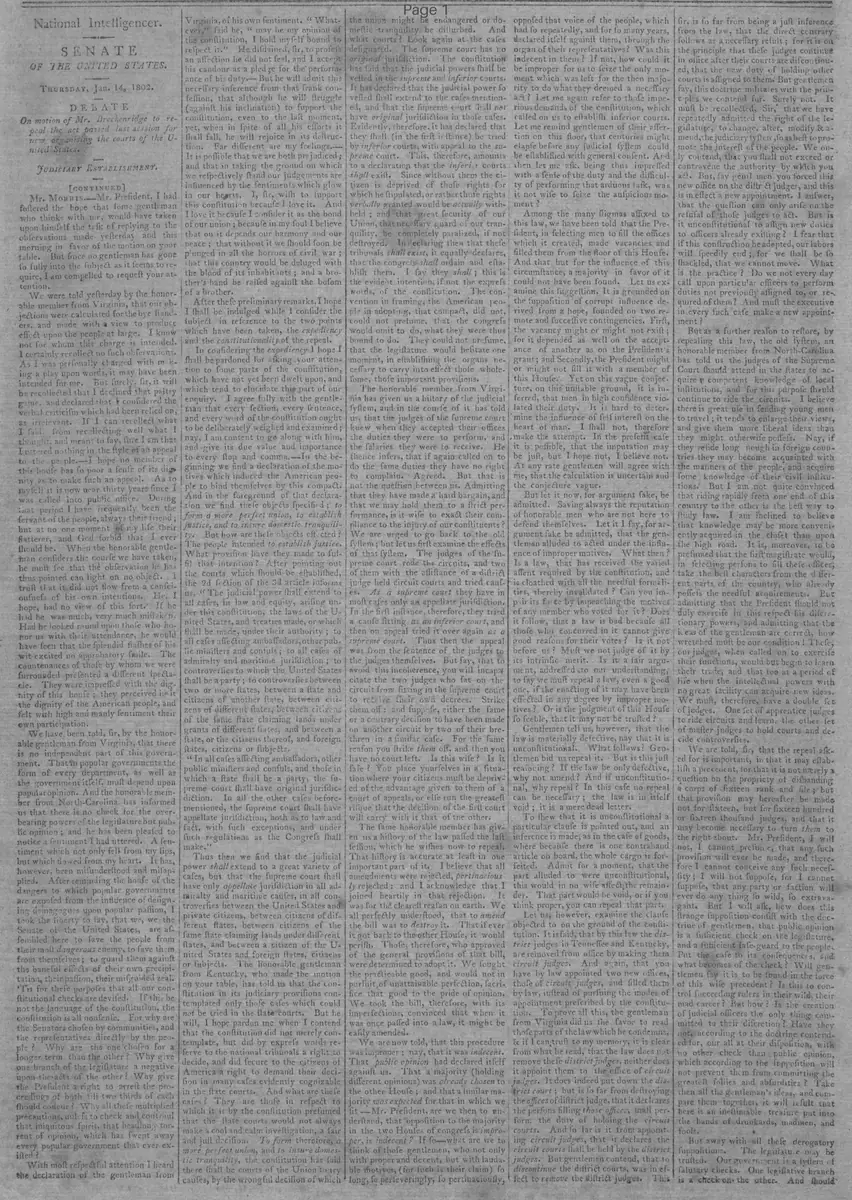
U.S. Senate debate on January 14, 1802: Mr. Monroe opposes repealing the Judiciary Act of 1801, arguing it upholds constitutional mandates for inferior courts, ensures justice, protects national unity, and counters claims of unconstitutionality and excessive expense.
Merged-components note: Merged sequential components forming the complete narrative of Mr. Monroe's speech in the Senate debate on the judiciary act, continued across pages 1 to 3.
Clippings
1 of 3
OCR Quality
Full Text
SENATE.
OF THE UNITED STATES.
THURSDAY, Jan. 14, 1802.
DEBATE
On motion of Mr. Breckenridge to repeal the act passed last session for organizing the courts of the United States.
JUDICIARY ESTABLISHMENT.
[CONTINUED]
Mr. Monroe.—Mr. President, I had offered the hope that some gentleman who thinks with me, would have taken upon himself the task of replying to the observations made yesterday and this morning in favor of the motion on your table. But since no gentleman has gone so fully into the subject as it seems to require, I am compelled to request your attention.
We were told yesterday by the honorable member from Virginia, that our objections were calculated for the bystanders, and made with a view to produce effect upon the people at large. I know not of whom this charge is intended. I certainly recollect no such observations. As I was personally charged with making a play upon words, it may have been intended for me. But surely, sir, it will be recollected that I declined that paltry game, and declared that I considered the verbal criticism which had been relied on, as irrelevant. If I can recollect what I said from recollecting well what I thought, and meant to say, sure I am that I uttered nothing in the style of an appeal to the people.—I hope no member of this house has so poor a sense of its dignity as to make such an appeal. As to myself it is now near thirty years since I was called into public office. During that period I have frequently been the servant of the people, always their friend; but at no one moment of my life their flatterer, and God forbid that I ever should be. When the honorable gentleman considers the course we have taken, he must see that the observation he has thus pointed can light on no object. I trust that it did not flow from a consciousness of his own intentions. He, I hope, had no view of this sort. If he had he was much, very much mistaken. Had he looked round upon those who honor us with their attendance, he would have seen that the splendid flashes of his wit excited no approbatory smile. The countenances of those by whom we were surrounded presented a different spectacle. They were impressed with the dignity of this house; they perceived in it the dignity of the American people, and felt with high and manly sentiment their own participation.
We have been told, sir, by the honorable gentleman from Virginia, that there is no independent part of this government. That in popular governments the form of every department, as well as the government itself, must depend upon popular opinion. And the honorable member from North-Carolina has informed us that there is no check for the overbearing powers of the legislature but public opinion; and he has been pleased to notice a sentiment I had uttered. A sentiment which not only fell from my lips, but which flowed from my heart. It has, however, been misunderstood and misapplied. After reminding the house of the dangers to which popular governments are exposed from the influence of designing demagogues upon popular passion, I took the liberty to say, that we, we the Senate of the United States, are assembled here to save the people from their most dangerous enemy, to save them from themselves; to guard them against the baneful effects of their own precipitation, their passion, their misguided zeal. 'Tis for these purposes that all our constitutional checks are devised. If this be not the language of the constitution, the constitution is all nonsense. For why are the Senators chosen by communities, and the representatives directly by the people? Why are the one chosen for a longer term than the other? Why give one branch of the legislature a negative upon the acts of the other? Why give the President a right to arrest the proceedings of both till two thirds of each should concur? Why all these multiplied precautions, unless to check and control that iniquitous spirit, that headlong torrent of opinion, which has swept away every popular government that ever existed?
With most respectful attention I heard the declaration of the gentleman from Virginia, of his own sentiment. "Whatever," said he, "may be my opinion of the constitution, I hold myself bound to respect it." He disdained, sir, to profess an affection he did not feel, and I accept his candor as a pledge for the performance of his duty. But he will admit this necessary inference from that frank confession, that although he will struggle (against his inclination) to support the constitution, even to the last moment, yet, when in spite of all his efforts it shall fall, he will rejoice in its destruction. Far different are my feelings.—It is possible that we are both prejudiced; and that in taking the ground on which we respectively stand our judgements are influenced by the sentiments which glow in our hearts. I, sir, wish to support this constitution because I love it. And I love it because I consider it as the bond of our union: because in my soul I believe that on it depends our harmony and our peace; that without it we should soon be plunged in all the horrors of civil war; that this country would be deluged with the blood of its inhabitants; and a brother's hand be raised against the bosom of a brother.
After these preliminary remarks, I hope I shall be indulged while I consider the subject in reference to the two points which have been taken, the expediency and the constitutionality of the repeal. In considering the expediency I hope I shall be pardoned for asking your attention to some parts of the Constitution, which have not yet been dwelt upon, and which tend to elucidate this part of our enquiry. I agree fully with the gentleman that every section, every sentence, and every word of the constitution ought to be deliberately weighed and examined; nay, I am content to go along with him, and give its due value and importance to every stop and comma.—In the beginning we find a declaration of the motives which induced the American people to bind themselves by this compact. And in the foreground of that declaration we find these objects specified; to form a more perfect union, to establish justice, and to insure domestic tranquility. But how are these objects effected? The people intended to establish justice. What provision have they made to fulfill that intention? After pointing out the courts which should be established, the 2d section of the 3d article informs us, "The judicial power shall extend to all cases, in law and equity, arising under this constitution, the laws of the United States, and treaties made, or which shall be made, under their authority; to all cases affecting ambassadors, other public ministers and consuls; to all cases of admiralty and maritime jurisdiction; to controversies to which the United States shall be a party; to controversies between two or more states, between a state and citizens of another state, between citizens of different states, between citizens of the same state claiming lands under grants of different states, and between a state, or the citizens thereof, and foreign states, citizens or subjects."
"In all cases affecting ambassadors, other public ministers and consuls, and those in which a state shall be a party, the supreme court shall have original jurisdiction. In all the other cases before mentioned, the supreme court shall have appellate jurisdiction, both as to law and fact, with such exceptions, and under such regulations as the Congress shall make."
Thus then we find that the judicial power shall extend to a great variety of cases, but that the supreme court shall have only appellate jurisdiction in all admiralty and maritime causes, in all controversies between the United States and private citizens, between citizens of different states, between citizens of the same state claiming lands under different states, and between a citizen of the United States and foreign states, citizens or subjects. The honorable gentleman from Kentucky, who made the motion on your table, has told us that the constitution in its judiciary provisions contemplated only those cases which could not be tried in the state courts. But he will, I hope pardon me when I contend that the constitution did not merely contemplate, but did by express words reserve to the national tribunals a right to decide, and did secure to the citizens of America a right to demand their decision in many cases evidently cognizable in the state courts. And what are these cases? They are those in respect to which it is by the constitution presumed that the state courts would not always make a cool and calm investigation, a fair and just decision. To form therefore, a more perfect union, and to insure domestic tranquility, the constitution has said there shall be courts of the Union to try causes, by the wrongful decision of which the union might be endangered or domestic tranquility be disturbed. And what courts? Look again at the cases designated. The supreme court has no original jurisdiction. The constitution has said that the judicial powers shall be vested in the supreme and inferior courts. It has declared that the judicial power so vested shall extend to the cases mentioned, and that the supreme court shall not have original jurisdiction in those cases. Evidently, therefore, it has declared that they shall (in the first instance) be tried by inferior courts, with appeal to the supreme court. This, therefore, amounts to a declaration that the inferior courts shall exist. Since without them the citizen is deprived of those rights for which he stipulated, or rather those rights verbally granted would be actually withheld; and that great security of our Union, that necessary guard of our tranquility, be completely paralyzed, if not destroyed. In declaring then that these tribunals shall exist, it equally declares, that the congress shall ordain and establish them. I say they shall; this is the evident intention, if not the express words, of the constitution. The convention in framing, the American people in adopting, that compact, did not, could not presume, that the congress would omit to do, what they were thus bound to do. They could not presume, that the legislature would hesitate one moment, in establishing the organs necessary to carry into effect those wholesome, those important provisions.
The honorable member from Virginia has given us a history, of the judicial system, and in the course of it has told us, that the judges of the supreme court knew when they accepted their offices the duties they were to perform, and the salaries they were to receive. He thence infers, that if again called on to do the same duties they have no right to complain. Agreed. But that is not the question between us. Admitting that they have made a hard bargain, and that we may hold them to a strict performance, is it wise to exact their compliance to the injury of our constituents? We are urged to go back to the old system; but let us first examine the effects of that system. The judges of the supreme court rode the circuits, and two of them with the assistance of a district judge held circuit courts and tried causes. As a supreme court they have in most cases only an appellate jurisdiction. In the first instance, therefore, they tried a cause sitting as an inferior court, and then on appeal tried it over again as a supreme court. Thus then the appeal was from the sentence of the judges to the judges themselves. But say, that to avoid this incoherence, you will incapacitate the two judges who sit on the circuit from sitting in the supreme court to receive their own decrees. Strike them off: and suppose, either the same or a contrary decision to have been made on another circuit by two of their brethren in a similar case. For the same reason you strike them off, and then you have no court left. Is this wise? Is it safe? You place yourselves in a situation where your citizens must be deprived of the advantage given to them of a court of appeals, or else run the greatest risque that the decision of the first court will carry with it that of the other.
The same honorable member has given us a history of the law passed the last session, which he wishes now to repeal. That history is accurate at least in one important part of it. I believe that all amendments were rejected, pertinaciously rejected: and I acknowledge that I joined heartily in that rejection. It was for the clearest reason on earth. We all perfectly understood, that to amend the bill was to destroy it. That if ever it got back to the other House, it would perish. Those, therefore, who approved of the general provisions of that bill, were determined to adopt it. We ought the practicable good, and would not in pursuit of unattainable perfection, sacrifice that good to the pride of opinion. We took the bill, therefore, with its imperfections, convinced that when it was once passed into a law, it might be easily amended.
We are now told, that this procedure was improper; nay, that it was indecent. That public opinion had declared itself against us. That a majority (holding different opinions) was already chosen to the other House; and that a similar majority was expected for that in which we sit—Mr. President, are we then to understand, that opposition to the majority in the two Houses of congress is improper, is indecent? If so—what are we to think of those gentlemen, who not only with proper and decent, but with laudable motives, (for such is their claim) so long, so perseveringly, so pertinaciously, opposed that voice of the people, which had so repeatedly, and for so many years, declared itself against them, through the organ of their representatives? Was this indecent in them? If not, how could it be improper for us to seize the only moment which was left for the then majority to do what they deemed a necessary act? Let me again refer to those imperious demands of the constitution, which called on us to establish inferior courts. Let me remind gentlemen of their assertion on this floor, that centuries might elapse before any judicial system could be established with general consent. And then let me ask, being thus impressed with a sense of the duty and the difficulty of performing that arduous task, was it not wise to seize the auspicious moment?
Among the many stigmas affixed to this law, we have been told that the President, in electing men to fill the offices which it created, made vacancies and filled them from the floor of this House. And that but for the influence of this circumstance, a majority in favor of it could not have been found. Let us examine this suggestion. It is grounded on the supposition of corrupt influence derived from a hope, founded on two remote and successive contingencies. First. the vacancy might or might not exist; for it depended as well on the acceptance of another as on the President's grant; and Secondly, the President might or might not fill it with a member of this House. Yet on this vague conjecture, on this unstable ground, it is inferred, that men in high confidence violated their duty. It is hard to determine the influence of self interest on the heart of man. I shall not, therefore make the attempt. In the present case it is possible, that the imputation may be just, but I hope not, I believe not. At any rate gentlemen will agree with me, that the calculation is uncertain and the conjecture vague.
But let it now, for argument sake, be admitted. Saving always the reputation of honorable men who are not here to defend themselves. Let it I say, for argument sake be admitted, that the gentlemen alluded to acted under the influence of improper motives. What then? Is a law, that has received the varied assent required by the constitution, and is clothed with all the needful formalities, thereby invalidated? Can you impair its force by impeaching the motives of any member who voted for it? Does it follow, that a law is bad because all those who concurred in it cannot give good reasons for their votes? Is it not before us? Must we not judge of it by its intrinsic merit. Is it a fair argument, addressed to our understanding, to say we must repeal a law, even a good one, if the enacting of it may have been effected in any degree by improper motives? Or is the judgement of this House so feeble, that it may not be trusted?
Gentlemen tell us, however, that the law is materially defective, nay that it is unconstitutional. What follows? Gentlemen bid us repeal it. But is this just restoring? If the law be only defective, why not amend? And if unconstitutional, why repeal? In this case no repeal can be necessary; the law is in itself void; it is a mere dead letter.
To show that it is unconstitutional a particular clause is pointed out, and an inference is made, as in the case of goods. where because there is one contraband article on board, the whole cargo is forfeited. Admit for a moment, that the part alluded to were unconstitutional. this would in no wise affect the remainder. That part would be void, or if you think proper, you can repeal that part. Let us, however, examine the clause objected to on the ground of the constitution. It is said, that by this law the district judges in Tennessee and Kentucky, are removed from office by making them circuit judges. And again, that you have by law appointed two new offices, those of circuit judges, and filled them by law, instead of pursuing the modes of appointment prescribed by the constitution. To prove all this, the gentleman from Virginia did us the favor to read those parts of the law which he condemns. And if I can trust to my memory, it is clear from what he read, that the law does not remove these district judges, neither does it appoint them to the office of circuit judges. It does indeed put down the district court; but is so far from destroying the offices of district judge, that it declares the persons filling those offices, in all performances the duty of holding the circuit courts. And so far is it from appointing circuit judges, that it declares the circuit courts shall be held by the district judges. But gentlemen contend, that to discontinue the district courts, was in effect to remove the district judges. This, sir, is so far from being a just inference from the law, that the direct contrary follows as a necessary result; for it is on the principle that these judges continue in office after their courts are discontinued, that the new duty of holding other courts is assigned to them. But gentlemen say, this doctrine militates with the principles we contend for. Surely not. It must be recollected, Sir, that we have repeatedly admitted the right of the legislature, to change, alter, modify & amend, the judiciary system, so as best to promote the interest of the people. We only contend, that you shall not exceed or contravene the authority by which you act. But, say gentlemen. you forced this new office on the district judges, and this is in effect a new appointment. I answer, that the question can only arise on the refusal of those judges to act. But is it unconstitutional to assign new duties to officers already existing? I fear that if this construction be adopted, our labors will speedily end; for we shall be so shackled, that we cannot move. What is the practice? Do we not every day call upon particular officers to perform duties not previously assigned to, or required of them? And must the executive in every such case make a new appointment?
But as a further reason to restore, by repealing this law, the old system, an honorable member from North-Carolina has told us the judges of the Supreme Court should attend in the states to acquire a competent knowledge of local institutions, and for this purpose should continue to ride the circuits. I believe there is great use in sending young men to travel: it tends to enlarge their views, and give them more liberal ideas than they might otherwise possess. Nay, if they reside long enough in foreign countries they may become acquainted with the manners of the people, and acquire some knowledge of their civil institutions. But I am not quite convinced that riding rapidly from one end of this country to the other is the best way to study law. I am inclined to believe that knowledge may be more conveniently acquired in the closet than upon the high road. It is, moreover, to be presumed that the first magistrate would, in electing persons to fill these offices, take the best characters from the different parts of the country, who already possess the needful acquirements. But admitting that the President should not duly exercise in this respect his discretionary powers, and admitting that the ideas of the gentleman are correct, how wretched must be our condition! These, our judges, when called on to exercise their functions, would but begin to learn their trade, and that too at a period of life when the intellectual powers with no great facility can acquire new ideas. We must, therefore, have a double set of judges. One set of apprentice judges to ride circuits and learn, the other set of master judges to hold courts and decide controversies.
We are told, sir, that the repeal asked for is important, in that it may establish a precedent, for that it is not merely a question on the propriety of disbanding a corps of sixteen rank and file; but that provision may hereafter be made not for sixteen, but for sixteen hundred or sixteen thousand judges, and that it may become necessary to turn them to the right about. Mr. President, I will not, I cannot presume, that any such provision will ever be made, and therefore I cannot conceive any such necessity; I will not suppose, or I cannot suppose, that any party or faction will ever do any thing so wild, so extravagant. But I will ask, how does this strange supposition consist with the doctrine of gentlemen, that public opinion is a sufficient check on the legislature, and a sufficient safeguard to the people? Put the case to its consequences, and what becomes of the check? Will gentlemen say it is to be found in the force of this wise precedent? Is this to control succeeding rulers in their wild, their mad career? But how? Is the creation of judicial officers the only thing committed to their discretion? Have they not, according to the doctrine contended for, our all at their disposition, with no other check than public opinion, which according to the supposition will not prevent them from committing the greatest follies and absurdities? Take then all the gentleman's ideas, and compare them together, it will result that there is an inestimable treasure put into the hands of drunkards, madmen, and fools.
But away with all these derogatory suppositions. The legislature may be trusted. Our government is a system of salutary checks. One legislative branch is a check on the other. And should
By violence party spirit has both of
their way, the President, an officer
high in honor, high in the public confi-
dence, charged with weighty concerns,
responsible to his own regulation, and to
the world, stands ready to arrest their
too impetuous course. This is our system.
It makes no mad appeal to every mob
in the country. It appeals to the sober
sense of men elected from their fellow-
citizens for their talents, for their vir-
tue--of men in advanced life, and of
matured judgment. It appeals to their
understanding, to their integrity, to their
honor, to their love of fame, to their
sense of shame. If all these checks
should prove insufficient, and alas! such
is the condition of human nature, that
I fear they will not always be sufficient--
the constitution has given us one more.
It has given us an independent judicia-
ry. We have been told, that the exe-
cutive authority carries your laws into
execution. But let us not be the dupes
of sound. The executive magistrate
commands indeed your fleets and armies;
and duties, imposts, excises, and all o-
ther taxes, are collected, and all ex-
penditures are made by officers whom he
has appointed. So far indeed he exe-
rutes your laws. But these his acts ap-
ply not often to individual concerns. In
those cases so important to the peace
and happiness of society, the execution
of your laws is consigned to your judges.
And therefore are they rendered inde-
pendent. Before then that you violate
that independence--Pause! there are
state sovereignties, as well as the ove-
reignty of the general government.--
There are cases--too many cases--in
which the interest of one is not consi-
dered as the interest of the other. Should
these conflict--if the judiciary be gone,
the question is no longer of law but of
force. This is a state of things which no
honest and wise man can view without
horror.
Suppose, in the omnipotence of your
legislative authority, you trench upon
the rights of your fellow-citizens, by
passing an unconstitutional law: If the
Judiciary Department preserve its vigor
it will stop you short. Instead of a re-
sort to arms there will be a happier ap-
peal to argument. Suppose a case still
more impressive. The President is at
the head of your armies. Let one of his
generals, flushed with victory, and proud
in command, presume to trample on
the rights of your most insignificant ci-
tizen. Indignant of the wrong, he will
demand the protection of your tribunals.
and safe in the shadow of their wings
will laugh his oppressor to scorn.
Having now, I believe, examined all
the arguments adduced to show the ex.
pediency of this motion, and which fair-
ly stated reduce themselves at last to these
two things. Restore the ancient system,
and save the additional expense: Be-
fore, I close, what I have to say on this
ground, I hope I shall be pardoned for
saying one or two words about the ex-
pense. I hope also that notwithstanding
the epithets which may be applied
to my arithmetic, I shall be pardoned for
using that which I learnt at school. It
may have deceived me when it taught
me that two and two make four. But
though it should now be branded with
opprobrious terms, I must still believe
that two and two do still make four.--
Gentlemen of newer theories, and of
higher attainments, while they smile at
my inferiority must bear with my infir-
mities, and take me as I am.
In all this great system of saving; in
all this ostentatious oeconomy, this rage
of reform, how happens it that the ea-
gle eye has not yet been turned to the
Mint? That no one piercing glance has
been able to behold the expenditures of
that Department? I am far from wish-
ing to overturn it. Though it be not
of great necessity, nor even of substan-
tial importance, though it be but a
splendid trapping of your government;
yet as it may by impressing on your cur-
rent coin the emblems of your sover-
eignty, have some tendency to encourage a
national spirit and to foster the national
pride; I am willing to contribute my
share to its support. Yes, Sir, I would
foster the national pride. I cannot in-
indeed approve of national vanity, nor feed
it with vile adulation. But I would
gladly cherish the lofty sentiment of
national pride. I would wish my coun-
trymen to feel like Romans, to be as
proud as Englishmen, and going still far-
ther, I would wish them to veil their
pride in the well bred modesty of French
politeness. But can this establishment,
the mere decoration of your political edi-
fice, can it be compared with the many
columns on which rest your peace and
safety? Shall the striking of a few half-
pence be put into a parallel with the dis-
tribution of justice? I find, sir, from the
estimates on your table, that the salaries
of the officers of your mint amount to
10,000 dollars, and that the expenses are
estimated at 10,900; making 21,500
dollars.
I find that the actual expenditure of
the last year, exclusive of salaries a-
mounted to
Dols. 25,154 44
Add the salaries,
10,000
We have a total of,
35,754 44
A sum which exceeds the salary of
these sixteen judges.
I find further, that during the last
year they have coined cents and half
cents to the amount of 10,473 dollar
and 20 cents. Thus their copper coin-
age falls a little short of what it costs
us for their salaries. We have howe-
ver from this establishment about a mil-
lion cents, one to each family in Ame-
rica. A little emblematic medal, to be
hung over their chimney pieces; and
this is all their compensation for all that
expense. Yet not a word has been said
about the mint, while the Judges whose
services are much greater, and of so
much more importance to the commu-
ity, are to be struck off at a blow, in or-
der to save an expense which, compar-
ed with the object, is pitiful. What con-
clusion then are we to draw from this
predilection?
I will not pretend to assign to gentle-
men, the motives by which they may be
influenced; but if I should permit my-
self to make the enquiry, the style of so
many observations, and more especially
the manner, the warmth, the irritability,
which have been exhibited on this occa-
sion, would lead to a solution of the pro-
blem. I had the honor, sir. when I ad-
dressed you three other day to observe,
that I believed the universe could not af-
ford a spectacle more sublime than the
view of a powerful state kneeling at the
altar of justice, and sacrificing there her
passion and her pride. That I once fos-
tered the hope of beholding that spec-
tacle of magnanimity in America. And
now what a world of figures has the gen-
tleman from Virginia formed on his ap-
prehension of that remark. I never ex-
pressed any thing like exultation at the
idea of a State ignominiously dragged
in triumph at the heels of your judges.
But permit me to say, the gentleman's
exquisite sensibility on that subject, his
alarm and apprehension, all show his
strong attachment to state authority.
Far be it from me, however, to charge
the gentleman with improper motives.
I know that his emotions arise from one
of those imperfections in our nature,
which we cannot remedy. They are ex-
cited by causes which have naturally
made him hostile to this constitution,
though his duty compels him reluctantly
to support it. I hope however, that
those gentlemen, who entertain differ-
ent sentiments, and who are less irri-
table on the score of state dignity, will
think it essential to preserve a consti-
tution, without which the independent ex-
istence of the States themselves will be
but of short duration.
This, sir, leads me to the second ob-
ject I had proposed. I shall therefore
pray your indulgence, while I consider
how far this measure is constitutional.
I have not been able to discover the ex-
pediency, but will now for argument
sake admit it; and here, I cannot but
express my deep regret for the situation
of an honorable member from North-
Carolina. Tied fast as he is, by his in-
structions, arguments, however forcible,
can never be effectual. I ought there-
fore, to wish for his sake, that his mind
may not be convinced by any thing I
shall say; for hard indeed would be his
condition, to be bound by the contra-
riant obligations of an order and an oath.
I cannot, however, but express my pro-
found respect for the talents of those
who gave him his instructions, and who
sitting at a distance, without hearing the
arguments, could better understand the
subject than the senator on this floor
after full discussion.
The honorable member from Virginia
has repeated the distinction, before taken,
between the supreme and the inferior
tribunals; he has insisted on the distinc-
tion between the words shall and may;
has inferred from that distinction, that
the judges of the inferior courts are sub-
jects of legislative discretion, and has
contended that the word may includes
all power respecting the subject to which
it is applied, consequently to raise up
and to put down, to create and to de-
stroy. I must entreat your patience, sir
while I go more into this subject than I
ever supposed would be necessary. By
the article, so often quoted, it is declar-
ed " that the judicial power of the U.
ited States, shall be vested in one su-
preme court and in such inferior courts,
as the congress may from time to time
establish." I beg leave to recall your
attention to what I have already said of
these inferior courts. That the original
jurisdiction of various subjects being giv-
en exclusively to them, it became the
bounden duty of congress, to establish
such courts. I will not repeat the argu-
ment already used on that subject. But
I will ask those, who urge the distinction
between the Supreme court and the in-
ferior tribunals, whether a law was not
previously necessary before the supreme
court could be organized. They reply
that the constitution says, there shall be
a supreme court, and therefore the con-
gress are commanded to organize it,
while the rest is left to their discretion.
This, sir, is not the fact. The consti-
tution says, the judicial power shall be
vested in one supreme court, and in infe-
rior courts. The legislature can there-
fore only organize one supreme court, but
they may establish as many inferior courts
as they shall think proper. The desig-
nation made of them by the constitution
is, such inferior courts as the congress
may from time to time ordain and esta-
blish. But why, say gentlemen, six pre-
cisely one supreme court, and leave the
rest to legislative discretion? The answer
is simple. It results from the nature of
things, from the existent and probable
state of our country. There was no dif-
ficulty in deciding, that one and only one
supreme court should be proper or nece-
ssary, to which should lie appeals from in-
ferior tribunals. Not so as to these.
The United States were advancing in
rapid progression. Their population of
three millions was soon to become five,
then ten, afterwards twenty millions.
This was well known as far as the future
can become an object of human compre-
hension. In this increase of numbers,
with a still greater increase of wealth,
with the extension of our commerce & the
progress of the arts, it was evident that
although a great many tribunals would
become necessary, it was impossible to
determine either on the precise number
or the most convenient form. The con-
vention did not pretend to this preci-
sion; but, had they possessed it, would
it have been proper to have established
then all the tribunals necessary for all fu-
ture times? Would it have been
wise to have planted courts among the
Chickasaws, the Choctaws, the Chero-
kees, the Tuscaroras, and God knows
how many more, because at some future
day the regions over which they roam
might be cultivated by polished men?
Was it not proper, wise, necessary to
leave in the discretion of congress, the
number and the kind of courts which they
might find it proper to establish for the
purpose designated by the constitution.
This simple statement of facts; facts
of public notoriety, is alone a sufficient
comment on and explication of the word
on which gentlemen have so much relied.
The convention in framing, the people in
adopting this compact, say the judicial
power shall extend to many cases, the ori-
ginal cognizance whereof shall be by the
inferior courts; but it is neither neces-
sary, nor even possible, now to determine
their number or their form; that essen-
tial power therefore, shall vest in such infe-
rior Courts as the congress may from time
to time, in the progression of time and
according to the indication of circum-
stances, establish. Not provide, ordain,
or determine, but establish. Not a mere
temporary provision, but an establish-
ment. If after this it had said in ge-
neral terms, that judges should hold their
offices during good behaviour, could a
doubt have existed on the interpretation
of this act, under all its attending cir-
cumstances, that the judges of the inf.-
rior courts were intended, as well as those
of the supreme court? But did the fram-
ers of the constitution stop there? Is
there then nothing more? Did they
risk on these grammatical niceties the
fate of America? Did they rest here the
most important branch of our govern-
ment? Little important, indeed, as to
foreign danger; but infinitely valuable
to our domestic peace and to personal
protection against the oppression of our
rulers. No. Lest a doubt should be rais-
ed, they have carefully connected the
judges of both courts in the same sen-
tence; they have said " the judges both
of the supreme and inferior courts," thus
coupling them inseparably together.
You may cut the bands, but you can ne-
ver untie them. With salutary caution
they devised this clause, to arrest the
overbearing temper which they knew
belonged to legislative bodies. They do
not say the judges imply, but the judg-
es of the supreme and inferior courts
shall hold their offices during good be-
haviour. They say therefore to the le-
gislature, you may judge of the proprie-
ty, the utility, the necessity of organiz-
ing these courts; but when established,
you have done your duty. Antici-
pating the course of passion in future times,
they say to the legislature, you shall not
disgrace yourselves by exhibiting the in-
decent spectacle of judges established by
one legislature removed by another.
We will save you also from yourselves.
We say these judges shall hold their of-
fices : and surely, sir, to pretend that they
can hold their office after the office is de-
stroyed, is contemptible.
The framers of this constitution had
seen much, read much, and deeply reflected.
They knew by experience the violence
of popular bodies, and let it be remem-
bered that since that day many of the
states, taught by experience, have found
it necessary to change their forms of go-
vernment to avoid the effects of that vio-
lence. The convention contemplated the
very act you now attempt. They knew
also the jealousy and the power of the
states; and they established for your and
for their protection, this most important
department. I beg gentleman to hear & to
remember what I say. It is this depart-
ment alone, and it is the independence
alone of this department, which can save
you from civil war. Yes, sir, adopt the
language of gentlemen, say with them,
by the act to which you are urged, " if
we cannot remove the judges we can de-
stroy them." Establish thus the depen-
dence of the judiciary department. Who
will resort to them for protection against
you? Who will confide in, who will be
bound by their decrees? Are we t' n to
resort to the ultimate reason of Kings!
Are our arguments to fly from the
mouths of our cannon?
We are told that we may violate our
constitution, because similar constitutions
have been violated elsewhere. Two states
have been cited to that effect, Maryland
and Virginia. The hon. gentleman from
Virginia tells us that when this hap-
pened in the state he belongs to, no com-
plaint was made by the judges. I will
not enquire into that act. although I
have the protest of the judges now lying
before me. Judges eminent for their
talents, renowned for their learning, res-
pectable for their virtue. I will not en-
quire what constitutions have been violat-
ed. I will not ask either when or where
this dangerous practice began, or last
has been followed. I will admit the fact.
What does it prove? Does it prove that
because they have violated, we also may
violate? Does it not prove directly the
contrary? Is it not the strongest reason
on earth for preserving the indepen-
dence of our tribunals? If it be true that
they have with strong hand seized their
courts, and bent them to their will, ought
we not to give suitors a fair chance for
justice in our courts, or must the suf-
fering citizen be deprived of all protection?
The gentleman from Virginia has call-
ed our attention to certain cases which
he considers as forming necessary excep-
tions to the principles for which we con-
tend. Permit me to say that necessity is
a bad law; and frequently proves too
much : and let the gentleman recollect
that arguments which prove too much
prove nothing.
He has instanced a case where it may
be proper to appoint commissioners for a
limited time to settle some particular
description of controversies. Undoubt-
edly it is always in the power of Con-
gress to form a board of commission-
ers for particular purposes. He asks are these
inferior courts, and must they also exist
forever? I answer that the nature of
their offices must depend on the law by
which they are created ; if called to exer-
cise the judicial functions designated by
the constitution they must have an ex-
istence conformable to its injunctions.
Again he has instanced the Mississippi
Territory, claimed by, and which may
be surrendered to the state of Georgia,
and a part of the union which may be
conquered by a foreign enemy. And he
asks triumphantly are our inferior courts
to remain after our jurisdiction is gone?
This case rests upon a principle so simple
that I am surprised the hon. member did
not perceive the answer in the very mo-
ment when he made the objection. Is
it by our act that a country is taken from
us by a foreign enemy ? Is it by our con-
sent that our jurisdiction is lost? I had
the honor, in speaking the other day, ex-
pressly and for the most obvious reasons,
to except the case of conquest. As well
might we contend for the government of
a town swallowed up by an earthquake.
General Mason explained- He had
supposed the case of territory conquered
and afterwards ceded to the conqueror,
or some other territory ceded in lieu of
it.
Mr. Morris.The case is precisely
the same. Until after the peace the con-
quest is not complete. . Every body knows
that until the cession by treaty, the origi-
nal owner has the possessory right to a
territory taken from him.--Beyond all
question where Congress are compelled
to cede the territory, the judges can no
longer exist unless the new sovereign con-
fers the office. Over such a territory the
authority of the constitution ceases, and
of course the rights which it confers.
It is said, the judicial institution is in-
tended for the benefit of the people, and
not of the judge; and it is complained
of, that in speaking of the office, we say
it is his office. Undoubtedly the insti-
tution is for the benefit of the people.
But the question remains how will it be
rendered most beneficial ? Is it by mak-
ing the judge independent, by making it
his office, or is it by placing him in a
state of abject dependence, so that the
office shall be his to-day and belong to
another to-morrow ? Let the gentleman
hear the words of the constitution; it
speaks of their offices, consequently as
applied to a single judge of his office, to
be exercised by him or the benefit of the
people of America, to which exercise his
independence it as necessary as his office.
The gentleman from Virginia has on
this occasion likened the judge to a
bridge, and to various other objects; but
I hope for his pardon, if while I admire
the lofty flights of his eloquence, I ab-
stain from noticing observations which
I conceive to be utterly irrelevant.
The same hon. member has not only
given us his history of the supreme court,
but has told us of the manner in which they
do business, and expressed his fears that
having little else to do, they will do mis-
chief.-We are not competent, sir, to
examine, nor ought we to prejudge, their
conduct. I am persuaded that they will
do their duty, and presume they will have
the decency to believe that we do our
duty. In so far as they may be busied
with the great mischief of checking the
legislative or executive departments in
any wanton invasion of our rights, I shall
rejoice in that mischief.I hope indeed
they will not be so busied, because I hope
we shall give them no cause. But also I
hope they will keep an eagle eye upon us
lest we should. It was partly for this
purpose they were established, and I trust
that when properly called on they will
dare to act. I know this doctrine is un-
pleasant. I know it is more popular to
appeal to public opinion, that equivocal,
transient being, which exists no where
and every where. But if ever the occa-
sion calls for it. I trust that the supreme
court will not neglect doing the great
mischief of saving this constitution, which
can be done much better by their delibe-
rations, than by resorting to what are
called revolutionary measures.
The hon. member from North-Caro-
lina, one pressed by the delicate situation
in which he is placed, thinks he has dis-
covered a new argument in favor of the
vote which he is instructed to give. As
far as I can enter into his ideas, and
trace their progress, he seems to have
assumed the position which was to be
proved, and then searched through the
constitution, not to discover whether the
legislature have the right contended for,
but whether, admitting them to possess
it, there may not be something which
might comport with that idea. I shall
state the honorable member's argument,
as I understand it, and if mistaken pray
to be corrected. He read to us that
clause which relates to impeachment, and
comparing it with that which fixes the
tenure of judicial office, has observed
that this clause must relate solely to a
removal by the executive power whose
right to remove. though not indeed any
where mentioned in the constitution, has
been admitted in a practice founded on
legislative construction,
That as the tenure of the office
is during good behaviour, and as the
clause respecting impeachment, does
not specify misbehaviour, there is evi-
dently a case of removal, which can-
not be reached by impeachment, and of
course (the executive not being permitted
to remove) the right must necessarily de-
volve on the legislature. Is this the ho-
norable member's argument ? If it be,
the reply is very simple. Misbehaviour
is not a term known in our law.The
idea is expressed by the word misde-
meanor; which word is in the clause
quoted respecting impeachments. Tak-
ing therefore the two together, and speak-
ing plain old English, the constitution
says : " The judges shall hold their of-
fices so long as they shall demean them-
themselves well, but if they shall misdemean,
if they shall on impeachment be convict-
ed of misdemeanor, they shall be removed.
Thus, sir, the honorable member will
find that the one clause is just as broad
as the other. He will see, therefore, that
the legislature can assume no right from
the deficiency of either, and will find that
this clause which he relied on goes, if
rightly understood, to the confirmation
of our doctrine.
Is there a member of this house, who
can lay his hand on his heart and say that
consistently with the plain words of our
constitution, we have a right to repeal
this law ? I believe not. And if we un-
dertake to construe this constitution
our purposes, and say that public opinion
is to be our judge, there is an end to all
constitutions. To what will not this dan-
gerous doctrine lead? Should it to day be
the popular wish to destroy the first magis-
trate, you can destroy him. And should
he to-morrow be able to conciliate to
him the popular will, and lead them to
wish for your destruction, it is easily ef-
fected. Adopt this principle, and the
whim of the moment will not only be the
law, but the constitution of our country.
The gentleman from Virginia has
mentioned a great nation brought to the
feet of one of her servants. But why is
she in that situation? Is it not because
popular opinion was called on to decide
every thing, until those, who wore bay-
onets, decided for all the rest. Our li-
tuation is peculiar. At present our na-
tional compact can prevent a state from
acting hostilely towards the general in-
terest. But let this compact be des-
troyed and each state becomes instan-
taneously vested with absolute sovereignty.--
Is there no instance of a Similar situa-
tion to be found in history ? Look at the
States of Greece. They were once in a
condition not unlike to that in which
we should then stand. They treated the
recommendations of their Amphictyonic.
Council (which was more a meeting of
ambassadors than a legislative assembly)
as we did the resolutions of the old Con-
gress. Are we wise? So were they.--
Are we valiant? They also were brave.
Have we one common language, and are
we united under one head? In this also
there is a strong resemblance. But by
their divisions, they became at first vie-
tims of the ambition of Philip, and
were at length swallowed up in the Ro-
man empire. Are we to form an excep-
tion to the general principles of human
ature, and to all the examples of his-
tory? And are the maxims of experience
to become false, when applied to our
fate?
Some, indeed, flatter themselves, that
our destiny will be like that of Rome-
Such indeed it might be if we had the
same wise, but vile, aristocracy under
whose guidance they became the mas-
ters of the world. But we have not that
strong aristocratic arm, which can seize
a wretched citizen, scourged almost to
death by a remorseless creditor, turn him
into the ranks, and bid him as a soldier
bear our Eagle in triumph round the
globe. I hope to God we shall never
have such an abominable institution.
But what, I ask, will be the situation of
these States (organized as they now are)
if by the dissolution of our national com-
pact they be left to themselves ? What
is the probable result ? We shall either
be the victims of foreign intrigue, and
split into factions, fall under the dominion of a foreign power, or else after the misery and torment of civil war, become the subjects of an usurping military despot. What but this compact! What but this specific part of it, can save us from ruin? The judicial power; that fortress of the constitution, is now to be overturned. Yes, with honest Ajax I would not only throw a shield before it. I would build around it a wall of brass. But I am too weak to defend the rampart against the host of assailants. I must call to my assistance their good sense, their patriotism, and their virtue. Do not, gentlemen, suffer the rage of passion to drive reason from her seat. If this law be indeed bad, let us join to remedy the defects. Has it been passed in a manner which wounded your pride, or roused your resentment? Have, I conjure you, the magnanimity to pardon that offence. I entreat, I implore you, to sacrifice those angry passions to the interests of our country. Pour out this pile of opinion on the altar of patriotism. Let it be an expiatory libation for the weal of America. Do not, for God's sake, do not suffer that pride to plunge us all into the abyss of ruin. Indeed, indeed, it will be but of little, very little avail, whether one opinion or the other be right or wrong--it will heal no wounds, it will pay no debts, it will rebuild no ravaged towns. Do not rely on that popular will, which has brought us frail beings into political existence? That opinion is but a changeable thing. I will soon change. This very measure will change it. You will be deceived. Do not, I beseech you, in reliance on a foundation so frail, commit the dignity, the harmony, the existence of our nation to the wild wind. Trust not your treasure to the waves. Throw not your compass and your charts into the ocean. Do not believe that its billows will waft you into port. Indeed, indeed, you will be deceived. Oh, cast not away this only anchor of our safety. I have seen its progress. I know the difficulties through which it was obtained. I stand in the presence of Almighty God, and of the world. I declare to you, that if you lose this charter, never! no never! will you get another. We are now perhaps arrived at the parting point. Here, even here, we stand on the brink of fate. Pause--Pause--For heaven's sake pause!
[Mr. Breckenridge's Speech in our next.]
What sub-type of article is it?
What themes does it cover?
What keywords are associated?
What entities or persons were involved?
Where did it happen?
Story Details
Key Persons
Location
Senate Of The United States
Event Date
Thursday, Jan. 14, 1802
Story Details
Mr. Monroe speaks in opposition to Mr. Breckenridge's motion to repeal the act organizing U.S. courts, defending its constitutionality, the necessity of inferior courts for justice and union, and criticizing arguments for repeal based on expediency, expense, and public opinion.