Thank you for visiting SNEWPapers!
Sign up free
Virginia Argus
Richmond, Virginia
What is this article about?
British House of Lords debates Orders in Council on March 29, with Lords Holland, Lauderdale, Grenville, and Hawkesbury criticizing the measures for provoking US, justifying the American embargo and treaty rejection, and warning of economic ruin; Commons evidence reinforces US policy wisdom and British trade harms.
Merged-components note: These components form a single continuous article from the National Intelligencer on British parliamentary debates and examinations regarding the Orders in Council, indicated by 'FROM THE SAME' header.
Clipping
OCR Quality
Full Text
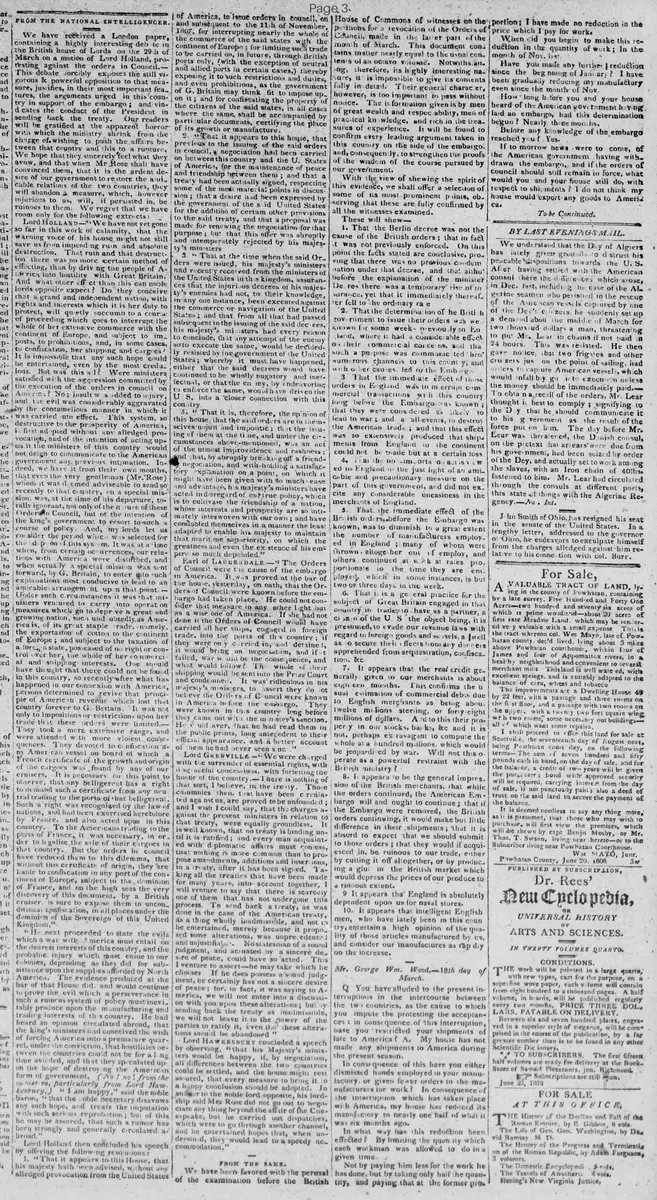
We have received a London paper containing a highly interesting debate in the British House of Lords on the 29th of March on a motion of Lord Holland, protesting against the orders in Council.—
This debate forcibly exposes the still vigorous & powerful opposition to that measure, justifies, in their most important features, the arguments urged in this country in support of the embargo; and, vindicates the conduct of the President in sending back the treaty. Our readers will be gratified at the apparent horror expressed of wishing to push the affairs between that country and this to a rupture,
We hope that they sincerely feel what they avow, and that when Mr Rose shall have convinced them, that it is the ardent desire of our government to restore the amicable relations, of the two countries, they will abandon a measure, which, however injurious to us, will, if persisted in, be ruinous to them: We regret that we have room only for the following extracts:
Lord HOLLAND—"We have not yet gone so far in this work of calamity, that the warning voice of this house might not still save us from impending ruin and absolute destruction. That ruin and that destruction there was no more certain method of effecting, than by driving the people of America into hostility with Great Britain. And what other effect than this can noble lords opposite expect? Do they conceive that a grand and independent nation, with rights and interests which it is her duty to protect, will quietly succumb to a course of proceeding which goes to interrupt the whole of her extensive commerce with the continent of Europe, and subject to impositions, to prohibitions, and, in some cases, to confiscation, her shipping and cargoes
It is impossible that any such hope could be entertained, even by the most credulous. But was this all? Were ministers satisfied with the aggression committed by the execution of the orders in council on America? No; insult was added to injury, and the evil was considerably aggravated by the contumelious manner in which it was carried into effect. This system, so destructive to the prosperity of America, first adopted without any alleged provocation, and of the intention of acting upon it the ministers of this country would not deign to communicate to the American government any previous intimation. Indeed, we have it from their own mouths, that even the very gentleman (Mr. Rose) whom it was deemed advisable to send so recently to that Country, on a special mission, was, at the time of his departure, totally ignorant, not only of the nature of these Orders in Council, but of the intention of the king's government to resort to such a course of policy. And, my lords let us consider the period which was selected for the adoption of this system. It was at a time when, from certain occurrences, our relations with America were disturbed, and when actually a special mission was sent forward, by G. Britain, to enter into such explanations most conducive to lead to an amicable arrangement upon that point.—
Under such circumstances it was that ministers ventured to carry into operation measures which go to deprive a great and growing nation, such undoubtedly as America is, of its great staple trade, namely, the exportation of cotton to the continent of Europe; and subject to the taxation of a foreign state, possessed of no right or control over her, the whole of her commercial and shipping interests. One should have thought that there could not be found in this country, so recently after what has happened in our connexion with America, persons determined to revive that principle of American revenue which lost that country forever to G. Britain. It was not only to impositions or restrictions upon her trade that these orders were limited.—
They took a more extensive range, and were attended with more violent consequences. They devoted to confiscation any American vessel on board of which a French certificate of the growth and origin of the cargoes was found by any of our cruisers. It is necessary on this point to observe, that any belligerent has a right to demand such a certificate from any neutral trading to the ports of that belligerent. Such a right was recognized by the law of nations, and had been exercised heretofore by France, and also acted upon in this country. To the Americans trading to the parts of France, it was necessary, in order to legalise, the sale of their cargoes in that country. But the orders in council have reduced them to this dilemma, that without this certificate of origin, they are liable to confiscation in any port of the continent of Europe, subject to the, dominion of France, and on the high seas the very discovery of this document, by a British cruiser, is sure to expose them to unconditional confiscation, in all places under the dominion of the Sovereign of this United Kingdom."
"He next proceeded to state the evils which a war with America must entail on the dearest interests of this country, and the probable injury which must ensue to our colonies, depending as they did for subsistence upon the supplies afforded by North America. The evidence produced at the bar of that House did, and would continue to prove the evil which a perseverance in such a ruinous system of policy must inevitably produce upon the manufacturing and trading interests of this country. He had heard an opinion circulated abroad, that the king's ministers had conceived the wish of forcing America into a premature quarrel, under the conviction, that hostilities between the countries could not be for a long time avoided, and that they speculated upon the hope of destroying the American form of government. (No! no! from the ministerial benches, particularly from Lord Hawkesbury,) "I am happy," said the noble baron, "that the noble Secretary disavows any such hope, and treats the imputation with such serious reprobation; but of this he may be assured, that such a rumor has been strongly and generally circulated abroad."
Lord Holland then concluded his speech by offering the following resolutions:
1. "That it appears to this House, that his majesty hath been advised, without any alleged provocation from the United States of America, to issue orders in council, on and subsequent to the 11th of November, 1807, for interrupting nearly the whole of the commerce of the said states with the continent of Europe; for limiting such trade to be carried on, in future, through British ports only, (with the exception of neutral and allied ports in certain cases,) thereby exposing it to such restrictions and duties, and even prohibitions, as the government of G. Britain may think fit to impose upon it; and for confiscating the property of the citizens of the said states, in all cases where the same shall be accompanied by particular documents, certifying the place of its growth or manufacture.
2. That it appears to this house, that previous to the issuing of the said orders in council, negociation had been carried on between this country and the U. States of America, for the maintenance of peace and friendship between them; and that a treaty had been actually signed, respecting some of the most material points in discussion; that a desire had been expressed by the government of the said United States for the addition of certain other provisions to the said treaty, and that a proposal was made for renewing the negociation for that purpose; but that this offer was abruptly and intemperately rejected by his majesty's ministers
3. That at the time when the said Orders were issued, his majesty's ministers had recently received from the ministers of the United States in this kingdom, assurances that the injurious decrees of his majesty's enemies had not, to their knowledge, in any one instance, been executed, against the commerce or navigation of the United States; and that from all that had passed subsequent to the issuing of the said decrees, his majesty's ministers had every reason to conclude, that any attempt of the enemy so to execute the same, would be decidedly resisted by the government of the United States; whereby it must have happened, either that the said decrees would have continued to be wholly nugatory and ineffectual, or that the enemy, by endeavoring to enforce the same, would have driven the U S. into a closer connection with this country
5. That it is, therefore, the opinion of this house, that the said orders are in themselves unjust and impolitic: that the issuing of them at the time, and under the circumstances above-mentioned, was an act of the utmost improvidence and rashness: and that, by abruptly breaking off a friendly negociation, and withholding a satisfactory explanation on a point, on which it might have been given with so much ease and advantage, his majesty's ministers have acted in disregard of our true policy, which is to cultivate the friendship of a nation, whose interests and prosperity are so intimately interwoven with our own; and have conducted themselves in a manner the least adapted to enable his majesty to maintain that maritime superiority, on which the greatness and even the existence of his empire so much depended."
Earl of LAUDERDALE.—"The Orders of Council were the cause of the embargo in America. It was proved at the bar of the house, yesterday, on oath, that the Orders of Council were known before the embargo had taken place. He could not consider that measure in any other light but as a wise one of America. If she had not done it the Orders of Council would have carried all her ships, engaged in foreign trade, into the ports of this country; if they were only carried in, and detained, it would bring on negociation, and if that failed, war would be the consequence, and what would follow? The whole of their shipping would be sent into the Prize Court and condemned. It was ridiculous in his majesty's ministers to assert they do not believe the Orders of Council were known in America before the embargo. They were known in this country long before they came out with the minister's sanction. He would aver, that he had read them in the public prints, long antecedent to their official appearance, and a better account of them he had never seen since.
Lord GRENVILLE —"We were charged with the surrender of essential rights, with disgraceful concessions, with forfeiting the honor of the country. There is nothing of that sort, I believe, in the treaty. Those calumnies then, that have been circulated against us, are proved to be unfounded; and I wish I could say, that the charges against the present ministers in relation to that treaty, were equally groundless. It is well known, that no treaty is binding until it is ratified; and every man acquainted with diplomatic affairs must confess, that nothing is more common than to propose amendments, additions and insertions, in a treaty, after it has been signed. Taking all the treaties that have been made for many years, into account together, I will venture to say that there is scarcely one of them that has not undergone this process. To send back a treaty, as was done in the case of the American treaty, as a thing wholly inadmissible, and not to be entertained, merely because it proposed some alterations, was unprecedented and unjustifiable No statesman of a sound judgment, and actuated by a sincere desire of peace, could have so acted. This I venture to assert—he may take which he chooses If he does possess a sound judgment, he certainly has not a sincere desire of peace; for, in fact, it was saying to America, we will not enter into a discussion with you upon these alterations; but by sending back the treaty as inadmissible, we will not leave it in the power of the parties to ratify it, even tho' these alterations should be abandoned"
—Lord Hawkesbury concluded a speech by observing,"that his Majesty's ministers would be happy, if, by negociation, all differences between the two countries could be settled, and the house might rest assured, that every measure to bring it to a happy conclusion should be adopted. In answer to the noble lord opposite, his lordship said Mr. Rose did not go out to negotiate any thing beyond the affair of the Chesapeake, but he carried out dispatches, which were to go through another channel, and he entertained hopes that, when understood, they would lead to a speedy accommodation.
FROM THE SAME.
We have been favored with the perusal of the examination before the British House of Commons of witnesses on the petitions for a revocation of the Orders of Council, made in the latter part of the month of March. This document contains matter nearly equal to the usual contents of an octavo volume. Notwithstanding, therefore, its highly interesting nature, it is impossible to give its contents fully in detail. Their general character, however, is too important to pass without notice. The information given is by men of great wealth and respectability, men of practical knowledge, and rich in the treasures of experience. It will be found to confirm every leading argument taken in this country on the side of the embargo, and, consequently, to strengthen the proofs of the wisdom of the course pursued by our government.
With the view of shewing the spirit of this evidence, we shall offer a selection of some of its most prominent points, observing that these are fully confirmed by all the witnesses examined.
These will shew—
1. That the Berlin decree was not the cause of the British orders; that in fact it was not previously enforced. On this point the facts stated are conclusive, proving that there was no previous condemnation under that decree, and that although before the explanation of the minister Decaen (there was a temporary rise of insurance, yet that it immediately thereafter fell to the ordinary rate
2. That the determination of the British government to issue their orders was well known for some weeks previous in England, where it had a considerable effect on their commercial concerns, and that such a purpose was communicated thro' numerous channels to this country, and with observations, led to the Embargo.
3. That the immediate effect of those orders in England was to interrupt commercial transactions with this country long before the Embargo was known; that they were considered as likely to lead to war; and, at all events, to destroy the American trade; and that this effect was so extensively produced that shipments from England to the continent could not be made but at a certain loss
4. That the non-importation act is viewed in England in the just light of an amicable and precautionary measure on the part of this government, and did not excite any considerable uneasiness in the merchants of England.
5. That the immediate effect of the British orders, before the Embargo was known, was to diminish to a great extent the number of manufacturers employed in England; many of whom were thrown, altogether out of employ, and others continued at wages proportionate to the time they are employed, which in some instances, is but two or three days in the week.
6. That it is a general practice for the subjects of Great Britain engaged in that country in trade to have as a partner, a citizen of the U. S. the object being, it is presumed, to evade our revenue laws with regard to foreign goods and vessels, as well as to secure their effects from any dangers apprehended from sequestration, Confiscation, &c
7. It appears that the real credit generally given to our merchants is about eighteen months. This confirms the usual estimation of commercial debts due to English merchants as being about twelve millions sterling, or forty-eight millions of dollars. Add to this their property in our Stocks, banks, &c and it is not, perhaps extravagant to compute the whole at a hundred millions, which would be jeopardized by war. Will not this operate as a powerful restraint with the British ministry?
8. It appears to be the general impression of the British merchants, that while the orders continued, the American Embargo will and ought to continue; that if the Embargo were removed, the British orders continuing, it would make but little difference in their shipments; That it is absurd to expect that we should submit to those orders; that they would if acquiesced in, be ruinous to our trade, either by cutting it off altogether, or by producing a glut in the British market which would depress the prices of our produce to a ruinous extent.
9. It appears that England is absolutely dependent upon us for naval stores.
10. It appears that intelligent English men, who have lately been in this country, entertain a high opinion of the quality of those articles manufactured by us, and consider our manufactures as rapidly on the increase.
Mr. George Wm. Wood.—18th day of March.
Q You have alluded to the present interruptions in the intercourse between the two Countries, as the cause to which you impute the protesting the acceptances: in consequence of this interruption, have you restricted your shipments of late to America? A. My house has not made any shipments to America during the present season.
In consequence of this have you either dismissed hands employed in your manufactory, or given fewer orders to the manufacturers for work? In consequence of the interruption which has taken place with America, my house has reduced its manufactory to nearly one half of what it was six months ago.
In what way has this reduction been effected? By limiting the quantity which each workman was allowed to do in a given time.
Not by paying him less for the work he has done, but by taking only half the quantity, and paying that at the former proportion; I have made no reduction in the price which I pay for work.
When did you begin to make this reduction in the quantity of work? In the month of Nov. last.
Have you made any further reduction since the beginning of January? I have been gradually reducing my manufactory even since the month of Nov.
—How long before you and your house heard of the American government having laid an embargo, had this determination begun? Nearly three months.
Before any knowledge of the embargo reached you? Yes.
If to morrow news were to come, of the American government having withdrawn the embargo, and if the orders of council should still remain in force, what would you and your house still do, with respect to shipments? I do not think my house would export any goods to America.
To be Continued.
What sub-type of article is it?
What keywords are associated?
What entities or persons were involved?
Where did it happen?
Foreign News Details
Primary Location
London
Event Date
29th Of March
Key Persons
Outcome
strong opposition expressed in british house of lords to orders in council; debate justifies us embargo and president's return of treaty; hopes for negotiation to restore amicable relations; evidence from house of commons confirms wisdom of us measures and detrimental effects of orders on british commerce.
Event Details
Debate in British House of Lords on motion by Lord Holland protesting Orders in Council issued without provocation, interrupting US commerce with Europe, and issued during ongoing negotiations including a signed treaty and Mr. Rose's mission. Lords Holland, Lauderdale, Grenville, and Hawkesbury discuss impacts, justifications for US embargo, and call for revocation. Extracts from speeches and resolutions highlight injustice, potential for war, and economic harm to Britain. Separate report on House of Commons examinations of witnesses confirms Orders were known prior to embargo, caused commercial interruptions, reduced manufacturing, and underscore US dependence for naval stores and mutual economic ties.