Thank you for visiting SNEWPapers!
Sign up free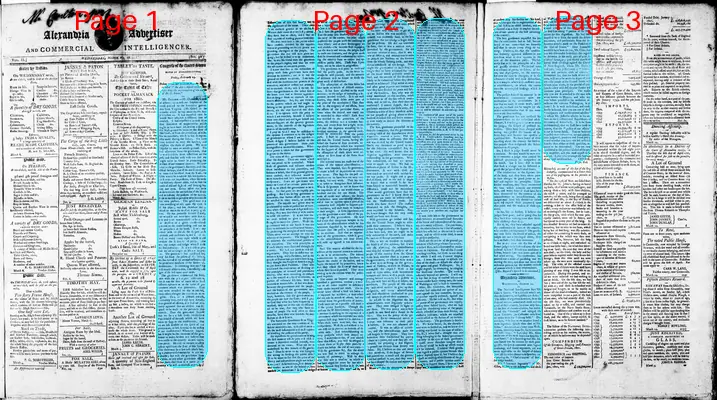
Alexandria Advertiser And Commercial Intelligencer
Alexandria, Virginia
What is this article about?
In a U.S. House debate on repealing acts organizing federal courts, Mr. Bayard responds to Mr. Giles' remarks, criticizing him for inflaming party divisions and defending Federalist policies on debt funding, taxes, army, navy, and XYZ affair against Republican attacks.
Merged-components note: Merged continuation of the report on Mr. Bayard's speech in the congressional debate across pages 1-3; the final component includes the start of the subsequent editorial commentary due to initial parsing, but the primary focused subject is the debate story.
Clippings

1 of 3
OCR Quality
Full Text
entitled "An Act to repeal certain
respecting the organization of the courts
of the U. States."
Mr. Bayard.—Mr. Chairman I must
be allowed to express my surprise at the
course pursued by the honorable gentle-
man from Virginia (Mr. Giles) in the
remarks which he has made on the sub-
ject before us. I had expected that he
would have adopted a different line of
conduct. I had expected it as well from
that sentiment of magnanimity which
ought to have been inspired by a sense of
the high ground he holds on the floor of
this house, as from the professions of a de-
sire to conciliate, which he has so repeat-
edly made during the session. We have
been invited to bury the hatchet, and
brighten the chain of peace. We were
supposed to meet on middle ground. We
had assurances from the gentleman, that
he would abstain from reflections on the
past, and that his only wish was that we
might unite in future in promoting the
welfare of our common country. We con-
fided in the gentleman's sincerity, and che-
rished the hope, that if the divisions of par-
ty were not banished from the house, its
spirit would be rendered less intemperate.
Such were our impressions, when the mask
was suddenly thrown aside, and we saw the
torch of discord lighted and blazing be-
fore our eyes. Every effort has been
made to revive the animosities of the house
and to inflame the passions of the nation.
I am at no loss to perceive why this course
has been pursued. The gentleman has
been unwilling to rely upon the strength
of his object, and has therefore deter-
mined to make the measure a party que-
-tion. He has probably secured success,
but would it not have been more honora-
ble and more commendable to have left
the decision of a great constitutional
question to the understanding and not to
the prejudices of the house. It was my
ardent wish to discuss the subject with
calmness and deliberation, and I did in-
tend to avoid every topic which could
awaken the animosity of party. This
was my temper and design when I took
my seat yesterday. It is a course at pre-
sent we are no longer at liberty to pur-
sue.
The gentleman has wandered far,
very far from the points of the debate,
and has extended his animadversions to all
the prominent measures of the former ad-
ministration. In following him through his
preliminary observations, I necessarily lose
sight of the bill upon your table.
The gentleman commenced his rema-
rkures with the prophetic observation,
that it was the fate of mankind to hold
different opinions as to the form of go-
vernment which was preferable. That
some were attached to the monarchical.
while others thought the republican more
eligible. This, as an abstract remark,
is certainly true, and could have furnish-
ed no ground of offence, if it had not evi-
dently appeared that an allusion was de-
signed to be made to the parties in this
country. Does the gentleman suppose
that we have a less lively recollection
than himself of the oath which we have
taken to support the constitution; that
we are less sensible of the spirit of our
government, or less devoted to the wishes
of our constituents? Whatever impres-
sion it might be the intention of the gen-
tleman to make, he does not believe that
there exists in the country an anti repub-
lican party. He will not venture to assert
such an opinion on the floor of this house.
That there may be a few individuals hav-
ing a preference for monarchy is not im-
probable ; but will the gentleman from
Virginia, or any other gentleman affirm
in his place, that there is a party in the.
country who wish to establish monarchy?
Insinuations of this sort belong not to the legislature of the union. Their place is an election ground or an alehouse. Within these walls they are lost; abroad, they have had an effect, and I fear are still capable of rousing popular credulity.
We were next told the parties which have excited, divided by the opposite views of promoting executive power and guarding the rights of the people. The gentleman did not tell us in plain language, but he wished it to be understood, that he and his friends were the guardians of the people's rights, and that we were the advocates of executive power.
I know that this is the distinction of party with some gentlemen have been anxious to establish; but it is not the ground on which we divide. I am satisfied with the constitutional powers of the executive, and never wished nor attempted to increase them; and I do not believe that gentlemen on the other side of the house ever had a serious apprehension of danger from an increase of executive authority. No, sir, our views as to the powers which do and ought to belong to the general and state governments, are the true source of our divisions. I co-operate with the party to which I am attached, because I believe their true object and end is an honest and efficient support of the general government, in the exercise of the legitimate powers of the constitution.
I pray to God I may be mistaken in the opinion I entertain as to the designs of gentlemen to whom I am opposed. Those designs I believe hostile to the powers of this government. State pride extinguishes a national sentiment. Whatever power is taken from this government is given to the States. The ruins of this government aggrandize the states. There are states which are too proud to be controlled. Whose sense of greatness and resource renders them indifferent to our protection, and induces a belief, that if no general government existed, their influence would be more extensive and their importance more conspicuous. There are gentlemen who make no secret of an extreme point of dependence, to which the government is to be sunk. To that point we are rapidly progressing. But I would beg gentlemen to remember, that human affairs are not to be arrested in their course, at artificial points. The impulse now given may be accelerated by causes at present out of view. And when those who now design well wish to stop, they may find their powers unable to resist the torrent. It is not true that we ever wished to give a dangerous strength to executive power. While the government was in our hands it was our duty to maintain its constitutional balance, by preserving the energies of each branch. There never was an attempt to vary the relation of its powers. The struggle was to maintain the constitutional powers of the executive. The wild principles of French liberty were scattered through the country. We had our jacobins and disorganizers. They saw no difference between a King, and a President, and as the people of France had put down their King, they thought the People of America ought to put down their President. They who considered the constitution as securing all the principles of rational and practicable liberty, who were unwilling to embark upon the tempestuous sea of revolution, in pursuit of visionary schemes, were denounced as monarchists. A line was drawn between the government and the people; and the friends of the government were marked as the enemies of the people. I hope, however, that the government and the people are now the same; and I pray to God that what has been frequently remarked, may not in this case be discovered to be true, that they who have the name of people the most often in their mouths, have their true interests the most seldom at their hearts.
The honorable Gentleman from Virginia wandered to the very confines of the federal administration, in search of materials the most inflammable and most capable of kindling the passions of his party. He represents the government as seizing the first moment which presented itself to create a dependent monied interest, ever devoted to its views. What are we to understand by this remark of the gentleman? Does he mean to say that Congress did wrong in funding the public debt? Does he mean to say that the price of our liberty and independence ought not to have been paid? Is he bold enough to denounce this measure as one of the federal victims marked for destruction? Is it the design to tell us that its day has not yet come but is approaching; and that the funding system is to add to the pile of federal ruins? Do I hear the gentleman say we will reduce the army to a shadow, we will give the navy to the worms, the mint which presented the people with the emblems of their liberty and of their sovereignty we will abolish—the revenue shall depend upon the winds and waves, the judges shall be made our creatures, and the great work shall be crowned and consecrated by relieving the country from an odious and oppressive public debt. These steps I presume, are to be taken in progression. The gentleman will pause at each and feel the public pulse. As the fever increases he will proceed, and the moment of delirium will be seized to finish the great work of destruction.
The assumption of the state debts has been made an article of distinct crimination. It has been ascribed to the worst motives; to the design of increasing a dependent monied interest. Is it not well known, that those debts were part of the price of the revolution? That they rose in the exigency of our affairs, from the efforts of the particular states, at times when the federal arm could not be extended to their relief? Each state was entitled to the protection of the union, the defence was a common burden then, and every state had a right to expect that the expenses attending its individual exertions in the general cause, would be reimbursed from the public purse. I shall be permitted further to add that the United States, having absorbed the sources of state revenues, except direct taxation, which was required for the support of the state governments, the assumption of these debts were necessary to save some of the states from bankruptcy.
The internal taxes are made one of the crimes of the federal administration. They were imposed, says the gentleman, to create a host of dependants on executive favor. This supposes the past administrations to have been not only very wicked, but very weak. They lay taxes in order to strengthen their influence. Who is so ignorant as not to know that the imposition of a tax would create an hundred enemies for one friend. The name of excise was odious; the details of collection were unavoidably offensive, and it was to operate upon a part of the community least disposed to support public burdens, and most ready to complain of their weight. A little experience will give the gentleman a new idea of the patience of this government. He will find it not that dangerous weapon in the hands of the administration which he has heretofore supposed it, he will probably discover that the poison is accompanied by its antidote. And that an appointment of the government, while it gives to the administration one lazy friend, will raise up against it ten active enemies.
No! The motive ascribed for the imposition of the internal taxes is as unfounded, as it is uncharitable. The federal administration in creating burdens to support the credit of the nation, and to supply the means of its protection, knew that they risked the favor of those upon whom their favor depended. They were willing to be the victims when the public good required.
The duties on imports and tonnage furnished a precarious revenue; a revenue at all times exposed to deficiency from causes beyond our reach. The internal taxes offered a fund less liable to be impaired by accident; a fund which did not rob the mouth of labour, but was derived from the gratification of luxury. These taxes are an equitable distribution of the public burdens. Through this medium the Western Country is enabled to contribute something to the expenses of a government which has expended and daily expends such large sums for its defence. When those taxes were laid, they were indispensable. With the aid of them it has been difficult to prevent an increase of the public debt. And notwithstanding the fair prospects which now dazzle our eyes, I undertake to say, if you abolish them this session, you will be obliged to restore them or supply their place by a direct tax before the end of two years.
Will the gentleman say, that the direct tax was laid in order to enlarge the bounds of patronage. Will he deny that this was a measure to which we had been urged for years by our adversaries, because they foresaw in it the ruin of federal power. My word for it, no administration ever be strengthened by a patronage united with taxes which the people are sensible of paying.
We were next told, that to get an army an Indian war was necessary. The remark was extremely bald, as the hon. gentleman did not allege a single reason for the position. He did not undertake to state, that it was a wanton war, or provoked by the government. He did not even venture to deny, that it was a war of defence, and entered into in order to protect our brethren on the frontiers from the bloody scalping knife, and murderous tomahawk of the savage. What ought the government to have done? Ought they to have calculated the value of the blood which probably would be shed, and, the amount of the devastation likely to be committed before they determined on resistance? They raised an army and after great expense and various fortune they have secured the peace and safety of the frontiers. But, why was the army mentioned on this occasion, unless to forewarn us of the fate which awaits them, and to tell us, that their days are numbered? I cannot suppose, that the gentleman mentioned this little army, distributed on a line of three thousand miles, for the purpose of giving alarm to three hundred thousand free and brave yeomanry ever ready to defend the liberties of the country.
The hon. gentleman proceeded to inform the committee, that the government, availing itself of the depredations of the Algerines, created a navy. Did the gentleman mean to insinuate, that this war was invited by the United States? Has he any document or proof to render the suspicion colourable? No, sir, he has none. He well knows that the Algerine aggressions were extremely embarrassing to the government. When they commenced, we had no marine force to oppose to them. We had no harbours or places of shelter in the Mediterranean. A war with these pirates could be attended with neither honor nor profit. It might cost a great deal of blood, and in the end it might be feared that a contest so far from home subject to numberless hazards and difficulties, could not be maintained. What would gentlemen have had the government to do? I know there are those who are ready to answer—abandon the Mediterranean trade. But would this have done? The corsairs threatened to pass the Streights, and were expected in the Atlantic. Nay, sir, it was thought that our very coasts would not have been secure.
Will gentlemen go farther and say, that the United States ought to relinquish their commerce. I believe this opinion has high authority to support it. It has been said, that we ought to be only cultivators of the earth, and make the nations of Europe our carriers. This is not an occasion to examine the solidity of this opinion; but I will only ask, admitting the administration were disposed to turn the pursuits of the people of this country from the Ocean to the land, whether there is a power in the government, or whether there would be if we were as strong as the government of Turkey, or even of France, to accomplish the object? With a sea coast of 1700 miles, with innumerable harbours and inlets, with a people enterprising beyond example, is it possible to say, you will have no ships or sailors, nor merchants. The people of this country will never consent to give up their navigation, and every administration will find themselves constrained to provide means to protect their commerce.
In respect to the Algerines the late administrations were singularly unfortunate. They were obliged to fight or pay them. The true policy was to hold a purse in one hand and a sword in the other. This was the policy of the government. Every commercial nation in Europe was tributary to these petty barbarians. It was not esteemed disgraceful. It was an affair of calculation, and the administration made the best bargain in their power. They have heretofore been scandalized for paying tribute to a pirate, and now they are criminited, for preparing a few frigates, to protect our citizens from slavery and chains. Sir, I believe on this and many other occasions, if the finger of heaven had pointed out a course and the government had pursued it, yet, that they would not have escaped the censure and reproaches of their enemies.
We are told, that the disturbances in Europe the army and I will not, Chairman, at present go to a detailed view of the events which compelled the government to put on the armour of defence, and to resist by force the French aggressions. All the world know the efforts which were made to accomplish an amicable adjustment of differences with that power. It is enough to state, that ambassadors of peace were twice repelled from the shores of France with ignominy and contempt. It is enough to say, that it was not till after we had drank the cup of humiliation to the dregs, that the national spirit was roused to a manly resolution, to depend only on their God and their courage for their protection. What, sir, did it grieve the gentleman, that we did not crouch under the rod of the Mighty Nation, and like the sycophant-powers of Europe, tamely surrender our independence? Would he have had the people of the United States relinquish without a struggle those liberties which had cost so much blood and treasure? We had not, sir, recourse to arms, till the mouths of our rivers were choaked with French corsairs, pillaged our shores, and every harbour, were insulted and violated. Till half our commercial capital had been seized and no safety existed for the remainder but the protection of force. At this moment a noble enthusiasm electrified the country—the national pulse beat high, and we were prepared to submit to every sacrifice, determined only, that our independence should be the last. At that time an American was a proud name in Europe; but I fear, much I fear, that in the course we are now likely to pursue, the time will come when our citizens abroad will be ashamed to acknowledge their country.
The measures of '98 grew out of the public feelings. They were loudly demanded by the public voice. It was the people who drove the government to arms, and not as the gentleman expressed it, the government which pushed the people to the X. Y. Z. of their political designs before they understood the A. B. C. of their political principles.
But what, sir, did the gentleman mean by his X. Y. Z. I must look for something very significant, something more than a quibble of expression, or a play upon words in what falls from a gentleman, of his learning and ability. Did he mean that the dispatches which contained those letters were impostures designed to deceive and mislead the people of America. Intended to raise a false spirit not justified by events. Though the gentleman had no respect for some of the characters of that embassy; though he felt no respect for the Chief Justice or the gentleman from South-Carolina, two characters as pure, as honorable and exalted, as any country can boast of, yet. I should have expected that he would have felt some tenderness for Mr. Gerry, in whom his party had since given proofs of undiminished confidence. Does the gentleman believe that Mr. Gerry would have joined in the deception, and assisted in fabricating a tale which was to blind his countrymen and to enable the government to destroy their liberties? Sir, I will not avail myself of the equivocations or contradictions of Talleyrand himself; I say these gentlemen will not dare publicly to deny what is attested by the hand and seal of Mr. Gerry.
The truth of these dispatches admitted, what was your government to do? Give us, say the Directory, 20,000 livres for our own purse, and purchase seven millions of dollars of the Dutch debt. (which was worth nothing) and we will receive your ministers and negotiate for peace.
It was only left to the government to choose between an unconditional surrender of the honor and independence of the country, or a manly resistance. Can you blame, sir, the administration for a line of conduct which has reflected on the nation so much honor, and to which under God, it owes its present prosperity.
These are the events of the general government which the gentleman has reviewed in succession, and endeavoured to render odious or suspicious. For all this I could have forgiven him, but there is one thing for which I will not, I cannot forgive him. I mean his attempt to disturb the ashes of the dead—to disturb the ashes of the great and good Washington. Sir, I might degrade by attempting to eulogize this illustrious character. The work is infinitely beyond my powers. I will only say that as long as exalted talents and virtues confer honor among men, the name of Washington will be held in veneration.
After, Mr. Chairman, the honorable member had exhausted one quiver of arrows against the late executive, he opened another equally poisoned, against the judiciary. He has told us, sir, that when the power of the government was rapidly passing from federal hands, after we had heard the thundering voice of the people which dismissed us from their service, we erected a judiciary, which we expected would afford us the shelter of an inviolable sanctuary. The gentleman is deceived. We knew better, sir, the characters who were to succeed us, and we knew that nothing was sacred in the eyes of infidels. No, sir, I never had a thought that any thing belonging to the federal government was holy in the eyes of those gentlemen. I could never therefore imagine that a sanctuary could be built up which would not be violated. I believe these gentlemen regard a public opinion because their power depends upon it, but I believe they respect no existing establishment of the government, and if public opinion could be brought to support them; I have no doubt they would annihilate the whole. I shall
at present only say rather on this head. that we thought the re-organization of the judicial system a useful measure, and we considered it as a duty to employ the remnant of our power to the best advantage of the country.
The hon. gentleman expressed his joy that the constitution had at last become sacred in our eyes--that we formerly held that it meant every thing or nothing. I believe, sir, that the constitution formerly appeared different in our eyes from what it now appears in the eyes of the dominant party. We formerly saw in it the principles of a fair and goodly creation? We looked upon it as a source of peace, of safety, of honor, and of prosperity, to the country. But now the views are changed: it is the instrument of wild and dark destruction. It is a weapon which is to prostrate every establishment, to which the nation owes the unexampled blessings which it enjoys.
The present state of the country is an unanswerable commentary upon our construction of the constitution. It is true that we made it mean much, and I hope, sir, we shall not be taught by the present administration that it can mean even worse than nothing.
The gentleman has not confined his animadversions to the individual establishment, but he has gone so far as to make the judges, the subject of personal invective. They have been charged with having transgressed the bounds of judicial duty, and become the apostles of a political sect. We have heard of their traveling about the country for little other purpose than to preach the federal doctrines to the people.
Sir, I think a judge should never be a partizan. No man would be more ready to condemn a judge who carried his political prejudices or antipathies on the bench. But I have still to learn that such a charge can be sustained against the judges of the United States.
The constitution is the supreme law of the land, and they have taken pains in their charges to grand juries to unfold and explain its principles. Upon similar occasions, they have enumerated the laws which compose our criminal code, and when some of those laws have been denounced by the enemies of the administration as unconstitutional, the judges may have felt themselves called upon to express their judgment upon that point and the reasons of their opinions.
So far, but no farther, I believe the judges have gone; and in going thus far they have done nothing more than faithfully discharge their duty.
But if, sir, they have offended against the constitution or laws of the country, why are they not impeached? The gentleman now holds the sword of justice, the judges are not a privileged order, they have no shield but their innocence.
But in any view are the sins of the former judges to be fastened upon the new judicial system? Would you annihilate a system, because some men under part of it had acted wrong. The constitution has pointed out a mode of punishing and removing the men, and does not leave this miserable pretext for the wanton exercise of powers which is now contemplated.
[Mr. Bayard's Speech to be continued.]
Alexandria Advertiser.
Wednesday, March 10.
The National Intelligencer says Mr. Giles's speech, "is a fortress which neither declamation, or sophistry can shake." The sallies of argument however, from the Federal orators, armed with truth and the good of their country, have not only forced the line of circumvallation, but undermined the "fortress" and obliged the Ajax Telamon, (as Callender calls him) to retire from his "strong hold." Duane says, "he has on no occasion heard a more ingenious speech than that of Mr. Giles." An extract of a letter from Washington, (probably from Dr. Leib) contains the following: "Yesterday Mr. Giles made one of the most luminous speeches I ever heard." It is surprising that Mr. Bacon should not be noticed by these panegyrists, his speech contained more logical reasoning, and sound argument, and was more applicable to the subject of debate than all the other democratic speeches, not excepting the "Chef d'oeuvre" of Breckenridge himself.
The "luminous ingenuity" of Mr. Giles, consists in his defamation and abuse
What sub-type of article is it?
What themes does it cover?
What keywords are associated?
What entities or persons were involved?
Where did it happen?
Story Details
Key Persons
Location
House Of Representatives
Event Date
March 10
Story Details
Mr. Bayard expresses surprise at Mr. Giles' partisan remarks during debate on repealing federal court organization acts, defends Federalist policies including debt funding, taxes, army, navy creation, XYZ affair, and judiciary reorganization against Republican criticisms, while accusing Giles of inflaming divisions and attacking Washington's legacy.