Thank you for visiting SNEWPapers!
Sign up free
The West Virginia Digest
Charleston, Kanawha County, West Virginia
What is this article about?
Dr. Edward L. Turner, president of Nashville's Meharry Medical College, led an experiment revealing orange juice increases stomach acid in ulcer patients, based on Beirut observations. The college seeks $1.5M in pledges by July 1 for $3.5M grants plus matching funds.
Clipping
OCR Quality
Full Text
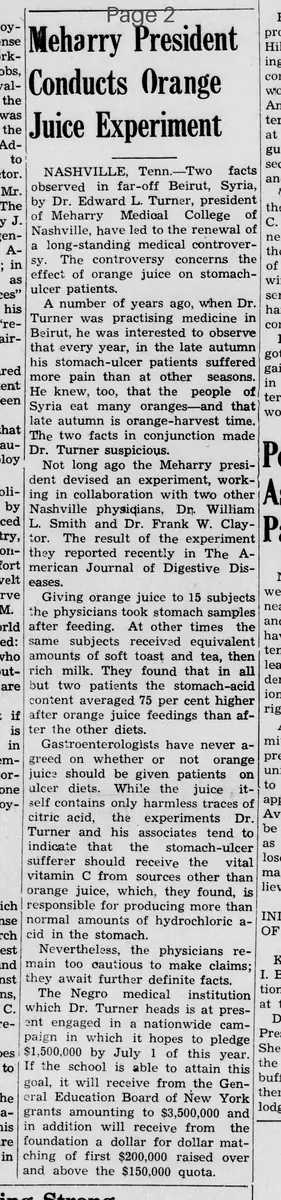
NASHVILLE, Tenn.—Two facts observed in far-off Beirut, Syria, by Dr. Edward L. Turner, president of Meharry Medical College of Nashville, have led to the renewal of a long-standing medical controversy. The controversy concerns the effect of orange juice on stomach-ulcer patients.
A number of years ago, when Dr. Turner was practicing medicine in Beirut, he was interested to observe that every year, in the late autumn his stomach-ulcer patients suffered more pain than at other seasons.
He knew, too, that the people of Syria eat many oranges—and that late autumn is orange-harvest time.
The two facts in conjunction made Dr. Turner suspicious.
Not long ago the Meharry president devised an experiment, working in collaboration with two other Nashville physicians, Dr. William L. Smith and Dr. Frank W. Clayton. The result of the experiment they reported recently in The American Journal of Digestive Diseases.
Giving orange juice to 15 subjects the physicians took stomach samples after feeding. At other times the same subjects received equivalent amounts of soft toast and tea, then rich milk. They found that in all but two patients the stomach-acid content averaged 75 per cent higher after orange juice feedings than after the other diets.
Gastroenterologists have never agreed on whether or not orange juice should be given patients on ulcer diets. While the juice itself contains only harmless traces of citric acid, the experiments Dr. Turner and his associates tend to indicate that the stomach-ulcer sufferer should receive the vital vitamin C from sources other than orange juice, which, they found, is responsible for producing more than normal amounts of hydrochloric acid in the stomach.
Nevertheless, the physicians remain too cautious to make claims; they await further definite facts.
The Negro medical institution which Dr. Turner heads is at present engaged in a nationwide campaign in which it hopes to pledge $1,500,000 by July 1 of this year.
If the school is able to attain this goal, it will receive from the General Education Board of New York grants amounting to $3,500,000 and in addition will receive from the foundation a dollar for dollar matching of first $200,000 raised over and above the $1,500,000 quota.
What sub-type of article is it?
What themes does it cover?
What keywords are associated?
What entities or persons were involved?
Where did it happen?
Story Details
Key Persons
Location
Nashville, Tenn.; Beirut, Syria
Event Date
Late Autumn, A Number Of Years Ago; Not Long Ago
Story Details
Dr. Turner observed increased ulcer pain in Beirut during orange harvest, leading to an experiment with colleagues showing orange juice raises stomach acid levels in most subjects compared to other diets, advising alternative vitamin C sources for ulcer patients; Meharry Medical College campaigns for $1,500,000 by July 1 to secure matching grants.