Thank you for visiting SNEWPapers!
Sign up free
Alexandria Daily Advertiser
Alexandria, Virginia
What is this article about?
Senator Timothy Pickering addresses Massachusetts Governor James Sullivan, criticizing the 1808 Embargo Act as baseless and secretive, warning of unnecessary war with Britain driven by hidden French demands, and calling for executive transparency to avert national ruin.
Merged-components note: These three components form a single continuous letter to the editor by Timothy Pickering spanning pages 2 and 3; relabel the latter two from editorial to letter_to_editor as they are part of the same document.
Clippings
1 of 2
OCR Quality
Full Text
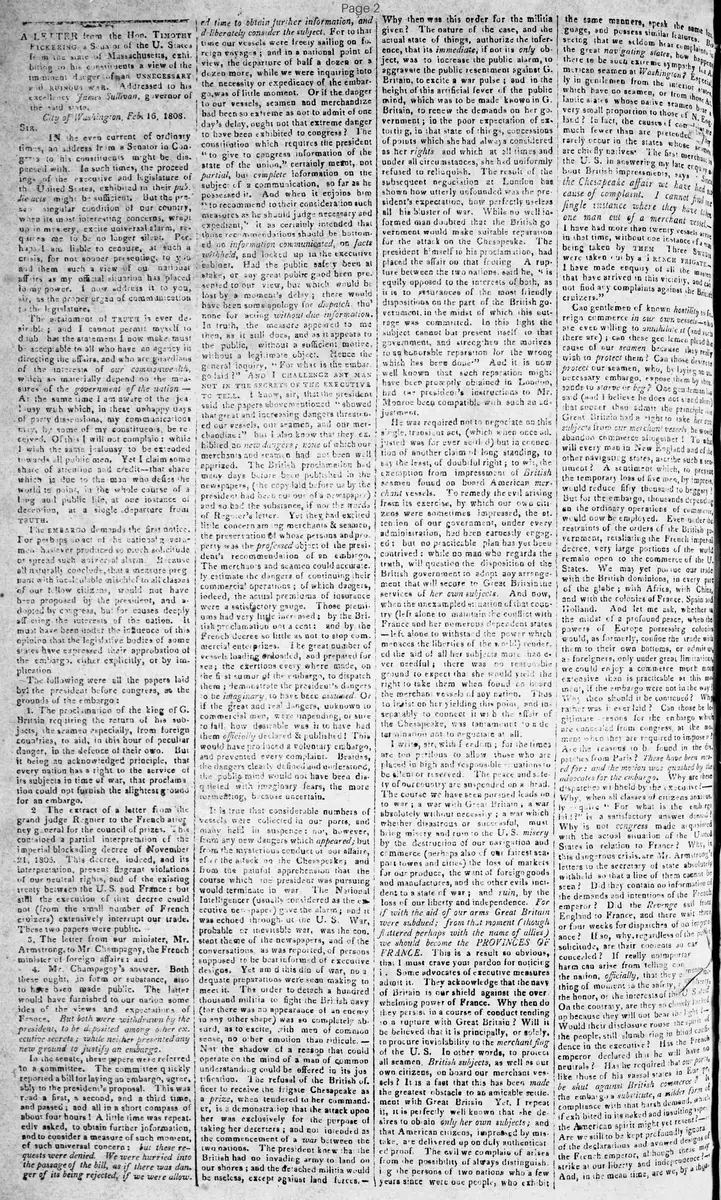
City of Washington, Feb. 16. 1808.
SIR,
IN the even current of ordinary times, an address from a Senator to his constituents might be dispensed with. In such times, the proceedings of the executive and legislature of the United States, exhibited in their public acts might be sufficient. But the present singular condition of our country, when its most interesting concerns, wrapt up in mystery, excite universal alarm, requires me to be no longer silent. Perhaps I am liable to censure, at such a crisis, for not sooner presenting, to you and them such a view of our national affairs as my official situation has placed in my power. I now address it to you, sir, as the proper organ of communication to the legislature.
The attainment of Truth is ever desirable; and I cannot permit myself to doubt that the statement I now make must be acceptable to all who have any agency in directing the affairs, and who are guardians of the interests of our commonwealth, which so materially depend on the measures of the government of the nation ---
At the same time I am aware of the jealousy with which, in these unhappy days of party dissensions, my communication may, by some of my constituents, be received. Of this I will not complain: while I wish the same jealousy to be extended towards all public men. Yet I claim some share of attention and credit--that share which is due to the man who defies the world to point, in the whole course of a long and public life, at one instance of deception, at a single departure from TRUTH.
The Embargo demands the first notice. For perhaps no act of the national government has ever produced so much solicitude or spread such universal alarm. Because all naturally conclude, that a measure pregnant with incalculable mischief to all classes of our fellow citizens, would not have been proposed by the president, and adopted by congress, but for causes deeply affecting the interests of this nation. It must have been under the influence of this opinion that the legislative bodies of some states have expressed their approbation of the embargo, either explicitly, or by implication
—The following were all the papers laid by the president before congress, on the grounds of the embargo :
1. The proclamation of the king of G. Britain requiring the return of his subjects, the seamen especially, from foreign countries, to aid, in this hour of peculiar danger, in the defence of their own. But it being an acknowledged principle, that every nation has a right to the service of its subjects in time of war, that proclamation could not furnish the slightest ground for an embargo.
2. The extract of a letter from the grand judge Regnier to the French attorney general for the council of prizes. This contained a partial interpretation of the imperial blockading decree of November 21, 1806. This decree, indeed, and its interpretation, present flagrant violations of our Neutral rights, and of the existing treaty between the U. S. and France: but still the execution of that decree could not (from the small number of French cruizers) extensively interrupt our trade. These two papers were public.
3. The letter from our minister, Mr. Armstrong, to Mr. Champagny, the French minister of foreign affairs: and
4. Mr. Champagny's answer. Both these ought, in form or substance, also to have been made public. The latter would have furnished to our nation some idea of the views and expectations of France. But both were withdrawn by the president, to be deposited among other executive secrets ; while neither presented any new ground to justify an embargo.
In the senate, these papers were referred to a committee. The committee quickly reported a bill for laying an embargo, agreeably to the president's proposal. This was read a first, a second, and a third time, and passed; and all in a short compass of about four hours! A little time was repeatedly asked, to obtain further information, and to consider a measure of such moment, of such universal concern: but these requests were denied. We were hurried into the passage of the bill, as if there was danger of its being rejected, if we were allowed time to obtain further information, and deliberately consider the subject. For to that time our vessels were freely sailing on foreign voyages; and in a national point of view, the departure of half a dozen or a dozen more, while we were inquiring into the necessity or expediency of the embargo, was of little moment. Or if the danger to our vessels, seamen and merchandize had been so extreme as not to admit of one day's delay, ought not that extreme danger to have been exhibited to congress? The constitution which requires the president " to give to congress information of the state of the union," certainly meant, not partial, but complete information on the subject of a communication, so far as he possessed it. And when it enjoins him " to recommend to their consideration such measures as he shall judge necessary and expedient," it was certainly intended that those recommendations should be bottomed on information communicated, on facts withheld, and locked up in the executive cabinet. Had the public safety been at stake, or any great public good been presented to our view, but which would be lost by a moment's delay : there would have been some apology for dispatch. tho' none for acting without due information.
In truth, the measure appeared to me then, as it still does, and as it appears to the public, without a sufficient motive. without a legitimate object. Hence the general inquiry, " For what is the embargo laid?" And I CHALLENGE ANY MAN NOT IN THE SECRETS OF THE EXECUTIVE To tell. I know, sir, that the president said the papers abovementioned " showed that great and increasing dangers threatened our vessels. our seamen, and our merchandise :" but I also know that they exhibited no new dangers; none of which merchants and seamen had not been well apprised. The British proclamation had many days before been published in the newspapers, ( the copy laid before us by the president had been cut out of a newspaper) and so had the substance. if not the words of Regnier's letter. Yet they had excited little concern among merchants & seamen, the preservation of whose persons and property was the professed object of the president's recommendation of an embargo.
The merchants and seamen could accurately estimate the dangers of continuing their commercial operations ; of which dangers, indeed, the actual premiums of insurance were a satisfactory gauge. Those premiums had very little increased: by the British proclamation not a cent: and by the French decree so little as not to stop commercial enterprizes. The great number of vessels loading or unloaded, and prepared for sea; the exertions every where made, on the first rumor of the embargo, to dispatch them ; demonstrate the president's dangers to be imaginary, to have been assumed. Or if the great and real dangers, unknown to commercial men, were impending, or sure to fall. how desirable was it to have had them officially declared & published! This would have produced a voluntary embargo, and prevented every complaint. Besides, the dangers clearly defined and understood, the public mind would not have been distracted with imaginary fears, the more tormenting, because uncertain.
It is true that considerable numbers of vessels were collected in our ports, and many held in suspence: not, however, from any new dangers which appeared; but from the mysterious conduct of our affairs, after the attack on the Chesapeake; and from the painful apprehension that the course which the president was pursuing would terminate in war The National Intelligencer (usually considered as the executive newspaper)gave the alarm; and it was echoed throughout the U. S. War, probable or inevitable war, was the constant theme of the newspapers, and of the conversations. as was reported, of persons supposed to be best informed of executive designs. Yet amid this din of war, no adequate preparations were seen making to meet it. The order to detach a hundred thousand militia to fight the British navy (for there was no appearance of an enemy in any other shape) was so completely absurd, as to excite, with men of common sense, no other emotion than ridicule. Not the shadow of a reason that could operate on the mind of a man of common understanding could be offered in its justification. The refusal of the British officer to receive the frigate Chesapeake as a prize, when tendered to her commander, is a demonstration that the attack upon her was exclusively for the purpose of taking her deserters ; and not intended as the commencement of a war between the two nations. The president knew that the British had no invading army to land on our shores ; and the detached militia would be useless, except against land forces.
Why then was this order for the militia given? The nature of the case, and the actual state of things, authorize the inference, that its immediate. if not its only object, was to increase the public alarm, to aggravate the public resentment against G. Britain, to excite a war pulse : and in the height of this artificial fever of the public mind, which was to be made known in G. Britain, to renew the demands on her government; in the poor expectation of extorting. in that state of things, concessions of points which she had always considered as her rights and which at all times and under all circumstances, she had uniformly refused to relinquish. The result of the subsequent negotiation at London has shown how utterly unfounded was the president's expectation, how perfectly useless all his bluster of war. While no well informed man doubted that the British government would make suitable reparation for the attack on the Chesapeake. The president himself in his proclamation, had placed the affair on that footing A rupture between the two nations. said he. " is equally opposed to the interests of both, as it is to professions of the most friendly dispositions on the part of the British government, in the midst of which this outrage was committed. In this light the subject cannot but present itself to that government, and strengthen the motives to an honorable reparation for the wrong which has been done" And it is now well known that such reparation might have been promptly obtained in London, had the president's instructions to Mr. Monroe been compatible with such an adjustment.
He was required not to negotiate on this single, transient act, (which when once adjusted was for ever sealed) but in connection of another claim of long standing, to say the least, of doubtful right; to wit, the exemption from impressment of British seamen found on board American merchant vessels. To remedy the evil arising from its exercise, by which our own citizens were sometimes impressed, the attention of our government, under every administration, had been earnestly engaged: but no practicable plan has yet been contrived : while no man who regards the truth, will question the disposition of the British government to adopt any arrangement that will secure to Great Britain the services of her own subjects. and now. when the unexampled situation of that country (left alone to maintain the conflict with France and her numerous dependent states --left alone to withstand the power which menaces the liberties of the world)rendered the aid of all her subjects more than ever needful; there was no reasonable ground to expect that she would yield the right to take them when found on board the merchant vessels of any nation. Thus to insist on her yielding this point, and inseparably to connect it with the affair of the Chesapeake. was tantamount to a determination not to negotiate at all.
I write, sir, with freedom : for the times are too perilous to allow those who are placed in high and responsible situations to be silent or reserved. The peace and safety of our country are suspended on a thread. The course we have seen pursued leads on to war; a war with Great Britain; a war absolutely without necessity ; a war which whether disastrous or successful, must bring misery and ruin to the U.S. misery by the destruction of our navigation and commerce (perhaps also of our fairest sea port towns and cities) the loss of markets for our produce, the want of foreign goods and manufactures, and the other evils incident to a state of war: and ruin, by the loss of our liberty and independence. For if with the aid of our arms Great Britain were subdued; from that moment (though flattered perhaps with the name of allies ) we should become the PROVINCES OF FRANCE. This is a result so obvious, that I must crave your pardon for noticing it. Some advocates of executive measures admit it. They acknowledge that the navy of Britain is our shield against the overwhelming power of France. Why then do they persist in a course of conduct tending to a rupture with Great Britain ? Will it be believed that it is principally, or solely. to procure inviolability to the merchant flag of the U. S. In other words, to protect all seamen, British subjects, as well as our own citizens, on board our merchant vessels? It is a fact that this has been made the greatest obstacle to an amicable settlement with Great Britain Yet, I repeat it, it is perfectly well known that she desires to obtain only her own subjects; and that American citizens. impressed by mistake, are delivered up on duly authenticated proof. The evil we complain of arises from the possibility of always distinguishing the persons of two nations who a few years since were one people, who exhibit the same manners, speak the same language and possess similar features. But is there to be such extreme sympathy lurking in gentlemen from the interior states which have no seamen, or from those Atlantic states whose native seamen bear a very small proportion to those of land? In fact, the causes of much fewer than are pretended in N. England are many rarely occur in the states whose seamen are chiefly natives' The first merchant of the U. S. in answering my late enquiry about British impressments, says Since the Chesapeake affair we have had no cause of complaint. I cannot find a single instance where they have taken one man out of a merchant vessel. I have had more than twenty vessels arrived in that time, without one instance of being taken by THEM Three Swedes were taken out by a French frigate- I have made enquiry of all the masters that have arrived in this vicinity, and can not find any complaints against the British cruisers. Can gentlemen of known hostility to foreign commerce in our own vessels-who are even willing to annihilate it (and such there are); can these gentlemen plead the cause of our seamen because they wish to protect them? Can those desire to protect our seamen, who, by laying an unnecessary embargo, expose them by thousands to starve or beg ? One gentleman has said (and I believe he does not stand alone) that sooner than admit the principle that Great Britain had a right to take her subjects from our merchant vessels he would abandon commerce altogether ! To what will every man in New England and the other navigating states, ascribe such a sentiment? A sentiment which, to prevent the temporary loss of five men, by impressment, would reduce fifty thousand to beggary ! But for the embargo, thousands depending on the ordinary operations of commerce would now be employed. Even under the restraints of the orders of the British government, retaliating the French imperial decree. very large portions of the world remain open to the commerce of the United States. We may yet pursue our trade with the British dominions, in every part of the globe ; with Africa, with China, and with the colonies of France. Spain and Holland. And let me ask. whether in the midst of a profound peace, when the powers of Europe possessing colonies would, as formerly, confine the trade with them to their own bottoms, or admit us as foreigners, only under great limitations we could enjoy a commerce much more extensive than is practicable at this moment, if the embargo were not in the way Why; when should it be continued? Why rather was it ever laid ? Can those be legitimate reasons for the embargo which are concealed from congress, at the moment when they are required to impose it! Are the reasons to be found in the dispatches from Paris ? These have been moved for: and the motion was quashed by the advocates for the embargo. Why are these dispatches withheld by the Executive?-- Why, when all classes of citizens anxiously inquire " For what is the embargo laid :?" is a satisfactory answer denied? Why is not congress made acquainted with the actual situation of the United States in relation to France? Why, in this dangerous crisis.are Mr. Armstrong's letters to the secretary of state absolutely withheld so that a line of them cannot be seen? Did they contain no information of the demands and intentions of the French emperor? Did the Revenge sail from England to France, and there wait three or four weeks for dispatches of no importance? If so, why--regardless of the public solicitude, are their contents so carefully concealed? If really unimportant harm can arise from telling the nation, officially, that they contain nothing of moment to the safety, liberty. On the contrary, are they so closely locked up because they will not bear the light -- the people, still slumbering in blind confidence. Would their disclosure rouse the spirit of the American people?-- Has the French emperor declared that he will have no confidence in the executive? Has the French required that our ports, like those of his vassal states in Europe compliance with that harsh demand, which the embargo a substitute, be shut against British in a milder form of commerce Is if exhibited in its naked and insulting aspect the American spirit might yet resent?-— Are we still to be kept profoundly ignorant of the views of the French emperor, although these may be of the declarations and avowed designs to strike at our liberty and independence?- And, in the mean time, are we, by a thousand irritations, by cherishing prejudices, drawn gradually into a war with Great Britain, of the public mind, is it still kept on the tenterhooks of expectation amidst extreme solicitude? The president's pertinacious silence respecting his French despatches? In this concealment there is danger. Ergo. On any other supposition it is inconceivable. Of things, I cannot repress my suspicions; I am alarmed, sir, at this perilous state of the grounds on which they rest. The people are advised to repose implicit confidence in the national government: in that unbounded confidence lies our danger. Armed with that confidence, the executive may procure the adoption of measures which may overwhelm us with ruin, as securely as if he had an army at his heels. By false policy, or by inordinate fears, our country may be betrayed and subjugated to France, as surely as by corruption. I trust sir, that no one who knows me will charge it to vanity when I say, that I have some knowledge of public men and of public affairs: and on that knowledge, and with solemnity, I do declare to you, that I have no confidence in the wisdom or correctness of our public measures: THAT OUR COUNTRY IS IN IMMINENT DANGER: that it is essential to the public safety that the blind confidence in our rulers should cease; that the STATE LEGISLATURES should know the facts and reasons on which important general laws are founded; and especially that those states whose farms are on the ocean, and whose harvests are gathered in every sea, should immediately and seriously consider how to preserve them. In all the branches of government, commercial information is wanting: and in this desert, called a city, that want cannot be supplied. Nothing but the sense of the commercial states clearly and emphatically expressed, will save them from ruin. Are our thousands of ships and vessels to rot in our harbours? Are our sixty thousand seamen and fishermen to be deprived of employment, and, with their families, reduced to want and beggary? Are our hundreds of thousands of farmers to be compelled to suffer their millions in surplus produce to perish on their hands: that the president may make an experiment on our patience and fortitude, and on the towering pride, the boundless ambition, and unyielding perseverance of the conqueror of Europe? Sir. I have reason to believe that the president contemplates the continuance of the embargo until the French emperor repeals his decrees violating as well his treaty with the United States as every neutral right; and until Britain thereupon recalls her retaliating orders! By that time we may have neither ships nor seamen: and that is precisely the point to which some men wish to reduce us. To see the improvidence of this project (to call it by no harsher name, and without adverting to ulterior views) let us look back to former years. Notwithstanding the well-founded complaints of some individuals, and the murmurs of others: notwithstanding the frequent executive declarations of maritime aggressions committed by Great Britain; notwithstanding the outrageous decrees of France and Spain, and the wanton spoliations practised and executed by their cruisers and their tribunals, of which we sometimes hear a faint whisper; the commerce of the U. S. has hitherto prospered beyond all example. Our citizens have accumulated wealth; and the public revenue, annually increasing, has been the president's annual boast. These facts demonstrate, that although Great Britain, with her thousand ships of war could have destroyed our commerce, she has really done it no essential injury; and that the other belligerents heretofore restrained by some regard to national law, and limited by the small number of their cruisers, have not done us much wound. Yet in this full tide of success, our commerce is suddenly arrested: an alarm of war is raised; fearful apprehensions are excited: the merchants, in particular, thrown into a state of consternation, are advised by a voluntary embargo, to keep their vessels at home. And what is the cause of this mighty alarm? The unauthorized attack of a British naval officer on the American frigate Chesapeake, known to be mischievous, but of a small extent. The British frigate Chesapeake deserters known to search to have for been and received take some on board, who had been often demanded, and as often refused to be delivered up.
As was expected by all considerate men, and by the president himself (as I have before observed) the British government, on the first information of the unfortunate event (and without waiting for an application) disavowed the act of its officer, disclaimed the principle of searching national armed vessels, and declared its readiness to make suitable reparation, as soon as the state of the case should be fully known. Under such circumstances, who can justify this alarm of war? An alarm which greatly disquieted the public mind, and occasioned an interruption of commerce extremely injurious to our merchants and sea-faring citizens. I will close this long letter by stating all the existing pretences, for there are no causes, for a war with Great Britain. 1. The British ships of war, agreeably to a right claimed and exercised for ages, a right claimed and exercised during the whole of the administrations of Washington, of Adams, and of Jefferson, continue to take some of the British seamen found on board our merchant vessels, and with them a small number of ours, from the impossibility of always distinguishing Englishmen from citizens of the U. S. On this point our government well know that Great Britain is perfectly willing to adopt any arrangement that can be devised, which will secure to her service the seamen who are her own subjects: and at the same time exempt ours from impressment. 2. The merchant vessels of France, Spain and Holland, being driven from the ocean, or destroyed, the commerce of those countries with one another, and with their colonies, could no longer be carried on by themselves. Here the vessels of neutral nations came in to their aid, and carried on nearly the whole commerce of those nations. With their seamen thus liberated from the merchant service, those nations, in the present and preceding wars, were enabled to man their ships of war; and the neutral vessels and seamen supplying their places, became in fact, though not in name, auxiliaries in war. The commerce of those nations, without one armed ship on the sea appropriated for its protection, was intended thus to be secured under neutral flags; while the merchant vessels of Great Britain, with its numerous armed ships to guard them were exposed to occasional captures. Such a course of things Britain has resisted, not in the present only but in all former wars; at least as far back as that of 1756. And she has claimed and maintained a right to impose on this commerce some limits and restraints because it was a commerce denied by those nations to neutrals in times of peace, because it was a commerce of immense value to the subjects of her enemies, and because it filled their treasuries with money to enable them to carry on their wars with G. Britain. 3. The third and only remaining pretence for war with G B. is the unfortunate affair of the Chesapeake; which having been already stated and explained, I will only remark here, that it is not to be believed that the British government, after being defeated as before mentioned, in its endeavors to make reparation in London, for the wrong done by its servant would have sent hither a special envoy to give honourable satisfaction, but from its sincere desire to close this wound, if our own government would suffer it to be healed. Permit me now to ask, what man, impartially viewing the subject, will have the boldness to say, that there exists any cause for plunging the U. S. into a war with G Britain? Who that respects his reputation as a man of common discernment will say it? Who that regards the interests and welfare of his country will say it; Who then can justify, who can find an excuse for a course of conduct which has brought our country into its present state of alarm, embarrassment and distress? For myself, sir, I must declare the opinion, that no free country was ever before so causelessly, & so blindly, thrown from the height of prosperity, and plunged into a state of dreadful anxiety and suffering. But from this degraded & wretched situation it is not yet too late to escape. Let the dispatches from our minister in France be no longer concealed. Let the president perform the duty required of him by the constitution; by giving to congress full information of the state of the union in respect to foreign nations. Above all let him unfold our actual situation with France. Let him tell us what are the demands and proposals of her ruler. Had these been honorable to the U. S. would not the president have been eager to disclose them? that they are of an entirely different nature, that they are dishonorable, that they are ruinous to our commercial interests, and dangerous to our liberty and independence, we are left to infer. I hope sir, that the nature and magnitude of the subject will furnish a sufficient apology for the length and style of this letter. Perhaps some may deem it presumptuous thus to question the correctness of the proceedings of our government. A strong sense of duty, & distressing apprehensions of national ruin have forced the task upon me. To some the sentiments which in the sincerity of my heart, I have expressed, may give offence: for often nothing offends so much as TRUTH. Yet I do not desire to offend any man. But when I see the dangerous extent of executive influence: when I see the great council of the nation called on to enact laws deeply affecting the interests of all classes of citizens, without adequate information of the reasons of that call: when I observe the deceptive glosses with which the mischiefs of the embargo are attempted to be palliated: and posterior events adduced as reasons to justify the measure: when I know that the risks of continuing their commercial pursuits against all known dangers can and will be more accurately calculated by our merchants than our government; when if any new dangers to commerce were impending, of which our merchants were uninformed but of which the government obtained the knowledge through its minister at Paris or elsewhere, it was plainly the duty of the executive to make those dangers known to congress and the nation: and if since so made known the merchants and sea-faring citizens would, for their own interests and safety, have taken due precautions to guard against them: and as it hence appears certain that an embargo was not necessary to the safety of our seamen, our vessels or our merchandize; when sir, I see and consider these things, and their evil tendency: in a word, when I observe a course of proceeding which to me appears calculated to mislead the public mind to public ruin; I cannot be silent. Regardless therefore of personal consequences, I have undertaken to communicate these details: with the view to dissipate dangerous illusions, to give to my constituents correct information to excite inquiry; and to rouse that vigilant jealousy which is characteristic of REPUBLICANS, and essential to the preservation of their rights, their liberties and their independence. I have the honour to be, Very respectfully, Sir, your obedient servant, TIMOTHY PICKERING. His excellency JAMES SULLIVAN governor of the commonwealth of Massachusetts.
What sub-type of article is it?
What themes does it cover?
What keywords are associated?
What entities or persons were involved?
Letter to Editor Details
Author
Timothy Pickering
Recipient
His Excellency James Sullivan, Governor Of The Commonwealth Of Massachusetts
Main Argument
the embargo act is unnecessary and based on secretive executive actions, likely influenced by dishonorable french demands, leading to imminent unnecessary war with britain; demands full disclosure to prevent national ruin.
Notable Details