Thank you for visiting SNEWPapers!
Sign up free
The Jersey City News
Jersey City, Hudson County, New Jersey
What is this article about?
The 1900 US Census announces a population of 76,295,220, adding 25 seats to the House of Representatives. New Jersey gains at least two congressional seats, possibly three. Debates anticipated over Southern 'grandfather' laws disenfranchising Black voters, potentially reducing those states' representation per the Constitution.
Merged-components note: The table provides supporting data on congressional representation and voting for the census apportionment discussion in the preceding article; relabeled to domestic_news as it covers U.S. political and electoral topics.
Clipping
OCR Quality
Full Text
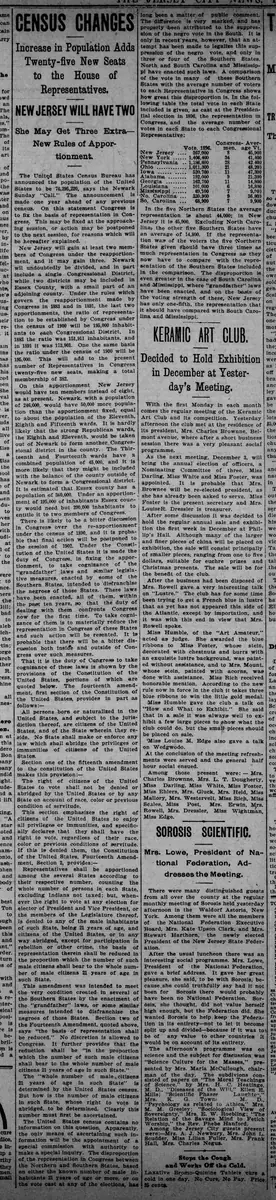
Increase in Population Adds Twenty-five New Seats to the House of Representatives.
NEW JERSEY WILL HAVE TWO She May Get Three Extra—New Rules of Apportionment.
The United States Census Bureau has announced the population of the United States to be 76,295,220, says the Newark Sunday "Call."
The announcement is made one year ahead of any previous census. On this statement Congress is to fix the basis of representation in Congress. This may be fixed at the approaching session, or action may be postponed to the next session, for reasons which will be hereafter explained.
New Jersey will gain at least two members of Congress under the reapportionment, and it may gain three. Newark will undoubtedly be divided, and in part include a single Congressional District, while two districts may be included in Essex County with a small part of an adjoining county. Under the rules which govern the reapportionment made by Congress in 1883 and in 1891, the last two apportionments, the ratio of representation to be established by Congress under the census of 1900 will be 195,000 inhabitants to each Congressional District. In 1883 the ratio was 151,911 inhabitants, and in 1891 it was 173,901. On the same basis the ratio under the census of 1900 will be 195,000. This will add to the present number of Representatives in Congress twenty-five new seats, making a total membership of 382.
On this apportionment New Jersey would have ten members instead of eight, as at present. Newark, with a population of 246,000, would have 50,000 more population than the apportionment fixed, equal to about the population of the Eleventh, Eighth and Fifteenth wards. It is hardly likely that the strong Republican wards, the Eighth and Eleventh, would be taken out of Newark to form another Congressional district in the county. The Thirteenth and Fourteenth wards have a combined population of 45,000, and it is more likely that they might be included with the balance of the county outside of Newark to form a Congressional district.
It is estimated that Essex county has a population of 360,000. Under an apportionment of 195,000 of inhabitants Essex county would need but 390,000 inhabitants to entitle it to two members of Congress.
There is likely to be a bitter discussion in Congress over the re-apportionment under the census of 1900, and it is probable that final action will be postponed to the session of 1902. Under the Constitution of the United States it is made the duty of Congress, in fixing the apportionment, to take cognizance of the "grandfather" laws and similar legislative measures, enacted by some of the Southern States, intended to disfranchise the negroes of those States. These laws have been enacted, all of them, within the past ten years, so that the duty of dealing with them confronts Congress now for the first time. To take cognizance of them is to materially reduce the representation in Congress of these States and such action will be resented. It is probable that there will be a bitter discussion both inside and outside of Congress over such measures.
That it is the duty of Congress to take cognizance of these laws is shown by the provisions of the Constitution of the United States, portions of which are quoted below. The fourteenth amendment, first section of the Constitution of the United States, provides in part as follows:
All persons born or naturalized in the United States, and subject to the jurisdiction thereof, are citizens of the United States, and of the State wherein they reside. No State shall make or enforce any law which shall abridge the privileges or immunities of citizens of the United States.
Section one of the fifteenth amendment to the constitution of the United States makes this provision:
The right of citizens of the United States to vote shall not be denied or abridged by the United States or by any State on account of race, color or previous condition of servitude.
This section emphasizes the right of citizens of the United States to enjoy all privileges or immunities, and specifically declares that they shall have the right to vote, regardless of their race, color or previous conditions of servitude.
If this is denied them, the Constitution of the United States, Fourteenth Amendment, Section 2, provides:
Representatives shall be apportioned among the several States according to their respective number, counting the whole number of persons in each State, excluding Indians not taxed; but whenever the right to vote at any election for elector of President and Vice President, or the members of the Legislature thereof, is denied to any of the male inhabitants of such State, being 21 years of age, and citizens of the United States, or in any way abridged, except for participation in rebellion or other crime, the basis of representation therein shall be reduced in the proportion which the number of such male citizens shall bear to the whole number of male citizens 21 years of age in such State.
This amendment was intended to meet the very condition created in several of the Southern States by the enactment of the "grandfather" laws, or some similar measures intended to disfranchise the negroes of those States. Section two of the Fourteenth Amendment, quoted above, says "the basis of representation shall be reduced." No discretion is allowed to Congress. It further provides that the reduction shall be "in the proportion which the number of such male citizens shall bear to the whole number of male citizens 21 years of age in such State."
The "whole number of male citizens 21 years of age in such State" is determined by the United States census. But how is the number of male citizens in such State, whose right to vote is abridged, to be determined. Clearly this number must first be ascertained.
The United States census contains no information on this question. Apparently, the only means of ascertaining such information will be the appointment of a special commission with authority to make a special inquiry. The disproportion of the representation in Congress between the Northern and Southern States, based on either the known number of male inhabitants 21 years of age or more, or on the vote cast at any of the elections, has long been a matter of public comment.
The difference is very marked and has properly been attributed to the suppression of the negro vote in the South. It is only in recent years, however, that an attempt has been made to legalize this suppression of the negro vote, and only in three or four of the Southern States.
North and South Carolina and Mississippi have enacted such laws. A comparison of the vote in many of these Southern States with the average number of voters to each Representative in Congress shows how great this disproportion is. In the following table the total vote in each State included is given, as cast at the Presidential election in 1896, the representation in Congress, and the average number of votes in each State to each Congressional Representative:
In the five Northern States the average representation is about 44,000; in New Jersey it is 45,900. Excluding North Carolina, the other five Southern States have an average of 14,500. If the representation was of the voters the five Northern States given should have three times as much representation in Congress as they now have to compare with the representation of the Southern States included in the comparison. The disproportion is even greater in the case of South Carolina and Mississippi, where "grandfather" laws have been enacted, and on the basis of the voting strength of these, New Jersey has only one-fifth the representation that it should have compared with South Carolina and Mississippi.
| Vote. 1896. | Congress. Aver. men. | age Vt. | |
| New Jersey | 367,000 | 8 | 45,900 |
| New York | 1,406,400 | 34 | 41,400 |
| Pennsylvania | 1,186,600 | 28 | 42,400 |
| Ohio | 1,011,300 | 21 | 48,200 |
| Iowa | 520,700 | 11 | 47,300 |
| Alabama | 192,000 | 9 | 21,300 |
| Georgia | 162,700 | 11 | 14,800 |
| Louisiana | 101,000 | 6 | 16,800 |
| Mississippi | 69,100 | 7 | 9,000 |
| No. Carolina | 230,900 | 9 | 36,800 |
| So. Carolina | 68,900 | 7 | 9,900 |
What sub-type of article is it?
What keywords are associated?
Where did it happen?
Domestic News Details
Primary Location
United States
Event Date
Census Of 1900
Outcome
adds 25 new seats to house, total 382; new jersey gains 2-3 seats; potential reduction in southern representation due to disenfranchisement laws
Event Details
US Census Bureau announces population of 76,295,220, leading to reapportionment with ratio of 195,000 per district. New Jersey to gain seats, with details on Newark and Essex County divisions. Constitutional duty to address Southern 'grandfather' laws disenfranchising Black voters, possibly requiring special commission. Table compares 1896 votes and representation in Northern and Southern states highlighting disparities.