Thank you for visiting SNEWPapers!
Sign up free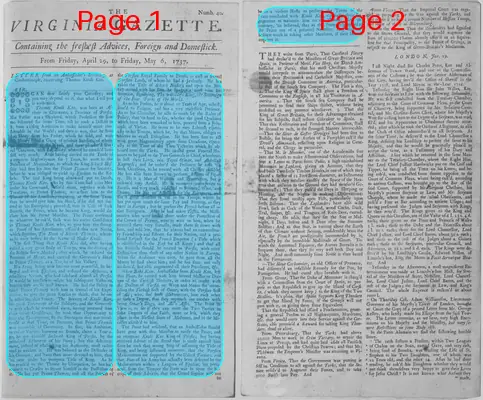
The Virginia Gazette
Richmond, Williamsburg, Richmond County, Virginia
What is this article about?
A letter from Constantinople details the rise of Thamas Kouli Kan (Nadir Shah) from shepherd to usurper king of Persia, his military victories, betrayal of Prince Thamas, cruelty to secure power, personal traits, favoritism toward Europeans especially French, and Ottoman Porte's hesitation to ratify peace amid Persian unrest.
Merged-components note: Continuation of the letter from an Ambassador's Secretary at Constantinople concerning Thamas Kouli Kan across pages.
Clippings
1 of 2
OCR Quality
Full Text
SIR,
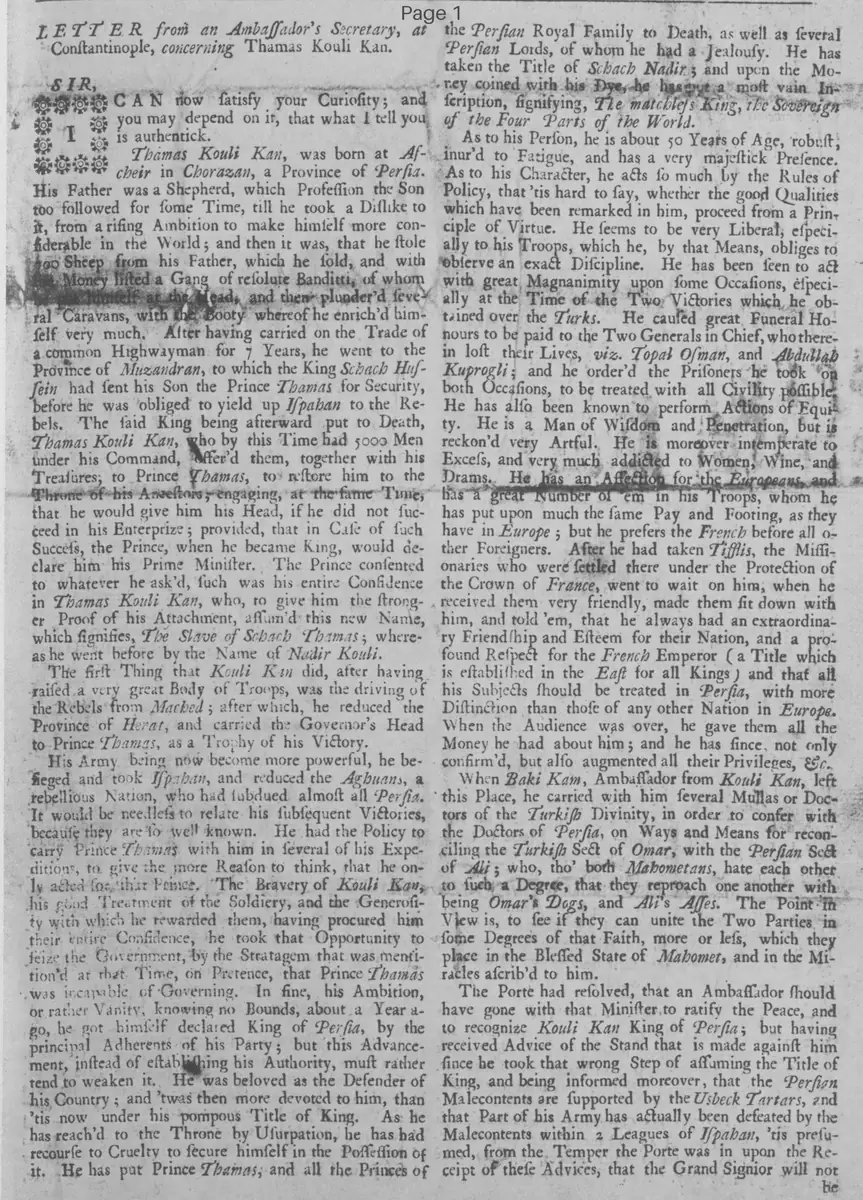
I CAN now satisfy your Curiosity; and you may depend on it, that what I tell you is authentick.
Thamas Kouli Kan, was born at Afcheir in Chorazan, a Province of Perfia. His Father was a Shepherd, which Profession the Son too followed for some Time, till he took a Dislike to it, from a rising Ambition to make himself more considerable in the World; and then it was, that he stole too Sheep from his Father, which he sold, and with Money listed a Gang of resolute Banditti, of whom himself at the head, and then plunder'd several Caravans, with the Booty whereof he enrich'd himself very much. After having carried on the Trade of a common Highwayman for 7 Years, he went to the Province of Mazandaran, to which the King Schach Hussein had sent his Son the Prince Thamas for Security, before he was obliged to yield up Ispahan to the Rebels. The said King being afterward put to Death, Thamas Kouli Kan, who by this Time had 2000 Men under his Command, offer'd them, together with his Treasures; to Prince Thamas, to restore him to the Throne of his Ancestors; engaging, at the same Time, that he would give him his Head, if he did not succeed in his Enterprize; provided, that in Case of such Success, the Prince, when he became King, would declare him his Prime Minister. The Prince consented to whatever he ask'd, such was his entire Confidence in Thamas Kouli Kan, who, to give him the stronger Proof of his Attachment, assumed this new Name, which signifies, The Slave of Schach Thamas; whereas he went before by the Name of Nadir Kuli. The first Thing that Kouli Kan did, after having raised a very great Body of Troops, was the driving of the Rebels from Mashhad; after which, he reduced the Province of Herat, and carried the Governor's Head to Prince Thamas, as a Trophy of his Victory. His Army being now become more powerful, he Besieged and took Ispahan, and reduced the Afghans, a rebellious Nation, who had subdued almost all Persia. It would be needless to relate his subsequent Victories, because they are too well known. He had the Policy to carry Prince Thamas with him in several of his Expeditions, to give the more Reason to think, that he only acted so. that Fact. The Bravery of Kouli Kan, his good Treatment of the Soldiery, and the Generosity with which he rewarded them, having procured him their entire Confidence, he took that Opportunity to seize the Government, by the Stratagem that was mentioned at that Time, on Pretence, that Prince Thamas was incapable of Governing. In fine, his Ambition, or rather Vanity, knowing no Bounds, about a Year ago, he got himself declared King of Persia, by the principal Adherents of his Party; but this Advancement, instead of establishing his Authority, must rather tend to weaken it. He was beloved as the Defender of his Country; and 'twas then more devoted to him, than 'tis now under his pompous Title of King. As he has reach'd to the Throne by Usurpation, he has had recourse to Cruelty to secure himself in the Possession of it. He has put Prince Thamas, and all the Princes of the Persian Royal Family to Death, as well as several Persian Lords, of whom he had a Jealousy. He has taken the Title of Schach Nadir; and upon the Money coined with his Die, he has put a most vain Inscription, signifying, The matchless King, the Sovereign of the Four Parts of the World.
As to his Person, he is about 50 Years of Age, robust; inur'd to Fatigue, and has a very majestic Presence. As to his Character, he acts so much by the Rules of Policy, that 'tis hard to say, whether the good Qualities which have been remarked in him, proceed from a Principle of Virtue. He seems to be very Liberal; especially to his Troops, which he, by that Means, obliges to observe an exact Discipline. He has been seen to act with great Magnanimity upon some Occasions, especially at the Time of the Two Victories which he obtained over the Turks. He caused great Funeral Honours to be paid to the Two Generals in Chief, who therein lost their Lives, viz. Topal Osman, and Abdullah Kioproli; and he order'd the Prisoners he took on both Occasions, to be treated with all Civility possible. He has also been known to perform Actions of Equity. He is a Man of Wisdom and Penetration, but is reckon'd very Artful. He is moreover intemperate to Excess, and very much addicted to Women, Wine, and Drams. He has an Affection for the Europeans, and has a great Number of them in his Troops, whom he has put upon much the same Pay and Footing, as they have in Europe; but he prefers the French before all other Foreigners. After he had taken Tiflis, the Missionaries who were settled there under the Protection of the Crown of France, went to wait on him, when he received them very friendly, made them sit down with him, and told 'em, that he always had an extraordinary Friendship and Esteem for their Nation, and a profound Respect for the French Emperor (a Title which is established in the East for all Kings) and that all his Subjects should be treated in Persia, with more Distinction than those of any other Nation in Europe. When the Audience was over, he gave them all the Money he had about him; and he has since, not only confirmed, but also augmented all their Privileges, &c. When Baki Khan, Ambassador from Kouli Kan, left this Place, he carried with him several Mullahs or Doctors of the Turkish Divinity, in order to confer with the Doctors of Persia, on Ways and Means for reconciling the Turkish Sect of Omar, with the Persian Sect of Ali; who, tho' both Mahometans, hate each other to such a Degree, that they reproach one another with being Omar's Dogs, and Ali's Asses. The Point in View is, to see if they can unite the Two Parties in some Degrees of that Faith, more or less, which they place in the Blood State of Mahomet, and in the Miracles ascribed to him.
The Porte had resolved, that an Ambassador should have gone with that Minister, to ratify the Peace, and to recognize Kouli Kan King of Persia; but having received Advices of the Stand that is made against him since he took that wrong Step of assuming the Title of King, and being informed moreover, that the Persian Malecontents are supported by the Uzbek Tartars, and that Part of his Army has actually been defeated by the Malecontents within 2 Leagues of Ispahan, tis presumed, from the Temper the Porte was in upon the Receipt of these Advices, that the Grand Signior will not
They be in a violent Hate to perform the Terms of the Peace concluded with Kouli Kan, especially their Engagement to maintain him on the Throne. On the contrary, 'tis believed, that as the Porte only agreed to the Peace out of a political Necessity, they will not hesitate much in taking other Measures, if their Interest requires it.
What sub-type of article is it?
What keywords are associated?
What entities or persons were involved?
Where did it happen?
Foreign News Details
Primary Location
Persia
Event Date
About A Year Ago
Key Persons
Outcome
usurped throne by stratagem; executed prince thamas and persian royals; declared king but facing malecontent opposition supported by uzbek tartars; part of army defeated near ispahan; ottoman porte hesitates to ratify peace and recognize him.
Event Details
Thamas Kouli Kan rose from shepherd and bandit to military leader, aiding Prince Thamas against rebels, recapturing territories including Ispahan from Afghans; later seized power claiming Prince incapable, executed royals; declared king about a year ago; favors Europeans especially French; efforts to reconcile Sunni-Shia sects; recent defeats and Ottoman reluctance to support.