Thank you for visiting SNEWPapers!
Sign up free
The Daily Missourian
Columbia, Boone County, Missouri
What is this article about?
James L. MacKay, a teacher in the Philippines, describes the backwardness in Filipino religious practices among Roman Catholics, including medieval customs like self-flagellation during Holy Week, and notes indifference from clergy. He also discusses untidy home life and peculiar food preparations.
Clipping
OCR Quality
Full Text
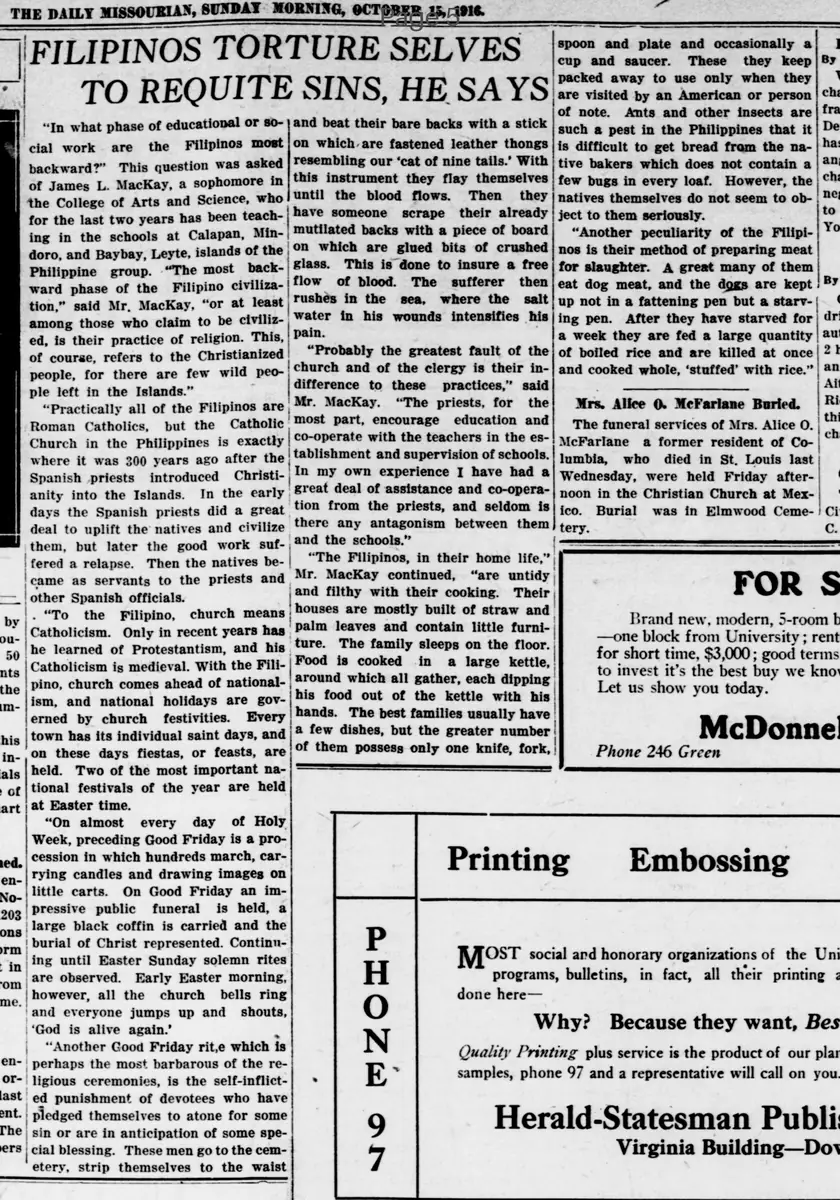
TO REQUITE SINS, HE SAYS
"In what phase of educational or social work are the Filipinos most backward?"
This question was asked of James L. MacKay, a sophomore in the College of Arts and Science, who for the last two years has been teaching in the schools at Calapan, Mindoro, and Baybay, Leyte, islands of the Philippine group.
"The most backward phase of the Filipino civilization," said Mr. MacKay, "or at least among those who claim to be civilized, is their practice of religion. This, of course, refers to the Christianized people, for there are few wild people left in the Islands."
"Practically all of the Filipinos are Roman Catholics, but the Catholic Church in the Philippines is exactly where it was 300 years ago after the Spanish priests introduced Christianity into the Islands.
In the early days the Spanish priests did a great deal to uplift the natives and civilize them, but later the good work suffered a relapse. Then the natives became as servants to the priests and other Spanish officials.
"To the Filipino, church means Catholicism.
Only in recent years has he learned of Protestantism, and his Catholicism is medieval. With the Filipino, church comes ahead of nationalism, and national holidays are governed by church festivities.
Every town has its individual saint days, and on these days fiestas, or feasts, are held. Two of the most important national festivals of the year are held at Easter time.
"On almost every day of Holy Week, preceding Good Friday is a procession in which hundreds march, carrying candles and drawing images on little carts.
On Good Friday an impressive public funeral is held, a large black coffin is carried and the burial of Christ represented. Continuing until Easter Sunday solemn rites are observed. Early Easter morning, however, all the church bells ring and everyone jumps up and shouts, 'God is alive again.'
"Another Good Friday rite, which is perhaps the most barbarous of the religious ceremonies, is the self-inflicted punishment of devotees who have pledged themselves to atone for some sin or are in anticipation of some special blessing. These men go to the cemetery, strip themselves to the waist and beat their bare backs with a stick on which are fastened leather thongs resembling our 'cat of nine tails.' With this instrument they flay themselves until the blood flows.
Then they have someone scrape their already mutilated backs with a piece of board on which are glued bits of crushed glass.
This is done to insure a free flow of blood.
The sufferer then rushes in the sea, where the salt water in his wounds intensifies his pain.
"Probably the greatest fault of the church and of the clergy is their indifference to these practices," said Mr. MacKay.
"The priests, for the most part, encourage education and co-operate with the teachers in the establishment and supervision of schools.
In my own experience I have had a great deal of assistance and co-operation from the priests, and seldom is there any antagonism between them and the schools."
"The Filipinos, in their home life," Mr. MacKay continued, "are untidy and filthy with their cooking.
Their houses are mostly built of straw and palm leaves and contain little furniture. The family sleeps on the floor.
Food is cooked in a large kettle, around which all gather, each dipping his food out of the kettle with his hands. The best families usually have a few dishes, but the greater number of them possess only one knife, fork, spoon and plate and occasionally a cup and saucer. These they keep packed away to use only when they are visited by an American or person of note. Ants and other insects are such a pest in the Philippines that it is difficult to get bread from the native bakers which does not contain a few bugs in every loaf. However, the natives themselves do not seem to object to them seriously.
"Another peculiarity of the Filipinos is their method of preparing meat for slaughter. A great many of them eat dog meat, and the dogs are kept up not in a fattening pen but a starving pen.
After they have starved for a week they are fed a large quantity of boiled rice and are killed at once and cooked whole, stuffed with rice."
What sub-type of article is it?
What keywords are associated?
What entities or persons were involved?
Where did it happen?
Foreign News Details
Primary Location
Calapan, Mindoro, And Baybay, Leyte, Islands Of The Philippine Group
Key Persons
Event Details
James L. MacKay, who has been teaching in Philippine schools, states that the most backward aspect of Filipino civilization is their practice of religion among Christianized Roman Catholics, which remains medieval since Spanish introduction 300 years ago. He describes Holy Week processions, Good Friday funeral rites, and self-inflicted punishments like flogging backs with thonged sticks, scraping with glass-embedded boards, and rushing into the sea. Priests are indifferent to these but cooperate on education. He also notes untidy home life, insect-infested food, and eating starved dogs stuffed with rice.