Thank you for visiting SNEWPapers!
Sign up free
The Daily Monitor
Mount Clemens, Macomb County, Michigan
What is this article about?
Post-Singapore fall, a looming Battle of the Indian Ocean threatens Allied navies with Japanese potential dominance, invasions of India and Madagascar, attacks on Burma, supply raids to Russia, and blockade of resource-rich India. Vast ocean distances complicate operations for both sides.
Clipping
OCR Quality
Full Text
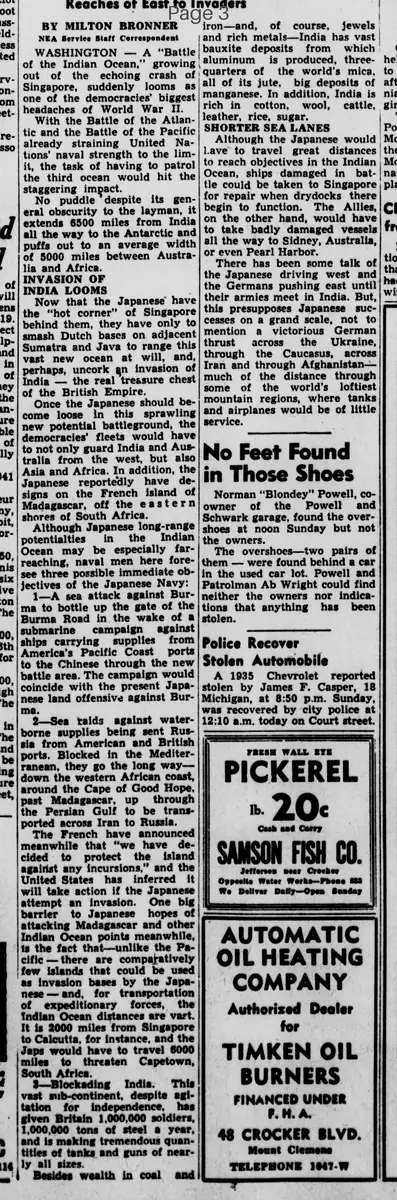
Fall of Indies Would Open Vast Reaches of East to Invaders
BY MILTON BRONNER
NEA Service Staff Correspondent
WASHINGTON
A "Battle of the Indian Ocean," growing out of the echoing crash of Singapore, suddenly looms as one of the democracies' biggest headaches of World War II.
With the Battle of the Atlantic and the Battle of the Pacific already straining United Nations' naval strength to the limit, the task of having to patrol the third ocean would hit the staggering impact.
No puddle—despite its general obscurity to the layman, it extends 6500 miles from India all the way to the Antarctic and puffs out to an average width of 5000 miles between Australia and Africa.
INVASION OF INDIA LOOMS
Now that the Japanese have the "hot corner" of Singapore behind them, they have only to smash Dutch bases on adjacent Sumatra and Java to range this vast new ocean at will, and, perhaps, uncork an invasion of India - the real "treasure chest of the British Empire."
Once the Japanese should become loose in this sprawling new potential battleground, the democracies' fleets would have to not only guard India and Australia from the west, but also Asia and Africa. In addition, the Japanese reportedly have designs on the French island of Madagascar, off the eastern shores of South Africa.
Although Japanese long-range potentialities in the Indian Ocean may be especially far-reaching, naval men here foresee three possible immediate objectives of the Japanese Navy:
1-A sea attack against Burma to bottle up the gate of the Burma Road in the wake of a submarine campaign against ships carrying supplies from America's Pacific Coast ports to the Chinese through the new battle area. The campaign would coincide with the present Japanese land offensive against Burma.
2-Sea raids against water-borne supplies being sent Russia from American and British ports. Blocked in the Mediterranean, they go the long way—down the western African coast, around the Cape of Good Hope, past Madagascar, up through the Persian Gulf to be transported across Iran to Russia.
The French have announced meanwhile that "we have decided to protect the island against any incursions," and the United States has inferred it will take action if the Japanese attempt an invasion.
One big barrier to Japanese hopes of attacking Madagascar and other Indian Ocean points meanwhile, is the fact that—unlike the Pacific—there are comparatively few islands that could be used as invasion bases by the Japanese—and, for transportation of expeditionary forces, the Indian Ocean distances are vast.
It is 2000 miles from Singapore to Calcutta, for instance, and the Japs would have to travel 6000 miles to threaten Capetown, South Africa.
3-Blockading India.
This vast sub-continent, despite agitation for independence, has given Britain 1,000,000 soldiers, 1,000,000 tons of steel a year, and is making tremendous quantities of tanks and guns of nearly all sizes.
Besides wealth in coal and iron—and, of course, jewels and rich metals—India has vast bauxite deposits from which aluminum is produced, three-quarters of the world's mica, all of its jute, big deposits of manganese. In addition, India is rich in cotton, wool, cattle, leather, rice, sugar.
SHORTER SEA LANES
Although the Japanese would have to travel great distances to reach objectives in the Indian Ocean, ships damaged in battle could be taken to Singapore for repair when drydocks there begin to function. The Allies, on the other hand, would have to take badly damaged vessels all the way to Sidney, Australia, or even Pearl Harbor.
There has been some talk of the Japanese driving west and the Germans pushing east until their armies meet in India. But, this presupposes Japanese successes on a grand scale, not to mention a victorious German thrust across the Ukraine, through the Caucasus, across Iran and through Afghanistan much of the distance through some of the world's loftiest mountain regions, where tanks and airplanes would be of little service.
What sub-type of article is it?
What keywords are associated?
Where did it happen?
Foreign News Details
Primary Location
Indian Ocean
Event Details
A potential Battle of the Indian Ocean looms after the fall of Singapore, posing a major challenge to Allied naval forces already strained in the Atlantic and Pacific. Japanese control of Sumatra and Java could allow them to dominate the ocean, threaten invasion of India, attack Burma by sea, raid supplies to Russia via the Cape route, and target Madagascar. Blockading India is another objective, given its strategic resources and contributions to Britain. Vast distances and few islands hinder Japanese operations, while Allies face longer repair routes.