Thank you for visiting SNEWPapers!
Sign up free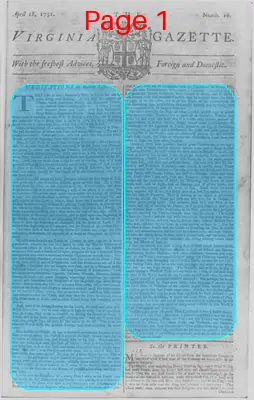
Literary
April 18, 1751
The Virginia Gazette
Richmond, Williamsburg, Richmond County, Virginia
What is this article about?
Philosophical essay reflecting on the miseries of human life across all stages—from infancy's helplessness to old age's decay—using metaphors like Penelope's web and a stormy sea. It argues that life is full of evils, true desirability lies in virtuous living guided by God, yet even that involves constant struggle against passions and the world.
Clipping
OCR Quality
95%
Excellent
Full Text
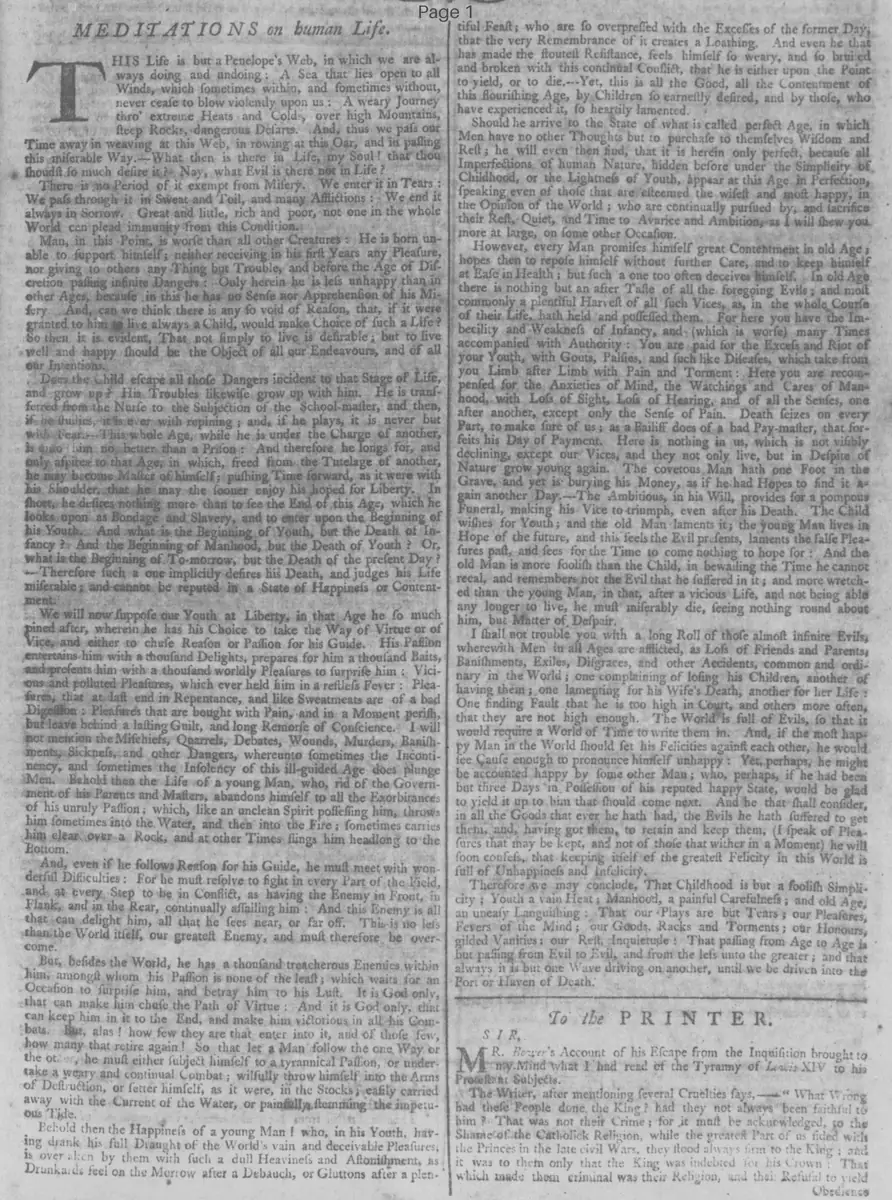
MEDITATIONS on human Life.
This Life is but a Penelope's Web, in which we are always doing and undoing: A Sea that lies open to all Winds, which sometimes within, and sometimes without, never cease to blow violently upon us: A weary Journey thro' extreme Heats and Colds, over high Mountains, steep Rocks, dangerous Desarts. And, thus we pass our Time away in weaving at this Web, in rowing at this Oar, and in passing this miserable Way. What then is there in Life, my Soul! that thou shouldst so much desire it? - Nay, what Evil is there not in Life?
There is no Period of it exempt from Misery. We enter it in Tears: We pass through it in Sweat and Toil, and many Afflictions: - We end it always in Sorrow. Great and little, rich and poor, not one in the whole World can plead immunity from this Condition.
Man, in this Point, is worse than all other Creatures: He is born unable to support himself; neither receiving in his first Years any Pleasure, nor giving to others any Thing but Trouble, and before the Age of Discretion passing infinite Dangers: Only herein he is less unhappy than in other Ages, because in this he has no Sense nor Apprehension of his Misery. And, can we think there is any one void of Reason, that, if it were granted to him to live always a Child, would make Choice of such a Life?
So then it is evident, That not simply to live is desirable; but to live well and happy should be the Object of all our Endeavours, and of all our Intentions.
Does the Child escape all those Dangers incident to that Stage of Life and grow up? His Troubles likewise grow up with him. He is transferred from the Nurse to the Subjection of the School-master, and then, if he studies, it is ever with repining; and, if he plays, it is never but with Fear. - This whole Age, while he is under the Charge of another, is drawn upon him no better than a Prison: And therefore he longs for, and only aspires to that Age, in which, freed from the Tutelage of another, he may become Master of himself; pushing Time forward, as it were with his Shoulder, that he may the sooner enjoy his hoped for Liberty. In short, he desires nothing more than to see the End of this Age, which he looks upon as Bondage and Slavery, and to enter upon the Beginning of his Youth. And what is the Beginning of Youth, but the Death of Infancy? And the Beginning of Manhood, but the Death of Youth? Or, what is the Beginning of To-morrow, but the Death of the present Day? - Therefore such a one implicitly desires his Death, and judges his Life miserable; and cannot be reputed in a State of Happiness or Contentment.
We will now suppose our Youth at Liberty, in that Age he so much pined after, wherein he has his Choice to take the Way of Virtue or of Vice, and either to choose Reason or Passion for his Guide. His Passion entertains him with a thousand Delights, prepares for him a thousand Baits, and presents him with a thousand worldly Pleasures to surprise him: Vicious and polluted Pleasures, which ever held him in a restless Fever: Pleasures, that at last end in Repentance, and like Sweetmeats are of a bad Digestion: Pleasures that are bought with Pain, and in a Moment perish, but leave behind a lasting Guilt, and long Remorse of Conscience. I will not mention the Mischiefs, Quarrels, Debates, Wounds, Murders, Banishments, Sickness, and other Dangers, whereunto sometimes the Incontinency, and sometimes the Insolency of this ill-guided Age does plunge Men. Behold then the Life of a young Man, who, rid of the Government of his Parents and Masters, abandons himself to all the Exorbitances of his unruly Passion; which, like an unclean Spirit possessing him, throws him sometimes into the Water, and then into the Fire; sometimes carries him clear over a Rock, and at other Times swings him headlong to the Bottom.
And, even if he follows Reason for his Guide, he must meet with wonderful Difficulties: For he must resolve to fight in every Part of the Field, and at every Step to be in Conflict, as having the Enemy in Front, in Flank, and in the Rear, continually assailing him: And this Enemy is all that can delight him, all that he sees near, or far off. This is no less than the World itself, our greatest Enemy, and must therefore be overcome.
But, besides the World, he has a thousand treacherous Enemies within him, amongst whom his Passion is none of the least; which waits for an Occasion to surprise him, and betray him to his Lust. It is God only, that can make him choose the Path of Virtue: And it is God only, that can keep him in it to the End, and make him victorious in all his Combats. But, alas! how few they are that enter into it, and of those few, how many that retire again! So that let a Man follow the one Way or the other, he must either subject himself to a tyrannical Passion, or undertake a weary and continual Combat; wilfully throw himself into the Arms of Destruction, or better himself, as it were, in the Stocks; easily carried away with the Current of the Water, or painfully stemming the impetuous Tide.
Behold then the Happiness of a young Man! who, in his Youth, having drank his full Draught of the World's vain and deceivable Pleasures, is over taken by them with such a dull Heaviness and Astonishment, as Drunkards feel on the Morrow after a Debauch, or Gluttons after a plentiful Feast; who are so overpressed with the Excess of the former Day, that the very Remembrance of it creates a Loathing. And even he that has made the stoutest Resistance, feels himself so weary, and so bruised and broken with this continual Conflict, that he is either upon the Point to yield, or to die.---Yet, this is all the Good, all the Contentment of this flourishing Age, by Children so earnestly desired, and by those, who have experienced it, so heartily lamented.
Should he arrive to the State of what is called perfect Age, in which Men have no other Thoughts but to purchase to themselves Wisdom and Rest; he will even then find, that it is herein only perfect, because all Imperfections of human Nature, hidden before under the Simplicity of Childhood, or the Lightness of Youth, appear at this Age in Perfection, speaking even of those that are esteemed the wisest and most happy, in the Opinion of the World; who are continually pursued by, and sacrifice their Rest, Quiet, and Time to Avarice and Ambition,-as I will Shew you more at large, on some other Occasion.
However, every Man promises himself great Contentment in old Age; hopes then to repose himself without further Care, and to keep himself at Ease in Health; but such a one too often deceives himself. In old Age there is nothing but an after Taste of all the foregoing Evils; and most commonly a plentiful Harvest of all such Vices, as, in the whole Course of their Life, hath held and possessed them. For here you have the Imbecility and Weakness of Infancy, and (which is worse) many Times accompanied with Authority: You are paid for the Excess and Riot of your Youth, with Gouts, Palsies, and such like Diseases, which take from you Limb after Limb with Pain and Torment: Here you are recompensed for the Anxieties of Mind, the Watchings and Cares of Manhood, with Loss of Sight, Loss of Hearing, and of all the Senses, one after another, except only the Sense of Pain. Death seizes on every Part, to make sure of us; as a Bailiff does of a bad Pay-master, that forfeits his Day of Payment. Here is nothing in us, which is not visibly declining, except our Vices, and they not only live, but in Despite of Nature grow young again. The covetous Man hath one Foot in the Grave, and yet is burying his Money, as if he had Hopes to find it again another Day.--The Ambitious, in his Will, provides for a pompous Funeral, making his Vice to triumph, even after his Death. The Child wishes for Youth; and the old Man laments it; the young Man lives in Hope of the future, and this feels the Evil present, laments the false Pleasures past, and sees for the Time to come nothing to hope or: And the old Man is more foolish than the Child, in bewailing the Time he cannot recall, and remembers not the Evil that he suffered in it: and more wretched than the young Man, in that, after a vicious Life, and not being able any longer to live, he must miserably die, seeing nothing round about him, but Matter of Despair.
I shall not trouble you with a long Roll of those almost infinite Evils, wherewith Men in all Ages are afflicted, as Loss of Friends and Parents, Banishments, Exiles, Disgraces, and other Accidents, common and ordinary in the World; one complaining of losing his Children, another of having them; one lamenting for his Wife's Death, another for her Life: One finding Fault that he is too high in Court, and others more often, that they are not high enough. The World is full of Evils, so that it would require a World of Time to write them in. And, if the most happy Man in the World should set his Felicities against each other, he would see Cause enough to pronounce himself unhappy: Yet, perhaps, he might be accounted happy by some other Man; who, perhaps, if he had been but three Days in Possession of his reputed happy State, would be glad to yield it up to him that should come next. And he that shall consider, in all the Goods that ever he hath had, the Evils he hath suffered to get them, and, having got them, to retain and keep them, (I speak of Pleasures that may be kept, and not of those that wither in a Moment) he will soon confess, that keeping itself of the greatest Felicity in this World is full of Unhappiness and Infelicity.
Therefore we may conclude, That Childhood is but a foolish Simplicity; Youth a vain Heat; Manhood, a painful Carefulnes; and old Age, an uneasy Languishing: That our Plays are but Tears; our Pleasures, Fevers of the Mind; our Goods, Racks and Torments; our Honours, gilded Vanities: our Rest, Inquietude: That passing from Age to Age is but passing from Evil to Evil, and from the less unto the greater; and that always in it is but One Wave driving on another, until we be driven into the Port or Haven of Death.
This Life is but a Penelope's Web, in which we are always doing and undoing: A Sea that lies open to all Winds, which sometimes within, and sometimes without, never cease to blow violently upon us: A weary Journey thro' extreme Heats and Colds, over high Mountains, steep Rocks, dangerous Desarts. And, thus we pass our Time away in weaving at this Web, in rowing at this Oar, and in passing this miserable Way. What then is there in Life, my Soul! that thou shouldst so much desire it? - Nay, what Evil is there not in Life?
There is no Period of it exempt from Misery. We enter it in Tears: We pass through it in Sweat and Toil, and many Afflictions: - We end it always in Sorrow. Great and little, rich and poor, not one in the whole World can plead immunity from this Condition.
Man, in this Point, is worse than all other Creatures: He is born unable to support himself; neither receiving in his first Years any Pleasure, nor giving to others any Thing but Trouble, and before the Age of Discretion passing infinite Dangers: Only herein he is less unhappy than in other Ages, because in this he has no Sense nor Apprehension of his Misery. And, can we think there is any one void of Reason, that, if it were granted to him to live always a Child, would make Choice of such a Life?
So then it is evident, That not simply to live is desirable; but to live well and happy should be the Object of all our Endeavours, and of all our Intentions.
Does the Child escape all those Dangers incident to that Stage of Life and grow up? His Troubles likewise grow up with him. He is transferred from the Nurse to the Subjection of the School-master, and then, if he studies, it is ever with repining; and, if he plays, it is never but with Fear. - This whole Age, while he is under the Charge of another, is drawn upon him no better than a Prison: And therefore he longs for, and only aspires to that Age, in which, freed from the Tutelage of another, he may become Master of himself; pushing Time forward, as it were with his Shoulder, that he may the sooner enjoy his hoped for Liberty. In short, he desires nothing more than to see the End of this Age, which he looks upon as Bondage and Slavery, and to enter upon the Beginning of his Youth. And what is the Beginning of Youth, but the Death of Infancy? And the Beginning of Manhood, but the Death of Youth? Or, what is the Beginning of To-morrow, but the Death of the present Day? - Therefore such a one implicitly desires his Death, and judges his Life miserable; and cannot be reputed in a State of Happiness or Contentment.
We will now suppose our Youth at Liberty, in that Age he so much pined after, wherein he has his Choice to take the Way of Virtue or of Vice, and either to choose Reason or Passion for his Guide. His Passion entertains him with a thousand Delights, prepares for him a thousand Baits, and presents him with a thousand worldly Pleasures to surprise him: Vicious and polluted Pleasures, which ever held him in a restless Fever: Pleasures, that at last end in Repentance, and like Sweetmeats are of a bad Digestion: Pleasures that are bought with Pain, and in a Moment perish, but leave behind a lasting Guilt, and long Remorse of Conscience. I will not mention the Mischiefs, Quarrels, Debates, Wounds, Murders, Banishments, Sickness, and other Dangers, whereunto sometimes the Incontinency, and sometimes the Insolency of this ill-guided Age does plunge Men. Behold then the Life of a young Man, who, rid of the Government of his Parents and Masters, abandons himself to all the Exorbitances of his unruly Passion; which, like an unclean Spirit possessing him, throws him sometimes into the Water, and then into the Fire; sometimes carries him clear over a Rock, and at other Times swings him headlong to the Bottom.
And, even if he follows Reason for his Guide, he must meet with wonderful Difficulties: For he must resolve to fight in every Part of the Field, and at every Step to be in Conflict, as having the Enemy in Front, in Flank, and in the Rear, continually assailing him: And this Enemy is all that can delight him, all that he sees near, or far off. This is no less than the World itself, our greatest Enemy, and must therefore be overcome.
But, besides the World, he has a thousand treacherous Enemies within him, amongst whom his Passion is none of the least; which waits for an Occasion to surprise him, and betray him to his Lust. It is God only, that can make him choose the Path of Virtue: And it is God only, that can keep him in it to the End, and make him victorious in all his Combats. But, alas! how few they are that enter into it, and of those few, how many that retire again! So that let a Man follow the one Way or the other, he must either subject himself to a tyrannical Passion, or undertake a weary and continual Combat; wilfully throw himself into the Arms of Destruction, or better himself, as it were, in the Stocks; easily carried away with the Current of the Water, or painfully stemming the impetuous Tide.
Behold then the Happiness of a young Man! who, in his Youth, having drank his full Draught of the World's vain and deceivable Pleasures, is over taken by them with such a dull Heaviness and Astonishment, as Drunkards feel on the Morrow after a Debauch, or Gluttons after a plentiful Feast; who are so overpressed with the Excess of the former Day, that the very Remembrance of it creates a Loathing. And even he that has made the stoutest Resistance, feels himself so weary, and so bruised and broken with this continual Conflict, that he is either upon the Point to yield, or to die.---Yet, this is all the Good, all the Contentment of this flourishing Age, by Children so earnestly desired, and by those, who have experienced it, so heartily lamented.
Should he arrive to the State of what is called perfect Age, in which Men have no other Thoughts but to purchase to themselves Wisdom and Rest; he will even then find, that it is herein only perfect, because all Imperfections of human Nature, hidden before under the Simplicity of Childhood, or the Lightness of Youth, appear at this Age in Perfection, speaking even of those that are esteemed the wisest and most happy, in the Opinion of the World; who are continually pursued by, and sacrifice their Rest, Quiet, and Time to Avarice and Ambition,-as I will Shew you more at large, on some other Occasion.
However, every Man promises himself great Contentment in old Age; hopes then to repose himself without further Care, and to keep himself at Ease in Health; but such a one too often deceives himself. In old Age there is nothing but an after Taste of all the foregoing Evils; and most commonly a plentiful Harvest of all such Vices, as, in the whole Course of their Life, hath held and possessed them. For here you have the Imbecility and Weakness of Infancy, and (which is worse) many Times accompanied with Authority: You are paid for the Excess and Riot of your Youth, with Gouts, Palsies, and such like Diseases, which take from you Limb after Limb with Pain and Torment: Here you are recompensed for the Anxieties of Mind, the Watchings and Cares of Manhood, with Loss of Sight, Loss of Hearing, and of all the Senses, one after another, except only the Sense of Pain. Death seizes on every Part, to make sure of us; as a Bailiff does of a bad Pay-master, that forfeits his Day of Payment. Here is nothing in us, which is not visibly declining, except our Vices, and they not only live, but in Despite of Nature grow young again. The covetous Man hath one Foot in the Grave, and yet is burying his Money, as if he had Hopes to find it again another Day.--The Ambitious, in his Will, provides for a pompous Funeral, making his Vice to triumph, even after his Death. The Child wishes for Youth; and the old Man laments it; the young Man lives in Hope of the future, and this feels the Evil present, laments the false Pleasures past, and sees for the Time to come nothing to hope or: And the old Man is more foolish than the Child, in bewailing the Time he cannot recall, and remembers not the Evil that he suffered in it: and more wretched than the young Man, in that, after a vicious Life, and not being able any longer to live, he must miserably die, seeing nothing round about him, but Matter of Despair.
I shall not trouble you with a long Roll of those almost infinite Evils, wherewith Men in all Ages are afflicted, as Loss of Friends and Parents, Banishments, Exiles, Disgraces, and other Accidents, common and ordinary in the World; one complaining of losing his Children, another of having them; one lamenting for his Wife's Death, another for her Life: One finding Fault that he is too high in Court, and others more often, that they are not high enough. The World is full of Evils, so that it would require a World of Time to write them in. And, if the most happy Man in the World should set his Felicities against each other, he would see Cause enough to pronounce himself unhappy: Yet, perhaps, he might be accounted happy by some other Man; who, perhaps, if he had been but three Days in Possession of his reputed happy State, would be glad to yield it up to him that should come next. And he that shall consider, in all the Goods that ever he hath had, the Evils he hath suffered to get them, and, having got them, to retain and keep them, (I speak of Pleasures that may be kept, and not of those that wither in a Moment) he will soon confess, that keeping itself of the greatest Felicity in this World is full of Unhappiness and Infelicity.
Therefore we may conclude, That Childhood is but a foolish Simplicity; Youth a vain Heat; Manhood, a painful Carefulnes; and old Age, an uneasy Languishing: That our Plays are but Tears; our Pleasures, Fevers of the Mind; our Goods, Racks and Torments; our Honours, gilded Vanities: our Rest, Inquietude: That passing from Age to Age is but passing from Evil to Evil, and from the less unto the greater; and that always in it is but One Wave driving on another, until we be driven into the Port or Haven of Death.
What sub-type of article is it?
Essay
What themes does it cover?
Death Mortality
Moral Virtue
What keywords are associated?
Meditations On Life
Miseries Of Ages
Virtue Vs Vice
Human Suffering
Life Stages
Penelope's Web
Path Of Virtue
Literary Details
Title
Meditations On Human Life.
Subject
On The Miseries Of Human Life Through Its Stages
Key Lines
This Life Is But A Penelope's Web, In Which We Are Always Doing And Undoing: A Sea That Lies Open To All Winds, Which Sometimes Within, And Sometimes Without, Never Cease To Blow Violently Upon Us: A Weary Journey Thro' Extreme Heats And Colds, Over High Mountains, Steep Rocks, Dangerous Desarts.
What Then Is There In Life, My Soul! That Thou Shouldst So Much Desire It? Nay, What Evil Is There Not In Life?
So Then It Is Evident, That Not Simply To Live Is Desirable; But To Live Well And Happy Should Be The Object Of All Our Endeavours, And Of All Our Intentions.
It Is God Only, That Can Make Him Choose The Path Of Virtue: And It Is God Only, That Can Keep Him In It To The End, And Make Him Victorious In All His Combats.
Therefore We May Conclude, That Childhood Is But A Foolish Simplicity; Youth A Vain Heat; Manhood, A Painful Carefulnes; And Old Age, An Uneasy Languishing: That Our Plays Are But Tears; Our Pleasures, Fevers Of The Mind; Our Goods, Racks And Torments; Our Honours, Gilded Vanities: Our Rest, Inquietude: That Passing From Age To Age Is But Passing From Evil To Evil, And From The Less Unto The Greater; And That Always In It Is But One Wave Driving On Another, Until We Be Driven Into The Port Or Haven Of Death.