Thank you for visiting SNEWPapers!
Sign up free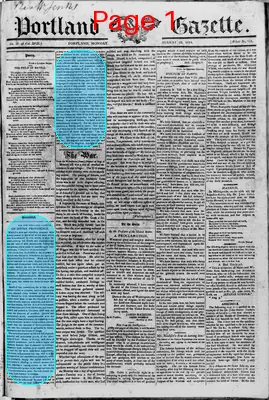
Editorial
August 22, 1814
Portland Gazette, And Maine Advertiser
Portland, Cumberland County, Maine
What is this article about?
An editorial essay in the Portland Gazette extolling the doctrine of divine providence, arguing its necessity for human comfort and guidance, supported by reason, natural observations, and biblical references, while critiquing infidelity and superficial belief.
Clipping
OCR Quality
95%
Excellent
Full Text
Monitorial.
FOR THE PORTLAND GAZETTE.
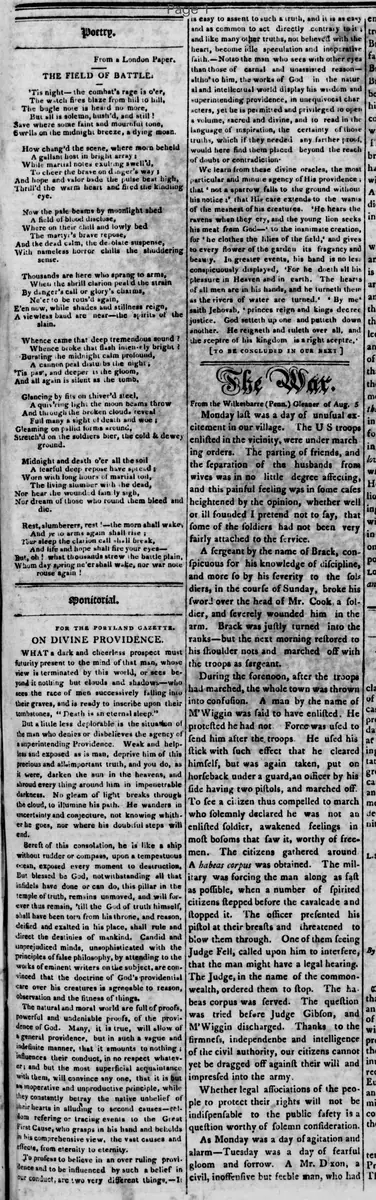
ON DIVINE PROVIDENCE.
What a dark and cheerless prospect must futurity present to the mind of that man, whose view is terminated by this world, or sees beyond it nothing but clouds and shadows—who sees the race of men successively falling into their graves, and is ready to inscribe upon their tombstones, "Death is an eternal sleep."
But a little less deplorable is the situation of the man who denies or disbelieves the agency of a superintending Providence. Weak and helpless and exposed as is man, deprive him of this precious and all-important truth, and you do, as it were, darken the sun in the heavens, and shroud every thing around him in impenetrable darkness. No gleam of light breaks through the cloud, to illuminate his path. He wanders in uncertainty and conjecture, not knowing whither he goes, nor where his doubtful steps will end.
Bereft of this consolation, he is like a ship without rudder or compass, upon a tempestuous ocean, exposed every moment to destruction.
But blessed be God, notwithstanding all that infidels have done or can do, this pillar in the temple of truth, remains unmoved, and will forever thus remain, till the God of truth himself, shall have been torn from his throne, and reason, deified and exalted in his place, shall rule and direct the destinies of mankind. Candid and unprejudiced minds, unsophisticated with the principles of false philosophy, by attending to the works of eminent writers on the subject, are convinced that the doctrine of God's providential care over his creatures is agreeable to reason, observation and the fitness of things.
The natural and moral world are full of proofs, powerful and undeniable proofs, of the providence of God. Many, it is true, will allow of a general providence, but in such a vague and indefinite manner, that it amounts to nothing: influences their conduct, in no respect whatever; and but the most superficial acquaintance with them, will convince any one, that it is but an operative and unproductive principle, while they constantly betray the native unbelief of their hearts in alluding to second causes—seldom referring or tracing events to the Great First Cause, who grasps in his hand and beholds in his comprehensive view, the vast causes and effects, from eternity to eternity.
To profess to believe in an overruling providence and to be influenced by such a belief in our conduct, are two very different things.—It is easy to assent to such a truth, and it is as easy and as common to act directly contrary to it: and like many other truths, not believed with the heart, become idle speculation and inoperative faith.—Not so the man who sees with other eyes than those of carnal and unassisted reason—altho to him, the works of God in the natural and intellectual world display his wisdom and superintending providence, in unequivocal characters, yet he is permitted and privileged to open a volume, sacred and divine, and to read in the language of inspiration, the certainty of those truths, which if they needed any farther proof, would here find them placed beyond the reach of doubt or contradiction
We learn from these divine oracles, the most particular and minute agency of His providence; that 'not a sparrow falls to the ground without his notice:' that His care extends to the wants of the meanest of his creatures. 'He hears the ravens when they cry, and the young lion seeks his meat from God—' to the inanimate creation, for 'he clothes the lilies of the field,' and gives to every flower of the garden its fragrancy and beauty. In greater events, his hand is no less conspicuously displayed, 'For he doeth all his pleasure in Heaven and in earth. The hearts of all men are in his hands, and he turneth them as the rivers of water are turned.' By me' saith Jehovah, 'princes reign and kings decree justice. God setteth up one and putteth down another. He reigneth and ruleth over all, and the sceptre of his kingdom is a right sceptre.'
[TO BE CONTINUED IN OUR NEXT]
FOR THE PORTLAND GAZETTE.
ON DIVINE PROVIDENCE.
What a dark and cheerless prospect must futurity present to the mind of that man, whose view is terminated by this world, or sees beyond it nothing but clouds and shadows—who sees the race of men successively falling into their graves, and is ready to inscribe upon their tombstones, "Death is an eternal sleep."
But a little less deplorable is the situation of the man who denies or disbelieves the agency of a superintending Providence. Weak and helpless and exposed as is man, deprive him of this precious and all-important truth, and you do, as it were, darken the sun in the heavens, and shroud every thing around him in impenetrable darkness. No gleam of light breaks through the cloud, to illuminate his path. He wanders in uncertainty and conjecture, not knowing whither he goes, nor where his doubtful steps will end.
Bereft of this consolation, he is like a ship without rudder or compass, upon a tempestuous ocean, exposed every moment to destruction.
But blessed be God, notwithstanding all that infidels have done or can do, this pillar in the temple of truth, remains unmoved, and will forever thus remain, till the God of truth himself, shall have been torn from his throne, and reason, deified and exalted in his place, shall rule and direct the destinies of mankind. Candid and unprejudiced minds, unsophisticated with the principles of false philosophy, by attending to the works of eminent writers on the subject, are convinced that the doctrine of God's providential care over his creatures is agreeable to reason, observation and the fitness of things.
The natural and moral world are full of proofs, powerful and undeniable proofs, of the providence of God. Many, it is true, will allow of a general providence, but in such a vague and indefinite manner, that it amounts to nothing: influences their conduct, in no respect whatever; and but the most superficial acquaintance with them, will convince any one, that it is but an operative and unproductive principle, while they constantly betray the native unbelief of their hearts in alluding to second causes—seldom referring or tracing events to the Great First Cause, who grasps in his hand and beholds in his comprehensive view, the vast causes and effects, from eternity to eternity.
To profess to believe in an overruling providence and to be influenced by such a belief in our conduct, are two very different things.—It is easy to assent to such a truth, and it is as easy and as common to act directly contrary to it: and like many other truths, not believed with the heart, become idle speculation and inoperative faith.—Not so the man who sees with other eyes than those of carnal and unassisted reason—altho to him, the works of God in the natural and intellectual world display his wisdom and superintending providence, in unequivocal characters, yet he is permitted and privileged to open a volume, sacred and divine, and to read in the language of inspiration, the certainty of those truths, which if they needed any farther proof, would here find them placed beyond the reach of doubt or contradiction
We learn from these divine oracles, the most particular and minute agency of His providence; that 'not a sparrow falls to the ground without his notice:' that His care extends to the wants of the meanest of his creatures. 'He hears the ravens when they cry, and the young lion seeks his meat from God—' to the inanimate creation, for 'he clothes the lilies of the field,' and gives to every flower of the garden its fragrancy and beauty. In greater events, his hand is no less conspicuously displayed, 'For he doeth all his pleasure in Heaven and in earth. The hearts of all men are in his hands, and he turneth them as the rivers of water are turned.' By me' saith Jehovah, 'princes reign and kings decree justice. God setteth up one and putteth down another. He reigneth and ruleth over all, and the sceptre of his kingdom is a right sceptre.'
[TO BE CONTINUED IN OUR NEXT]
What sub-type of article is it?
Moral Or Religious
What keywords are associated?
Divine Providence
Gods Care
Infidelity
Scriptural Proofs
Superintending Providence
What entities or persons were involved?
God
Infidels
Jehovah
Editorial Details
Primary Topic
Belief In Divine Providence
Stance / Tone
Strongly Affirmative Promotion Of Faith In God's Providence
Key Figures
God
Infidels
Jehovah
Key Arguments
Denial Of Providence Leads To Despair And Uncertainty
Nature And Moral World Provide Undeniable Proofs Of God's Providence
True Belief Influences Conduct, Unlike Superficial Profession
Scripture Confirms God's Minute And Overarching Care Over Creation And Human Affairs